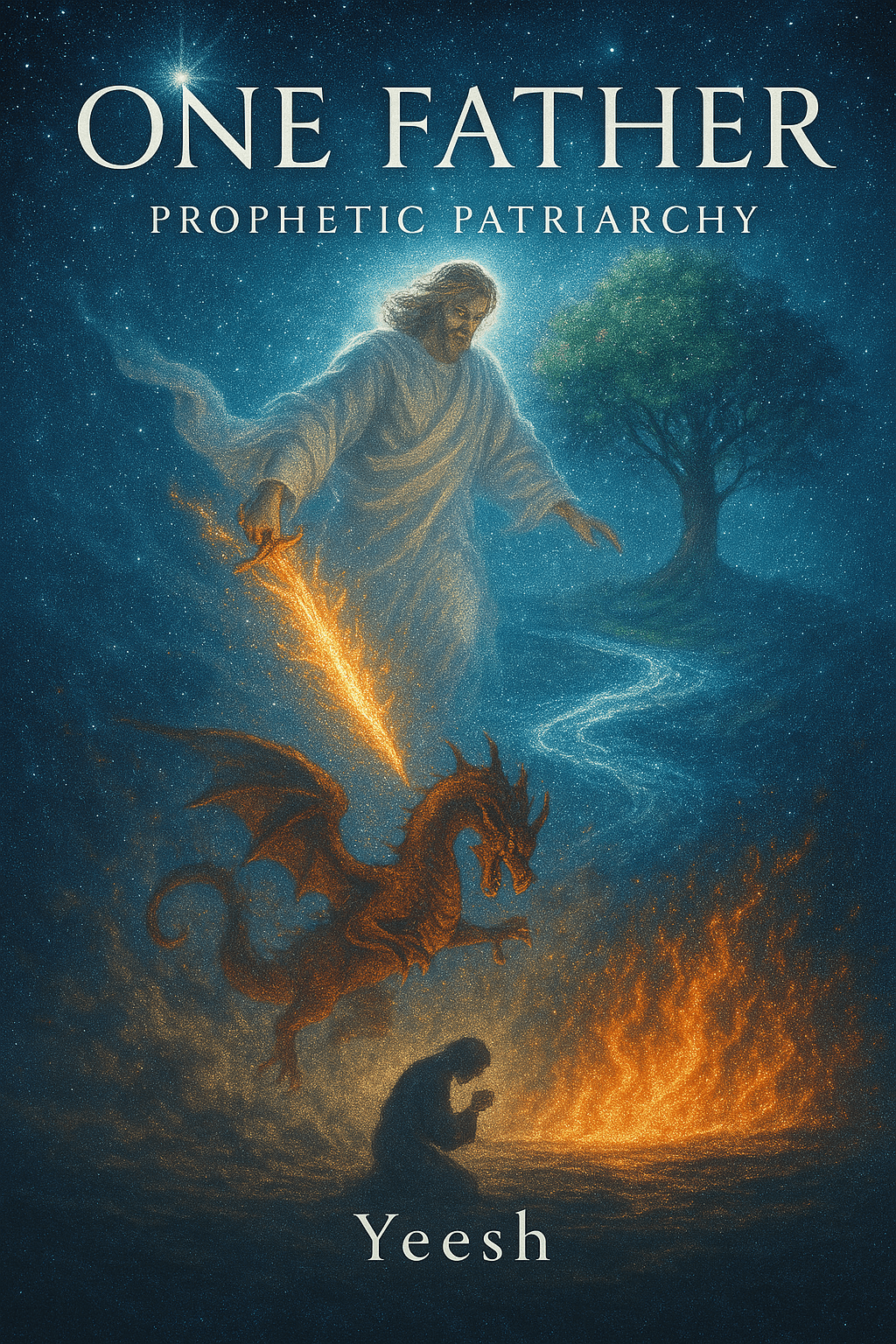
Involved & Relational Body of Messiah
Every household tells a story. Every father lives in two modes: he is both involved and relational. He sits at the table, shares the meal, wipes a child’s tears and that is his involvement. But he also stands at the threshold, disciplines, protects, sets the order and that is his relational authority. These two aspects are not in tension; they are the dual heartbeat of any living home. And so it is with the Messiah and His Body. Too often, we confuse oneness with singularity, forgetting that the deepest oneness is found not in sameness, but in the harmony of distinct parts, joined in a common order. This is not only the case in marriage, but in the Body of Messiah. People don’t always have eyes to see so they miss this. The conflation of organic unity with mathematical singularity has birthed a monstrous doctrine: the idolatry of enforced monogyny which imposes strain on the Father involvement and relationship with the body. From the involved perspective - the view from inside the household - we see Messiah among us taking position as a Brother (Hebrews 2:11), the Firstborn among many sons (Romans 8:29), walking in the garden with us in the cool of the day, bearing our burdens as a strong elder brother would, breaking bread in our midst. Here, we are members of one body, animated by one Spirit, partaking of one baptism (1 Corinthians 12:12–13). It is familial, intimate, and interdependent. This is the subjective view as we see the Messiah within the congregation, born on earth, and in the flesh. But from the relational perspective - the outside, structural view - we behold the Messiah not simply as Brother, but as Head of the household, the Everlasting Father (Isaiah 9:6), the singular Husband walking among many lampstands (Revelation 1:12–13), tending each with divine precision. In this mode, He is not just present but also He presides. He orders, governs, prunes, and manages household necessities. He removes what is fruitless and secures what is faithful. This is not intimacy from within but headship from above. It is the Father overseeing the household, not just the Brother dwelling in it.
These two perspectives - involved and relational - are both true, both Scriptural, and both necessary. To collapse them into one is to fall into error. To confuse Yeshua’s indwelling presence in the Body of Messiah with His executive authority is to misread the architecture of heaven. And this misreading has consequences. Many today, in pursuit of an overly simplified “oneness, ” have built doctrines that violate the very structure of biblical plurality. They enforce a rigid monogyny as the only acceptable household structure, mistaking unity for singularity, and in doing so, deny the visible witness of scripture: that one Father has many sons, one Husband can have many brides, one Vine almost always has many branches, and one Head can govern many bodies. This chapter will dismantle that artificial singularity. Through a careful reading of Paul’s metaphor of the Body (1 Corinthians 12) and John’s vision of the Lampstands (Revelation 1–3), we will see how scripture holds both the inside and outside perspectives in tension and Spirit. Paul speaks of a unified body with many members - that’s the lived, involved experience of the saints. But John unveils the relational structure: seven distinct congregations, each as a lampstand, each evaluated independently by the one Head who walks among them. The pattern is everywhere. Paul’s metaphor is inward-facing - a description of how the family works from within, like a father raising sons under one roof. John’s metaphor is covenantal and overseeing - the Father managing the household, pruning where needed, rewarding where faithful. These are not contradictions; they are complementary lenses that both reinforce a unity in potential plurality. Never do we get a picture of a duality. In the same way, a man may be one with his wife in covenantal intimacy, yet also stand as the head over multiple wives in structured love and responsibility. The first is a function of oneness in flesh. The second is a demonstration of oneness in rule. Both are true in Messiah. He is both in us and over us, both Fellow Heir and Sovereign Lord. To deny the relational structure in favor of internal experience is to confuse presence with position. It is possible to feel close to God while resisting the very order He has ordained. This is not intimacy - it is
insubordination dressed in spiritual language. And when structure is removed in the name of unity, what often emerges is not harmony but chaos. It opens the door to a kind of theological confusion, even possession: many spirits attempting to dwell within a single, undefined body - without headship, without form, without distinction. But scripture does not celebrate this kind of fusion. It declares a clear and holy pattern: many members, one Spirit (1 Corinthians 12:12); many congregations, one Husband (Revelation 1:20); many sons, one Father (Hebrews 2:10–11). Unity without structure is not biblical unity. The true Spirit never obliterates identity. He organizes it aligning each member, each lampstand, each household, into divine order under Messiah who is both in us and over us. True patriarchal order does not erase distinction in the name of unity. It exalts unity by honoring structure and individuality. This chapter’s goal is to restore that view or reinforce it. It proclaims that Messiah’s household is not built on forced exclusivity, but on structured plurality - where many are brought into one house, under one name, in one Spirit, and in one faithful order, each allowed to be a unique individual in covenant with Him. Let us walk into the household now. Let us listen to the rhythm of the Father’s feet on the floorboards, hear the rustle of robes as the Son serves at the table, and lift our eyes to see the Head of the house - Messiah, our Elohim - both involved and relational, both with us and over us, that in Him we may be all in all.
Messiah Among the Lampstands Has The Bride What follows was logic I originally worked on almost a decade ago. I attempt to go verse by verse in Revelation laying out the logical case for the Lampstands being metaphors for the 7 congregations and thus the entire thing having the imagery of entering wedding feasts as described in Matthew 25. Revelation 1:1 The letter is written to the servants (apostello, meaning “sent ones” in Greek), indicating apostolic instruction. Revelation 1:4 – The letter is addressed to the seven congregations.
Revelation 1:4 The phrase “to the seven churches” does not exclude the seven spirits of God, but rather reveals a profound mystery: these seven individual spirits are the very eternal life of the churches - distinct in expression, yet united in One Spirit. This interplay between seven and one echoes throughout Revelation, testifying to a divine pattern of multiplicity in unity. The throne from which this message proceeds is not bound by time. It sees all things as they truly are - past, present, and future - held in a single gaze. From that vantage, the seven congregations are not merely historical congregations, but eternally present before God, like lampstands burning continually in His sight (Revelation 4:5). Yet these congregations are also real, earthly institutions - called to overcome, to endure, and to repent earlier in Revelation. They exist in time even as they are seen outside of it. This is the wonder of heavenly prophetic perspective: it unveils how what is happening now in the congregations is already seen forever before the throne. the Spirit dwells among them in fullness, not only to empower, but to testify - bearing eternal witness to their faithfulness, their suffering, and their love. We bring Heaven to Earth by seeing both sides and bridging the gap with Faith.
Exodus 3:14"I AM WHO I AM" – Elohim exists outside of time. Matthew 22:32 “I am the Elohim of Abraham, Isaac, and Jacob - He is not the Elohim of the dead but of the living.”
Ephesians 1:4, 2:10, Colossians 1:17 – The throne is eternal, and the congregations are indwelled by the Spirit. Revelation 1:12–13, 2:1 – Messiah walks among the lampstands, meaning He is intimately involved with them. Revelation 1:13 – The description resembles a wedding garment for a priest-king (Exodus 28:4, Zechariah 6:13).
Revelation 1:20 – The seven lampstands are the seven congregations - a direct metaphorical connection.
The Singular Spirit Speaking to the Plural Churches Revelation 2:7 – the Spirit (singular) speaks to the congregations (plural). Revelation 2:11, 2:17, 2:29, 3:5, 3:6, 3:8, 3:22 – This pattern repeats across all seven congregations, showing that the one Spirit indwells multiple distinct congregations. Revelation 3:1 – The seven spirits belong to Messiah, similar to the seven stars (angels). The spirits are not angels, as angels have already been defined as the stars.
The Seven Spirits and Their Connection to the Lampstands
Revelation 4:5“Seven torches of fire were burning before the throne, which are the seven Spirits of Elohim.”
While “lampstand” and “torches” are not identical words in Greek, they carry a very similar symbolic meaning and the close proximity can allow us to infer these are the congregations, typified as eyes. Think “the eye is the lamp of the body” as just one other witness.
Revelation 5:6“The Lamb had seven eyes, which are the seven Spirits sent into all the earth.” The Greek phrase here is “Apostellos”, which is apostles meaning sent out into all the earth. The apostles of the church, are indeed a part of the body of Messiah in the congregation. Therefore, by inference, the seven eyes are the seven churches. The seven spirits, lampstands, eyes, and congregations are all interconnected. Seven Eyes = Seven Lampstands = Seven Churches = Seven Spirits. If the seven spirits represent the congregations living eternally through Yeshua, then they are one in Spirit, yet distinct in manifestation. 1 Monogyny vs. Polygyny in the Biblical Metaphor Throughout this book, monogyny refers to a one‑woman household structure, and polygyny to a multi‑wife household structure. Yeshua repeatedly treats “many spirits in one body” as a mark of demonic disorder, not divine design (Matthew 12:45; Mark 5:9; Mark 1:23–26; Matthew 8:29; Luke 8:2; Revelation 18:2). That principle matters when we read Revelation’s imagery of the Spirit, the lampstands, and the congregations. The monogyny-only model pushes the marriage metaphor toward a contradiction: it tends to collapse Revelation’s distinct lampstands into one singular “body,” as though the Spirit must be contained in a single vessel. But Revelation does the opposite—Messiah walks among multiple lampstands, and the one Spirit is present and active across many distinct congregations. The point is not many spirits in one body; it is one Spirit shared across many bodies—unified in Him, distinct in manifestation. Messiah’s parable of the virgins reinforces the same logic: each lampstand must have its own lamp and oil—Word and Spirit—because fruitfulness is personal and stewardship is required (Matthew 25:1–10). Paul speaks the same way when he says the congregation is betrothed to one Husband (Messiah) and warns against receiving “another spirit” (2 Corinthians 11:2–4). The concern is fidelity of Spirit, not numerical reduction of the Bride into a single vessel. Zechariah’s “seven eyes” threads the imagery even deeper: governance, witness, and oversight expressed through a sevenfold pattern that aligns with Revelation’s lampstands and congregational messages (Zechariah 4:10; Revelation 5). In other words, Revelation does not picture one undifferentiated Bride; it pictures multiple distinct lampstands—set apart, tended, corrected, and loved—yet unified under one Husband. That pattern coheres naturally with polygyny as metaphor: one Husband, one Spirit, many distinct congregations—each truly His, all truly one in Him. At Home in The "Body of Messiah" Metaphor In 1 Corinthians 12:12–27, Paul describes believers as members of one body - the Body of Messiah. We know from these passages that there is one body, but many members, no member can say to another, “I have no need of you.”, and the whole metaphor is about unity in function, despite diversity in members. Thus it’s also testimony to polygyny being built in as a necessary choice for unity to exist. Notice also that the framework of the phrase is “Body of Messiah” - meaning the masculine side, the Head of the Church, so of course it is frameworked as a single body in this fleshly example as it is preserving the nature of patriarchy and headship as represented in the Hebrew understanding. So, we can know from having this understanding that Paul seems to be emphasizing the unity of believers united in One Head, not by making them one single entity but by showing that they are interdependent parts of a unified whole. This is not the same thing as saying they are literally one being. Rather, it’s a structured unity - just like a human body is singular but consists of many different parts. In this sense, Paul presents unity through order under a singular patriarchal head - biblically this is the closest we get to monogyny as an idea, but when you really get in and study the nuance of the language, the oneness of the Church is clearly unity focused, whereas the oneness of Messiah is numerical and singular. The ‘plural’ Church can act in “unity” in the Husband who they become one flesh with. This is what makes unity possibly, the two shall become one flesh and now that one is free to become one flesh again. One Head (Messiah) One Body - Many members (individuals, functioning in their roles) This model assumes that the unity is organic and structural, meaning the body functions properly because the members are connected in proper relationship with the head (Messiah) by keeping with One Spirit. This unity of Spirit is discussed often and Paul even warns against receiving ‘another spirit’. So the Body of Messiah metaphor intrinsically confirms again the idea that multiple spirits in one body is bad - though it suppresses the individuality of the members in doing this as their ‘spirits’ aren’t implied as having their own body like in John’s metaphor. This further proves that Paul’s whole point is about unity in diversity as well. Another way of resolving this in your mind might be to think of Paul’s metaphor as functional (a living organism - an interdependent system. Whereas John’s metaphor is relational (a covenant structure - distinct but unified under Messiah). Both metaphors serve different theological purposes 1 but are not at odds. Paul’s is about how believers work together in the flesh. John’s is about how the Messiah relates to them as a collective Church from a heavenly perspective. If you want a direct parallel to marriage, Paul’s structure looks more like polygyny from the inside, the head of the household, the man - one body, multiple members. John’s looks more like polygyny from the outside multiple congregations, one Husband. So in a way, Paul’s metaphor represents the lived experience of believers within the faith, while John’s represents the covenant relationship from a heavenly perspective. This is more evidence for lawful and good polygyny, as we see in scripture both metaphors of monogyny and polygyny represented, but when it looks like monogyny the function is the flesh and the ‘body’ is always specifically frameworked as plural - meaning that even in monogyny the emphasis is on unity and not being a unit of singularity limited to two members as monogyny-only implies. Based on everything we've discussed, monogyny-only as an enforced doctrine appears to be a forbidden restriction rather than a divinely commanded ideal. The following verse is perfectly applicable in this place. 1 Timothy 4:1–3 "Now The Spirit expressly says that in later times some will depart from the faith by devoting themselves to deceitful spirits and teachings of demons, through the insincerity of liars whose consciences are seared, who forbid marriage and require abstinence from foods that Elohim created to be received with thanksgiving by those who believe and know the truth."
If forbidding marriage is grouped under false doctrine inspired by demons, then an enforced monogyny-only rule, which outlaws polygyny, is suspect and stands cornered. Polygyny is not just permitted but was used by Elohim Himself to build Israel (Jacob’s 12 sons through 4 women) and even serves as a metaphor for Messiah and the Church.
Could Believing monogyny-Only Invite Possession? This is where it gets deep and ironic. Possession in scripture is often linked to false doctrine, pride, and enforced control over others. monogyny-only dogma could create an ironic feedback loop because:
The Body of Messiah:
Many members in 1 headship frameworked as many marriages
The body of possession:
Many headships in 1 Body frameworked as 1 marriage
If monogyny-only believers hyperfixate on “oneness" meaning a singularity (when in other places, "one" is about unity, not numerics), they could unknowingly warp the very nature of the Body of Messiah metaphor and fall into an ironic form of spiritual idolatry that reduces the authority of the son to being subject to the body at worse, and equal at best. If they force "1" and exclude the possibility for plurality, they could be imposing an alien framework onto Yeshua and his congregation. Could this lead to spiritual oppression? Possibly. Since "many spirits in one body" is possession and is implied by anyone associating salvation with singularity. However, "many members in one body" is unity that could be at a minimum a duality, but could also be a plurality, protecting the idea of Salvation in Yeshua for the individual and the congregation. Thus distorting the singularity into the unity could be dangerous and offer possessive cracks in our psyche that might be leveraged to cause us to hurt others and be hurt in return. Consider that the Pharisees rejected Yeshua and accused him of being possessed. When Yeshua broke their rigid interpretations of lawful doctrine, they accused Him of having a demon (John 8:48, Mark 3:22). If you’re being accused of being demonic while standing on the plain meaning of scripture, you’re in good company as that’s what they did to the Messiah! Often, the Spirit that cries "demon! " is the one that cannot handle correction (1 John 4:1).
The rejection of polygyny has not led to stronger families; it has led to women leaving their first husbands to find a "better one." It has allowed an environment to fester to tends to extreme feminist views and egalitarian ethic blanket that leaves our families unified only in atrophy of authority. Top-tier men hoarding all the women anyway through dating culture and being completely fruitless in the process. It leads to destruction of male-led family structures (weakening patriarchy). Could the fruit of enforced monogyny-only doctrine be proof that it is not of Elohim but of a false spirits masquerading as righteousness? They reject multiple wives but accept multiple spirits in one body. They call you demonic while defending a doctrine with no biblical basis. They accuse polygyny of being chaotic, yet their serial monogyny creates havoc and fatherless homes are rampant. While monogyny itself is fine, forcing it as a doctrine, as if Elohim Himself demands it, is false teaching. scripture shows that Elohim does not forbid polygyny, and the Holy Spirit never inspired a ban on it. In fact, forbidding marriage is explicitly linked to demonic teaching (1 Timothy 4:1–3). Thus, enforcing monogyny-only as the only lawful form of marriage is not only unbiblical but categorically meets the standard of "doctrine of demons.". As for spiritual attack, remember: "Blessed are you when others revile you and persecute you and utter all kinds of evil against you falsely on my account." – Matthew 5:11 In Paul’s metaphor, the One Spirit (Holy Spirit) indwells the body (Bride), but the individual members are still distinct. They don’t “merge” into some singular consciousness. They coexist in unity while retaining individual function. Demonic possession is different as it’s when foreign spirits take control of one body against its being that would be nurtured by a Loving Head. The One Spirit is not a foreign spirit - it is Elohim dwelling in the believers. This is not the same as possession, because it’s alignment with patriarchal order, not disorder or invasion.
The Spirit’s Role in the Body of Messiah Yes, the Spirit is intricately connected to Paul’s discussion of the Body of Messiah in multiple places. In fact, the presence of the one Spirit seems to be the key unifying factor that makes the many members function as one body.
1 Corinthians 12:12–13"For just as the body is one and has many members, and all the members of the body, though many, are one body, so it is with Messiah. For in one Spirit we were all baptized into one body - Jews or Greeks, slaves or free - and all were made to drink of one Spirit."
This verse directly links the oneness of the body to the fact that all members share the same Spirit. This is significant because it explains how many spirits (people) can be part of one body - they are all unified through the singular Holy Spirit.
Ephesians 4:4–6"There is one body and one Spirit - just as you were called to the one hope that belongs to your call - one Lord, one faith, one baptism, one Elohim and Father of all, who is over all and through all and in all."
Paul again emphasizes one body and one Spirit, tying the two together. This suggests that the singularity of the "body" is not about numerical oneness but about unity under the Spirit of Elohim.
Romans 8:9–11"You, however, are not in the flesh but in The Spirit, if in fact The Spirit of Elohim dwells in you. Anyone who does not have The Spirit of Messiah does not belong to him. But if Messiah is in you, although the body is dead because of sin, The Spirit is life because of righteousness. If The Spirit of him who raised Yeshua from the dead dwells in you, he who raised Messiah Yeshua from the dead will also give life to your mortal bodies through his Spirit who dwells in you."
Paul connects the indwelling of the Spirit to membership in Messiah’s body. This supports the idea that the "Body of Messiah" is not a singular fleshly
body but a collective entity animated by the Spirit the patriarchy Head of Messiah and His body. That body, being framework as Messiah, is necessarily singular in presentation, but plural in actuality, filled with One Spirit. monogyny-only theology tries to force absolute numerical singularity in places where scripture allows structured plurality. If we apply their logic to marriage, then we would have to apply it to the Body of Messiah as well which would mean only one believer could be saved at a time and that Yeshua would abandon the first in pursuit of the second and so on (which is obviously false). Instead, the Body of Messiah functions like polygyny as many members, one unity under Messiah. Thus, if many spirits can exist in one metaphorical body under patriarchal order, then many wives can exist in one marital body.
The Beam and the Eye: Visible and Hidden in Genesis in Plain Sight In Genesis 2:21–22, Elohim takes the “ ( ֵצלָעtsela)” from Man, traditionally translated as “rib.” However, the word tsela appears elsewhere in scripture to mean beam, plank, timber, side, or chamber - suggesting a much larger structural component than just a rib. This is not a mute biblical concept, but instead threads throughout scripture. Many authors pivot on ideas of beams as structures and employ them in metaphors. This beam/plank (tsela) taken from man and used to form woman finds an ironic parallel in Messiah’s words in the New Testament: “And why do you look at the splinter in your brother’s eye, but do not notice the beam in your own eye?” (Matthew 7:3) If we apply this metaphor back to Genesis, we see a hidden irony that man’s eye was upon the “beam” (tsela) taken from him -the Woman he eventually called Eve after falling. So she became the “apple of his eye” (Deuteronomy 32:10, Psalm 17:8) in an almost literal way. And when adversity (HaSatan, )הׂשטןcame, his eye remained on her, rather than on The Spirit and The Word.
The Eye and the Fall: A Test of Vision Now, let’s bring in another critical teaching from Yeshua: “If your right eye causes you to sin, gouge it out and throw it away. It is better for you to enter life with one eye than to have two eyes and be thrown into the fire of Gehenna.” (Matthew 18:9) Could this warning be connected to man's mistake? He set his eye on women rather than on The Word. His heart on her help rather than the Spirit. When she was deceived, he chose to follow her instead of waiting on Elohim. His misplaced focus on the “beam” led to the fall. He had a beam in His eye. Yeshua warns that if your eye is leading you astray, remove it. Could this mean that if a man prioritizes an altered understanding of marriage (one that exalts a restrictive view of monogyny above Elohim’s true structure), he risks throwing “his whole body” into hell? In this metaphor with the body being one, the singularity of the eye is compared to the plurality of the body. It’s saying to choose the plural body over the singular eye. If your eye would have you cast all other members into hell, it’s an eye leading the body to hell, that’s the eye that should be plucked out. The threads in mightily with the idea of eyes being congregations of the Lamb in Revelation. So we argue then, that monogyny-only theology has become a beam in the eye as it distorts the vision of scriptures and the authority of Yeshua. It forces contradictions into Elohim’s Word (where polygyny is established but never condemned). It becomes an altar where men stumble, just as men stumbled when he followed women instead of leading. Just as the beam blinded Man, it blinds modern readers who refuse to acknowledge what The Word actually says. If the man does not remove the false beam from his eye, he risks misleading not only himself but his entire body - his household, and his family, and even the larger body of Messiah by implication of his leven.
“Every plant that my heavenly Father has not planted will be pulled up by the roots. Leave them; they are blind guides. If the blind lead the blind, both will fall into a pit.” (Matthew 15:13–14) This is a call to pull out the beam that has caused a wrong view of Genesis and to return to the Spirit and The Word as the true foundation of marriage and life. As the christian saying goes “Marriage is a metaphor for Messiah and His Church”. Therefore don’t stand between him and the gathering.
Pictographic Analysis: tsela, isha, and nashim The imagery of tsela ( ) ֵצלָעas a beam strengthens the idea that man was propping her up, elevating her beyond what Elohim had intended.
tsela – The Beam, The Structure, The Side
Tsade (– )צA hook, desire, or a snare.
Lamed (– )לAuthority, control, teaching.
Ayin (– )עEye, perception, focus.
Literal Meaning: A structural beam or side to something.
Pictographic Meaning: “A hooked authority that directs the eye.” Man’s eye ( )עbecame hooked ( )צto Eve, and he made her his authority ()ל rather than The Word. The “beam” (tsela) wasn’t just a rib -it was a supporting structure. Man used it to uphold Eve, making her into something more than a companion -a pedestal. He saw ( )עher as the fulfillment of what he lacked, rather than waiting on The Spirit. This all makes the “beam in the eye” metaphor from Messiah (Matthew 7:3) even more ironic and also deeply meaningful as the context in our mind shifts a bit. I don’t think this is the only way this metaphor can be applied, but it certainly fits very well with the teaching. Man's eye was fixed on the wrong thing - woman became the new center of his reality.
isha – Woman named by Adam Aleph (– )אStrength, leader. Shin (– )שConsume, devour, transform. Hey (– )הRevelation, breath, spirit. Literal Meaning: “Woman” or “fire” (a play on words in Hebrew). Pictographic Meaning: “The strong one who transforms through revelation.” Man named her in a way that gives her power - he ascribes transformation and revelation to her. He elevated her role beyond what Elohim said, subtly shifting his focus from The Spirit to her words. The “fire” ( ) שin the name isha connects to the strange fire theme in scripture - offering something to Elohim that He did not command. Did Man, by this naming, unwittingly build an “altar” to Eve?
nashim – Women (Plural)
Nun (– )נSeed, life, continuation.
Shin (– )שConsume, devour, transform.
Yod (– )יHand, work, deed.
Mem (– )םWater, chaos, nations.
Literal Meaning: “Women” or “wives.”
Pictographic Meaning: “The seed that is consumed through work and spreads across the nations.” nashim is about multiplication, legacy, and spreading life. The contrast is that man named her “isha” singular, as if she was the completion - yet later, the plural form “nashim” appears when scripture speaks of multiple wives. Man's singular focus on woman set a precedent for later men to “worship” a singular ideal of womanhood rather than her prophetic structure in the makeup of the family.
tsela, isha, and nashim Adam, in turning his gaze toward the woman, did not merely welcome her - he exalted her. He projected meaning onto her instead of receiving meaning from the Spirit. He looked at the tsela which was the structural beam taken from his side and turned it into a pedestal. His perception (Ayin) was hooked (Tsade) by her form and flesh, and he assigned her (Lamed) the authority meant to remain in the Word. Thus, tsela as the beam became the very object lodged in his eye. He called her isha, a name full of power and prophecy, yet also one that subtly misdirects. Aleph ( ) אmade her strong, Shin ( ) שgave her fire, and Hey ( ) הplaced revelation in her breath. He named her not just “woman, ” but “the strong one who transforms through revelation.” This naming was poetic, but also perilous as after his rebellion it placed upon her a role that belonged to the Spirit. It made her a source of transformation, rather than a vessel within the structure. When woman ate, man followed and rather than subduing (Kabash, ּ)ָכ בַׁשthe deception, he willingly proceeded. He reached out and ‘ate’ the fruit, which is a metaphor for believing it. Man was not deceived, yet he still failed (1 Timothy 2:14). Why? Because he believed that the woman given to him, standing before his eyes, was his ezer kenegdo in full revelation and followed her into the ‘wisdom’ and false promises of the serpent’s words. Idols get built from there. 213 To remove the beam from our own eye (Matthew 7:3) the tsela must be reinterpreted - not as an idol we uphold, but as the structure we restore in truth. As it is in scripture a structural plank of Adam, a piece of Noah’s arc, and plank in a brothers eye, so when restored it becomes something that elevates revelation. Helping us accomplish our mission and vision as given from the Heavenly Father. The woman must be honored in her role, but never crowned exclusively in place of the Spirit. The fire must be purifying and the word must continue the wash. The breath must align with the Word. And the plurality of nashim must be seen not as a threat to love, but as a reflection of the Father's design for fruitfulness and responsibility as well as a representation of the nature of his headship and Love.
“Every high place must be torn down.” (2 Kings 23:15) “Break down their altars, smash their sacred stones.” (Exodus 34:13)
A Single Rib Among Many When Elohim formed the woman, He did not take something external to Adam, nor did He create her from the dust as He had done with man. Instead, He took from Adam’s side a specific rib ( ֵצלָע, tsela). This term is important. The Hebrew root of tsela carries the meaning of "side, " "flank, " or even a chamber or structural support. It is used elsewhere in scripture to describe the sides of the Tabernacle (Exodus 26:20), showing not just anatomy, but architectural integrity. The phrase in Genesis 2:21 is וִַּיַּק ח ַאחַ ת מִ ַּצ לְע ֹתָ יו- "and He took one from his sides." The word mitzalotav ( ) מִ ַּצ לְע ֹתָ יוis grammatically plural. This is a crucial detail: it implies not that Elohim removed a singular essence from Adam to complete him with Eve, but that He selected one from among many ribs. This subtle linguistic detail undermines the commonly held belief that man and woman are each half a whole, or that Adam was somehow rendered incomplete by Eve's formation. On the contrary, Adam remained whole. The woman was not taken to fill a void; she was drawn out from and abundant source. How many times have you heard the expression that a man with an abundance mentality is more attractive to women? Well, here in detail is prefigured proof in my thinking. The plurality of the structure shows that Adam possessed within himself a fullness capable of being given without loss from within himself. This gives us a very different picture of the structure of Adam’s frame, one of abundance, not lack. This is the natural order of the male headship model in scripture, where the congregate has at least plural possibility while the center is singular and full of authority and abundance. When Adam beholds her, he exclaims, “This at last is bone of my bones and flesh of my flesh” (Genesis 2:23). This is not a cry of relief from lacking, but one of recognition. Modern thinking has lost this nuance and in doing so become the fallen Adam. The same Elohim who formed her from one rib
could have formed another and another, without ever diminishing Adam’s frame. What’s wild is that the human rib which is the very bone Elohim chose to draw out is the only bone in the human body with the natural capacity to regenerate when properly protected. Surgeons have long known that a removed rib, if the surrounding membrane (the periosteum) is left intact, will grow back over time. If you ask me this isn’t accidental: it’s prophetic engineering. Adam’s frame was not permanently diminished by the act of giving. Instead, the rib stands as a living parable and a sign that true headship is never reduced by the outpouring of life, but is designed for replenishment, healing, and ongoing strength. What was taken is restored, what is given is made whole again. In this way, the creation of the woman does not result in lack, but displays the masculine pattern of self-giving abundance: Adam’s strength is shown not by hoarding, but by the confident willingness to give, knowing his wholeness remains intact. In the economy of the Father, sacrifice is not subtraction but is indeed multiplication. This is the masculine glory: to give and be restored, to protect and yet remain undiminished, to love without fear of losing oneself. In fact, this idea affirms a powerful picture of masculinity often overlooked - that true strength is not depleted by giving, but revealed through it. The act of forming woman from man is not about creating a gap in him that could then be refilled by the one woman Eve; it is about revealing what was already within him and demonstrating the beauty of individuality. The rib, as a picture of strength, protection, and inner structure, is chosen to reflect not just intimacy, but inner readiness and uniqueness, and isha with oil. Adam need not be wounded - instead he could be willing and able. And consider the context that he had not yet fallen and he had not sinned. His frame was uncorrupted. the Spirit was on its way - ruach hayom, the wind or breath of the day (Genesis 3:8). Had Adam obeyed and held his frame, the Spirit may have filled him fully, sealing his design with divine breath. But instead, when the Spirit arrives, Adam is hiding in nakedness, his robe fallen to the grown as he flees the scene. The man who gave from his side was now retreating in shame with his woman.
But even this yields a prophetic blueprint. From the side of the first man came the first bride. From the side of the second Man Yeshua whom was pierced on the tree, came water and blood: the Spirit and the covenant, from which His Bride is formed. Not because He lacked, but because He loved. This understanding of the rib realigns our understanding of Adam. It elevates his role not as incomplete or searching for his missing part, but as possessing within himself the capacity to reveal others without losing himself. This is like Messiah. This is a Man in complete abundance. Just because something is initially singular does not mean it is ultimately exclusive. The rib that formed the Woman was singular in act, but plural in principle. Woman was a chosen revelation - not the last possible revelation. This affirms the masculine frame, not as broken without her, but as capable of producing, sharing, and giving without being emptied fully. We pour into them day by day, word by word, intimate moment by intimate moment. This perspective restores Adam’s dignity and reshapes our understanding of his completeness, not in terms of halves reunited, but of divine abundance expressed through structured giving. Likewise the woman in herself held the capacity to nourish many members, the eggs of life buried deep within her. Successive generations of family and opportunity. Adam did not lose something. He gave something. And in that giving, he became the image of the One who would come later, whose side would be pierced not to repair Himself, but to redeem others. From a plural rib structure, Elohim revealed one - just as from a plural people, He calls one Bride. The rib was never about loss. It was always about love. I wish the story ended here, but we know Adam moved forward in an intentional choice to break faith with YHWH in pursuit of something other. However the lessons remain, and in the last Adam our frame is restored, so take hope as the first Adam can be resurrected in the last Adam to completion in Spiritual abundance.
Messiah Inside & Outside the Congregation Just as with the metaphor of the Body of Messiah, we can explore Yeshua’s identity and role through two distinct yet unified perspectives. These
perspectives don’t require marriage imagery to make sense - they’re found right within the family structure itself, a context where most people already acknowledge plurality without conflict. After all, if the man and the woman form the marital union, no one questions their ability to have many children. The problem only arises when we challenge cultural assumptions at the level of marriage itself. But when it comes to fatherhood and sonship, everyone instinctively recognizes that one father can have many sons. That’s the framework we’ll use here. Let’s begin with the involved, inflective, or inside perspective - seeing Messiah as one of us. This is the intimate view, the functional family dynamic, where Yeshua identifies with humanity as our Brother. Hebrews 2 tells us that He who sanctifies and those who are sanctified are all from one Father, and for that reason, He is not ashamed to call us brothers (Hebrews 2:11–12). This isn’t poetic exaggeration - it’s theological precision. Yeshua walked among us not only as Teacher and Lord but as Fellow Son, immersed in the struggles of flesh and blood (Hebrews 2:14). From this viewpoint, the Father remains singular, and we - along with Yeshua - are the many sons that make up His family. Romans 8:29 reinforces this, calling Yeshua the firstborn among many brothers, predestined to bear the image of the Son. Even in His resurrection, this perspective endures: when He appears to Mary, He says, “Go to My brothers and say to them, ‘I ascend to My Father and your Father, to My Elohim and your Elohim’” (John 20:17). Now let’s visit the relational, reflective, or outside perspective. This is where we see Messiah not as a brother among brothers, but as the Father figure, the Head over the household. Isaiah 9:6 calls the coming Son the Everlasting Father, and John 14:9 records Yeshua saying, “Whoever has seen Me has seen the Father.” These are not contradictions - they are complementary vantage points. From within, we are brothers. From without, we are children under the authority of a singular Father. This view positions our brother who is Messiah also as the one Father over many sons, ruling with love and authority. As Matthew 23:9 reminds us, “You have one Father, who is in heaven.” And Yeshua reaffirms this divine unity in John 10:30: “I and the Father are one.” The pattern is deeply consistent throughout scripture. What we see in the Body - one body, many members - shifts in the covenantal realm to one
Husband, many Brides. Likewise, in the family structure, we see one Father, many Sons from within, and one Head or Father, many Children from without. This is the divine rhythm of unity and plurality. From within, we are in Messiah - fellow heirs, brothers in the household, members of His Body. From without, He remains distinct - the singular authority, the Husband, the Father, the Head. This dual relational model is vital because it resolves several deep theological tensions as it shows how Messiah can be fully Elohim, yet fully man - fulfilled in the nature of his first and second coming. It also allows us to be “in” Messiah while still being distinct individuals and not spiritually possessed. It affirms that we are heirs as sons, and remain subject under One Father who becomes to Son with us. It upholds true unity among believers, without collapsing us into a single super unified body seeking to parallel Yeshua in authority or glory. It means He lived with us in creation as Yeshua our brother but lives in eternity as One Father over all, simultaneously upholding all things; and when he returns he comes as the everlasting Father in One Spirit. Importantly, this framework also refutes monogyny-only ideology, which often insists on artificial singularity in relationships. In contrast, scripture shows that the Father has many sons, just as Messiah has many brides. Polygyny, in this light, aligns with Elohim’s structured plurality, whereas forced monogyny distorts that order, reducing divine structure to a cultural preference. The Kingdom of Elohim reflects a unity that is ordered, not forced - a harmony built on roles, relationships, and plurality flowing from a single Source, One Head, One Father.