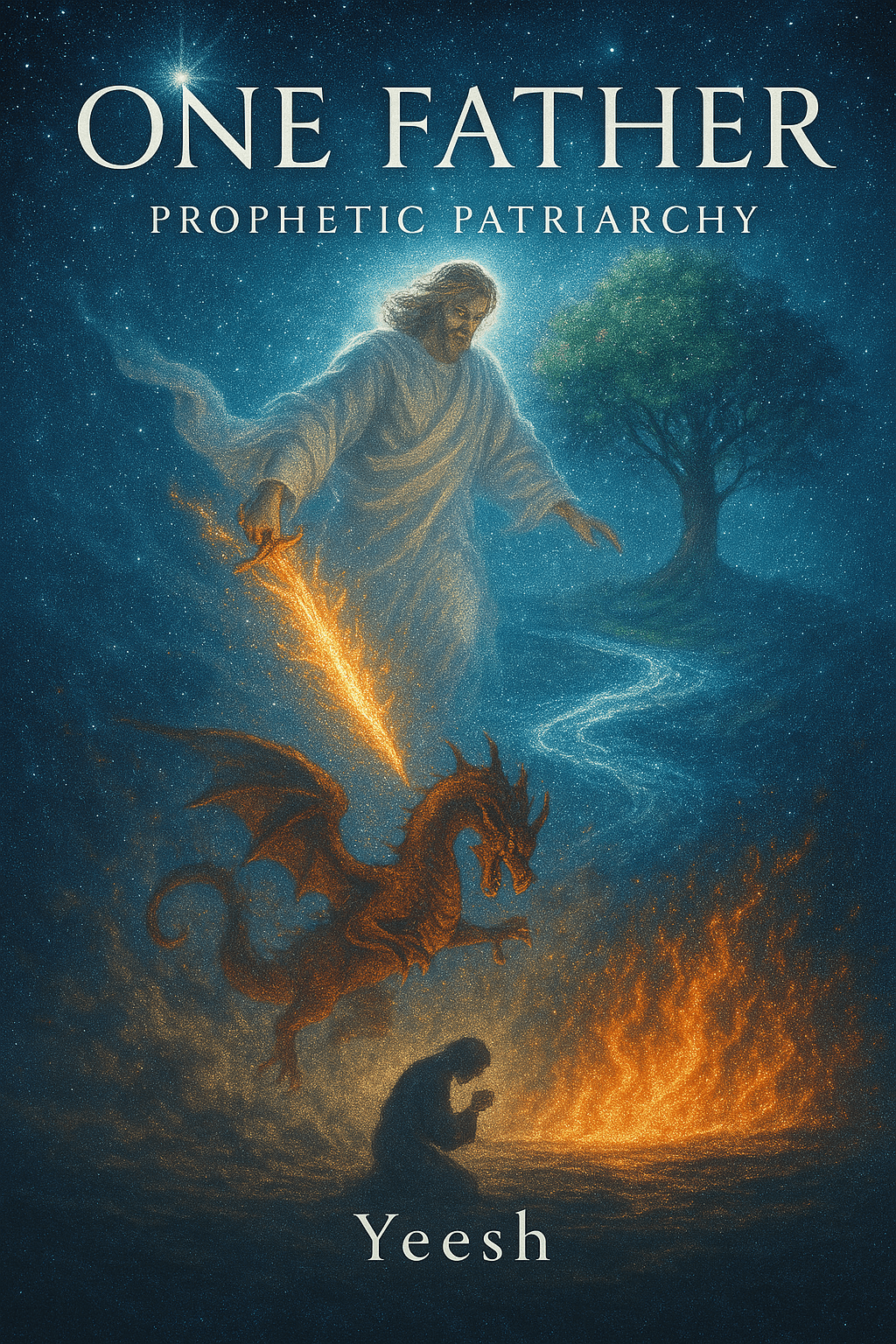
This is my Sword
We need to remind ourselves that as long as adversity remains everything must be guarded. It is no coincidence that Genesis records the placement of a flaming sword at the east of Eden - not to banish man forever, but to preserve the way to the Tree of Life. What was revealed in the Sabbath presence, peace, union - must now be protected from inversion. Just as the rest was entered, so too must it be upheld. For not all who approach the garden do so in love; some, like the serpent, twist the idea of the help we need into a usurper and trade true covering for counterfeit glory. The sword must rise, not against the innocent or poor, but against the lies that masquerade as light. Thus, the journey continues - not back to labor, but forward into discernment. As Chapter 8 unfolds, we are called to wield the sword of the Spirit, not to destroy - but to divide rightly between what is from Elohim and what only appears to be. Just as Yeshua rose on the third day and now walks with us on the seventh, we are called to stand with Him in the garden of this age - alert, resting in Him, yet armed with truth. For the serpent still speaks, and many altars still burn with strange fire. But the true man, the Yeesh, walks forward now - not to sleep beside deception, but to cut through it with the Word, restoring order, headship, and covenant. The Sabbath taught us how to dwell; the sword will teach us how to defend that dwelling. And together, they prepare us for the return of the King who rests with us now and reigns forever. So let us make a straight path for YHWH to travel, and smash the idols in His way. “The Sword of the Lord is not a blade of steel, but a Word - precise, living, and able to divide soul from spirit.” - In Hebrew, this Word has a shape. Its form is encoded even in pronouns. This chapter begins with one such word: ‘Zō’th.’ To understand the sword, we must first understand the wound.”
The Restoration of Courses: From Zō’th to Zeh to Seh In Genesis 2:23, Adam declares:
“This at last is bone of my bones and flesh of my flesh; she shall be called Woman, because she was taken out of Man.” (Genesis 2:23, ESV) When we examine the Hebrew word for this - ( ז ֹאתZō’th) - we find more than just a feminine demonstrative pronoun. In the biblical pattern, it functions as a spiritual incision, a moment of clear delineation. It points to the precise boundary where separation, identification, or revelation occurs. The scriptures often use this word at thresholds - when the course of history shifts, when the old is cut off and the new begins. As in Exodus 14:13, when Moses declares to Israel at the edge of the Red Sea: “Fear not, stand firm, and see the salvation of the Lord, which he will work for you today. For the Egyptians whom you see today, you shall never see again.” (Exodus 14:13, ESV) The word translated as “today” is Zō’th - not merely a point on a calendar, but a prophetic pinpoint in time. This day is unlike all others. This moment divides idolaters from the delivered, the waters from the dry ground, bondage from freedom. Zō’th marks the boundary between the false course and the true one. And again, we hear echoes of Zō’th in 1 Samuel 17:47, as David stands before Goliath and says: “All this assembly may know that the Lord saves not with sword and spear. For the battle is the Lord’s, and he will give you into our hand.” (1 Samuel 17:47, ESV) The word translated as “this” in many decisive verses - including here - is Zō’th. But Zō’th is not merely a pointer or a pronoun. It is a spiritual blade, a divine declaration that this is the moment. This is the separation. This is the incision between what was and what must be.
In 1 Samuel 17:47, David proclaims: “All this assembly may know that the Lord saves not with sword and spear. For the battle is the Lord’s, and he will give you into our hand.” The “this” in “this assembly” is Zō’th - an invisible banner over the battlefield. It marks the dividing line between human strength and divine deliverance. David wields no visible sword, but his word cuts. Zō’th appears where the battle is not fought with weapons, but with faith. Zō’th’s denotes something that appears, or something is being judged, exposed, or divided. It is not time - it is timeliness. Not a calendar moment, but a critical incision. A decisive “now” that separates false paths from true ones, idols from Elohim, and fear from faith. Here again, the word “this” is Zō’th. And it is critical indeed. Adam assigns identity. He does not merely observe the woman - he names her. He declares Zō’th -this one. The insertion of the Hebrew letter Aleph in Zō’th (as opposed to the masculine form Zeh) becomes prophetically significant. Aleph represents headship, strength, or leader. By calling her Zō’th, Adam however innocently or intentionally - places headship in her through his declaration and she assumes it next. And yet, we must remember who put it there: not God, but Adam. Zō’th, then, becomes not just a pointer to the woman, but a transfer of headship that was never God’s design. It foreshadows the tension that unfolds in the next chapter - when the serpent speaks not to Adam, but to Zō’th. She answers not from rebellion alone, but from misassigned authority. Now consider the masculine counterpart: ( זֶהZeh). In grammatical terms, Zeh is simply the masculine form of “this.” But spiritually, its structure is revelatory. Unlike Zō’th, Zeh contains no Aleph. There is no headship transferred, no false projection, no confusion of roles. It removes the misplaced Aleph - and in doing so, symbolically removes the woman as head. Zeh becomes the restoration of order. It points not to the helper as the leader, but to the one from whom she came as her headship is taken out of the side of Zeh.
The scriptures use Zeh in key redemptive moments. Consider Exodus 12:11: “In this manner you shall eat it: with your belt fastened, your sandals on your feet, and your staff in your hand. And you shall eat it in haste. It is the Lord’s Passover.” (Exodus 12:11, ESV) The word “this” in “It is(this) the Lord’s Passover” is Zeh Now, returning to Zō’th ( ) ז ֹאתlet us observe a critical addition: the Aleph ()א, signifying headship, authority, and strength, is placed at the center. This configuration, ironically, positions the Woman as a false helper, inadvertently established by Adam (this is really every man’s problem as we have a propensity to put her on that pedestal), who assigned her an authority and role she was never intended to bear. This place becomes an altar, and its not surprising to find such a confluence of important typological and literal characters and words. The fact that Yeshua came as submissive and feminine in his first coming to seek and save and is returning as righteous Father is also not without profoundly deep prophetic and philosophical implications on the inflections surrounding this verse about this word. This action of Adam is not merely linguistic but deeply spiritual, akin to erecting an altar to false doctrine. By choosing the word Zō’th ( ) ז ֹאתadam is in a way inserting a word where the Aleph (headship) is inserted into the Zeh (this). Adam transformed the symbolic sword of his words as a representative of the Word of Elohim born in the flesh into an object of misdirected reverence towards what would transpire next. This act foreshadows humanity’s consistent struggle with elevating creation over Creator, the transient over the eternal, the seen over the unseen. It is akin to the action and reaction principle in physics. This set the stage for what was next, the cosmic test of wits against the craftiest of creatures wanting to throw everyone out of orbit and bring chaos to order. scripture is full with warnings against such subtle idolatries, against the tiniest leven that would blow up the lump. It’s not that this word was an inappropriate choice, it is simply that in the context it leaves something
unresolved. Adam’s opinion is perfectly clear, the woman was the thing itself. However that revelation is never fully confirmed at this point. By recognizing the alteration Adam introduced - placing the Aleph (symbolizing false headship) into Zeh - inflecting that the Woman was the Helper - we begin to dismantle the a major altar of false doctrine. Removing that misplaced authority (Aleph) restores Zeh as a placeholder for the Lamb. The Lamb that was slain before the foundation of the world. But what if the restoration of Zeh is only the beginning? There exists, quietly, among certain ancient lexical traditions and scribal commentaries, the idea that the word recorded as Zō’th in Genesis 2:23 might have originally been Seh - ֶׂש ה- the Hebrew word for lamb. This is not imaginative mysticism; it is a minority but real scholarly position from ancient, held within streams of textual and Masoretic tradition that acknowledge the visual ambiguity between the letters Zayin ( ) זand Shin ()ש in ancient Hebrew scripts - especially in scrolls written without vowel markings or clear spacing. In some marginal notes and scribal glosses, the possibility of Seh appears not as a doctrine, but as a question. A flicker of light in the margin. A mystery whispered by the text itself. And if this whisper is even faintly credible and if the word Adam spoke, whether intentionally or providentially, was not merely “this” but “lamb” then the implications are staggering. We are no longer just talking about symbolic misalignment or projected headship; we are looking at a hidden altar buried within the language of Eden itself. A lamb on an alter. A prophetic slip encoded into the breath of man, placed there by the Spirit who “searches everything, even the deep things of God” (1 Corinthians 2:10). Consider Genesis 22:13 in this context “And Abraham lifted up his eyes, and looked, and behold behind him a ram caught in a thicket by his horns: and Abraham went and took the ram, and offered him up for a burnt offering in the stead of his son.”. Adam’s exclamation, “This is now bone of my bones and flesh of my flesh, ” we may now hear an echo of another declaration -Behold the Lamb of God, who takes away the sin of the world. If Seh is even poetically plausible, then the woman is momentarily confused with the Lamb a confusion that runs
rampart throughout the human story. We see it in Israel, when they turned the bronze serpent into an idol. We see it in Rome, where mother and child iconography elevated Mary above Messiah. We see it in modernity, where romance, self-help, and emotional union have become salvific surrogates. Always, the temptation is to crown the created thing in the place of the Redeemer. But the Lamb suffers these projections without resistance, because His purpose is to bear them and burn them away in His righteousness as he takes or our error. As Paul wrote, “He who knew no sin became sin, so that in Him we might become the righteousness of God” (2 Corinthians 5:21). Likewise, we may say, He who knew no error became as error, so that in Him even the errors of men - textual, spiritual, emotional, and physical - could be transfigured into truth in the flesh of Yeshua Messiah, the lamb that was slain. And so, we see the gospel not merely told, but textually fulfilled. The Lamb does not simply die on the cross - He is veiled in the very syllables of the fall, appearing hidden in Adam’s declaration. He enters the narrative through a word, allowing Himself to be misnamed, so that He might later be rightly revealed. From the foundations of the world, the Lamb was not only slain but He was also spoken over and over in different ways, and different languages, as the gospel goes to all tribes, nations, and tongues. And in the word here in Genesis 2, potentially is ‘Seh’, the lamb. This is the Lamb as a type, as a another prophetic prefiguring. We glimpse at both substitution and solution, both sacrifice and sovereignty. What a place in scripture prophetically speaking. This vision on things, even if never conclusively proven, does not diminish the glory of the idea in the text as much as it expands it. It shows us that scripture is alive, layered, and able to bear more meaning than its surface might suggest. It invites us not to tamper, but to tremble. Not to correct, but to worship. Consider the prophet Isaiah cries out against misplaced reverence: “All we like sheep have gone astray; we have turned - every one - to his own way; and the YHWH has laid on him the iniquity of us all” (Isaiah 53:6). Here we find
the lamb again, the true Lamb, contrasted against humanity’s wandering heart. The Gospels fulfill this prophetic image vividly. John the Baptist declares, “Behold, the Lamb of Elohim, who takes away the sin of the world!” (John 1:29). John’s proclamation explicitly corrects Adam’s error, shifting focus from misplaced headship back to the true sacrificial Lamb whose authority and headship are divinely appointed. Yeshua Himself confirms His sacrificial identity when He states, “I am the good shepherd. The good shepherd lays down his life for the sheep” (John 10:11), thus reclaiming rightful authority from false idols erected by human misunderstanding. The book of Revelation further reinforces the triumph of the true Lamb over all counterfeit images and misplaced headships. It declares, “And I saw between the throne… a Lamb standing, as though it had been slain” (Revelation 5:6). The Lamb, slain yet risen, powerfully embodies victory over idolatry, false authority, and misplaced worship, and its consequences in death. In this recognition, we are not just correcting a linguistic detail but we are also reversing a spiritual pattern: a cycle of man surrendering his headship, the woman being miscast as the primary helper/savior figure, and the serpent gaining ground on the prophetic blessings of the Word of Elohim. But now the order is restored as the Lamb is enthroned, the woman is covered and fruitful in the garden, and the serpent is found once again crawling in the dust he was sentenced to consume in defeat at the Feet of Yeshua the resurrected Messiah and King who is to come. This is the victory that restores the patriarchy and brings us back into the structure Elohim ordained from the beginning, trusting in the Lamb that was slain before the foundation of the world. Whether Zō’th, Zeh, or Seh, the Spirit is speaking. In Zō’th, we saw the Aleph - the misplaced headship, the pronouncement of man. Then in Zeh, we saw the restoration - the removal of the false headship, the return of patriarchal order. And finally in Seh, we now glimpse the Lamb - silent, present, bearing the error and turning it into glory.
This is not a contradiction. This is cruciform prophecy. I am humbled to be typing these words. He will reveal what is, in His return as King, as I see dimly in a mirror, but then face to face. Even if the scrolls show Zō’th, and even if most scholars maintain that translation, we cannot ignore the implications of Seh. In the holy ambiguity, we find a parable of the Word made flesh: misunderstood, misnamed, misrepresented - and yet chosen, perfect, and true. “He was despised and rejected by men… and we esteemed him not” (Isaiah 53:3). But He was not undone by our estimation. He was exalted by the Father, enthroned as the Lamb, and declared worthy by the chorus of heaven in the presence of the new Jerusalem. So what, then, is this moment in Genesis 2? Is it the elevation of the woman? Or the projection of man? Or the hiding place of the Lamb? Or the alter of false doctrine and serpent inflections? It has in time become all of them and in its prophetic finality will be revealed by YHWH Elohim on His return. Because this is how the Lamb moves - He hides inside the fig leaves, inside the misidentifications, inside the “mistakes” we make when we try to understand glory on our own terms, silently bearing our sin in His flesh as this is His role. He is the Helper fit for Man and His Spirit goes forth abundantly from this. And then, when the time is right, He pulls back the veil - not to shame us, but to save us. This is the victory of Messiah. So let this strange whisper in Genesis 2 - this glimmer of the Lamb in Seh undefined call you to awe, not argument. Let it mark the moment where idols begin to crumble, not with violence, but with recognition. Let it remind you that He who was called sin is also the one who knew no sin, so that we might become the righteousness of Elohim in Him. That even in textual ambiguity, truth is never lost and instead is simply waiting for the right eyes to see and that the best revelations of all can come through faith not through sight. And behold…this may be the Lamb; humble, face down, in prayer “Abba, Father”.
Fallen Angels Is it unreasonable to think that the serpent may have appeared as an angel of light? Does it have to be a literal snake? In my view, either could be true, and yet His word remains unshaken - because in one case, the “angel of light” is the metaphorical reality while the serpent is physical, and in the other, the “angel of light” is the physical reality while the snake is metaphorical. Either way, the spiritual message remains intact, and the lessons remain the same in the words received. Never underestimate Elohim’s ability to juxtapose physical and metaphorical reality in teaching and sanctifying us. There are many lessons in understanding this spectrum of communication. I firmly believe in the physical creation, for the very spirit of the antichrist denies that Yeshua came in the flesh. I believe this is a mistaken theme throughout scripture, where the fleshly interpretation is denied for the purely spiritual and is a mistake. For this reason, I hold that both the physical and metaphorical interpretations of Genesis are valid and that, beneath the surface, the prophetic meaning is embedded for those with the vision to perceive it. Just as the ultimate fruit of prophecy was the Word made flesh, I believe these stories in Genesis happened exactly as described, yet they carry layers of metaphorical, prophetic, and typological meaning that unfold throughout time. Even now, these truths continue to expand outward toward their fulfillment, echoing through history in ways that only full revelation can unveil. But the story of scripture now is continuously about restoration. Whenever prophets and kings tore down false idols, blessing followed. This chapter is dedicated to tearing down idols. Gideon tore down his father’s altar to Baal → Israel was delivered (Judges 6:25–27). Josiah destroyed the idols in the land → A revival of Elohim’s Law (2 Kings 23:4–25). Elijah confronted the prophets of Baal → Fire from Heaven and national repentance (1 Kings 18:20–40).
Likewise, we must tear down the altar of misunderstanding in our lives. If we let the Spirit and The Word be our true Helper, the blessing can be restored. “Seek first the Kingdom of Elohim and His righteousness, and all these things shall be added to you.” (Matthew 6:33) “Return to me, and I will return to you, says YHWH of Hosts.” (Malachi 3:7) This is not just about theology but it is about unlocking the original blessing Elohim ordained for mankind. We must through active action redefine in better terms the theological anchors of idols past and in doing so restore the Kingdom of God in clarity and revelation. We must cast downward those idols falsely raised from tradition in the congregations. Tradition often founded on faulty interpretations of Genesis built around the sin of Adam and the twisting words of the serpent.
The Two Words for “Man” in Genesis At creation, the man ( ) אדםis formed first, but when the woman is introduced, the text shifts and begins to use the terms Yeesh ( ) אישand Ishah ( ) אשהas the distinct male and female parts. This shift in names isn’t random - it reveals a deeper spiritual truth. The context and use of each term is nuanced and I have not covered all angles, but the next goal is to bring more light to Yeshua Messiah as revealed in the original language.
Adam in Genesis 1 ( )אדם-Before Woman Aleph (– )אStrong leader Dalet (– )דA door, a pathway Mem (– )םWaters, chaos Man without a woman is “the leader walking through the door toward chaos.” He is unfinished - he needs direction (the Spirit and The Word) and fruitfulness (descendants and spiritual fruit). The naming is a major illusion to what is to come, and Elohim’s ultimate plan for him.
As “the strong one who passes through the door into chaos” man was formed from the dust of the ground (adamah) - his name binds him to the ground. He was meant to subdue and bring order to the ground, putting the snake of the grass and dust under his feet, but when he followed the Woman, rather than leading through The Spirit and The Word, he passed through a door ( ) דinto the waters and chaos ( ) םof a fallen world. He made it appear as if the serpent was elevated with wisdom, rather than already at his feet. Adam defines the woman by her physical nature rather than waiting for revelation or definition from Elohim. This sets the perfect stage for a trick question - which biblically speaking seems to be the way of things called serpents. The Pharisees and other teachers and serpents love these inflection points for a reason, because there is probably something good hidden and they are trying to obfuscate it whether by insidious and intelligent design or by being subservient to greater forces of influence from heavenly realms. Their questions are spoken from darkness, but we are of the light; so let us shine light on the situation. It’s almost as if all creation should find its way to his Word, and witness its nature to attract whether of the light or the darkness.
The False Helper who Corrupts Womanhood Ashtoreth was a false goddess of the old testament attributed to fertility and she is where humanity begins to misunderstand it’s true helper by looking to the seen rather than the unseen, the flesh alone rather than the Spirit included.
Pictographically, Ashtoreth is revealed in the following letters.
Ayin (– )עEye, to see, experience.
Shin (– )שTeeth, devour, destroy.
Tav (– )תMark, covenant.
Resh (– )רHead, leader.
Tav (– )תMark, covenant.
( עשתרתAshtoreth) represents “A vision of destruction that marks the head with a false covenant.” This is exactly what happens when flesh replaces The Spirit and The Word as our guide. Ashtoreth was worshiped as a fertility
goddess, a corrupted version of womanhood that emphasized sensuality, power, and misguided devotion. Man’s intention is exposed when the serpent does show up, and he chooses the fruit now in the role of Yeesh, following the woman into the serpent's twist. As Yeesh, he was bearing the image of Husband, which is why a fall was possible at this point as it prophetically points to the Messiah’s role as Husband of the Bride which is the congregation. As Yeesh, Adam was taking on the image of Messiah and the congregation and this prophetically was typifying the consummation of the Bride of Messiah at the end of the age. After the fall, The Word calls out to them as they are hiding and ashamed. The fruitful blessing being brought with the addition of the Spirit had yet to be fully received. Instead, man had taken part in a series of verses where his words and the woman’s words and the serpent's words form a cord of three twisted strands, intermingling together to alter context. This is not without irony in the juxtaposition of the chapter 1 of this book. It’s the reverse three as I like to call them.
False Winnowing as Opposition to the Blessing As we’ve discussed, Hasatan (the Adversary) seeks the inversion of the 5-Fold Blessing. He wages war against fruitfulness, promoting barrenness, generational ignorance of Elohim, and the destruction of family structures. Be Fruitful → Opposed through barrenness and abortion and all kinds of idolatry Multiply → Opposed through anti-family ideology, government malfeasance, and low birth rates Fill the Earth → Opposed through population decline and cultural decay Subdue → Opposed through weakening of men and lack of spiritual authority Rule → Opposed through tyranny and usurpation of Elohim's order In order to obey the commandment to rule, we must stand against this inversion by fully embracing both the spiritual and physical aspects of the 5-Fold Blessing, ensuring that we not only bear fruit spiritually (Love, Joy, Peace, Patience, Kindness, Goodness, Gentleness, Self-control) but also raise
up a generation that knows and walks with Him in The Word. These are real born children to walk the earth in knowledge and love of Him. We have to push the serpent from his perceived lofty position to the ground without losing sight of the blessing and the one who gives us access, Yeshua. This metaphorically is taking the garden back, by denying the serpents fake rule and trusting Elohim in his full revealed Word and Spirit, we enable Elohim to act on our faith with His faithfulness and orchestrate the events that will lead to His Glory in our lives, as we follow Him to victory.
Enter Yeesh Yeesh ( ) אִ יׁשis the husband, the transformed Adam, who would be a part of the groundwork for the prophecy of Messiah and the congregation. This second word for man in Genesis 2 is a prophetic type of Messiah. It is the Husband who shall rule. This metaphor spins out through scripture, ultimately culminating in Messiah and the gathering of the Bride. Yeesh was the true destination for Adam, because in Yeesh he would metaphorically and physically be in his unified life with the woman together representing Messiah and the congregation. Prophetically we are seeing the completed work in Genesis 1, so Yeesh was the role Adam was intended to step into in full representation of Yeshua’s salvation. The woman was to be the helper by implication, in the flesh. It’s not without expectation that Yeesh would prototype the solution to the problem of ashtoreth worship, which was taking place at the spot of the offering of the wisdom of the serpent. Subtly presented through the perceived helper fit for him, of his flesh and bone, she looked the part. Let’s dig in more to the root words and see if anything can be revealed. This was a role that man was going to receive after the fall, a role that would ultimately be another prophetic picture for Messiah as a Husband to the congregation. "Ish is the strong leader (Aleph) who works (Yod) to refine and protect (Shin) his household." Fire refines so this could symbolize passing through the trials. The hand (Yod) shows man taking action, leading and protecting. Yeesh is a man transformed into his Elohim given role as a refined, active, fruitful leader.
This is the biblical design of the husband who is a man called to lead, serve, and spiritually refine his family through faithful action and ultimately help bring the Kingdom of Heaven to meet earth in full embrace. Mankind starts as Adam ()אדם, the grounded man from the dust where the waters rise, but when he receives a woman, he is called Yeesh ()איש, the husband called in Faith to rise with Yeshua. The husband seeking to honestly represent him in patriarchy and submission to His will here on earth. Instead of embracing this role, often we go after foreign gods, anyone and anything other than YHWH. In this mistake, we throw the woman, and thus the serpent, on an altar in an incomplete place. As Yeesh mankind is not yet perfect but it’s still a role we need to mature in understanding while not continuing in the mistakes of Genesis 3. We must be born again to new life in Yeshua.
Yeshua as the True Yeesh Adam, the first man, did not walk through the garden in victory. He did not resist the adversary, nor did he stand firm on the Word of Elohim. Instead, he followed a voice that contradicted both the Spirit and the Word. Acting as a Yeesh, he listened to a false perception of help and yielded to twisted counsel. In doing so, he failed to embody the name Yeesh - the strong leader refined by fire. He let the subtle lies of the serpent reshape his understanding and disrupt the order given to him. When Yeshua entered the wilderness, He faced the very same categories of temptation that confronted Adam. But unlike Adam, He was fully alone and without woman, without abundance, without shelter, without even a morsal of bread. The adversary came not through a vessel, but in full confrontation. And the temptations? The same old seeds of his original inversion repackaged; for to the serpent Yeshua appears as adversity, present to subdue. The lust of the flesh, he offers - “Turn these stones into bread.” (Matthew 4:3–4) Just like the fruit of the tree in Eden, made to satisfy the body and appetising in presence. A test of trust in the Father’s provision.
Then comes the pride of life - “Throw yourself down… He will command His angels concerning You.” (Matthew 4:5–7) As if to say, "Force Elohim’s hand, prove your identity." This mirrors the serpent's whispered doubt: “You shall not surely die.” The lust of the eyes - “All the kingdoms of the world… if You bow down and worship me.” (Matthew 4:8–10) As with the tree that was “pleasant to the eyes” and “desirable to make one wise.” Before Yeshua’s eyes, were all the kingdoms of the world. Yeshua’s responses were swift and grounded in the Word: "It is written: Man shall not live by bread alone, but by every word that proceeds from the mouth of Elohim." "It is also written: You shall not test YHWH your Elohim." "Be gone, Satan! For it is written: You shall worship YHWH your Elohim, and Him only shall you serve." Each response cut through the lies with the Word with Spiritual precision - exactly what the first man failed to do. Yeshua did not reason with the serpent, nor did He hesitate. He rebuked the adversary outright, upholding the order of Elohim. And then something crucial happens almost immediately after this confrontation, Yeshua is filled with the Spirit. Luke 4:1 says He was led into the wilderness by the Spirit, but Luke 4:14 reveals that He "returned in the power of the Spirit to Galilee." The fullness came after the testing. Yeshua, after the temptation received the fullness of the Spirit, yet another parallel to Genesis stories unfolding. This gives incredible weight to the idea that had Adam resisted temptation and had he guarded the garden, crushed the serpent, and obeyed the voice of Elohim that then in the cool of the day, when the Spirit (ruach) moved through the garden (Genesis 3:8), it might have filled him with power as well. But instead, he was caught hiding with his wife in a self revelation of nakedness and shame, perhaps wearing his own man-made covering of leaves and vines. Exposed to the elements of the dirt, mud, and air, cold and afraid,
shivering in a place of abundance. There in his felt flesh, devoid of the Spirit and hiding from the Word of YHWH. The moment of Adam's test and the approach of the Spirit were not disconnected - they were sequential. Had he stood in obedience, the breath of Elohim would have animated him further, sealing his dominion with glory. Instead, the Spirit arrives and Adam is ashamed. The breath intended to empower becomes a wind of exposure driving him out of the garden and into the transient fields of grass. So here in Yeshua’s triumph, we see the pattern clearly repeated: temptation, Word-response, Spirit-filling. Adam failed at the first step. Yeshua completed all three and was filled with the Spirit. Yeshua is not only the last Adam. He is the true Yeesh as the Husband that has the bride. He is the Strong One, who worked the Word, refined in fire, and emerged as the Head of the body. Where the man was silent, Yeshua spoke. Where man followed, Yeshua led. Where man accepted the adversary’s lie, Yeshua clung to the truth and became the Adversary to the serpent, usurping even his position ultimately. Where man lost his covering of Light and was exiled from the garden, Yeshua rejected temptation and was clothed in glory and power from on high. In this way, Yeshua fulfills the original blueprint of man. Not just in form, but also in function. The temptation narrative is not just a New Testament story but it is the restoration of Eden’s lost order. It is Genesis revisited, and this time, the Strong Leader stands his ground.
Three Sword Slashes Let’s dig deeper into the temptations of man with another verse often quoted to destroy biblical patriarchy and its implications for polygyny. If Deuteronomy 17:17 was not a prohibition against polygyny in general than it was a warning against the lust of the eyes, the lust of the flesh, and the pride of life. The issue in our generation's sense of this verse, is the complete isolation of the restriction on women out of context and in ignoring the clear
tri-fold nature of this verse. I suspect in many cases, hypocrisy in the areas of wealth and pride will be with those that argue against righteous polygyny. “For everything in the world - the lust of the flesh, the lust of the eyes, and the pride of life - comes not from the Father but from the world.” (1 John 2:16) So t hey fail to realize this verse cuts three ways - against excessive pleasures and beauties, excessive wealth, and excessive power (beasts/laborers). If they truly want to uphold this verse as law, then why do they ignore two-thirds of its commanding? They focus only on the first clause about wives, ignoring the fact that many of them have multiplied gold (wealth) and beasts (workers/employees) far beyond what Joseph stored in Egypt during seven years of famine, far beyond what can be justified as biblically reasonable outside of a coming prophetic famine. Why do we act as if unlimited wealth accumulation is justifiable? Biblically, beasts represent people in certain metaphors. Paul even applies this to laborers when quoting from the Law. It can be an employee, or a institution we are in charge of, a business we have established. “For the scripture saith, Thou shalt not muzzle the ox that treadeth out the corn. And, The laborer is worthy of his reward.” (1 Timothy 5:18) Paul directly equates the ox (a beast) to a laborer in the context of paying workers. The same principle is found elsewhere: “A righteous man regardeth the life of his beast: but the tender mercies of the wicked are cruel.” (Proverbs 12:10) This means that if they are applying Deuteronomy 17:17 against polygyny, then they must also apply it against financial wealth in all its manifestations and forms as well as the overaccumulation of power over people and workers. They must treat these workers with dignity and respect, fulfilling the Spirit of the Law in Love.
These same critics often own multiple houses, vacation homes, businesses, land, cars, and massive financial assets, but they refuse to fill those houses with children and wives. Instead of multiplying households, they multiply possessions and increase the cost of living for younger families, stifling family formation in the excessive accumulation and speculation. They limit themselves to one wife, while cheating on the side. Never fruitful, close to being cut down and thrown in the fire. But what does scripture say about hoarding wealth? “There is one alone, and there is not a second; yea, he hath neither child nor brother: yet is there no end of all his labor; neither is his eye satisfied with riches.” (Ecclesiastes 4:8) Isaiah directly warns against those who accumulate property but leave their houses empty. “Woe unto them that join house to house, that lay field to field, till there be no place, that they may be placed alone in the midst of the earth!” (Isaiah 5:8) They attack righteous polygyny, yet they have 10 properties, 5 businesses, a fleet of cars, and a vault of wealth - all while they fail to multiply children and families. This is the opposite of Elohim’s first command to mankind: “Be fruitful, and multiply, and replenish the earth.” (Genesis 1:28) Yet, we must temper this warning against wealth with an understanding that Elohim does not call us to laziness, nor does He despise provision and wise financial management. The key is perspective - is wealth serving us as a tool to glorify Elohim, or are we serving wealth as our master? Hard work is good → “In all toil there is profit, but mere talk tends only to poverty.” (Proverbs 14:23) Investing wisely is good → “The plans of the diligent lead surely to abundance, but everyone who is hasty comes only to poverty.” (Proverbs 21:5)
Providing for family is a dutiful privilege → “If anyone does not provide for his relatives, and especially for members of his household, he has denied the faith and is worse than an unbeliever.” (1 Timothy 5:8) Leaving an inheritance is biblical → “A good man leaves an inheritance to his children’s children.” (Proverbs 13:22) The issue is not the possession of wealth, but whether it possesses you and you leverage it to the detriment of others. Wealth properly handled with heal, multiply, and help those in need. Wealth is deceptive, and can fool us into finding security in the world. “Charge those who are rich in this present world not to be arrogant nor to put their hope in wealth, which is so uncertain, but to put their hope in Elohim.” (1 Timothy 6:17) After all, a man cannot server two masters, so go ahead and choose which Master you will Love, and if the other still sticks around you will find over time you will despise the other if he tries to rule you.
The Three of The World Sometimes I look at the Word of God, bound in paper and ink, and I marvel - not at the page, but at the throne it carries. The Word is enthroned on the page. It does not bow to it. The paper may burn, but the Word remains. It is gold refined seven times, eternal, imperishable, incorruptible. It does not fade, inflate, or corrode. Then I glance at the bills in my wallet. The faces of men stare back - printed in ink, framed in symbols of power, enshrined as if sovereign. These, too, are words on paper. But unlike the Word of YHWH, they are not eternal. They are counterfeit thrones. Currency mimics covenant. It offers a false promise of provision, a man-made manna that spoils by morning. Just as Elohim’s river flows from a throne, so too does the world’s counterfeit streams. One descends from the heights, from the throne of God and of the Lamb - from which proceeds the river of living water, clear as
crystal (Revelation 22:1), nourishing the Tree of Life. That river is the Spirit. That water is the Word. That flow is the Bread that came down from heaven, feeding the soul with truth. The other river rises from below. It is not a river of life but a current of control. It flows not from heaven but from Babylon, from thrones made by merchants and kings. Its waters are not clear but clouded - polluted with debt, inflated with deception in infinite fiat terms, backed not by righteousness but by empire. It is the fiat river: endlessly multiplying, endlessly devaluing, printing promises it cannot keep. It appears to nourish, but it leeches. It mimics wealth but breeds hunger. It offers freedom but enslaves both those that accumulate it and those that have it not. Both rivers appear bound in paper. But only one is eternal. Elohim’s Word is bound in holy scripture - pure, imperishable, overflowing. It does not change to meet desire. It shapes desire into truth. The world’s wealth, too, is bound to paper, but it must inflate into infinity just to stay alive. Like Pharaoh’s magicians, it can imitate the staff becoming a serpent - but it cannot swallow death. Its glory is printed but not spoken and alive. Its value decays even as it multiplies. And just as the true river brings life wherever it flows, the counterfeit splits into three poisoned tributaries - each feeding one appetite of fallen man: the lust of the eyes, the lust of the flesh, and the pride of life. The Apostle John did not stutter: “For all that is in the world - the desires of the flesh and the desires of the eyes and the pride of life - is not from the Father but is from the world.” (1 John 2:16) These are not random temptations. They are rivers - spiritual riptides that flow through economies, cultures, and systems. They course beneath the
altars of false religion and surge behind the thrones of false kings. They weave together like a threefold cord of deception. Each current feeds the others. Each disguises itself as light. And when one vein is poisoned, the whole river is deadly. You may think you stand on the bank of only one. But if you step into the stream of the flesh, the eyes will soon follow. And when pride drinks deep, it opens its mouth to devour the rest. But the River of God still flows. It flows from the throne. It waters the Trees. It does not inflate but it nourishes organic and spiritual growth. It does not corrode but it endures as it calls us to come, drink, and live. “Let him that is athirst come. And whosoever will, let him take the water of life freely.” (Revelation 22:17) Let us now wade deeper into each of the three counterfeit currents. Their origin. Their deception. And their end.
The Lust of the Eyes: The Worship of Appearance It began when Adam opened his eyes and saw the woman and said, “This…” - Zō’th (Genesis 2:23). In that moment, his gaze affixed to the visible form. His declaration was not wrong in affection, but premature in authority. He crowned her with headship before the Spirit had crowned Him with life eternal. He saw with the eyes of longing, not with the eyes of Light. The lust of the eyes is not merely about sexual desire; it is about false exaltation of the visible and the idolization of form over function, beauty over truth, flesh over Spirit. the Woman herself would fall into this same temptation, for it is written: “The woman saw that the tree was good for food, and that it was a delight to the eyes…” (Genesis 3:6). The deception entered not through her stomach, but through her sight. She wanted what looked good, even when Elohim had said otherwise.
This tributary continues to run through the scriptures. The kings of Israel were not blind to beauty. Solomon, in particular, “had seven hundred wives, princesses, and three hundred concubines. And his wives turned away his heart” (1 Kings 11:3–4). It was not just that he married many, but that he did not guard his gaze. He let the appearance of women override the Word of Elohim, and he paid in spiritual confusion and national division. Also note, that to framework what Solomon was doing here as sexually driven is to completely misunderstand many elements, so we won’t go there. Solomon was likely using marriage to form alliances in uniting Israel and surrounded nations which also plays into the pride of life and the lust of the flesh. It was a failed strategy as it wasn’t being led by the Spirit and instead ended up putting foreign gods in his view. The modern man, too, is caught in this torrent. He measures women by curves and the social status she can provide. He judges congregations by lighting, ministries by branding, and success by sparkle. He crowns the visible while ignoring the invisible. He forgets the command: “Walk by faith, not by sight” (2 Corinthians 5:7). And so his eyes become his Elohim.
The Lust of the Flesh: Grasping for Strength If the eye leads man to admire, the flesh urges him to grasp. It wants to hold, to consume, to secure. This is the temptation of strength apart from Elohim - the desire to make flesh our fortress. It is not merely sensuality, though it includes that. It is the instinct to control outcomes through human effort, to trust in what can be touched instead of the Spirit who is unseen. When man listened to the woman instead of Elohim, he demonstrated this lust. He clung to her voice rather than the Word. It wasn’t just about intimacy but it was about identity. His allegiance shifted from obedience to Elohim to co-dependence on the flesh. He potentially feared losing her more than he feared disobeying the command. And so, he fell not by temptation alone, but by disordered loyalty as well. Elohim had also warned Israel’s kings not to multiply horses - a metaphor for military might (Deuteronomy 17:16). Yet in their pride, they trusted in chariots instead of covenant. “Woe to those who go down to Egypt for help and rely on horses, who trust in chariots because they are many and in
horsemen because they are very strong, but do not look to the Holy One of Israel or consult the YHWH!” (Isaiah 31:1). The Psalmist offers the antidote: “Some trust in chariots and some in horses, but we trust in the name of YHWH our Elohim” (Psalm 20:7). The lust of the flesh always whispers that we can do it ourselves. That we can build our own enclosed Eden devoid of the Spirit and The Word. That we can preserve what we love without submission to Elohim. But the Flaming Sword still turns, barring that path. Flesh cannot enter glory without the temperance of The Word and the Spirit in His life. It is an endeavor of the Life of man to seek sanctification in Faith and obedience.
The Pride of Life: Building Our Own Thrones At the end of all lust is pride. Not the pride of visible arrogance, but the deeper deception in the belief that we can live without Elohim. The Pride of Life is the intoxication of self-sufficiency, self-knowledge, and self-wisdom. It builds cities, fortresses, corporations, and even congregations without prayer. It multiplies wealth and security while hollowing out the soul. It sees itself as competence and it’s presence as a blessing, without bringing the blessing from the Spirit. Yeshua warned of this false spirit in His parable of the rich fool: “I will tear down my barns and build larger ones… Soul, you have ample goods laid up for many years; relax, eat, drink, be merry.” But Elohim said to him, ‘Fool! This night your soul is required of you…’” (Luke 12:16–21). It was not the barn that damned him. It was the belief that his own hand could secure his future which naturally led him to accumulate wealth. James likewise thundered against this pride: “Your gold and silver have corroded… Their corrosion will testify against you and eat your flesh like fire” (James 5:3). And Yeshua made it plain: “No one can serve two masters… You cannot serve both Elohim and money” (Matthew 6:24).
The Only Way Back Is Upstream The three rivers of the world - sight, flesh, and pride - are the very same that flowed through the temptation in the garden. The serpent baited the
Woman with all three. She saw, she desired, and she took. And Adam followed, swordless, Wordless, and headship surrendered. He was waiting for fruit instead of wielding faith. But another Man came. Another Adam called the Last Adam who is Yeshua. And when tempted by the same three rivers - bread, kingdom, glory He did not drink. He drew the sword of the Spirit. He spoke what Adam did not: “It is written.” That Sword is still available. It is sharper than ever. It divides the rivers and parts the waters and seas. And it calls men even now: “Come out from her, My people.” Step out of the raging floods of the world and return to the Word. Return to the garden. Return to the Tree of Life. And drink from the river that flows from the throne of Elohim and of the Lamb.
Desires and Material Needs in the New Testament It’s also ironic to accuse someone of justifying their flesh when desire (epithymia in Greek) is used throughout scripture to refer to far more than just sexual appetite. The Bible warns about many fleshly desires - greed, pride, gluttony, laziness, wrath - not just sexual indulgence. If you live comfortably, chase wealth, indulge in entertainment, or fuel your own emotions (anger, envy, self-righteousness), you too are gratifying the flesh.
James 4:3"You ask and do not receive, because you ask amiss, that you may spend it on your pleasures."
1 John 2:16"For all that is in the world - the lust of the flesh, the lust of the eyes, and the pride of life - is not of the Father but is of the world."
Romans 8:6"For to be carnally minded is death, but to be spiritually minded is life and peace."
So, if you’re going to rebuke fleshly desires, do it holistically and not just when it offends your sensibilities. The concept of fleshly desires in scripture
is far broader than modern theologians often acknowledge. While sexual immorality is indeed a major concern in biblical teaching, carnality (sarkikos in Greek) refers to any excessive indulgence of the flesh - be it in sexual sins, wealth accumulation, gluttony, wrath, or even spiritual arrogance. When someone says, “He just wants to justify his flesh, ” the implicit assumption is that only certain fleshly indulgences are problematic and in our culture it is usually implied to be the sexual ones. However, consider how scripture levels the playing field: Wealth and materialism: "But she that liveth in pleasure is dead while she liveth." (1 Timothy 5:6) "Woe to you who are rich, for you have received your consolation." (Luke 6:24) Gluttony and laziness: "Whose Elohim is their belly, and whose glory is in their shame, who mind earthly things." (Philippians 3:19) "The desire of the lazy man kills him, for his hands refuse to labor." (Proverbs 21:25) Wrath and self-righteousness: "For the wrath of man worketh not the righteousness of Elohim." (James 1:20) "These six things doth YHWH hate... a proud look, a lying tongue, and hands that shed innocent blood." (Proverbs 6:16–17) The hypocrisy lies in calling out one type of carnal indulgence while embracing another. Many who judge polygyny as fleshly justification actively feed their own carnal appetites. They do this through pride, money, comfort, or power. But true spiritual discernment calls us to crucify all aspects of the flesh, not just the ones that make us uncomfortable.
The Sword and the Word Scripture repeatedly describes the Word of Elohim as a Sword - a weapon that divides truth from deception, light from darkness, righteousness from rebellion.
"For the word of Elohim is living and active, sharper than any two-edged sword, piercing to the division of soul and spirit, of joints and marrow, and discerning the thoughts and intentions of the heart." (Hebrews 4:12) Thus, the sword of the Word is not just for battle - it is for refining, for cutting away what is false, for restoring what is pure. Man’s failure was that he did not wield this sword going forward but instead gave the narrative over in his pursuit of the woman and transgression of The Word - he did not separate truth from distortion, nor protect his bride from deception. Yeshua, however, stood as the True Yeesh - the strong leader who works through fire, refining His people, cutting through falsehood with the sword of truth. "He had in His right hand seven stars, out of His mouth went a sharp two-edged sword, and His face was like the sun shining in its strength." (Revelation 1:16) He does not wield this sword to destroy His bride - but to protect her, to cut away what is false, to bring her into unity with Him. In the wilderness, Yeshua did wield the sword to reject the enemy. By rejecting Hasatan, resisting temptation, and standing firm in the Word, He tore down the altar of false authority and restored the true pattern - submission to the Father, obedience to the Word, and empowerment by the Spirit. This is the battle between Ashtoreth and Yeesh and between the false helper and the true Head. Between the one to be crushed, and the one being adopted as a Son to the glory of the Father who is in Heaven.
A Call to Pick Up the Sword Man fell because he did not wield the sword of the Word. Yeshua conquered because He did. The choice is now ours. Will we remain silent like Man, or will we take up the sword of the Spirit? This is not just about men leading in their homes but it is about every believer standing firm in truth, refusing to bow to deception, and aligning their lives under the true Head, Yeshua HaMashiach.
"Therefore take up the whole armor of Elohim, that you may be able to withstand in the evil day, and having done all, to stand firm. Stand therefore, having fastened on the belt of truth… and take the sword of the Spirit, which is the word of Elohim." (Ephesians 6:13–17) Yeshua is the True Yeesh. He does not lead by domination, but by sacrifice. He does not rule through oppression, but through truth. He does not wield His sword against His bride, but for her protection. The serpent, the counterfeit, the false bride of idolatry - it all falls before the sharp edge of His Word. Let us, then, tear down the idols, reject the deception of Ashtoreth, and take up the sword. The battle is already won, but we must stand and fight just as our King did in the wilderness, just as He does even now. "For He must reign until He has put all His enemies under His feet." (1 Corinthians 15:25) Yeshua is called the second man (1 Corinthians 15:45). Where man failed to protect Eve, Yeshua protects His Bride. Yeshua restores headship, unlike Ashtoreth, who corrupts it. "For the husband (Yeesh) is the head of the wife as Messiah is the head of the congregation… Husbands (Yeesh), love your wives, as Messiah loved the congregation and gave himself up for her." The bride must submit to her true Husband, rejecting the false headship of deception, false teachers, and worldly wisdom. And husbands must follow Yeshua’s model - leading through truth, not through silence; guiding through the Word, not through personal desire. A true Yeesh does not dominate his wife but sacrifices for her. Yeshua contrasts Ashtoreth - instead of leading people into lust and idolatry, He leads them into holiness and redemption. A true Yeesh represents strength, order, and leadership, he is called to protect, refine, and provide. He is ultimately fulfilled in Messiah, the True Husband to the Bride, but each of us, as Yeesh as well, can look to him to be like him. We should seek Him in all things.
The Flaming sword & the Tree of Life In the surface telling of the original scrolls, the sword first appears not in the hand of man at the alter of‘this’, but in the fire of God as the man is cast out from the garden in his belief of the serpent and rebellion against the divine order. In Genesis 3:24, a flaming sword is placed at the east of Eden to guard the way to the Tree of Life. It turns every way, not to cut down man in vengeance, but to preserve the path in holiness. This is no ordinary weapon. It is Spirit-born, ever-burning, a threshold of truth. It marks the boundary between exile and return, deception and revelation, barrenness and fruitfulness. The sword returns in Ephesians 6:17 - not of steel, but of Spirit. “The sword of the Spirit, which is the Word of God.” This sword discerns thoughts, pierces hearts, exposes idols, and makes a way where none could walk. The Word of God is not passive. His Word sometimes cuts. It separates soul from spirit, truth from tradition, holy from profane. Those who long for the Tree of Life must go through this sword, not around it. The counterfeit systems of man mimic this sword but cannot replicate its power. The world writes its promises on paper, inflating them without end, multiplying currency like dust, offering security that corrodes. But the Word of God is pure gold. It does not inflate and it does not decay. One stream flows from the throne, clear as crystal, watering the Tree of Life. The other flows from the thrones of men - polluted, printed, and perishing. These two rivers both appear bound on paper. One nourishes. The other consumes. One is eternal. The other must multiply to survive. And from the counterfeit stream come three poisoned tributaries - the lust of the flesh, the lust of the eyes, and the pride of life. These are not passive temptations. They are spiritual riptides, reinforced by culture, religion, and fear. They drown men slowly, feeding their flesh while starving their legacy. But the Tree of Life still waits. It is not only eternal life - it is fruitfulness. It is descendants. It is branches on the vine, sons and daughters raised in righteousness. And the way to that tree is still guarded. The sword still turns. Not every marriage is fruitful. Not every path leads to life. But righteous polygyny and monogyny, done in obedience and humility, may restore the
tree - expanding the family, multiplying the fruit, and honoring the God who said be fruitful and multiply. Yeshua did not come to bring peace, but a sword (Matthew 10:34). He is the Vine, and we are the branches. He is the Lamb, and He is also the Word. His sword does not flatter. It divides. It separates the obedient from the merely religious, the fruitful from the barren, the faithful from those that fear evil. So now we stand before the turning blade. We do not fear it as we pass through it because our eyes are on Yeshua! This is the moment to tear down the idols. The false ones. The safe ones that represent choosing something good while ignoring something great. The ones built on jealousy, comfort, and compromise. Prophetic Patriarchy does not apologize. It anticipates and positions for fulfillment in Yeshua. It does not hide behind tradition or sentiment. It follows the Sword of The Word wherever it cuts, and it multiplies life wherever the fire clears a path - the scorched grass becomes fertilizer, and the wheat is nestled safely in the barn.