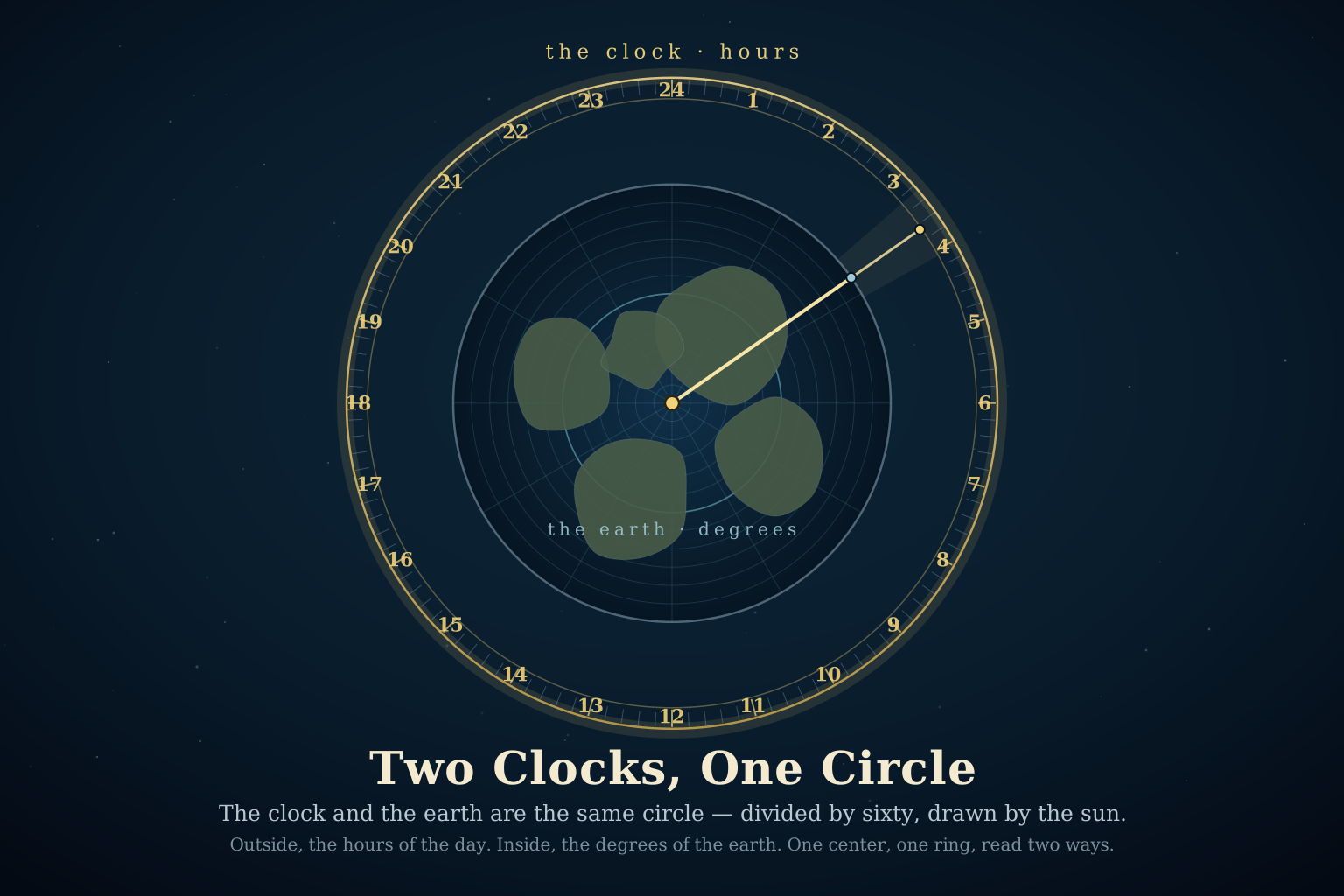
Outer ring: a clock. Inner disk: the earth.
One line. One end is an hour. The other is a place.
Same circle.
Try them yourself — Two little tools go with this. One reads the sun and draws the map: From the Circle to the Sphere. One reads a clock and finds a place on the earth: The Dial Triangle. Open them in two tabs while you read.
The simple idea
Look at a clock. Now look at a map of the world with lines on it. They seem like two completely different things — one tells you the time, the other tells you where places are.
They’re not different things. They’re the same circle, used two ways. And the thing that ties them together is the sun.
That’s the whole post. The rest is just showing you why it’s true.
Where a clock comes from
Before clocks, people told time by the sun. It comes up, it climbs, it’s highest at noon, it goes down. Day after day, the same trip across the sky.
A clock is just that trip, written down. Noon on the clock means the sun is at its highest point. The hours are the sun’s journey chopped into equal pieces. That’s all a clock is: a little record of where the sun is, so you don’t have to go outside and look.
So when you glance at your watch, you’re really reading the sun. Somebody already looked at the sun for you, and the clock remembers the answer.
Where a map comes from
The lines on a world map come from the sun too.
The sun rises in the east and sets in the west, every single day. That gives you two directions you can always count on. The stars wheel around a fixed point at night, and that gives you north and south. Once you have those directions, you can start drawing a grid on the world — and that grid is what lets you say exactly where any place is.
People spent thousands of years building that grid, measuring the sun and the seasons to get the numbers right. The result is the latitude and longitude on every map, and the coordinates inside every phone and GPS today. All of it traces back to watching the sun.
Here’s the surprise
A clock is a circle, divided up. A map of the world is a circle, divided up. And they’re divided up the same way, because both were measuring the same thing: the sun going around.
So a clock face and a world map aren’t cousins. They’re the same picture wearing two outfits. The hours on your watch and the longitude lines on a map are the very same slices of the very same circle.
A clock tells you the sun’s position in time. A map tells you the sun’s position in space. But it’s one circle, and the sun draws it.
That’s why the picture at the top works. The outer ring is a clock; the inner disk is the earth; they share one center. And a single line from the middle points to an hour on the clock and a place on the earth at the same time — because the hour and the place were never two separate things.
The two little tools
This is where the two apps come in. They both connect the sun to the earth, but they start from opposite ends.
From the Circle to the Sphere starts with the sun. You watch it, measure it, and the map gets built from what you see. This is the long, careful way the ancients actually did it — and it needs tools, math, and training to pull off.
The Dial Triangle starts with a clock. You set the time, and it shows you a spot on the earth. No telescope, no measuring — just a clock face, which anybody can read.
Here’s the neat part. Because a clock is already a recording of the sun, setting the clock to the right time is pointing at the sun — just secondhand. So the second tool gets to the same place as the first one, but through something everybody already carries on their wrist. One tool does the hard sky-measuring. The other lets you skip straight to the answer, because the measuring was already done and stored in the clock.
Neither one is “cheating.” They’re the same trip, started from different ends.
What the Bible has to say about it
There’s an old line in Genesis about why the sun and stars were made in the first place:
“Let there be lights in the firmament of the heaven… and let them be for signs, and for seasons, and for days, and years.” (Genesis 1:14)
Notice it says two things at once. The lights are for days and years — that’s the counting part, the clock part, the how. But they’re also for signs and seasons — that word “seasons” means appointed times, set meetings, the why. Same sun. Two jobs. One of them just keeps time; the other points to something time was made for.
And there’s an even older line, about a circle drawn before anything else existed:
“When he prepared the heavens, I was there: when he set a compass upon the face of the depth.” (Proverbs 8:27)
A “compass” here just means a drawn circle. The point is the order of events: the circle was there first, before the dry land, before anybody measured anything. Every circle people have drawn since — the clock, the map, the one on your wrist — is just tracing a circle that was already there.
And one more, to keep it humble:
“For a thousand years in thy sight are but as yesterday when it is past, and as a watch in the night.” (Psalm 90:4)
A clock can measure the sun. But the sun isn’t where time comes from — it’s just a lamp put up to help us keep track. To the One who made it, a thousand years and a single hour are the same glance.
Why the flat picture sees this so easily
Here’s something worth sitting with. There are two ways to draw the earth: the flat round map (pole in the middle, edge all the way around) and the globe. They’re both real ways to picture the same world — you can take any spot on one and find the exact same spot on the other. Neither one is “the wrong map.” They hold the same information.
But they don’t make the same things easy to notice. And that turns out to matter a lot.
The clock trick — treat the earth like a clock face, put hands on it, find a place — is the most natural thing in the world on the flat map. Why? Because the flat map already is a clock face: a center, an edge, a full circle around. The moment you see it, treating it like a dial is the obvious first move. You could have done it the day the flat map was first drawn, thousands of years ago, with nothing but a circle and a clock. No telescopes. No measuring the seasons. No discoveries at all.
On the globe, that same idea is basically invisible. Nobody looks at a ball and thinks, “let me put clock hands on this and find the middle of a triangle.” There’s no center staring at you, no rim, no dial. The idea just doesn’t suggest itself.
And yet — here’s the strange part — once you’ve found your spot on the flat map, you can carry it straight over to the globe and it lands in a real place. It works on the globe too. The globe could always hold this idea. It just would never have handed it to you.
Both maps contain the same truth. But only the flat one puts it where a person could have found it from the very beginning — with nothing but a circle and a clock.
That’s the quiet point, and it’s worth being careful about. This is not “the flat map is right and the globe is wrong.” They’re the same world drawn two ways, and the math agrees with itself either way. The point is gentler and stranger than that: the shape you choose to draw decides what you’re able to see. Draw the earth as a globe and the clock-and-earth connection hides inside a pile of machinery. Draw it as a flat dial and a child could spot it. Same cosmos. One picture buries the seam; the other lays it open.
The other tool, From the Circle to the Sphere, is the long discovery road: centuries of watching the sun, measuring the tilt of the earth, working out the numbers, before you can place anything. The dial tool needs none of that. It was always sitting there in the flat picture, waiting, free for the taking. The discoveries didn’t make it true. They were just the expensive way to reach something the simple picture gave away for nothing.
So did somebody “solve time”?
No. But something true got shown, which is quieter and maybe better.
Most people wear the answer on their wrist every day and never notice it: that a clock and a map are the same circle, and the sun draws both. The little dial tool just makes that visible — it takes the most ordinary thing in the world, a clock, and lands it right back on the real earth, so you can see the hour and the place were always one and the same.
And the timing is a nice wink. There’s an old feast called Shavuot that isn’t set by a date on a calendar — you find it by counting, day by day, in step with the sun. It’s the holiday that’s literally built out of counted, sun-measured time. On the old sun-based (Zadok) calendar, the day this little tool was finished landed exactly on that feast. Not proof of anything cosmic — just the kind of rhyme that makes you smile: a toy about counted time, finished on the day of counted time.
And there’s a next step hiding in it. Right now the dial tool just keeps time — the plain, mechanical part. The richer version would mark the meetings: a dial where the numbers aren’t 1 through 12, but the appointed days; where the top of the clock is the moment light and dark are equal. Same circle. But pointed at why instead of just when. That one’s still to build.
Go play with it
Open the two tools side by side. One looks at the sun and draws the map. One reads the clock and finds the place. In the middle is one circle — and the sun, still drawing it.
- From the Circle to the Sphere — the long way: watch the sun, build the map.
- The Dial Triangle — the shortcut: read the clock, find the place.