Chapter 13

The Book that Breaks the Binary

It wasn't the book,
it wasn't the words,
it wasn't a person,
not something I heard.
It wasn't a pretense
or an aesthetic desire.
It wasn't to be great,
to be accepted, or aspire.
It wasn't for wealth,
it wasn't for pride,
it wasn't because
I had it inside.
It wasn't a place
to run from disgrace.
It wasn't to build
some holy facade,
or to live in the safety
of the assemblies of God.
It was because I was broken,
the fall of my life,
forever unspoken
how He came inside.
It was because in His grace
He has made Himself known,
that this servant now bows
at His glorious throne.

Broken Logic Yeshua did not describe hell in philosophical terms or judicial abstractions. He described it with sound. With embodiment. With raw

contradiction. “There will be weeping and gnashing of teeth.” This is poetic flourish and it is prophecy about what happens when the soul becomes sealed in duality. The hellish weeping is the collapse of identity into victimhood. It is sorrow detached from repentance, grief without trust. It is the cry of the one who cannot accept mercy because he has measured himself unworthy of it. His tears are many, but they are sterile. They do not water resurrection. They rot the seed in regret. Gnashing of teeth is the clenched defiance of the bitter. It is the hardened soul who will not bow. It is the rebel who sees the gates of the Kingdom swing open for others and responds not with longing, but with envy and attempts at shutting the door of the Kingdom in people faces. The jaw tightens as the eyes burn with real envy, the kind that accuses because it excepts others to be as decrepit as itself. Not with hunger for righteousness, but with fury at grace. It is the scream of the one who believes he should be god or that none should be. Unwilling to submit to the Head of Yeshua. These two though opposite in tone are joined at the root. Both are fruit of the Tree of Knowledge. Both are binary loops sealed from within. One collapses. One clenches. But neither can lift its eyes. Neither can breathe the Breath. Neither can yield to the Third outcome which is the headship of Yeshua. For those who reject the divine resolution, the place where judgment and mercy meet, and where faith pierces through logic only this cycle remains. From weeping to gnashing. One swings from self-loathing to self-righteousness. The other swings from accusation to despair. This is hell and it is not just a place, but a spiritual geometry in which no axis of faith exists. A flat world. A closed loop. A cry that echoes but never ascends. But even this serves a purpose. The outer darkness reveals the nature of the inner war. And it sets the stage for what must come next.

Being Broken and Born Again And so, we return to the beginning and not to escape the tension, but to trace its source. In the beginning, Elohim divided, and it was good. Yet not all

division is violence. Not all separation is judgment. For His dividing was not the blade of wrath, but the chisel of design. He did not part light from darkness with disdain, but with delight with each boundary a border for beauty, each contrast a canvas for covenant. He separated sea from sky, evening from morning, and called it good not because it ended unity, but because it formed a womb for fruitfulness in unity of creation, a poetic march towards the crescendo. But when He planted the garden eastward in Eden, He placed not one choice in its center, but two. And from that sacred center, a paradox was born. A choice not merely of obedience, but of ontology. One choice offered the power to know, the other, the power to continue in life with YHWH. One choice invited man to divide, to measure, to name. The other invited him to abide, to receive, to dwell. One granted the illusion of mastery. The other offered the mystery of life. The Tree of the Knowledge of Good and Evil stood as the axis of contrast—an epistemological lever requiring tension to define itself. Good is not good unless evil shadows it. Righteousness cannot be known unless sin is present. The garden isn’t a garden unless it has a boundary to transgress. It is logic born of division, binary in nature: yes and no, right and wrong, clean and unclean. And yet, even in its stark delineation, the tree was not evil in itself. It was placed by the same Elohim who spoke light into being. It was lawful, but not lifegiving. It was true, but not sustaining. It revealed, but could not redeem. The Tree of Life, by contrast, did not argue. It abided. It offered no comparisons, no syllogisms, no unfolding logic charts. The tree of life was presence, it was YHWH. It pulsed outward in glory with the rhythm of the Breath that hovered over the deep. Its fruit was not earned, but given. It did not need to be justified, because it was of Him who is both the just and justifier. This was the difference from the first: one tree granted man the power to define in self-perceived terms; the other invited him to dwell and learn in transcendent terms. In the first, he measured. In the second, he multiplied. In one, he judged between. In the other, he became one in His headship.

But the moment the man reached for the fruit that divides, he ruptured something that words cannot sew. For to know good and evil apart from the Giver is to unseat faith with judgment, and covenant with criticism. And so the spiral began into a fall into sin. A collapse of logic into paradox. For now, man would live by what he could measure, but he would long for what could not be weighed. He would be caught between two lights: one from the sun above him, and one from the Spirit within him. The first would guide his days; the second would beckon him home as it called him back into orbit. The story of Abraham is the first great fracture in that logical path. For Abraham was given a promise that through Isaac a nation would arise, stars would gain names, dust would find destiny. And then, with the voice that cannot lie, Elohim said: “Take now your son, your only son, whom you love… and offer him as a burnt offering.”Here, the covenant meets the cleaver. If the man obeys, the promise is extinguished. If he disobeys, the command is void. No binary can resolve this. No chart can make sense of it. This is the divine absurdity, the paradox at the altar, the test of faith as it has been called. But Abraham rises early. He does not argue or delay. He believes that the Giver is not bound by the logic of the gift and that even if Isaac is consumed, the promise will rise. And the Word affirms it: “He considered that God was able even to raise him from the dead.” Herein lies the seed of resurrection: not as a reaction, but as a premonition embedded in faith. The covenant does not collapse. It ascends in trust in the nature of Elohim. This is the pattern of faith. It is the breath that enters where the binary chokes. It is the voice that speaks when the diagram breaks. And it appears again in the life of Job, who is declared righteous twice, once by the narrator, and once by the mouth of YHWH Himself. And yet Job suffers more than any man should. His wealth is stripped and his children silenced as his body is shattered. His friends, wise by the tree of contrasting knowledge, accuse him. “Surely you have sinned, ” they say. “The righteous are blessed. You are cursed. Therefore, you are unrighteous.” But the logic fails. Job has done no evil and still, he is undone. The syllogism crumbles. And what does God give him? Not an answer. A mighty whirlwind. Not a reason. A voice of affirmation. And Job, the man who refused to lie to defend God’s justice, now says: “I had heard of You by the hearing of the ear, but now my eye sees You.” He does not receive explanation. He receives presence.

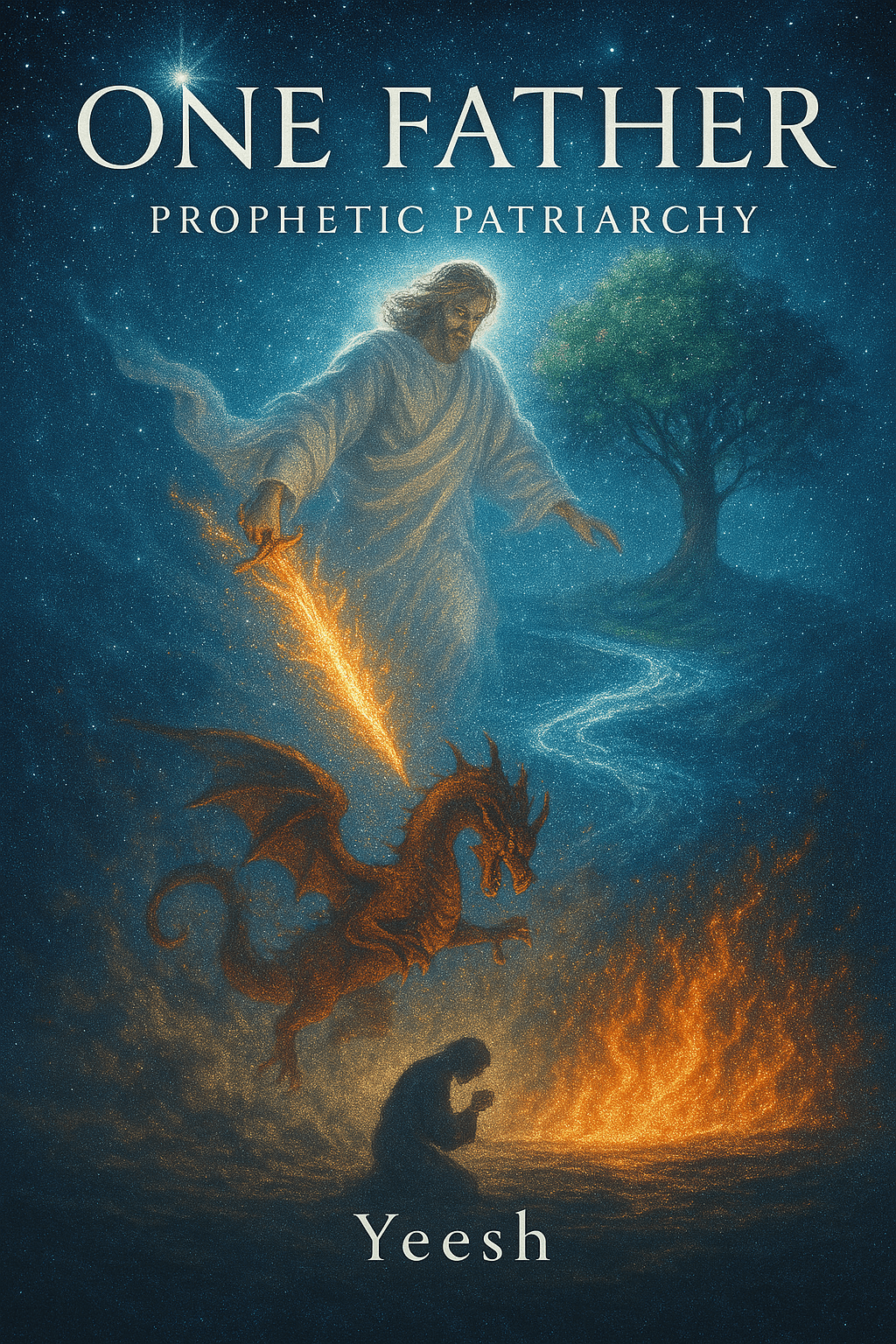
He is not vindicated by proof, but by the encounter. And in that, the paradox resolves and not by reversal, but by revelation. The same God who allowed the fracture now fills it with Himself. This is the axis upon which all true knowing must pivot. The mind of man cries for clean lines and closed loops. It demands a world that can be solved. But the Spirit invites a world that can be walked with. the Spirit that hovered at creation now hovers in the cleft between command and contradiction, between promise and pain. And when the binary fails, the Spirit remains. So the question arises of which tree governs our thinking? Which tree informs our systems, our theology, our relationships? Do we live by what we can explain, or by the One whom we can trust in Spirit and Word? For every attempt to return to Eden without the Tree of Life becomes another layer of logic and just another fig leaf. But the flaming sword does not guard against man. It guards against re-entry by the path of the mind and flesh alone. Only the Spiritual may pass through. The option isn’t in the binary framework choice, its in faith in the Word and Spirit. Then there comes a point in every sacred story where the law reaches its limit. It fulfills the very purpose for which it was given: to expose the boundary of the flesh, the boundary of reason, the edge where dust meets breath. At that edge, the Spirit waits to lift the heart beyond its measurement. This is the moment when the system breaks, and the Spirit speaks. It is not an error when logic collapses and thus an invitation. The Word, when it first descended, separated light from darkness. But that same Word returns, clothed in glory, not to separate but to gather, cloth, and feed others Himself. The same fire that divided tongues at babel now knits them into a new language of Spirit at pentecost. The same Voice that once declared boundaries now cries“Come unto Me, all who labor…” It is not a reversal, but a transfiguration. What was once external becomes internal. What was written on stone is now breathed into flesh. the Spirit does not erase the line but it writes it deeper, into the marrow. The new covenant is coming to pass, a fruitful seed, is becoming a tree in imminent bloom. Consider Moses, whose longing was not merely to lead but to behold. He had seen fire in the bush, thunder on Sinai, manna in the wilderness. But he

wanted something more than wonders. He wanted to see the Face. Yet when he asks, YHWH responds with a contradiction. “You cannot see My face and live, ” and then immediately, “I will make all My goodness pass before you.” This is the divine tension as to see God is death, yet to live without seeing Him is no life at all. Moses is placed in the cleft of the rock - a symbolic wound in the mountain - and covered by the very hand of the One he longs to behold. He sees not the face, but the passing glory. Not the fullness, but the afterglow. And in that partial glimpse, something eternal is planted in him. The veil that once shielded becomes the veil he later wears, his face glowing with a reflection he could not explain. Logic would have required death or denial. But the Spirit hides him and reveals Him all at once. That is faith and is not contradiction ignored, but contradiction held and holy. This cleft logic reappears in Solomon who was the wisest of men, the inheritor of David’s covenant, the builder of the Temple. His words drip with insight. His proverbs shape generations. Yet at the end of his days, as he gathers his words in the book of Ecclesiastes, his wisdom folds in upon itself. “All is vanity, ” he says. “The more knowledge, the more sorrow.” Here, the Tree of Knowledge bears its bitter fruit. All its paths end in death. All striving in its fruit leads to decays. There is no gain under the sun. And what is his conclusion? Not more analysis. Not more theory. But a return to awe: “Fear God and keep His commandments.” - not the least of which is that fruitful multiplication and replenishment and leads to dominion. Not because it solves the riddle, but because it plants you in something deeper than reason. Reverence becomes the only stable ground in a world too heavy with questions. Faith does not silence the mind but it anchors it, and we all must have an object of faith. So have Faith in Yeshua, who is demonstrably pre imminent in all things. In each of these, the pattern emerges again:

● The law points forward, but cannot carry across.
● Logic opens the path, but not the gate.
● Knowledge builds the altar, but only fire from heaven consumes the
sacrifice.

This pattern reaches its clearest echo in the agony of Gethsemane, where the Word made flesh begins to sweat blood. Here is Yeshua as the Living Word, the embodiment and atonement of the broken loop of sin. He who is Life itself prepares to die a sinners death. He who is sinless prepares to become sin. He who is Son cries out to the Father, “If it be possible, let this cup pass from Me.” Here, binary breaks: if the cup passes, man is not redeemed. If He drinks, the spotless becomes the cursed. Either path defies what came before. But He adds: “Nevertheless, not My will but Yours be done.” The paradox is not resolved—it is submitted. The prayer is not answered with escape, but with resurrection. And again, the Voice speaks—not with explanation, but presence. “This is My Son.” And on the third day, the grave folds like a linen cloth. The logic is not discarded as it is fulfilled by going through death, not around it. On the seventh day the loop will be completed in the Kingdom fully come. So many seek to build their houses upon proof. They craft doctrines like equations, lay foundations of syllogism and systematics. But when the storm comes as it always does those houses fall. Why? Because they were founded on the sand of understanding, not the rock of faith. And the Rock is not a concept. The Rock is a person and that person is Yeshua. For the Spirit will not conform to the mind of man. He dances where He pleases. He blows where He wills. And yet, He speaks only what He hears from the Father. In this is the paradox of divine logic: absolute obedience in absolute freedom. the Spirit is the breath of ordered covenant. But His order is not ours. He teaches in dreams, speaks through donkeys, writes on walls, hides glory in jars of clay, and shatters the proud with the cry of a newborn in a feeding trough. This is why every man who encounters God deeply must first be broken. For the mind cannot contain Him. He appears in burning bushes that are not consumed, speaks from mountains wrapped in smoke, and wrestles in the night until the hip is undone. He comes not to affirm our understanding, but to consume it with glory. And in that fire, we are not destroyed we are remade.

What emerges from these moments is not a better theory, but a deeper walk. Moses does not return from the cleft with new theology as he returns glowing. Job does not explain God but he repents in dust and ashes. Solomon does not resolve the vanity but he does bow in reverence. And Yeshua, crowned with thorns, mocked by kings, forsaken by friends, rises with a glorified body and still bears the scars. This is the way of the Spirit. The breath that enters when the words run out. The oil that flows when the vessel is empty. The fire that falls not on understanding, but on obedience. And it is here, in the collapse of logic, that the covenant shines most clear not as a system to be parsed, but as a life to be lived.

The Axis of Rotation to Reconstitution in Resurrection Yeshua is not an answer. He is the axis itself. The fulfillment of the Law, the breath of the Spirit, the embodiment of salvation unto those whom believe in faith. He does not explain away the paradox. He inhabits it. He becomes the contradiction in order to collapse it into life. The humble Lamb is slain and stands as a righteous and proud Lion. The Shepherd is struck, but gathers the sheep and returns as a King to striker. The Judge is condemned by man and justifies by faith in the punishment of His false condemnation. What no system could resolve, He becomes. He is the single solution to our systematic error. He is the glorious head to our broken body. Even now, those that hate him see Him and His Word as the error, devoid of Spirit they mock the offering of Salvation in Yeshua at the point between a broken Earth and a coming Kingdom of Heaven. At the Cross, the horizontal beam where the logic of man, the judgments of earth, the reach of Adam’s mind all intersects with the vertical. Heaven’s will, eternal decree, the downward voice that spoke before time began is revealed. The place of intersection is not tidy. It is blood-soaked. It is where sin and innocence meet, where wrath and mercy kiss, where dust is raised and breath is given again. For the Cross is both: judgment and grace, justice and intimacy, the splitting and the healing. And it is planted not in a garden, but on a hill outside the city gate to rejected by men, accepted by Heaven, to point the way back to the garden, to invite those that would to partake of the tree of Life.

He who knew no sin was made to be sin. The incorruptible became corruption. The eternal entered time. The Word that was in the beginning became a cry of forsakenness. And yet, in that very cry of “My Adonai, My Adonai, why have You forsaken Me?” He pulls every broken logic into Himself. He speaks not doubt, but scripture. Not confusion, but fulfillment. He recites David’s psalm from the center of its pain and rewrites its ending with His resurrection. What began as a question ends as a crown. This is the Z-axis of reality as the unseen axis that makes the other two hold. Law stretches left and right. Spirit moves up and down. But Faith pierces through and transcends levels. It does not run alongside; it runs through. It does not counterbalance and instead it transforms. Yeshua is the One who holds both judgment and mercy in perfect unity and he does this not by compromise, but by consummation. Here, then, is the revealed logic of scripture as not two-dimensional, but living. Not flattened into systems, but lifted into song resonance every direction. For the Word of God is not bound in itself, it binds reality in Spirit and Yeshua. It breathes. It weeps. It walks. It is sharpened and shaping, cutting soul from spirit, bone from marrow. It does not divide for division’s sake, but to heal with precision. And He, the Word, walks among the lampstands, holding the congregations in His hand, speaking to each in voice and in Spirit, cutting with truth and anointing with oil. And we, sons of Adam, daughters of Eve, are invited not to understand Him alone but to follow Him as well. Not to solve Him but to be formed by Him. The tri-axial frame reveals the shape of the Cross and the breath of Pentecost. It is the living pattern for all covenant life. The Law—the structure, the justice, the clarity. the Spirit—the movement, the fruit, the indwelling. Faith—the axis unseen, the piercing trust, the living connection. The Law teaches the fear of God. the Spirit teaches the intimacy of God. But only faith teaches the willingness to die before seeing the end, to walk when there is no path, to plant when there is no rain. This is why Abraham is called the father of faith, though the Law came centuries later. He walked by faith before it was revealed, and in so doing, saw the day of Messiah and

rejoiced. He saw the seed, and he knew that all logic would one day collapse into the arms of the One who upholds it. The prophets spoke in riddles because riddles are the language of resurrection. They saw the wheels within wheels, the throne above the firmament, the man among the coals of fire. They saw a Branch that would be both priest and king. A stone with seven eyes. A child born who would be called Everlasting Father. These are not contradictions to be resolved. They are mysteries to be received. This is why, even now, every system built without Faith will fracture. Every theology that does not kneel before paradox will become brittle. Every heart that insists on understanding before trusting will remain outside the veil. The way back to the garden is not paved with certainty. It is guarded by a flaming sword. And that sword turns in every direction until it finds flesh that will not resist. And when it does, the way opens. Not to knowledge but to life and life abundant. Yeshua is the pattern. the Spirit is the guide. The Father is the source. And the Word that hung on the Cross is the same Word that said, “Let there be light.” The same Voice that spoke to Moses from the bush speaks still, not to explain, but to send. Not to solve, but to sanctify. Not to offer a system, but to call a people. This, then, is the logic of heaven: to become poor and inherit all things. To die and be raised. To descend and be lifted up. To be last and be greatest. To love enemies. To bless those who curse. To believe in what cannot be seen, and by doing so, to become what cannot be shaken. For in Messiah, all paradox collapses into Person. And every contradiction bows to covenant. And every tongue will confess because they finally understood and they finally saw Him in all things as he is. And in seeing, they lived.