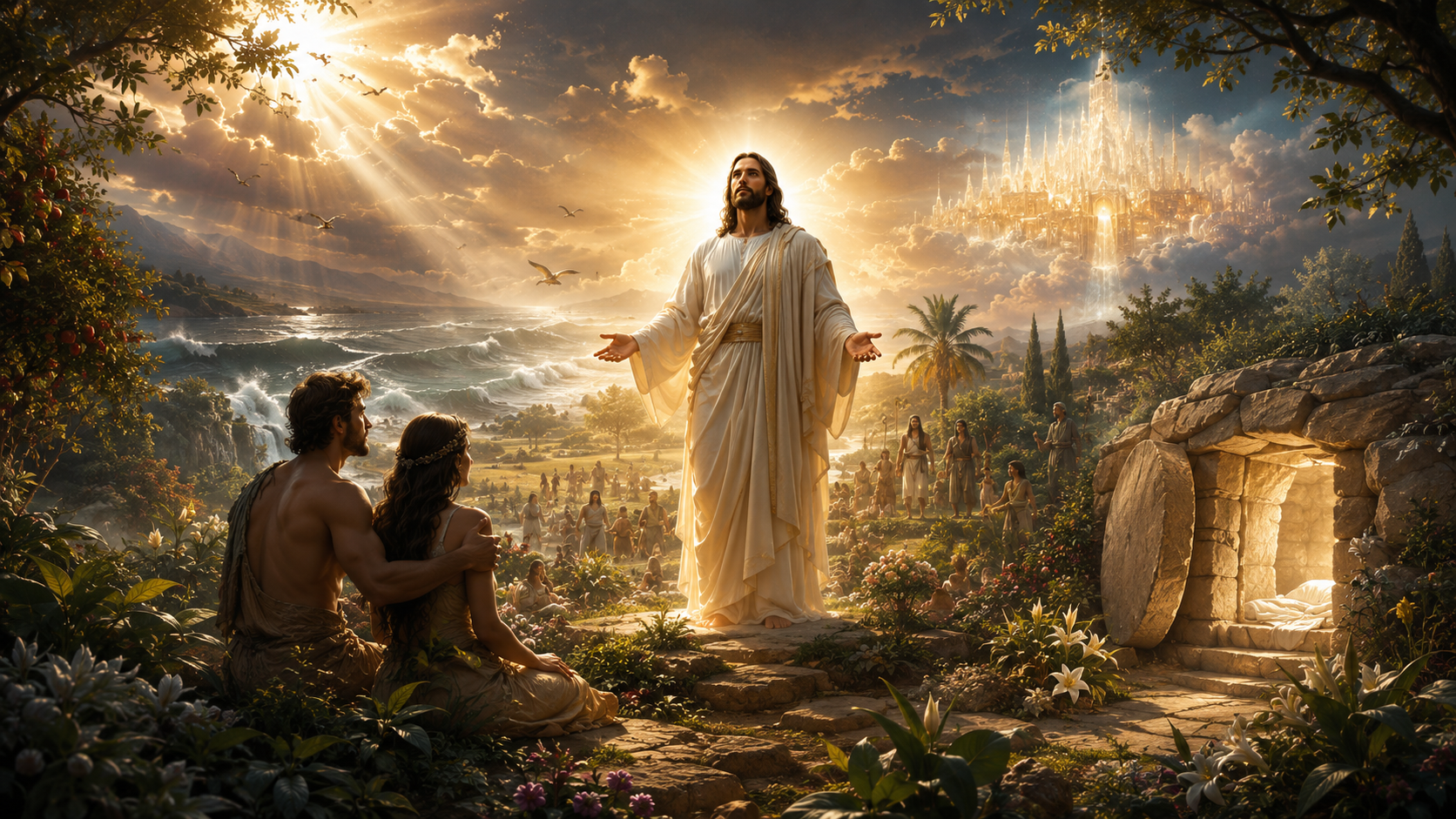
Introduction
One of the central problems in modern biblical interpretation is fragmentation.
Creation is often studied as one doctrine, marriage as another, Torah as another, resurrection as another, and the Kingdom as still another. Even when these doctrines are affirmed individually, they are often held apart from one another as separate theological categories.
The result is a reading of Scripture that may preserve many true statements while missing the deeper unity that binds them together.
My contention is that Scripture presents something more integrated. The Bible does not merely offer isolated doctrines. It reveals a unified architecture of creation and restoration. From Genesis onward, the themes of land, seed, headship, body, covenant, household, judgment, resurrection, and Kingdom develop together. They are not loosely related motifs. They are structurally connected.
In this framework, Yeshua is not simply the solution to sin in a narrow forensic sense. He is the faithful Head through whom the entire created order is restored. He fulfills Adam, restores sonship, redeems the Bride, gathers the nations, reestablishes covenant order, and brings the Kingdom of the Father into fullness.
Yeshua did not come merely to save isolated individuals from death. He came as the faithful Head to restore the architecture of creation itself.
This restoration includes the Father’s house, the Son’s inheritance, the covenantal ordering of head and body, the redemption of the Bride, the resurrection of the dead, and the final establishment of the Kingdom.
Creation as Ordered Architecture
Genesis begins not with human need, but with divine ordering. The earth is without form and void, darkness is over the face of the deep, and the Spirit of God hovers over the waters. Into this condition, God speaks.
“And God said, Let there be light: and there was light.”
Genesis 1:3
The first movement of creation is not merely production, but ordering. Light is distinguished from darkness. Waters above are separated from waters below. Dry land appears. Vegetation is appointed to bear seed according to its kind. Living creatures are ordered by domain. Humanity is formed in relation to dominion, fruitfulness, and image-bearing.
This means creation is not presented as raw material alone. It is presented as structured reality. God builds by distinction, placement, naming, and purpose.
The appearance of dry land on the third day is especially significant. The waters are gathered, the earth appears, and seed-bearing life is introduced. This is the first major movement from hiddenness to visible stability. It is also the first day in which the creation narrative gives a double declaration of goodness. The land appears, and the land becomes fruitful.
This pattern becomes foundational. Land is not merely geography. It is the stable place where life may be rooted. Seed is not merely biological reproduction. It is the principle of continuity, inheritance, and future fruit. The third day therefore becomes a creation-pattern of emergence, planting, and eventual resurrection.
This is why the resurrection of Yeshua on the third day should not be treated as an arbitrary timing detail. The third day had already been marked in creation as the day when life emerges from the ground and seed-bearing fruitfulness begins.
Yeshua Himself interprets His death through seed imagery:
“Except a corn of wheat fall into the ground and die, it abideth alone: but if it die, it bringeth forth much fruit.”
John 12:24
The resurrection is therefore not detached from creation. It fulfills creation’s own pattern. The Last Adam rises from the earth in the same symbolic field in which the first Adam was formed from the ground. In both cases, the ground is central. In both cases, life emerges where death or hiddenness might have been expected. In both cases, the result is fruitfulness.
Adam, Headship, and the Burden of Representation
The creation of Adam is not merely the creation of an individual. It is the establishment of representative headship.
In Genesis 2, Adam is formed from the dust of the ground and placed in the garden to work it and guard it. His vocation is priestly and kingly. He is not created as an isolated male, but as a covenantal head entrusted with order, cultivation, naming, and obedience.
This representative role becomes especially clear after the fall. Eve eats first, yet God calls Adam first:
“And the LORD God called unto Adam, and said unto him, Where art thou?”
Genesis 3:9
This detail is not incidental. It reveals the logic of headship. The head is the one who answers. The head bears responsibility for the body entrusted to him.
Paul confirms this structure in Romans:
“Wherefore, as by one man sin entered into the world, and death by sin...”
Romans 5:12
Although Eve was deceived first, Scripture places the representative burden of the fall on Adam. This is not because Eve’s transgression was irrelevant, but because Adam stood as covenantal head. His failure was not merely personal. It was federal. It affected those joined to him and those who would descend from him.
This is essential for understanding biblical headship. Headship is not first a privilege of power. It is a burden of accountability. The head answers. The head represents. The head bears consequences.
This also explains why Yeshua must come as the Last Adam. If death entered through the failure of one covenantal head, restoration must come through the obedience of another.
“For as by one man's disobedience many were made sinners, so by the obedience of one shall many be made righteous.”
Romans 5:19
The gospel is therefore not only the forgiveness of individuals. It is the replacement of a failed head with a faithful Head. Yeshua succeeds where Adam failed. He obeys where Adam rebelled. He remains watchful in the garden where Adam failed to guard. He submits His will to the Father where Adam grasped after forbidden wisdom.
This is why Christology and headship cannot be separated. Yeshua restores humanity by becoming the true Head of a redeemed body.
Woman, Body, and the Completion of the Image
The formation of the woman also belongs to this architecture. She is not created as an unrelated second humanity, but is built from Adam’s side. This establishes the head-body pattern that later becomes central to Paul’s theology of marriage and Christ.
Adam is formed first. The woman is then built from him and brought to him. Together they constitute the male-and-female fullness of humanity.
This sequence matters because Scripture repeatedly treats woman as glory, body, and relational completion. She is not an afterthought, nor is she an autonomous parallel creation detached from Adam. She is taken from him, brought to him, named in relation to him, and joined to him in one flesh.
Paul later interprets this mystery through Christ and the Church:
“For the husband is the head of the wife, even as Christ is the head of the church...”
Ephesians 5:23
“This is a great mystery: but I speak concerning Christ and the church.”
Ephesians 5:32
Marriage is therefore not merely a social institution. It is a prophetic structure. The union of man and woman reveals something about head and body, Christ and Church, source and glory, covenant and fruitfulness.
This is why modern attempts to reduce marriage to romance, mutual affection, or legal partnership cannot carry the full biblical weight. Romance may accompany covenant, but it cannot define it. The biblical category is heavier. Marriage is covenantal, representative, fruitful, and typological.
When marriage is distorted, more is at stake than private happiness. The sign itself is obscured.
Covenant as the Structure of Faithful Reality
Covenant is one of the central load-bearing concepts in Scripture. It governs God’s dealings with individuals, households, Israel, the nations, and ultimately creation itself.
Modern readers often treat covenant as a religious version of contract. This is too thin. Covenant is not merely an agreement between parties. It is a binding relational order witnessed by God, carrying obligations, blessings, sanctions, inheritance, and identity.
This is why Malachi speaks of marriage in covenantal terms:
“Yet is she thy companion, and the wife of thy covenant.”
Malachi 2:14
Marriage is not grounded merely in affection. It is grounded in covenant. Likewise, Israel’s relationship to YHWH is repeatedly described in marital and covenantal language. Idolatry is adultery because covenant is not merely legal. It is relational allegiance.
This provides the deeper logic behind biblical prohibitions concerning adultery, divorce, defilement, and return. These are not arbitrary purity concerns. They concern the integrity of covenantal structure. A field, a house, a body, and a bride cannot be treated as if they belong equally to multiple heads without introducing disorder.
This also clarifies why Scripture treats unfaithfulness so severely. Covenant treachery is not merely emotional betrayal. It is structural rebellion. It attacks the house.
At the same time, Scripture’s story is not simply that covenant can be broken. It is that God Himself provides the lawful means of restoration. This is where the death and resurrection of Yeshua become central.
The Death of the Husband and the Lawful Restoration of the Bride
One of the most profound biblical mysteries is that Yeshua’s death does not bypass the law. It fulfills the law in order to accomplish lawful restoration.
Israel is repeatedly described as an unfaithful wife. The prophets accuse her of adultery, harlotry, and covenant treachery. Under Torah, the problem is severe: a defiled wife cannot simply return as though nothing happened. The law exposes the reality of covenant breach.
Yet Paul provides the legal and theological key in Romans 7:
“The woman which hath an husband is bound by the law to her husband so long as he liveth...”
Romans 7:2
And then:
“Wherefore, my brethren, ye also are become dead to the law by the body of Christ...”
Romans 7:4
The death of Christ is not only substitutionary atonement. It is covenantal release and lawful transition. The Husband dies. The old claim is fulfilled. The Bride may now belong to the risen Christ without the law being mocked or ignored.
This is astonishing.
God does not restore His Bride by pretending the covenant was never violated. He restores her through death and resurrection. The law is honored. Judgment is satisfied. The Bride is cleansed. The household is rebuilt under a resurrected Head.
This is why grace must not be framed as lawlessness. Grace is not God ignoring His own order. Grace is God fulfilling His own order in Yeshua so that restoration can happen truthfully.
Torah as Boundary, Wisdom, and Restoration
Within this framework, Torah should not be treated as an embarrassment to Christian theology. Torah reveals the ordered wisdom of God. It defines boundaries. It protects inheritance. It guards households. It distinguishes clean from unclean, holy from common, lawful from unlawful.
Torah is not the fullness of restoration by itself, but it gives the categories by which restoration can be understood.
Without Torah, sin becomes vague. Covenant becomes sentimental. Marriage becomes subjective. Judgment becomes arbitrary. Grace becomes permissiveness. The cross becomes detached from the legal and covenantal realities it fulfills.
Yeshua did not come to destroy the law or the prophets:
“Think not that I am come to destroy the law, or the prophets: I am not come to destroy, but to fulfil.”
Matthew 5:17
Fulfillment does not mean the law was false. It means the law reaches its intended goal in Him.
The sacrifices point to His blood.
The priesthood points to His mediation.
The kingship points to His reign.
The purity laws point to His holiness.
The marriage laws point to covenant faithfulness.
The inheritance laws point to the Kingdom.
The Sabbath points to final rest.
Torah is therefore part of the architecture. It is not the house in its completed form, but it reveals the measurements, boundaries, and holy logic by which the house is built.
Judgment as the Exposure of False Order
Judgment in Scripture is not merely punitive. It is revelatory. Judgment exposes what has been falsely built.
False heads are exposed.
False covenants are exposed.
False worship is exposed.
False unity is exposed.
False peace is exposed.
False houses collapse.
This is why biblical judgment often falls on heads: fathers, kings, priests, shepherds, husbands, and rulers. Those entrusted with representation bear greater accountability.
The fall itself establishes this pattern. Adam is called first. Later, Israel’s kings bring consequences upon the nation. Priests corrupt worship and the people suffer. Shepherds devour the flock and are judged. Achan’s sin affects his household. David’s sin affects his house. Manasseh’s sins affect Judah.
The pattern is consistent: headship carries consequence.
This is sobering, but it is also necessary. A house cannot be restored unless false structures are exposed. Judgment clears the ground for restoration. It removes the illusion that rebellion can produce life.
This is also why final judgment is not disconnected from the Kingdom. Judgment distinguishes what can inherit from what cannot. It separates the living from the dead, the faithful from the rebellious, the true house from the counterfeit.
Resurrection and the Kingdom
The resurrection of Yeshua is the decisive turning point in the architecture of restoration.
It is not merely proof of life after death. It is the enthronement of the faithful Head over a restored creation.
After His resurrection, Yeshua declares:
“All power is given unto me in heaven and in earth.”
Matthew 28:18
This statement is cosmic in scope. Heaven and earth are brought under His authority. The Last Adam receives the dominion that the first Adam failed to exercise righteously.
This means resurrection is inseparable from Kingdom. The risen Christ is not merely alive. He reigns.
Paul makes this explicit:
“For he must reign, till he hath put all enemies under his feet.”
1 Corinthians 15:25
The resurrection begins the restoration of the created order under its rightful Head. Death itself must be defeated. The saints must be raised. The Kingdom must be inherited. The earth must be renewed. The Father’s house must be filled.
This is why the hope of Scripture is not an abstract heaven detached from creation. The meek inherit the earth. The kingdoms of this world become the Kingdom of our Lord and of His Christ. New Jerusalem descends. The dwelling of God is with man.
The end of the story is not escape from the house.
It is the restoration of the house.
The Father’s House and the Restoration of Sonship
At the center of this architecture is Fatherhood.
Not fatherhood as sentiment.
Not fatherhood as mere biology.
Not fatherhood as male ego.
Fatherhood as source, covering, discipline, inheritance, instruction, name, house, and blessing.
The biblical story begins with God as Creator, but it moves toward the revelation of God as Father. Yeshua does not merely reveal divine power. He reveals the Father.
“He that hath seen me hath seen the Father.”
John 14:9
Through Yeshua, believers receive the Spirit of adoption:
“Ye have received the Spirit of adoption, whereby we cry, Abba, Father.”
Romans 8:15
This is not merely language of intimacy. It is language of identity, inheritance, and household restoration. Sons receive inheritance. Sons bear the name. Sons are disciplined. Sons are conformed to the image of the Firstborn Son.
The restoration of sonship is therefore central to the restoration of creation. Fatherless humanity is brought back into the Father’s house through the obedient Son.
This has implications for earthly fatherhood as well. Human fatherhood is not ultimate, but it is not meaningless. It is a created witness. Fathers are called to image, however imperfectly, the responsibility, instruction, provision, discipline, and blessing that flow from the Father.
When fatherhood collapses, households collapse. When households collapse, cultures fracture. When cultures fracture, covenant becomes unintelligible.
This is why the restoration of fatherhood is not peripheral. It belongs to the same architecture as covenant, inheritance, and Kingdom.
The Bride, the Body, and Ordered Plurality
The final biblical image of restoration is not an isolated individual. It is a Bride, a city, and a people.
John is told:
“Come hither, I will shew thee the bride, the Lamb's wife.”
Revelation 21:9
What he sees is New Jerusalem.
This is deeply significant. The Bride is one, yet composed of many. She is singular and plural. Personal and corporate. Feminine and architectural. Relational and civic.
This reflects a broader biblical pattern: unity does not require numerical singularity. Biblical unity is not always the same kind of oneness. Scripture uses oneness in distinct categories, and confusing those categories creates theological fog.
The oneness of God is not the same kind of oneness as the one body. The oneness of the body is not the same kind of oneness as the one Head. The Father, Son, and Spirit must not be flattened into the same type of composite unity as the Church. Likewise, the many-membered body must not be treated as if its oneness is numerical simplicity.
The body is one precisely because it has many members ordered under one Head.
“For as the body is one, and hath many members... so also is Christ.”
1 Corinthians 12:12
The Bride is one insofar as she is covenantally gathered, purified, and presented, yet she may also be described corporately as a city, a people, and an assembly.
Biblical unity is therefore not the erasure of plurality. It is the righteous ordering of plurality under faithful headship.
This matters because modern thought often confuses unity with sameness. Scripture does not. In Scripture, true unity is not the denial of distinction. It is the proper ordering of distinction under a faithful head.
This is why the Church can be many and one. This is why the body can have many members and one Head. This is why a city can be called the Bride. This is why “one flesh” must be understood as covenantal union rather than simplistic numerical reduction.
The mystery of Christ and the Church is not the abolition of plurality. It is the sanctification of plurality under one righteous Head.
The House Was Scattered, and Yeshua Restores the House
The burden of this framework is that Scripture is far more unified than modern readers often assume.
Genesis is not merely the beginning of the world. It is the beginning of the pattern.
The third day is not merely a day of vegetation. It is the seed-form of resurrection.
Adam is not merely the first man. He is the failed head whose office must be fulfilled by the Last Adam.
Woman is not merely a companion. She is body, glory, and the prophetic sign of the Bride.
Marriage is not merely romance. It is covenant.
Torah is not merely law. It is divine architecture.
Judgment is not merely punishment. It is the exposure of false order.
Resurrection is not merely survival after death. It is the beginning of restored creation.
The Kingdom is not merely an afterlife hope. It is the inheritance of the restored house.
Fatherhood is not merely biology. It is the created witness of source, name, instruction, covering, and inheritance.
And Yeshua is not merely one doctrine among many. He is the center in whom the whole house holds together.
“And he is before all things, and by him all things consist.”
Colossians 1:17
The conclusion, then, is not that every biblical use of “one” functions in the same way. Scripture speaks of oneness in distinct categories. There is divine oneness, representative oneness, and corporate covenantal oneness. These must be distinguished if the architecture is to remain clear.
The one Father is revealed through the faithful Son. The Son is established as Head over a redeemed body. That body is not solitary, but many-membered. The Bride is not a flattened singularity, but a covenant people and finally a city, ordered in holiness and prepared for her Husband. The Kingdom is not the erasure of plurality, but the righteous ordering of sons, households, tribes, nations, and inheritance under the reign of Yeshua.
Scripture’s unity is therefore not sameness.
It is not a denial of distinction.
It is not the collapse of many into an undifferentiated one.
It is the restoration of rightly ordered plurality under the true and faithful Head.
The Bible is not scattered.
The house is scattered.
And Yeshua restores the house.
He restores Adam by becoming the Last Adam.
He restores Israel by becoming the faithful Son.
He restores the Bride by giving Himself for her.
He restores the nations by gathering them under one Head.
He restores covenant by fulfilling the law.
He restores fatherhood by revealing the Father.
He restores sonship by giving the Spirit of adoption.
He restores creation by rising bodily from the dead.
He restores the Kingdom by reigning until every enemy is placed beneath His feet.
This is the unified architecture of restoration.
Creation, covenant, headship, Torah, judgment, resurrection, and Kingdom under one faithful Head.