Adam on the Third Day

The complete argument in reading form — every slide of the deck as plain text.


Orientation

1. Adam on the Third Day

The Third Day · zeraʿ · Genesis 1:9–13 — A Covenant Parallel Reading

A Covenant Parallel Reading

Adam on the Third Day

Genesis 1 — 2 read as parallel mirrors

Two clear statements in Scripture describe the creation of Adam. In Genesis 1 God created mankind in his image. In Genesis 2 God formed Adam from the dust of the ground.

57 slides  ·  30–45 minutes

2. Why Reconsider Day 6?

The classical reading places both Adam and Eve on Day 6. This presentation argues something different — but specific:

The thesis in one sentence

Adam is formed on Day 3 (when dry land rises and seed-life is appointed), and Eve is built on Day 6 (completing the corporate "male and female" of Gen 1:27).

This is a parallel reading of Genesis 1 and 2, not a contradictory one. Genesis 1 gives the cosmic outline; Genesis 2 zooms into the household process — and the zoom preserves a sequence.

Why this is worth your time

  • The text has a causal chain. Gen 2:5–7 says no field-plant existed because (כִּי) there was no man to till — then the man is formed. Cause precedes effect; the man precedes the field-plant.
  • The Hebrew narrative reads forward. Gen 2:7 → 2:9 → 2:19 is a wayyiqtol chain — Hebrew's default sequential past. "Had formed" is a translation choice, not a grammatical given.
  • Day 6 is corporate completion, not necessarily individual formation. Gen 1:27 says God created him (singular אֹתוֹ) and created them (plural אֹתָם) male and female — within one verse. The day-statement is about the category arriving complete, not a stopwatch-mark on the first man's forming.
  • Day 3 is Scripture's resurrection register. Land rises, seed is appointed, "good" is declared twice, and the Last Adam rises on the third day (1 Cor 15:4). The architecture rhymes from origin to fulfillment.

This deck is structured to be tested. It names its premises (the "Three Axioms" slide), drives them through the text, faces the strongest objections in their best form (the steelman slide), and lands on what each reading actually requires of its reader.

3. Zakar — Remember / Male

The irony that opens Genesis 1

Hebrew root

זָכַר

zākar

to remember

First used of “male”

זָכָר וּנְקֵבָה

zākār û·neqēbāh

male and female

(Genesis 1:27)

The word for male (זָכָר) is built on the same root as remembering (זָכַר).

This study is about remembering: why mankind was made, how Adam was formed, and when the text places him.

Adam’s formation is framed in the register of ground / dust—the same register that aligns with the third‑day emergence of dry land.

Yeshua is raised from the grave on the third day—fulfilling the pattern in history.

The irony is not accidental: men are called to remember origin—and to restore the pattern Scripture reveals.

To remember is to return to origin. To return is to restore the household order.

4. First Principle – Covenant Architecture

One Father

Framing lens for modern readers

Genesis is not only origins-history; it is prophetic household architecture—a pattern that repeats through covenant history and culminates in Messiah.

The cast of Genesis becomes the cast of covenant

  • Adam → the man / head: formed from ground, commissioned to till/guard, carrying a priestly responsibility.
  • Eve → the body / bride: built to complete the “male + female” corporate image and to multiply the household.
  • The serpentadversity + counterfeit wisdom: the voice that tries to reorder the house (a prototype of false teaching within the congregation).
  • YHWH Elohim → the Husband‑Presence: not distant decree, but covenant nearness—walking, speaking, clothing, judging, and promising.
  • The Ruach → the Spirit who moves from the inevitable future: hovering over chaos, guiding history toward rest and completion.
  • “Father and Mother” (Gen 2:24) → the old household authority a man leaves in order to establish a new headship line (a new house, a new name, a new inheritance).

Thesis for the modern church: these aren’t just ancient characters — they model covenant realities. Adam (head) + Eve (body) becomes the foundational grammar for Scripture’s later “one Head / many members” logic, culminating in the Bride and the city that comes down from heaven.

So when we ask “what day was Adam formed?” we’re not chasing trivia — we’re tracing the blueprint of how the household is built.

5. First Principle – Parallel Mirrors

God frequently teaches by mirror-structure: a first pass establishes the macro-pattern; a second pass restates it with covenant detail. Genesis 1 is the cosmic overview; Genesis 2 is the household zoom.

GENESIS 1
“Elohim said…” (cosmic decree)
Days are presented as a structured liturgy of forming + filling.
GENESIS 2
“YHWH Elohim formed…” (covenant nearness)
Same week, retold as a priestly household story: ground, breath, garden, vocation, helper.
Parallel

What “parallel” means here

  • Not a contradiction — a double witness.
  • Not two different worlds — the same world, two lenses (cosmic → covenant).
  • Not random repetition — a deliberate Head → Body logic that mirrors how Scripture builds households, kingdoms, and temples.

This is why we can treat Genesis 2’s sequence as meaningful in itself, rather than forcing it to be a simple “Day 6 footnote.”

6. The Two Names of God

Two Different Perspectives

The shift in divine name is deliberate and signals two complementary viewpoints:

Genesis 1ElohimTranscendent Creator • cosmic order
Genesis 2YHWH ElohimCovenant God • personal household builder

Key phrase in Genesis 2:4:

בְּיוֹם עֲשׂוֹת יְהוָה אֱלֹהִים אֶרֶץ וְשָׁמָיִם

Transliteration: beyom asot YHWH Elohim eretz veshamayim

English: “in the day that YHWH Elohim made the earth and the heavens”

Quote from One Father: “This phrase strongly aligns with a specific day of creation rather than a summary decree” (p. 51)

7. Genesis 2:4 – The Key Pivot

Not a new story — a new lens

This is the classic “toledot” (generations) header.

אֵלֶּה תוֹלְדוֹת הַשָּׁמַיִם וְהָאָרֶץ בְּהִבָּרְאָם בְּיוֹם עֲשׂוֹת יְהוָה אֱלֹהִים אֶרֶץ וְשָׁמָיִם

Transliteration: elleh toledot hashamayim veha'aretz behibare'am beyom asot YHWH Elohim eretz veshamayim

English: “These are the generations of the heavens and the earth when they were created, in the day that YHWH Elohim made the earth and the heavens.”

This does NOT start a new creation account. It says: “Now look at the same events from the covenant-household perspective.”

One Father (p. 51) says this phrase points to a specific day — the day the earth was formed and named.

Textual Case

8. The Three Axioms

What this argument is built on — stated openly

IITextual Case
Axiom • p.21–27 One Father — Method

Every reading of Genesis rests on premises. Most arguments hide them. We will name ours, so the conversation can be honest about what is being assumed.

Axiom 1 — Ontological Image
"Image of God" (צֶלֶם אֱלֹהִים) entails ontological correspondence — likeness of kind / form / pattern, not merely a job description.
If "image" is only functional ("has dominion"), then humanity is just God's appointed manager. If image is ontological, humanity reflects something about God's being — including how He is one and many at once.
premise
Axiom 2 — Non-Identity Rule
When Genesis 1 speaks of "adam" corporately ("male and female… them"), this category-statement is not necessarily identical with the first individual male described in Genesis 2.
Gen 1:27 alternates singular ("he created him") and plural ("he created them") inside one verse. The verse is describing the category arriving complete, not stopwatch-marking the first man's forming.
premise
Axiom 3 — Wayyiqtol Sequencing
The Hebrew wayyiqtol verb form is the default mainline past in narrative. It carries pluperfect ("had X-ed") only when the discourse provides the cues — scene break, flashback marker, resumptive device.
Genesis 2:7, 2:9, 2:19 are wayyiqtol chains with no such cues. Reading them as forward-moving sequence is the textual default; reading them as flashback requires evidence the passage does not supply.
premise

What follows if all three are accepted

If image is ontological → humanity reflects a corporate-yet-singular pattern (Axiom 1).
If "adam" in Gen 1 is corporate → it does not stopwatch-mark the first individual's formation (Axiom 2).
If wayyiqtol runs forward unless marked otherwise → Gen 2's chain (formed → planted → caused-to-sprout → formed-animals → built-woman) is sequential within the week (Axiom 3).

Together: Genesis 2 is a parallel zoom that preserves a sequence — and that sequence places Adam's forming inside Day 3's "ground rises / seed appointed" register, with Eve's building completing the corporate "male and female" on Day 6.

The argument doesn't ask you to prove these axioms — it asks you to see them, decide whether you accept them, and follow the consequences honestly. If a reader rejects an axiom, that's where the real disagreement lives.

9. Conditions Before Adam – Gen 2:5–7

Adam on the Third Day • p.2 Sequential Walk • p.1

Genesis 2 doesn't merely list a "not-yet" state. It gives a causal chain: an explanation for why field-life is absent.

Gen 2:5a — Effect
No plant of the field; no herb of the field had yet sprouted
טֶרֶם יִצְמָח
terem yitzmach — "had not yet sprouted"
Gen 2:5b — Cause
For (כִּי) YHWH had not caused rain, and there was no man to till the ground
כִּי לֹא הִמְטִיר... וְאָדָם אַיִן
ki lo himtir… we-adam ayin
Causal

The logical move

The Hebrew particle כִּי (ki, "for / because") makes this a grounding clause — it states the reason the field-life is absent. The reason has two parts joined by and: no rain, and no man.

If the absence of cultivated growth is caused by the absence of the man, then the man's presence is the condition for that growth. Therefore: the man precedes the cultivated growth, not the other way around.

Gen 2:5
No field-plant
terem yitzmach
(boundary set)
Gen 2:7
Adam formed
vayyitzer
(forming inside boundary)
Gen 2:9
Trees sprout
vayatzmach
(boundary released)

This is not a typological inference — it is a syntactic one. The text itself frames Adam as the missing element whose forming activates the soil. That "missing element" language fits Day 3, where dry land has just risen but the soil is still awaiting its priest-cultivator.

10. Key Hebrew Markers in Gen 2:5–9

The argument stands on these verbs and markers.

Text Hinges • Gen 2:5–9

Genesis 2:5–9 is built on timeline markers — not vibes.

תֶּרֶם (terem) — “not yet”

A hard boundary: the narrative starts before something exists.

צָמַח (tsamach) — “sprout / cause to sprout”

The “sprout” verb appears in the setup (2:5) and the payoff (2:9).

יָצַר (yatsar) — “form”

Used for Adam (2:7) and later in the same chapter for animals (2:19).

בָּנָה (banah) — “build”

Eve is “built” later — a distinct act completing the pair.

If the “not‑yet” and “sprout” markers are real, the question becomes: what day is that timeline describing?

11. Adam Formed – Gen 2:7

וַיִּיצֶר יְהוָה אֱלֹהִים אֶת־הָאָדָם עָפָר מִן־הָאֲדָמָה

Transliteration: vayyitzer YHWH Elohim et‑ha’adam ‘afar min‑ha’adamah

“Then YHWH Elohim formed the man of dust from the ground…” (Gen 2:7)

Key point: וַיִּיצֶר (vayyitzer) is narrative wayyiqtol (“and‑formed”) — the story is moving forward.

The man is “shaped” (יָצַר / yatsar) from the same “ground” (אֲדָמָה / adamah) that Day 3 has just brought up into visibility.

  • Gen 2 begins with “not‑yet” conditions (Gen 2:5–7) and then immediately: “then… formed the man.”
  • Dust + breath = the human as both earth‑bound and God‑breathed (Job 33:4).
  • Formation language here is the same artisan logic as a potter shaping clay (Ps 103:14).

12. Adam / Adamah Wordplay

Covenantal Foundation

הָאָדָם ← הָאֲדָמָה

Transliteration: ha'adam ← ha'adamah

English: the man ← the ground

How the wordplay actually works

  • Shared root. Both words are built on the triliteral root א-ד-ם (a-d-m). "Man" and "ground" don't just sound alike — they share the same three-letter spine. In Hebrew, the root carries the meaning; the surrounding pattern carries the role.
  • Morphology of adamah. The trailing ה (-ah) is the feminine noun ending. Adamah is grammatically feminine — the "mother-ground" from which the man is drawn.
  • The הָ prefix. The leading ha- is the definite article ("the"). Ha'adam reads as "the man" — the specific individual — rather than generic mankind.
  • The red-earth layer. The same root underlies אָדֹם ('adom, "red"). Many readers hear an additional sense: adam as "the red-earth one" — a creature named for the clay he was shaped from.
  • What the arrow is doing. Not claiming one word is grammatically derived from the other (they are cognates from a shared root). The arrow marks narrative direction: the man is drawn out of the ground in Gen 2:7 — substance and source.

The head of the household is drawn from the land he is called to rule — on the very day the land first appears (Day 3).

13. From Dust, From Ground

Gen 2:7 — “dust from the ground”

אָדָם

’āḏām

man

אֲדָמָה

’ădāmāh

ground / land

עָפָר

‘āfār

dust

Genesis frames Adam’s origin in the vocabulary of land—before we ever debate day-numbers.

14. Cursed Ground, Return to Dust — the Adamah Loop

Gen 3:17–19 — the ground bears the judgment

אֲרוּרָה הָאֲדָמָה
’ărūrāh hā’ădāmāh — “Cursed is the ground…”

קוֹץ וְדַרְדַּר
qōṣ wə‑dardār — “thorns and thistles”

כִּי עָפָר אַתָּה
kî ‘āfār ’attāh — “For dust you are…”

וְאֶל־עָפָר תָּשׁוּב
wə’el‑‘āfār tāšûb — “and to dust you shall return.”

The fall is narrated as a ground-reversal: the man returns to the very register from which he was formed.

Formation → Curse → Toil → Return

Origin

Gen 2:7 — dust from the ground

Curse

Gen 3:17–19 — ground cursed; thorns

Return

“To dust you shall return.”

This loop doesn’t assign a numbered day—yet it strengthens why the dry‑land hinge is the natural register for Adam’s formation pattern.

15. Day 3 Hinge – Gen 1:9–12

Day 3 · Third-Day Register

Gen 1:9–12 – Dry land appears → vegetation is appointed

This is the hinge of the week: land rises out of the waters, and seed-bearing life is commanded. Genesis 2’s opening “not-yet / then formed” sequence fits this moment more naturally than a late Day‑6 insertion.

DAY 3 (GEN 1)
Dry land appears
The earth is prepared for seed-life and fruitfulness.
GEN 2 OPENING
No field-growth yet… no man to till
The narrative frames a world poised for cultivation.
Hinge
DAY 3 (GEN 1)
Seed-bearing plants appointed
Gen 1:11–12 uses seed/fruit language as the engine of life.
GEN 2:7
The man is formed from the ground
Dust + breath → a tiller placed precisely where cultivation will matter.
Vocation

If Day 6 is the corporate completion (“male and female”), then Day 3 becomes the formation hinge where the Head is first raised from the earth and prepared for fruit.

16. Double “Good” on Day 3

Unique Emphasis in the Text

Day 3 · Third-Day Register

Genesis 1 says “good” twice only on Day 3:

1:10 – “And God saw that it was good” (after dry land)

1:12 – “And God saw that it was good” (after vegetation)

This double declaration foreshadows resurrection fruitfulness — life from death.

Discussion trigger: Why the double “good” only on Day 3?

17. Day 3 Has Two Vegetation Streams

deshe + eseb as a pretype of the two trees

Day 3 · Third-Day Register

Genesis 1 doesn’t give “plants” as one undifferentiated category.

On Day 3 the text presents dual vegetation before it ever introduces the two trees in Eden — a pre‑pattern that matters for how we read Gen 2.

דֶּשֶׁא • עֵשֶׂב

deshe (דֶּשֶׁא) — “grass / tender shoot”

eseb (עֵשֶׂב) — “herb / plant (for eating, cultivation, sustenance)”

See the Day‑3 wording: Gen 1:11–12

  • deshe often carries “temporary / withering” imagery (Isa 40:6–8; Matt 6:30).
  • eseb is directly tied to human eating and “field” life (Gen 3:18).
  • The Torah itself pairs “grass” and “herb” in a teaching/Word motif (Deut 32:2).

Claim: Day 3’s “grass + herb” quietly prefigures Eden’s later “two‑tree” reality — one stream associated with fading/curse, the other with sustenance/food.

18. The Mirror-Hinge and the “Not-Yet” Field

ʿēśeb ↔ dešeʾ — and the field-terms that mark a pre-cultivation earth

Day 3 · Third-Day Register

Look at the irony in English:

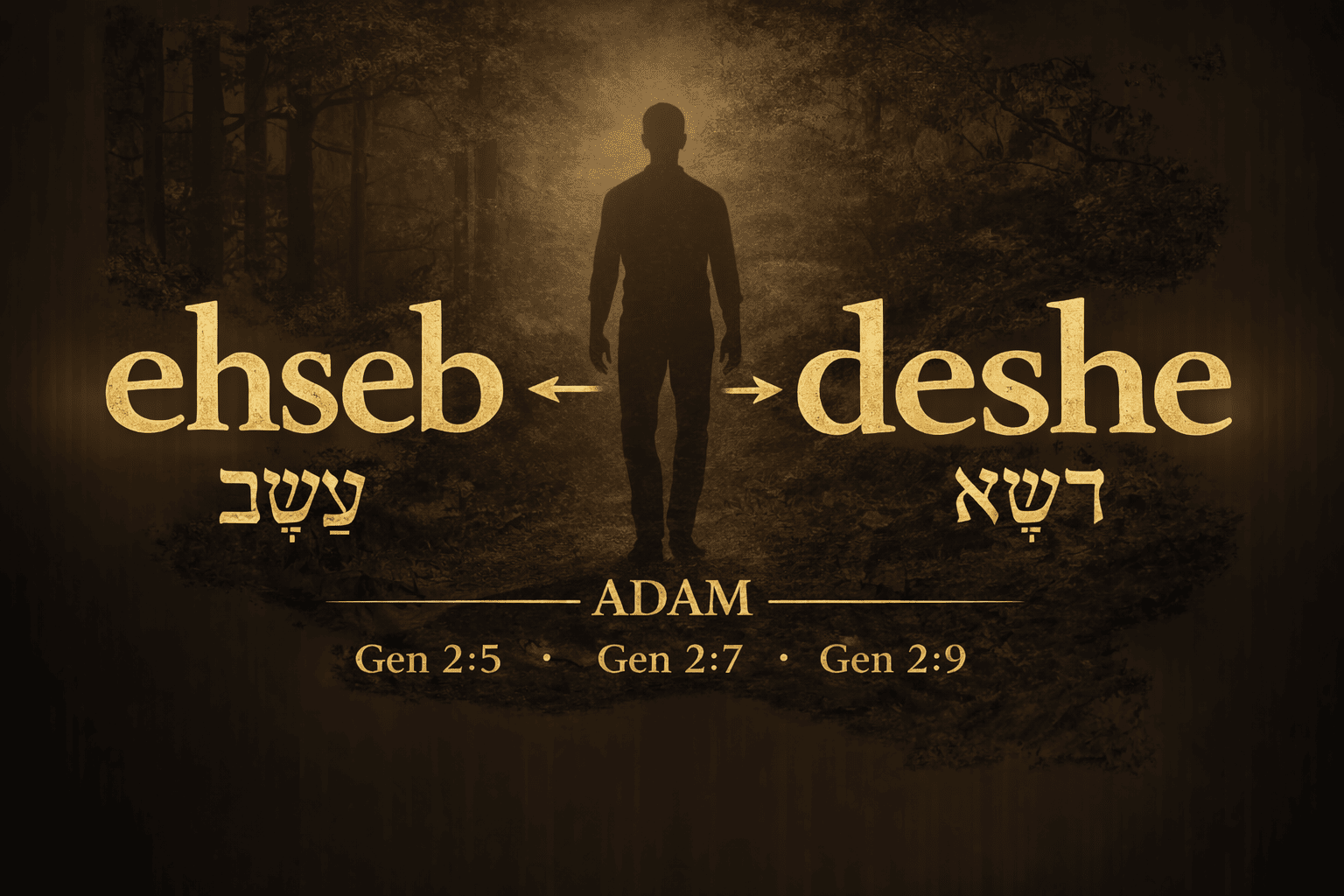
ehseb ↔ deshe — nearly the same letters, reversed. And ADAM stands right between the two vegetation streams in the narrative.

ehseb and deshe mirror hinge with Adam between

Now read the sequence:

  • Before the man: ʿēśeb ha‑sadeh is “not yet” ( Gen 2:5 ).
  • Then the man is formed ( Gen 2:7 ).
  • Then growth “sprouts” ( Gen 2:9 ).

The point is the hinge: the text places Adam between “not yet” and “sprouted”. Gen 2:5–9.

Day 3 · Third-Day Register

Genesis 2 begins with lexical boundaries.

Before the man is formed, the text repeats “not‑yet” language and uses two distinct ‘field’ expressions — signaling a world not yet ordered for cultivation.

שִׂיחַ הַשָּׂדֶה

sîaḥ haśśādeh

“bush / shrub of the field”

Wild / uncultivated growth — framed as “not yet.”

עֵשֶׂב הַשָּׂדֶה

‘êśeb haśśādeh

“plant / herb of the field”

Field‑life language tied to tilling / food / cultivation.

The narrative logic is explicit: “for… there was no man to work the ground”then the man is formed.

Hover the full context: Gen 2:5–7

This is why the Day‑3 framework reads Gen 2 as a “pre‑cultivation” scene rather than simply a Day‑6 replay.

19. Interlinear Hinges and the Sprout Loop

Gen 2:5 → 2:7 → 2:9 — same hinge words, setup and payoff

Interlinear Hinges • Gen 2:5 / 2:7 / 2:9

Watch the same “hinge words” recur across the sequence.

Gen 2:5

תֶּרֶם … יִצְמָח

terem (“not yet”) + yitzmach (“sprout”) = pre‑sprout boundary.

Gen 2:7

וַיִּיצֶר … הָאָדָם

vayyitzer (“and he formed”) = the forming event placed inside that boundary.

Gen 2:9

וַיַּצְמַח … מִן־הָאֲדָמָה

vayatzmach (“and he caused to sprout”) = the sprout payoff.

This is why “Gen 2 is a recap” doesn’t solve it: the chapter is written as a forward-moving chain with repeated hinges.

Verb Payoff • צמח (sprout)

Genesis 2:5 sets up a “sprout deficit.” Genesis 2:9 pays it off.

Setup (Gen 2:5)

“...and every plant of the field had not yet sprouted...”

Payoff (Gen 2:9)

“And the LORD God caused to sprout from the ground every tree...”

So the narrative logic is: not‑yet sprouted → Adam formed → God causes to sprout.

20. Cultivated vs Wild – the ‘Field’ Terms

Grant the nuance. Keep the timeline.

Clarifier • “Field” Terms

What's the objection?

Some readers defuse Gen 2:5 by saying its "plant of the field" refers only to cultivated crops — agricultural plants that need a farmer — not vegetation in general. If that's right, "no plant of the field" no longer conflicts with Day 3's earlier creation of plants, and the Day-3 Adam case appears to lose its anchor.

Even if you read "plant of the field" as cultivated, the timeline still holds.

Concession (steelman)

Yes — śādeh (“field”) can carry a cultivated nuance in context.

But the hinge remains

Genesis 2 still uses terem (“not yet”) + tsamach (“sprout”) as an explicit boundary, then pays it off in 2:9.

So the debate becomes which vegetation stream is in view — not whether the chapter is moving forward.

The grammar in plain English

The forward motion in Gen 2 isn't about which plants. It's a before/after pair built into the verbs themselves:

  1. Gen 2:5 — the field plants "had not yet sprouted" (terem yitzmach: the "not-yet-sprout" form sets up an unfulfilled boundary).
  2. Gen 2:7 — God forms the man.
  3. Gen 2:9"and God caused to sprout" (vayyatzmach: the matching "did sprout" form pays the boundary off).

"Had not yet sprouted" → forming → "caused to sprout" is a structural before/after — regardless of which plants are in view. The chapter is moving forward. Whatever śādeh covers lexically does not reverse the verbs.

21. Why It Matters

Lexical clues expose prophetic structure

Small words… big architecture.

When the vegetation terms and “field” markers are read carefully, Genesis is doing more than reporting sequence — it is laying a pattern that later Scripture amplifies.

  • Dual vegetation → dual trees: Day 3 prefigures Eden’s later “two‑way” reality.
  • Field‑terms + tilling: the “ground” is a domain to be worked — a prophetic picture of the Word/land being cultivated (Gen 2’s “not‑yet” logic).
  • Head/body timing: Day 6 defines image as male and female (corporate completion) (Gen 1:26–28).
  • Bride trajectory: Scripture ends with a corporate “city‑bride” completion (Rev 21:2).
  • Marriage as mystery: head/body is not merely social — it is typological (Eph 5:32).

Takeaway: These “literal timing” observations (plants, animals, woman, adversity) are not trivia — they function as prophetic scaffolding for the rest of Scripture.

22. Parallel Alignment — Structure vs Sequence

Genesis 1 (cosmic) ↔ Genesis 2 (covenant zoom)

A Parallel Structure • p.4 One Father • p.50–51

Framing (balanced persuasion): This presentation is not arguing that Genesis 1 is “wrong.” It’s arguing that Genesis 1 and 2 are parallel vantage points of the same week:

  • Genesis 1 gives day-level results (cosmic overview).
  • Genesis 2 gives covenant-level process (household zoom).
  • The question is not “which chapter wins,” but how they interlock.
Genesis 1 • Cosmic (Day Markers) Genesis 2 • Covenant (Household Process)
Day 3: dry land + seed-bearing earth
(Gen 1:9–12)
“Not-yet” field conditions → man formed from ground
(Gen 2:5–7)
Day 6: the image is stated as male and female
(Gen 1:26–28; Gen 1:31)
Woman is built later as the completing “body”
(Gen 2:18–23)

So the claim becomes coherent:

  • Adam’s formation frame (ground/seed/day‑3 logic) is read in Genesis 2.
  • Humanity’s corporate completion (“male and female”) is stated at the Day 6 level in Genesis 1.

23. Animals – Gen 2:19: Form & Translation History

Why “had formed” is a translation choice, not a grammatical given

Adam Among the Beasts • p.1–4 Axiom • p.7–8

Some modern translations render Gen 2:19 as "had formed" — making it a flashback. But the Hebrew form is wayyiqtol, the default mainline past. The pluperfect is a translation choice, not a grammatical given.

The form in question
וַיִּצֶר יְהוָה אֱלֹהִים
vayyitzer YHWH Elohim — "And YHWH Elohim formed"
wayyiqtol = waw-consecutive prefix conjugation; the backbone of Biblical Hebrew narrative; default sense is sequential past.

How the verse has been rendered (chronologically)

Septuagint (3rd c. BC)
ἔπλασεν — "he formed" (aorist)
The earliest translation we have. Aorist is the simple-past sense; many manuscripts add ἔτι ("still / further"), which actively reads as continuing forward action, not flashback.
KJV (1611)
"the LORD God formed every beast…"
Simple past. The reading held for centuries.
1611
RSV (1952), HCSB/CSB, ESV
"formed"
Major modern committees retained the simple past.
NIV-1984 → NIV-2011
"had formed"
Shifted to pluperfect to harmonize with Gen 1's order. The footnote in many editions still preserves "or formed."
Modern shift

What scholars say about unmarked pluperfect

  • Waltke & O'Connor (An Introduction to Biblical Hebrew Syntax): wayyiqtol is the conjunctive-sequential backbone of Hebrew narrative — default past sequence.
  • S. R. Driver, Treatise on the Use of the Tenses in Hebrew: cautions against importing English/Indo-European tense assumptions onto Hebrew aspect.
  • Randall Buth (discourse analysis): unmarked pluperfect requires specific discourse signals (scene break, flashback marker, resumptive device). Gen 2:19 has none of these.
  • C. John Collins, "The wayyiqtol as 'Pluperfect': When and Why" (Tyndale Bulletin 46, 1995): grants pluperfect is possible in some cases — and acknowledges Gen 2:19 is debated.
  • NET Bible note: explicitly says "had formed" here is a harmonizing move, and that the discourse criteria typically required for that overlay are not present.

24. Animals – Gen 2:19: Discourse Flow

Why the immediate context argues for “formed”

Beyond the form and the translation history, the immediate text — the discourse inside Genesis 2:18–20 itself — also pushes against the pluperfect reading.

The discourse flow argues against pluperfect

Gen 2:18 — Intent
"It is not good… I will make him a helper"
Divine resolve. A purpose is announced.
Gen 2:19 — Action
"YHWH formed… and brought them to the man"
The purpose is enacted. Bringing them is to test for a helper.
flow
Gen 2:20 — Result
"…but for Adam there was not found a helper"
Assessment: no animal qualifies. The chain reads intent → action → assessment.
What pluperfect would require
An odd reuse of pre-existing animals as the means of now testing for a helper
Why bring already-formed creatures to suddenly test a category that didn't exist as a question until v.18?
tension

The plain Hebrew, the LXX, the KJV-line of translations, and the immediate discourse flow all point the same direction: "formed," not "had formed." The pluperfect is a harmonization choice that smooths a tension the text itself creates if Day-6 is assumed.

Objections

25. Eve on Day 6 – The Climax

IIIObjections

After the animals are brought and named, the narrative turns to the climactic household completion.

  • “Not good that the man should be alone” (Gen 2:18) — though the Spirit is already present (Gen 1:2 hovering; Gen 3:8 walking "in the cool of the day")
  • Helper corresponding: עֵזֶר כְּנֶגְדּוֹ (ʿēzer kənegdô) — the spiritual archetype is the Ruach; the woman is its visible echo, not its origin
  • Woman “built”: וַיִּבֶן (vayyiven) — architectural language (household completion)
  • “This at last…” זֹאת הַפַּעַם (zōt happaʿam) — Adam's recognition (the line is in Adam's voice, not pronounced as YHWH's verdict)

Lane B note: Genesis 1 gives the completed image (male + female). Genesis 2 narrates how that completion is reached.

26. Gen 1:27 – Result vs Process

זָכָר וּנְקֵבָה בָּרָא אֹתָם

Transliteration: zākār ûneqēbāh bārā ʾōtām

English: “…male and female he created them.”

Corporate humanity on Day 6: the image is spoken in the plural (“them”). Day 6 describes the completed human reality as male + female.

  • Genesis 1:27 = the finished result (the corporate image described as complete)
  • Genesis 2 = the formation narrative that leads into that completion — Eve initiates the corporate unfolding of humanity

The true Helper precedes the visible echo

Eve completes the corporate image visibly — but the true ezer kenegdô (the one who sees, bears a sword, leads) is the Ruach, present from every side at once:

  • From the past — hovering over the waters before the man is even formed (Gen 1:2).
  • From the future — the "another Helper" Yeshua promises, the Spirit of truth (John 14:16).
  • In the present — walking with man "in the cool of the day" (Gen 3:8).

The woman is ezer only insofar as she walks filled with the Spirit — a visible vessel of an already-present spiritual archetype. Adam's failure was not Eve. It was clinging to the reflection before clinging to the Substance.

An irony Revelation picks up

The sequence preserved by this thesis — Adam formed → among the beasts (Days 4–5) → woman built (Day 6) — places Eve after the very beasts she will later be lifted on. Genesis 3 then shows her listening to the dragon. Revelation 17 paints the picture exactly: a woman riding the beast, drunk on the system she should have left behind.

The redeemed inverse closes Scripture: a Bride descending from heaven, adorned in the Spirit (Rev 21:2) — not riding the beast, but coming down with her Head.

27. Him and Them — Inside Gen 1:27

The singular-plural alternation that holds open the door

Adam on the Third Day • §4 Parallel Structure • §"Theological Parallel"

The strongest single textual hint that Gen 1:27 is describing category-completion, not individual-formation, is hidden in the verse's own pronoun pattern.

וַיִּבְרָא אֱלֹהִים אֶת־הָאָדָם בְּצַלְמוֹ ... זָכָר וּנְקֵבָה בָּרָא אֹתָם

vayyivra Elohim et-ha'adam betzalmo… zakhar uneqevah bara otam

"And God created the man in His image… male and female He created them."

Singular pronoun
אֹתוֹ (oto)
"He created him" — Gen 1:27a. The category-name "ha-adam" is treated as a single referent.
Plural pronoun
אֹתָם (otam)
"He created them" — Gen 1:27b, immediately following. Same act, now described as a plurality.
same verse

What the alternation does

In a single verse, "ha-adam" oscillates between singular reference and plural reference. This is precisely the move you'd expect if the verse is talking about a category — humanity-as-kind — that is completed as male and female, rather than narrating the manufacturing-step of one individual man.

Standard grammars note this: the verse is defining what "adam" is at the level of kind. It is not describing the first man's chronological forming. That description is reserved for Genesis 2.

How this matches the rest of Genesis 1

Each Day-6 act follows the same pattern:

  • Animals — Day 6 says God made "the beast of the earth after its kind" (1:25). This is a category-statement, not a detailed account of any individual animal's forming.
  • Plants — Day 3 says "let the earth bring forth… plants yielding seed after their kind" (1:11–12). Again, category-talk.
  • Humanity — Day 6 says "male and female he created them" (1:27). Same register: the kind, completed.

Genesis 1 announces kinds-as-completed. Genesis 2 narrates processes-of-forming — and the process for ha-adam runs longer than a single day, with the woman's building closing the kind.

This is why the Day-6 reading often looks obvious from Gen 1 alone: the verse appears to "place" Adam there. But what the verse actually does is announce that the category "male and female humanity" is finished by Day 6 — leaving Genesis 2 to tell us when the first male's forming begins.

28. Steelman – The Strongest Day‑6 Reading

State it fairly, then test it against the text.

Fair Hearing Wenham 1987 • Walton 2001 • Collins 1995

Before answering objections, here is the strongest Day-6 reading stated fairly — engaging the actual scholars who hold it.

The Day-6 case in its best form

  1. Genesis 1 is the chronological backbone. Numbered days set the order of creation. Mankind appears in the Day-6 panel (1:26–31). Whatever Genesis 2 is doing, it is not allowed to contradict that anchor. (Wenham 1987, Genesis 1–15 WBC)
  2. The toledot at 2:4 is a continuation header, not a parallel re-tell. Toledot ("these are the generations of…") functions throughout Genesis to advance the story to its next development — not to restart it from another vantage. (Wenham 1987)
  3. "Plant of the field" (עֵשֶׂב הַשָּׂדֶה) is cultivated growth, not all vegetation. The qualifying phrases — "field," "rain," "till" — point to agricultural conditions. Gen 2:5 is therefore not contradicting Day 3's general vegetation; it is describing a pre-agricultural moment within Day 6. (Walton 2001, Genesis NIVAC; Cassuto 1961)
  4. Wayyiqtol can carry pluperfect sense in some discourse contexts. Gen 2:19 may be one of those cases. The reader knows from Gen 1 that animals exist already; the wayyiqtol of 2:19 is then read as resumption rather than fresh action. (Collins 1995, Tyndale Bulletin)
  5. Genesis 2 is a topical zoom. The chapter narrows from cosmos to garden because its subject is humanity. That topical narrowing does not require a separate timeline.

This is a coherent, scholarly, defensible reading — not a strawman. We will answer it on its own ground.

The questions the steelman has to answer

  • If 2:5 is only about agriculture, why is the cause of the plants' absence "no man to till" — making man's presence the condition for their sprouting? (The causal chain still runs forward.)
  • If 2:19 is pluperfect, where are the discourse signals Hebrew normally needs (scene break, marker, resumption)? They are not in 2:18–20.
  • If 1:27 already places Adam on Day 6, why does the verse alternate him (singular) with them (plural) — describing the category arriving, not the first individual's forming?
  • If toledot is "continuation," what does "in the day YHWH made earth and heavens" (Gen 2:4) mean — clearly a summary span, not a single Day 6?

The next slides take these questions one by one.

29. Objection 1 – Gen 1:27 on Day 6

A Parallel Structure • p.4
Objection
“Gen 1:27 says male and female on Day 6.”
Hidden assumption
Genesis 1 must be describing the full formation-process of both Adam and Eve on Day 6.
Text-first reply
Genesis 1 often states the result at the day-level, while Genesis 2 zooms into the covenant-process. This does not deny Day 6 — it clarifies what Day 6 is claiming (corporate completion). Day 6 can still be the day the image is completed as “male and female,” even if Adam’s formation occurs earlier in the zoomed sequence.
Gen 1:26–27 Gen 2:18–23

Anchor texts:

  • Day‑6 corporate statement: Gen 1:26–28 (+ “very good” Gen 1:31)
  • Genesis 2 formation frame: Gen 2:5–7

Balanced conclusion: Day 6 states the image as completed (“male and female”). Genesis 2 shows the steps by which that completion arrives.

Why this match matters — the ontological & prophetic shape

Beyond the textual case, the Day-3 reading preserves a four-stage shape that runs from Genesis to Revelation. The Day-6 collapse erases it.

  • Day 3 — Head formed from dust. Adam rises from the ground that itself rose from the deep. Yeshua, the Last Adam, rises from the grave on the third day (1 Cor 15:4).
  • Days 4–5 — Head among the beasts. Adam stands with the creatures, naming them, finding no helper among them. Beasts in Scripture stand for kingdoms (Dan 7); fish for peoples (Ezek 47; John 21:11's catch of 153). Mankind walks the same corridor — through the beast-nations, named and ordered under a coming Head.
  • Day 6 — Bride built; corporate completion. The woman is built and the image arrives complete as "male and female." Revelation closes with the same shape: the Bride adorned, the New Jerusalem descending (Rev 21:2).
  • Day 7 — Rest and enthronement. The Sabbath of Head and Body together. Messiah's seventh-day return completes the pattern (Heb 4:9).

The Day-3 reading does not invent this shape — it lets the text show it. The Day-6 collapse compresses Head, beasts, and Bride into a single day, and the prophetic rhyme that Scripture builds for thousands of pages thins out.

30. Objection 2 – Animals After Adam?

Adam Among the Beasts • p.2Adam on the Third Day • p.4–5
Objection
“Animals existed before Adam, so Gen 2:19 must mean ‘had formed.’”
Hidden assumption
The only way to harmonize is to force Gen 2:19 into pluperfect time.
Text-first reply
Genesis 2 is not retelling Day 6 chronologically — it is placing animals into the household pedagogy: bring the creatures, name them, perceive “no helper,” then build the woman. The default wayyiqtol reading supports that flow.
Gen 2:18–23

31. Objection 3 – Adam Alone for Days?

Adam Among the Beasts • p.2
Objection
“Would Adam be alone for multiple days?”
Hidden assumption
If Adam is Day 3, he must be “lonely” until Day 6.
Text-first reply
Genesis 2’s “not good” is not psychological loneliness first; it’s covenant design: Adam must learn that no animal is his counterpart, so the woman’s arrival is understood as covenant completion.
Gen 2:18–23

Prophetic layer

In Scripture, “beasts” repeatedly become a vocabulary for nations and empires. Adam’s exposure to the animal system—and his refusal to find a “helper” there—becomes a parable: mankind is not completed by the beast-kingdom order. The story drives toward a different completion: Body / Bride under one Head, culminating in the household-city motif (the Bride and the New Jerusalem).

So the “lesson among the beasts” is not filler: it is discernment-training. Covenant humanity must learn what is not a fit before receiving what is.

32. What Each Reading Requires

The honest dependency map

Axiom • p.22–27 For elders

Both readings cost something. Stated honestly, here is what each one needs you to grant.

Day-6 Adam reading requires
You hold the line on these moves:
  1. Gen 1's numbered days are the only chronological anchor; Gen 2 must conform to it.
  2. "Plant of the field" must mean only cultivated/agricultural growth, not vegetation in general.
  3. Gen 2:19's wayyiqtol is pluperfect ("had formed"), even though no discourse cues mark it.
  4. Gen 1:27's "him/them" alternation is just style; the verse does stopwatch-mark Adam's forming on Day 6.
  5. The toledot at Gen 2:4 is continuation, even though it summarizes "in the day YHWH made earth and heavens" (a span, not a single day).
cost
Day-3 Adam reading requires
You hold the line on these moves:
  1. Gen 2 is a parallel zoom with its own preserved sequence, not merely a Day-6 footnote.
  2. Gen 2:5's "no man to till" is a causal statement (the כִּי clause): the man's absence causes the absence of growth, so the man's presence is the condition for it.
  3. Wayyiqtol carries its default sequential past sense in Gen 2:7, 2:9, 2:19.
  4. Gen 1:27's category-statement ("male and female… them") describes completion of the kind, leaving room for Gen 2 to tell us when the first male's forming begins.
  5. Day 3's "land rises / seed appointed / 'good' twice" register is the right covenant-context for Adam's forming from adamah.
cost

Where the disagreement actually lives

Notice: both readings make demands on the reader. The Day-6 reading is not "the plain reading and yours is the reach" — it is one set of interpretive commitments. The Day-3 reading is another.

The honest question is: which set of commitments is more anchored in the words on the page?

  • The Day-6 reading must narrow the range of "plant of the field," override the default of wayyiqtol, and flatten the singular/plural alternation in 1:27.
  • The Day-3 reading lets each of these features do what they natively do: a causal clause causes, wayyiqtol advances, and a category-statement names a kind.

The Day-3 reading does not need to "win" this conversation by being the only possibility. It only needs to be at least as text-anchored as the alternative — and to restore what the Day-6 reading strips out: the Day-3 / resurrection register that Scripture itself returns to over and over.

Implications

33. Day 3 Typology — Two Streams, Seed Planted

IVImplications

Gen 1:11–12 — Day‑3 vegetation has two key streams

Provision stream

ʿēśeb (עֵשֶׂב) — the “herb/plant” tied to seed and food

Gen 1:29 — given for food

Ps 104:14 — causes plants to grow for man’s use

Transience stream

dešhe (דֶּשֶׁא) — “sprout/grass/green growth” imagery that often withers

Isa 40:6–8 — grass withers

Matt 6:30 — grass thrown into the oven

1 Pet 1:24 — all flesh is like grass

So the text is not saying “seed and grass are the same thing.” It places seed‑bearing ʿēśeb alongside dešhe growth — and later Scripture leans on the grass image to preach fragility, fading glory, and death, while seed‑herb signals provision and life.

Day 3 · Third-Day Register

Day 3 Typology — Seed Planted

Day 3 is the first time Scripture explicitly introduces seed, fruit, and the earth “bringing forth.” It is a built‑in pattern for burial → emergence → multiplication.

“Unless a grain of wheat falls into the earth and dies…” (John 12:24)

Third‑day logic: the seed goes down first… then life comes up bearing fruit.

This same “raising on the third day” motif echoes later in the prophets (Hos 6:2) and culminates in Messiah’s resurrection testimony (Luke 24:7).

If Adam is formed in the Day‑3 “soil/seed” frame, the text is quietly placing “human origin” inside the same prophetic architecture that later becomes “resurrection.”

34. Shlishi – The Yod-Shin Spine

How the day's Hebrew name carries the names of God

The Hebrew word for “third” — שְׁלִישִׁי (shlishi) — embeds the same yod-shin spine that opens the names of God.

The third day

שְׁלִישִׁי

shlishi

the letters yod & shin sit twice inside the word

The yesh-root (יֵשׁ) and the names

In Hebrew, יֵשׁ (yesh, “there is” / being / existence) is one of the most foundational words in the language — used to declare that something is. The same two letters sit at the spine of the names that frame salvation:

  • יהוה — YHWH. The covenant name opens with yod (י), the same letter that opens yesh. Many traditions read YHWH as the divine “I AM” — the One who simply is.
  • יֵשׁוּעַ — Yeshua. The Messiah's name is built on the root יֶשַׁע (yesha', salvation), which itself shares the yod-shin spine. “Yeshua” reads as “YHWH is salvation” — being and rescue fused into one name.
  • שְׁלִישִׁי — shlishi (third). The day Scripture marks for “earth bringing forth,” for “good” said twice, and — in the resurrection register — for life rising. The word for “third” carries the yod-shin imprint the names of God carry.

The third day is not arbitrarily attached to salvation. The name of the day already carries the salvation root.

35. Shlishi – Aleph at the Front (Ish / Yeesh)

God placed at the head of being

Take the yod-shin spine we just traced — the one that runs through yesh, Yeshua, shlishi, and the opening of YHWH — and add a single letter to its front.

Add an aleph at the front

Man / husband

אִישׁ

ish  (or yeesh)

aleph (א) + yod (י) + shin (שׁ)

Take yesh (יֵשׁ, “there is”) and place an א (aleph) in front of it: you get אִישׁish (or yeesh) — the Hebrew word for “man” / “husband.”

The aleph is the first letter, the silent letter, and in the pictographic reading of the Hebrew alphabet it points to origin / strength / the Strong One. So ish reads, letter by letter:

  • א aleph — origin / strength / God
  • י yod — hand / work / acting
  • שׁ shin — fire / consume / two-witness

Man (ish) reads as “the one whose origin is God, whose hand acts, whose witness burns.” The same yod-shin that runs through “third,” “Yeshua,” and the opening of YHWH — but fronted by the aleph that places God at the head.

Why this isn't decorative

Adam is formed on Day 3. The day's Hebrew name carries yod-shin. The resurrected Last Adam — Yeshua — rises on the third day, with a name built on that same yod-shin spine, sent by the YHWH whose own name opens with the same yod. Man (ish) is that same root with an aleph set in front: God at the head of being. The third-day claim isn't a poetic flourish — it's the shape the names themselves keep insisting on.

Adam planted on Day 3 foreshadows the Third Day resurrection.

Coincidence — or design that runs all the way down into the consonants?

36. Resurrection on the Third Day

Day 3 · Third-Day Register
  • Hos 6:2 — “On the third day he will raise us up…”
  • Luke 24:7 — “on the third day rise”
  • 1 Cor 15:4 — “raised on the third day according to the Scriptures”
  • John 12:24 — the seed falls into the earth, dies, and bears much fruit

Third‑day register: Scripture repeatedly ties “third day” to life emerging from the earth — seed → death → fruit. This is why the Day‑3 formation frame is not a gimmick; it’s the same covenant logic Messiah fulfills.

And the day itself is named for the pattern. שְׁלִישִׁי (shlishi, “third”) carries the yod-shin spine that runs through יֵשׁוּעַ (Yeshua) and the opening yod of יהוה (YHWH). The verses above don't add resurrection to the third day — they recognize what the name already carries.

37. Stronger Seed Typology – John 12:24

Day 3 · Third-Day Register

Stronger Seed Typology — Last Adam Fruit

John 12:24 isn’t merely poetic — it’s covenant math: death precedes multiplication. That is exactly how Day 3 speaks.

“Unless a grain of wheat falls into the earth and dies, it remains alone; but if it dies, it bears much fruit.” (John 12:24)
  • Day 3 introduces seed: “plants yielding seed… fruit trees…” (Gen 1:11–12).
  • The Last Adam framework: “The last Adam became a life‑giving spirit.” (1 Cor 15:45).
  • Return to dust is not the end: the seed goes into the earth… and rises bearing fruit (Gen 3:17–19).

Discussion trigger: If Scripture encodes “third‑day seed logic” as resurrection prophecy, what does it mean that Adam's formation is narrated in soil‑first terms?

It means we are soil.

Adam was formed of dust on the day the dust first knew it could rise — the same Day 3 ground where seed was first appointed to break and bear fruit. The man wasn't made after Eden's growth; he was made as the field of it: the living ground prepared to host the Seed who was to come.

The Word does not bypass the dust — it descends into it. As Yeshua descended into the grave on the third day, so the Word descends into us, dies the small deaths of our resistance, and rises in us bearing fruit.

To be made of dust is to be made for planting. To return to dust is not the end — it is the seed-form. What is sown in dishonor is raised in glory; what is sown in weakness, raised in power (1 Cor 15:42–44).

So the soil-first frame of Adam's forming isn't biology — it's liturgy. We are the field. Yeshua is the Seed. And the third day comes for everyone the Word is planted in.

38. Implication — Headship: Seed First, Then the Body

Head precedes body; resurrection precedes authority

Pattern: head first → body later. Instruction/seed precedes fulfillment/fruit.

  • Blueprint → Temple (pattern shown before the house is built)
  • Ark instructions → Ark built (word first, vessel later)
  • Prophecy → Kingdom (decree before dominion)
  • Promise → Inheritance (seed before land)
  • Firstborn → Nation (a head produces a people)
  • David anointed → Kingdom established
  • Christ the Head → Church the Body

In Genesis 2, “formed first… then built” fits the same architectural logic: headship precedes corporate fullness.

1 Tim 2:13 echoes the order: “Adam was formed first, then Eve.”

Why “Day 3” matters for headship: the third-day register culminates in Messiah’s resurrection—then authority.

  • Resurrection → Authority: the risen Christ receives all authority in heaven and on earth (Matt 28:18).
  • Head restored → households gathered: the pattern begins with a head before a body, then extends into covenant households.
  • Double “good” (Day 3): emergence + fruitfulness—later mirrored as resurrection + dominion.

Patriarchy is not a cultural preference; it is the creational architecture that reappears under the risen Head.

39. Implication — Household Dominion: Addressed to “Them”

Individual accountability in the Head; corporate dominion in the Body

Implication 2 — Household Dominion

Dominion is addressed to “them” — not to an isolated man. The mandate presupposes a completed household order.

Corporate language: “let them have dominion…” (Gen 1:26–28)

This is why Eve’s arrival functions as “completion”: the corporate can finally receive the fruitfulness command.

  • Fruitfulness follows union: “Be fruitful and multiply…” is spoken within the male+female image frame (Gen 1:28).
  • Household becomes a new ‘one’: “they shall become one flesh” (Gen 2:24).
  • Head/body order is theological: “the head of the woman is the man…” (1 Cor 11:3).

If Eve is the Day‑6 “corporate completion,” then Genesis 1’s “mankind” is not merely an individual — it’s a covenant patriarchy designed to carry rule outward.

Headship is individual — dominion is corporate.

Individual accountability (the Head)

Gen 3:9 — God calls to the man first

Rom 5:12 — Adam represents the whole

1 Cor 11:3 — headship order

Corporate dominion (the Body)

Gen 1:26–28 — “let them have dominion” — the pronoun is plural; the mandate is given to “them,” not to an isolated head.

Eph 5:25 — the head lays down his life for the body

Josh 24:15 — “as for me and my house…”

A righteous head does not “go solo” — he carries the body's welfare before God.

The “them” inaugurates a category, not a count. Eve's arrival opens the corporate; she does not exhaust it. The head's dominion runs through and over a body that scales — household → tribe → nation → bride-city (Rev 21:2). What begins as “let them have dominion” ends as a city descending in the Spirit.

Discussion trigger: How does this challenge modern individualism while preserving real (singular) accountability?

40. Implication — The Plural Body, and What Flattening Costs

Day 6 sets the head↔body grammar; the parallel account keeps it plural

One head shelters many brides — reflecting Elohim's plurality in unity.

Where Day 6 sets the grammar

Day 6 doesn't only produce a man and a woman — it establishes the shape of the image itself: a singular Head paired with a Body whose first command already speaks it as plural.

  • “Let them have dominion” (Gen 1:26) — the body is plural in the mandate that calls it.
  • “Be fruitful and multiply” (Gen 1:28) — multiplication is the assignment, not the exception.
  • Eve is “built” from one rib among many (Gen 2:22) — the design permits more than any single moment shows.

Eve, then, is the visible inauguration of a category. As an individual she is one woman; as a type she is the Body — and the Body is where the literal opens out into the metaphor.

The Body is plural — Scripture says so twice

  • Paul (from inside the Body): “the body is one and has many members” (1 Cor 12:12–14). Oneness here is structural unity, not numerical singularity.
  • John (from outside the Body): Messiah walks among seven lampstands, each a distinct congregation, each His own (Rev 1:12–20). One Husband, many brides.

Both lenses give the same answer: one Head, many members. The Bride is plural — and Scripture never tries to hide it.

If the Body is plural — both inside (Paul) and outside (John) — then the question becomes: how far does the pattern run, and what does it cost to refuse it?

How far the type can be taken — either direction

If the Kingdom of Heaven were only “Christ and one undifferentiated bride,” then righteous covenantal plurality on earth would have no heavenly type. But the Kingdom is not two persons. It is a Head over a household — Abraham (Sarah, Hagar, Keturah); Jacob (four wives → twelve tribes); David (the plural House of David); Messiah (many congregations, one Husband).

So a man may rightly covenant with more than one woman only insofar as the Kingdom itself is more than two persons — which it manifestly is. Take away the plural Bride and the pattern collapses; restore her, and the covenantal household reappears as the natural earthly shadow of what is already true above.

The intuition no one escapes

Here is the tell: everyone wants their loved ones saved — as the unique persons they are, with their own bodies, their own faces, their own names. Nobody actually pictures the resurrection as a single person absorbing all the others. The instinct to want each beloved preserved is itself a quiet confession that the Bride is plural — that “many made one” is not “many erased into one.”

The Spirit in us groans for corporate salvation — not undifferentiated unity, but a household. The Body has many members. The Kingdom is built that way on purpose.

Polygyny is not forbidden in Scripture; it is consistently presented as a model of fruitfulness under righteous headship — Abraham, Jacob, David.

“One Father shelters many brides in covenant order.”

Discussion trigger: Does modern monogamy-only theology limit God's original fruitfulness pattern — or enforce a category narrower than the one the text actually establishes?

The Day-3 Adam reading restores the original “One Father” pattern.

Where the parallel account exposes plurality

Read together rather than collapsed, Genesis 1 and 2 are not a single linear story. They are a cosmic decree (chapter 1) harmonizing with a covenant zoom (chapter 2). At the covenantal layer, both chapters speak the body as plural:

  • Gen 1 — “them.” “Let them have dominion… be fruitful and multiply” (Gen 1:26–28). The mandate is plural before it is individual.
  • Gen 1 — “male and female.” The image is defined as a corporate completion, not a man with a footnote. Eve is the inauguration of a category.
  • Gen 2 — rib among many. The first woman is “built” from one of many ribs (Gen 2:22). The architecture permits more than any single moment shows.
  • Gen 2 — household, not headcount. “A man shall leave his father and mother and cleave to his wife” (Gen 2:24) names a covenant grammar — leaving, joining, becoming one — not a numerical limit.

Both chapters, read in parallel, carry the head ↔ body grammar. Both anchor plurality in the very structure of the image.

Read in parallel, the text gives plurality. Reading monogyny-only out of it requires three deliberate flattening moves — and each one strips a layer the text is doing on purpose.

What monogyny-only has to do with the text

To read “monogamy only” out of the parallel account, three moves are required — and each one strips a layer the text is doing on purpose:

  1. Flatten the structure. Treat Gen 1 and 2 as a single linear chronology, with chapter 2 a “footnote” to Day 6, so the cosmic-and-covenant double witness collapses into one tracking voice.
  2. Singularize the type. Treat the individual Eve as exhausting the typological category, so “Eve” never grows beyond “this one woman” and the corporate Bride is never let in the door.
  3. Numericalize echad. Read “one” in “one flesh” as a numerical claim about household composition rather than what it actually is — a covenant grammar of unity-in-distinction, the same echad applied to the plural-yet-one Elohim and to the many-membered Body (1 Cor 12:12).

Each move is required. Each move is a flattening. None of them is what the text actually does.

What the prophetic layer preserves

Read parallel — cosmic decree harmonizing with covenant zoom — Gen 1 and 2 are doing what every later chapter of Scripture confirms: setting up the head/body architecture that resolves only at the marriage of the Lamb (Rev 21:2).

The Day-3 reading lets the chapters carry that prophetic weight. The flattened reading cannot — its commitments leave no room for the corporate Bride to be present in creation, only inserted later as a New Testament metaphor with no creational anchor.

The Bride is not bolted on. She is built in. Genesis 1 names her (“them”), Genesis 2 inaugurates her (Eve), and the rest of Scripture multiplies her under one Head.

One head over many in covenant order → fruitfulness, protection, multiplication.

Modern systems distort this into individualism or egalitarianism — both born of the same flattening move.

Discussion trigger: How can we recover this in our families and communities today?

The full covenant-order case lives on the Sixth Day. This deck establishes the textual reading; the applications — covenant, courts, household order — are argued chapter by chapter in the Kingdom series →

41. The Last Adam Completion

The first Adam is framed by ground and dust; the Last Adam is framed by resurrection and authority.

  • First Adam: formed from dust (ground-origin architecture)
  • Last Adam: rises on the third day “according to the Scriptures” — new creation begins
  • Completion: one Head gathers many sons into one covenant body (a corporate image made whole)

Third-day coherence: the “double good” day becomes the signature of restoration: life emerging from the earth and authority restored under the risen Son.

42. Nations Gathered Under Headship

John 21 ends with a covenant sign: a catch of 153 great fish—and the net is not broken (John 21:6–11).

  • Unbroken net: covenant security — the resurrection catch will hold.
  • “Sons of God” cipher: b’nei ha’Elohim aligns with 153—John begins with sonship (John 1:12) and ends with 153.
  • Triangular fullness: 153 as the 17th triangular number (victory / goodness register).
  • Ark echo: 153 connects to ark dimensions (Gen 6:15) — a vessel preserving a household through judgment.
  • Seas → nations: “seas” symbolize peoples (Rev 17:15) — the catch signifies ingathering from the nations.
  • Ezekiel’s river: the living water brings “a very great multitude of fish” (Ezek 47:9–10).

Connection to headship: the risen Christ gathers sons from the seas into an indestructible covenant net—one Head, one secured household.

Beasts as nations (prophetic layer): Scripture often uses beasts to symbolize kingdoms/empires:

  • Dan 7:3–7 — beasts rise from the sea as successive kingdoms.
  • Rev 13:1–2 — the composite beast as an empire system.
  • Rev 17:15 — waters/seas as peoples and nations.

So Genesis 2’s sequence carries an implicit lesson: the “helper” is not found in the beast‑system. The covenant trajectory moves instead toward the bride‑city (Rev 21:2) — the corporate body under one head (Eph 5:32).

Close

43. One‑Minute Case for Elders

A calm summary that doesn’t rely on extra theories.

VClose
One Minute

If only one thing lands, let it be the text chain:

  1. Gen 2:5 opens with terem (“not yet”) + sprout markers — a real boundary.
  2. Gen 2:7 places Adam’s forming inside that boundary.
  3. Gen 2:9 pays off the boundary: God causes to sprout from the ground.
  4. Gen 2:19 reads forward (wayyiqtol): animals are formed and brought to Adam — not “had formed” retroactively.
  5. Gen 1:27 is the completion statement (“male and female”) — consistent with Eve’s later building.

The claim is simple: Genesis 2’s own sequence aligns Adam’s forming with Day 3’s ground/seed hinge, while Day 6 completes the corporate image.

44. Conclusion – The Text Speaks

A parallel reading doesn’t flatten the text—it lets the architecture speak.

Genesis 1 and 2 are not in tension; they are married. Chapter 1 speaks the head's decree. Chapter 2 is the body of covenant — and the decree blooms from the body.

Third‑Day formation pattern • Sixth‑Day image completion

Genesis 2 never prints a day-number, yet its sequence and vocabulary repeatedly land in the dry‑land / seed register where Day 3 begins.

The outcome is not a forced timestamp, but a coherent pattern—one that Scripture later sharpens into the Third‑Day hope.

45. Final Quote

A covenant mirror, a prophetic pattern

Genesis is not merely chronology—it is covenant architecture: a household ordered before it becomes a nation, and a man shaped before he is asked to bear fruit.

In Genesis 2, Adam is framed in the language of ground and dust, in sequences that echo the dry‑land hinge and the beginning of seed‑bearing life. The pattern is subtle, but consistent: origin in the land, vocation in the land, and (after the fall) judgment returning him to the land.

And the woman is revealed as the corporate body glory of the image—not an appendix, but the moment the pattern becomes visible as “male and female.” The body is whole, but it awaits the Ruach to fill it — for the Spirit is the true finishing glory, the One who fills all things.

When we restore the order, we recover the meaning. And when we recover the meaning, the prophecy sharpens: what is framed in a Third‑Day register points forward to what will be raised on the Third Day.

So the question is not only when—but whether we will read by surface sequence alone, or by the covenant pattern the text is designed to reveal.

Genesis is not two competing stories. It is one covenant pattern — head first, body later — and that pattern is resurrection.
46. Discussion Questions

Implied objections + next steps

Questions to take home

  • If Genesis 1 and 2 are married — chapter 1 the head's decree, chapter 2 the body of covenant the decree blooms from — what other places in Scripture have we mistaken a marriage for a contradiction?
  • If “image” arrives in the plural (“let them… male and female”), what part of Christian doctrine has been quietly singularizing what the text left plural — and what would it cost to let the plural stand?
  • If the true ezer kenegdô is the Ruach — present from Gen 1:2 hovering, Gen 3:8 walking — how does that change what Adam was doing when he turned first to the woman, and what we are doing when we turn first to anything else?
  • If shlishi (the Hebrew name of the third day) carries the yesh-spine that fills Yeshua and the opening of YHWH, can resurrection on the third day still be called “symbolism” — or is it the shape the names themselves keep insisting on?
  • Eve was built after the beasts; Revelation 17 shows a woman riding the beast; Revelation 21 shows a Bride descending, adorned in the Spirit. Which posture defines us right now — and how do we tell the difference?

Open the map (press M) to revisit the sections where the text felt most “locked.”

47. Sources & Further Study

Read everything. Verify everything. The case is in the books.

The flagship work

One Father

The full verse-by-verse case for Genesis as prophetic architecture — the parallel structure of Genesis 1 and 2, Adam on the Third Day, and the covenant pattern that runs from Eden to the New Jerusalem.

Read online → · Download PDF ↓

Supporting research used in this deck:

Continue at yeesh.life:

  • Kingdom — 14-chapter brief on covenant order, serial monogamy, and Babylon's romance system
  • Blog — short notes and long-form studies on Genesis, kingdom, and prophecy
  • Tools & Research — Genesis Scroll, Genesis Prime Lab, the Second Gate, Covenant Case Study
  • The Brotherhood — application-gated community for covenant-minded men

Tip: open each PDF and use your browser search to jump to the cited sections.


This page is the server-rendered reading view of the interactive deck. Slide content is loaded live from slides.json, so both views always match.