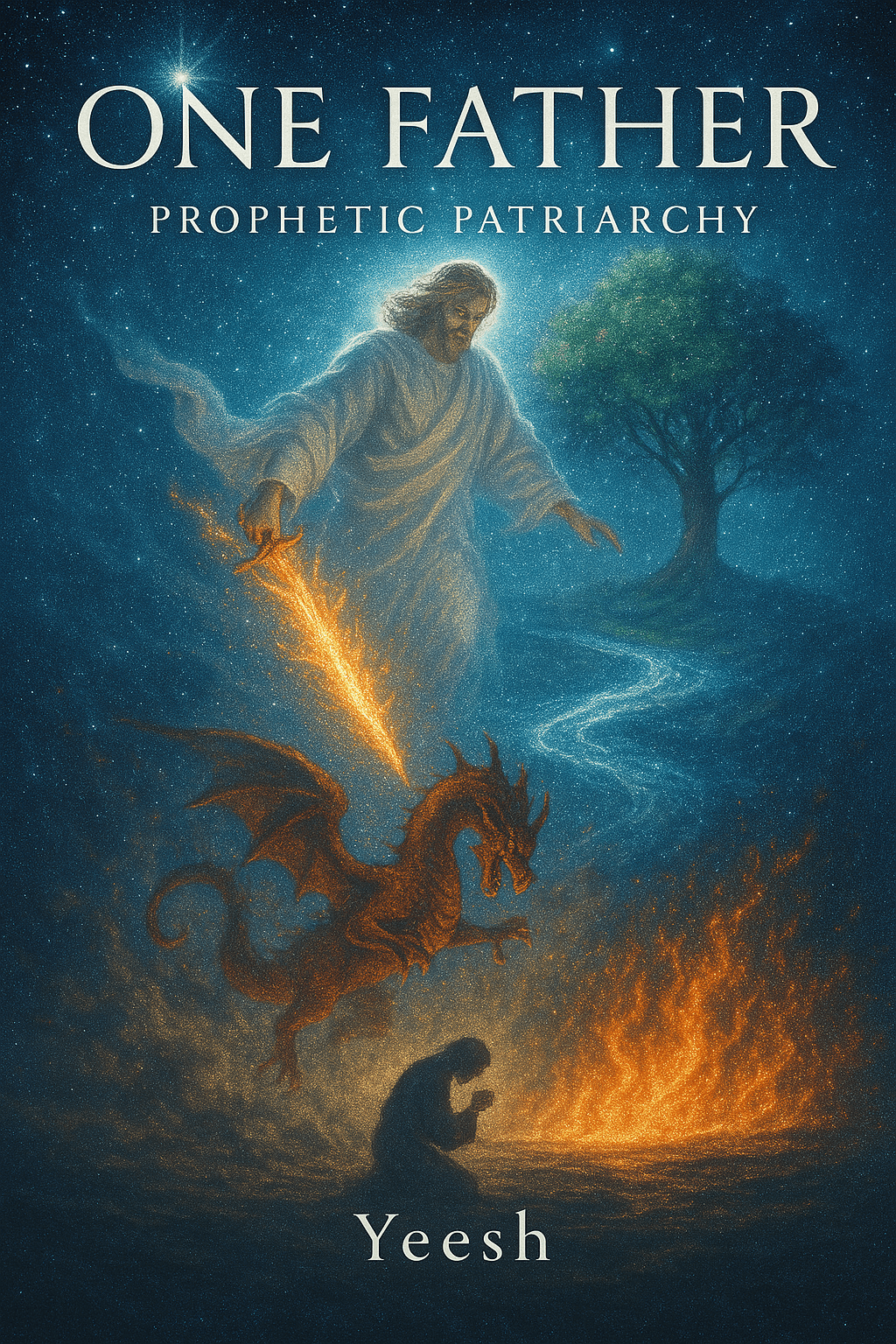
One Father
Prophetic Patriarchy
Contents
- Preface Foreword & How to Read
- 01 Abba, Father — In the Beginning
- 02 The Kingdom of Light and lights
- 03 The Third Day
- 04 The God of Days
- 05 The Net That Does Not Break
- 06 The Word and The Spirit
- 07 Enter His Rest
- 08 Prophetic Patriarchy
- 09 This Is My Sword
- 10 Involved & Relational Body of Messiah
- 11 The One on One
- 12 Love as a Binding Headship Invitational
- 13 The Book That Breaks the Binary
- 14 The Congregate United
- Appx. Appendix
Foreword & How to Read
Foreword
The first thing Scripture ever evaluates is the Word of God. “And God said, Let there be light… and God saw the light, that it was good.” Before any deed is weighed, any creature judged, any man measured, the mouth of God is heard and the eye of God approves what it spoke. That is one of the first lessons of the Bible, and it is the standing invitation of this book: taste and see. Everything argued in these pages stands or falls by that same first test — not whether it is novel, but whether, set beside the Word, it is seen to be good.
One Father traces the Father’s pattern of divine order — seeded in Genesis, carried through the whole canon, and fulfilled in Yeshua Messiah — so that what was fractured in Eden can be restored in the earth. It argues that prophetic patriarchy is not a disposable cultural artifact but a recurring scriptural archetype: the Father plants one Seed and reaps many sons; He brings order to chaos; He gathers what is scattered and establishes a place where the congregate can stand. And it makes that argument the way Genesis itself does — by walking the week. The creation days are not this book’s decoration; they are its skeleton, climbed twice from light to rest.
Reader key: in Scripture quotations, LORD corresponds to YHWH.
One Father does not add to the canon; it illuminates the canon’s own internal architecture. It follows the Spirit’s witness across Scripture to show how Eden’s loss — fatherhood and sonship severed, order inverted, headship attacked — is answered in Messiah, and how that restoration forms households again: sons under blessing, fathers in covenant responsibility, families gathered toward the Father. Read it as a lens — not to replace the Word, but to see what the Word has already planted.
What was declared from the beginning will come to pass.
Psalm 78:5–7“That the next generation might know them, the children yet unborn, and arise and tell them to their children…”
One Father is intergenerational, written to restore the father-line of blessing for any generation that would receive it. It does not only teach doctrine; it calls forth reconciliation at the level of spiritual inheritance, binding what was severed between the fathers and the children — and, beneath that, between the scattered parts of Scripture itself. The Word is one.
Malachi 4:6“And he shall turn the heart of the fathers to the children, and the heart of the children to their fathers…”
One Father is architectural in design. It brings light to something ancient — not with nostalgia but with precision — glorifying Yeshua in the Spirit of prophecy as a testimony to His coming dominion.
Isaiah 58:12“And they that shall be of thee shall build the old waste places: thou shalt raise up the foundations of many generations…”
Most of all, One Father reveals that the person of the Father, made flesh, is Yeshua — not as a linguistic flourish but as a foundational claim. He is not an abstraction but Abba, Father: relational, reigning, righteous, and victorious from before time began.
John 17:6“I have manifested Thy name unto the men which Thou gavest Me…”
This book is the fruit of years of prayer, covering, and fasting — what was hidden in plain sight to the casual reader, now opened to sons. It is not new scripture. It is what Scripture said would come: that in the last days sons and daughters would prophesy (Joel 2:28), and that the mystery hidden for ages — Messiah in you, the hope of glory (Colossians 1:27) — would come alive.
And it is not only about the restoration of fatherhood. It is about how the Father Himself enters that restoration and initiates it — as the Son, in Yeshua, who speaks back to His Father in trust, “Abba, Father,” and teaches other sons to do the same.
What This Book Argues
A foreword should tell the truth about what waits inside, so here it is, plainly. This book argues that Scripture’s relational architecture is one pattern repeated at every scale: a singular head over a structured plurality — one Father, many sons; one Shepherd, one flock of many sheep; one Vine, many branches; one Messiah, many congregations; one Body, many members. And it follows that pattern where most modern books stop short: into the household itself. The chapters ahead will argue that the covenant order of marriage is likewise a singular head over a body that Scripture leaves open to plurality — that righteous polygyny is regulated, never condemned, in the Torah and the Prophets, and that monogyny-only doctrine misreads the unity Scripture actually teaches. If that sentence startles you, good — it is better met at the door than sprung in the hallway.
Be equally clear about the register of the claims. Some readings in this book are old and broadly held; others are minority readings; and a few — Adam’s forming placed on the third day, the marriage argument above, the pictographic letter-studies — the reader may never have met before. They are presented with full conviction and open references, and the strongest objections to the most contested of them are not hidden but taken up directly in the appendix, on the table: “the husband of one wife,” Eden’s arithmetic, “a wife to her sister,” the count in “the two shall become one flesh,” and Qumran’s ancient ruling among them. Nothing here asks to be believed on the author’s word. Everything here asks to be tested against the Word.
The Author, and the Method
The name on this book is Yeesh — a pen name, and a confession. Yeesh (אִישׁ, ish) is simply Hebrew for man, for husband: the word that enters the story in Genesis 2 when the man first speaks. Its ancient letters read Aleph, Yod, Shin — strength, hand, refining fire: a strong leader who works and refines. The author took the name years ago, when he first began writing on patriarchy and polygyny, and he keeps it because the argument of this book does not rest on who he is. It rests on what is written.
As for the method: this book reads Scripture linearly first — letter by letter, word by word, in canonical order — and metaphorically second, tracing how a word or a pattern echoes across authors, centuries, and covenants. It digs beneath translation into the Hebrew, and it makes frequent use of the ancient pictographic meanings of the Hebrew letters — always as an additional witness alongside the plain text, never as a foundation for doctrine. If a letter-picture ever seems to be carrying an argument alone, stop and check: the claim should already be standing on verses before the letters are invited to speak. The full notes on this method, and on why the author trusts it, are in the appendix — readers who want the tools before the tour may go there first.
How to Read This Book
This book is written to be tested. Here is the map, and then the manner.
The map. The book climbs the creation week twice. Chapters 1–7 walk days one through seven in the register of creation; chapters 8–14 walk the same seven days again in the register of love and covenant. Set them side by side and the architecture is visible at a glance:
- Day 1 — Light. Ch. 1, Abba, Father: the first word, and the first lesson — the Word of God is good. Second loop: Ch. 8, Prophetic Patriarchy — the father-line as the light of a household.
- Day 2 — The Divide. Ch. 2, The Kingdom of Light and lights: the firmament, glory, and the cosmology of orbit. Second loop: Ch. 9, This Is My Sword — the guarded gate, the divide defended.
- Day 3 — The Seed and the Soil. Ch. 3, The Third Day: Adam formed of the just-bared ground, the Seed buried and risen. Second loop: Ch. 10, Involved & Relational Body of Messiah — what the risen Head gathers to Himself.
- Day 4 — The Clock. Ch. 4, The God of Days: the lamps, the feasts, time made fixable. Second loop: Ch. 11, The One on One — echad, and love kept from becoming an idol.
- Day 5 — The Teeming. Ch. 5, The Net That Does Not Break: the nations as fish and fowl, the first blessing. Second loop: Ch. 12, Love as a Binding Headship Invitational — the binding that holds the net.
- Day 6 — The Kingdom. Ch. 6, The Word and The Spirit: the Image completed, the return, the first resurrection, the reign. Second loop: Ch. 13, The Book That Breaks the Binary — the loop completed in the Kingdom fully come.
- Day 7 — The Rest. Ch. 7, Enter His Rest: beyond the Kingdom, the second rising, the day with no evening. Second loop: Ch. 14, The Congregate United — the seventh day come home.
Two keys travel with the map. First, the two scrolls: Genesis 1 is the report — the decree pronounced and sealed good; Genesis 2 is the process — the same week re-entered close to the ground, where the man is formed of third-day dust and the woman is built by the sixth — made within the week, and shown in a second week of ceremony, as the earliest sequential witness outside the canon heard it (the book of Jubilees, weighed on the table in chapter 3 and in the appendix). When this book sets the two chapters side by side, that is the machinery at work, not a contradiction being managed. Second, the sixth and seventh days are not the same promise: the sixth is the Kingdom — the return, the first resurrection, the millennial reign; the seventh is the rest beyond it — the new heaven and the new earth, the one day never given an evening. Hold that distinction and the whole book stays in focus.
And the manner:
- Read in order. The argument builds chapter by chapter; each loop assumes the one before it.
- Verify the Scripture chains. This book is a lens, not new canon. Nothing here asks to be believed on the author’s word.
- Use the Hebrew as a study aid. Transliterations are italicized and the script is shown for reference — never as a replacement for the plain text, and the letter-pictures never carry an argument alone.
- Track the pattern, then test the conclusion. If a claim feels bold, follow the references before you judge it — the boldest claims travel with the most references.
- When a chapter names its day, take the map out. The day tells you where you are in the week, which loop you are climbing, and what the chapter is building toward.
- Read the objections. The appendix takes up the strongest counter-arguments to the most contested claims, on the table. Testing them is not a betrayal of the book; it is the book’s own request.
- Bring faith as well as proof. Chapter 13 will say why: houses built on syllogism alone fall in storms. Test everything — but test it the way Scripture asks to be tested, with a heart willing to be taught.
- Move slowly. The goal is restoration through clarity, not speed-reading for debate. The week took a week.
Abba, Father — In the Beginning
In the evening groves of Gethsemane, where the weight of eternity pressed upon trembling flesh, the New Man’s voice rose from the silence — not rebellion, not resignation, but reverent submission. In that prayer two wills were brought into alignment, and the Father’s will was embodied on earth in Yeshua Messiah, who came to do it.
Mark 14:36“Abba, Father… all things are possible for You; remove this cup from Me. Yet not what I will, but what You will.”
He was alone in that moment — praying, hoping, feeling the weight and the presence of the Spirit of Glory. His brow ran with sweat, blood rising to the skin and falling to the ground, as if the dry dust were eager to receive it: the food of the fallen. Around Him the disciples lay asleep while Yeshua, the Last Adam, kept watch. Their eyes were heavy not only with grief but with the weight of prophetic irony, for had they known the hour they would not have dozed. Their slumber was both exhaustion and fulfillment — a premature rest in a garden where vigilance was demanded, echoing what Scripture had said long before. The sheep would scatter when the shepherd was struck (Zechariah 13:7); the first Adam, too, was put into a deep sleep.
But Yeshua did not sleep. He stayed awake, stayed aligned, stayed fixed in the will of the Father. And when His blood-touched sweat mingled with the soil, that same ground was reminded that man was taken from it and would return to it. Yet this time His blood would make the difference. In those small drops He showed the joy of one willing to endure the cross for the joy set before Him (Hebrews 12:2). The ground had received the first Adam in curse and hunger; now it received the Last Adam in blood — and with Him the revelation that within a few days the curse would be broken in resurrection.
“Abba, Father” was the cry of a Son — not orphaned, not disillusioned, but begotten, anchored, and focused. Ordained with authority, His feet on the ground and His mind in the heavenly will, an army of angels ready to descend at His call. It was the cry of the Last Adam, speaking from the muddy ground, on His way to reverse the curse brought through the first Adam’s folly. With a fist full of earth, Yeshua was reminded of His brother’s forming. And so, in love, with that cry of submission, two worlds were bridged: heaven and earth, the fallen and the resurrected, the Tree of Life in the garden and the blood-stained cross at Golgotha.
The phrase “Abba, Father” appears three times in the New Testament: once from the lips of Yeshua in Gethsemane, and twice from the apostle Paul, in Romans and Galatians. Within those three invocations a universe is restored. “Abba” is a child’s first breath, a word of trust. “Father” is a title — legal, ordered, immutable, authoritative — shaping fatherhood for generations. Together they carry the weight of a cosmos in need of a name to follow and a hero to revere. This is not redundancy. It is a revelation of character: a sacred fusion of relationship and rule, affection and authority, the whisper of the Spirit and the decree of the King. The Son cries it forth to sanctify the way; the Spirit cries it in us to certify our adoption. It rests upon a man, a son, a Messiah, and a Father — named Yeshua.
To say “Abba, Father” in the Spirit of Yeshua is to locate oneself in a divine pattern: to remember the garden, to acknowledge the government of the heavens, to admit origin, to accept order, and to bow under blessing. And this is precisely what the world has forgotten. We are surrounded by children who speak to no fathers, congregations that lead without headship, marriages that war without peace. We are living in the ruins of an abandoned architecture, and the House of the Father has been desecrated, its foundation mocked.
Perhaps you have felt it — that ache beneath the surface, the question of where you belong. You look around at the shattered frame of fatherhood, the silence of empty rooms in abandoned homes, and something in you longs to return. You would say Abba, if only you knew how to trust. You would say Father, if you knew someone worth seeing that way — if you were sure you were still welcome, and that the Father was good. Take heart: the story is not finished. Even now the shadows tremble with the hint of restoration, and prophetically we are almost home.
The Two Men in the Garden
The Gospel of Mark records an often-overlooked detail not long after this prayer, near that same place. As Yeshua is betrayed and arrested, a young man — unnamed, unarmed, wrapped only in linen — flees the scene, his cloak pulled away by the hands of the arresting party seeking to seize him as well (Mark 14:51–52). He had come forward as if to throw himself at Yeshua’s feet and follow Him into arrest. Instead, his small faith failed, and he fled, leaving his garments behind as he disappeared into the darkness. The parallel is hard to ignore.
This story has never reached a clear consensus; it is sometimes read as Mark’s own signature. That may be so. But in One Father it serves as another anchor between the first Adam and the Last Adam — a point of decision where two men choose their paths: one forward in obedience and trust, the other into nakedness and darkness, exposed and away from the presence of Yeshua.
The nameless young man becomes, paradoxically, a symbol of those who are near the Son yet not yet clothed by Him. He becomes, too, a figure of the first Adam, who had not walked with the Spirit and who fled from the Word naked and ashamed, hiding in the garden. He had walked with Yeshua at a distance — not with armor or faith, but with the fragile veil of self-made covering. When danger came he fled, exposed and unformed: without father or mother, in no way ready to lead a family as a husband. His nakedness is not only physical but theological — and deeply relatable. This is a type of the first Adam.
This moment echoes the garden. And yet here the Son does not hide. Here the Last Adam presses forward while the man beside Him flees. Only One walks fully clothed in righteousness and offers salvation; the other is left with the invitation to share in that One’s victory through faith. The first Adam invited temptation, surrender to untruth, and the fear of shame and nakedness. The Last Adam offers the way out. Where the first Adam hid, Yeshua stood. Where the young man fled, the Son submitted to the will of the Father. One man ran, unclothed, into the night; the other remained, robed in obedience, to be stripped for our sake. The covering of fig leaves is replaced with garments of His righteousness.
Mark seals the contrast with his own thread of linen. The garment the young man leaves behind is a sindōn (σινδών) — and the only other sindōn in his Gospel is the linen cloth in which Yeshua’s body is wrapped for burial (Mark 15:46). One man flees out of his linen into the night; the Other is bound into linen and carries it into the grave. And when the women arrive at the tomb, whom do they find? A neaniskos — a “young man,” the same word as the fleeing figure of Gethsemane — now “clothed in a long white garment,” seated, announcing the resurrection (Mark 16:5). The Gospel opens the passion with a young man stripped and running from a garden, and closes it with a young man clothed and seated in a garden tomb, proclaiming the risen One. Nakedness and flight are answered by covering and commission. What the first figure lost in fear, the last figure wears in glory — the very exchange this book will trace from the fig leaves of Eden to the robes of the redeemed.
And the man who was once ashamed may now be called a son — a son on the path to becoming a patriarch in the faith. For those who are led by the Spirit are sons of God; and if sons, then heirs — not only of salvation, but of order and authority, of legacy and the blessing to be fruitful. They are sons of name and authority, provided from the beginning in Yeshua, in the reality of prophetic patriarchy.
Romans 8:15“For you did not receive the spirit of slavery to fall back into fear, but you have received the Spirit of adoption as sons, by whom we cry, ‘Abba! Father!’”
The Spirit does not teach us to cry “King” first, though Elohim is King; nor does He begin with “Judge,” though that is true as well. The Spirit places the first word of every prayer on the tongue of a child — demonstrated perfectly by His firstborn Son, Yeshua: “Abba, Father.” And so the Spirit invites us into both intimacy and order in the Father.
For Yeshua came not only to redeem but to restore — not merely to save souls, but to call sons home. The gospel is not an escape hatch from hell; it is the reconstitution of a family, the rebuilding of the Father’s house upon the cornerstone of the Son. As it is written: “I will give you the keys of the kingdom of heaven, and whatever you bind on earth shall be bound in heaven, and whatever you loose on earth shall be loosed in heaven” (Matthew 16:19). These are not decorative keys. They are judicial. They imply trust, and an inheritance from the Father for His sons. They imply the restoration of a Kingdom that brings the Father’s will to earth — an answer to many prayers — as it is in heaven, so on earth. Only sons are given keys.
Only those who remain, who do not flee when the sword falls, are entrusted with the binding and loosing that reflects Heaven’s rule. These keys are not tools of control but of covenantal government. They restore borders. They open gates. They guard what is holy and nurture what is fruitful. And all of it flows from the Father, who is also the firstborn Son, the firstfruits of the resurrection, the Savior of the body.
Abba, Father: A Two-Part Revelation of Yeshua
Two witnesses are a theme throughout Scripture, so expect a fair amount of that in this book. Even here, in this single utterance — Abba, Father — a convergence of tongues unfolds, a liturgical layering that spans history and nations. Aramaic breathes first: Abba, the primal sound on a child’s lips, unlearned yet eternal. Then Greek follows: Pater (Father), legal and liturgical, the tongue of empires and epistles. Yet behind them both stands Hebrew — Av (אָב) — the root of all fathering, the seed-syllable of origin: the pictographic Aleph-Bet forming the Leader (א) and the House (ב), strength that shelters, authority that builds.
Even in the English word Father the weight remains. No language escapes the resonance. From every tongue the name rises; from every shore it is echoed. This is the name Yeshua spoke — not as a metaphor, but as a revelation of essence: “He who has seen Me has seen the Father” (John 14:9). Yeshua did not come merely to teach about the Father; He came as the express image of His person (Hebrews 1:3). In Him the name is enfleshed. In Him the glory is visible.
“Abba, Father” stretches together heaven and earth, Israel and the nations, the breath of the prophets and the ink of the apostles. It was a multilingual coronation — a cosmic enthronement veiled in agony, the tongues of Babel reversed in the groaning of a Son who would soon receive all authority in heaven and on earth (Matthew 28:18).
Philippians 2:10–11“That at the name of Yeshua every knee should bow… and that every tongue should confess that Yeshua Messiah is Lord, to the glory of God the Father.”
Every knee — and every tongue: not in one language only, but in many, each confessing the same Lord.
This is the heart of the Father, in the Son — not a theological abstraction but a linguistic convergence, a prophetic alignment of every nation under the Name that is above every name. The Father is not divided. His languages are not at war. They harmonize in the flesh of the Son who was born and lived among us. And every language that names Him as Father sings the same eternal song, as each nation and tongue is reintegrated into its source, inspired in its expression by the Spirit of prophecy, which is the testimony of Yeshua.
One Father: The Witness of Scripture
So the tongues confess what the garden revealed. And they do not confess it newly, as though it had only now been discovered. The canon has been saying it from the first — one Father, named and renamed, sentence after sentence, across the long arc of the Book.
Listen, then, to the witness in Scripture’s own voice. Hear it move outward, ring by ring: from the household to the nation, from the nation to the whole creation, and back again into the family of the redeemed.
Malachi 2:10“Have we not all One Father? Hath not one Elohim created us? Why do we deal treacherously every man against his brother, by profaning the covenant of our fathers?”
Matthew 23:9“And call no man your father on earth, for you have one Father, who is in heaven.”
1 Corinthians 8:6“Yet for us there is one God, the Father, from whom are all things and for whom we exist…”
Ephesians 4:6“One Elohim and Father of all, who is over all and through all and in all.”
Isaiah 9:6“For unto us a child is born, unto us a son is given… and his name shall be called Wonderful, Counsellor, the mighty God, the everlasting Father, the Prince of Peace.”
Genesis 42:32“We are twelve brothers, the sons of one father…”
1 Corinthians 4:15“For though you have countless guides in Messiah, you do not have many fathers. For I became your father in Messiah Yeshua through the gospel.”
The witness runs in two registers at once — the Father in heaven, and the fathers He raises on earth. Genesis names one human father over twelve sons; Paul names himself a father to those he begot in the gospel; and above them both stands the One from whom all fatherhood takes its name (Ephesians 3:14–15). This is the pattern the book will trace: one Father, reaping many sons, restoring the household.
If the Father’s name is carried in every tongue, we should expect it carried in the very letters as well — in the Hebrew itself, Leader and House, strength that shelters. And so it is. It begins where everything begins: with the first word of Scripture.
In the Beginning
Scripture opens with one word: Bereshit (בְּרֵאשִׁית) — “In the beginning.” Before it narrates creation, it announces a pattern: the end is already present in the beginning. Even the letters carry a gospel-shaped testimony — Yeshua’s identity, His crucifixion, and His resurrection — etched into the first breath of the scroll. This is why John can begin his Gospel where Genesis begins: creation and redemption are not two stories but one story under one Father (Isaiah 46:10; Revelation 22:13).
Breakdown of בְּרֵאשִׁית (Bereshit)
| Letter | Name | Symbol | Meaning |
|---|---|---|---|
| ב | Bet | 🏠 | House, family, dwelling |
| ר | Resh | 👤 | Head, chief, first |
| א | Aleph | 🐂 | Strength, Elohim, sacrifice |
| ש | Shin | 🔥 | Consume, destroy, press |
| י | Yod | ✋ | Hand, work, deed |
| ת | Tav | ✝ | Covenant, mark, sign |
Read together, an idea begins to emerge in the light of all Scripture.
“The House (Bet) of the Chief (Resh) is revealed through the Leader (Aleph) being destroyed (Shin) by the work (Yod) of the Covenant (Tav).”
It is a prophecy etched into the first word of Scripture — a whisper of the Cross in the cadence of creation.
The Prophecy of the Cross in Bereshit
The last two letters of Bereshit combine ‘Hand’ (Yod, י) and ‘Cross’ (Tav, ת). This imagery foreshadows the crucifixion of Yeshua, whose hands (י) were nailed to a cross (Tav). Even within Bereshit itself, the crucifixion is embedded.
Psalm 22:16“They pierced my hands and my feet.”
A note for the careful reader: the received Hebrew text of Psalm 22:16 reads כארי (“like a lion”), while the oldest surviving Hebrew copy of this verse — a Dead Sea Scroll from Nahal Hever, centuries older than the received text — reads כארו, “they pierced,” and the ancient Greek translation agrees. The oldest witnesses carry the piercing.
Zechariah 12:10“They will look upon Me, whom they have pierced.”
Yeshua, the Chief (Resh), comes from the House (Bet) of the Father — the House of Elohim. He is the Leader (Aleph), yet He is crushed (Shin) by the work (Yod) of His own hands — pierced to establish the Covenant (Tav). It is a picture of the crucifixion hidden in the first word of Scripture. As the nails were driven through His hands (Yod), He sealed the New Covenant (Tav) with His blood. In this single word, Bereshit, we see the Son, the Sacrifice, the Creator, the Chief, and the Foundation — and behind them all, the Father whose house He builds and whose covenant He seals, revealed in seed form.
John 1:3–5“All things were made through Him, and without Him was not any thing made that was made. In Him was life, and the life was the light of men. The light shines in the darkness, and the darkness has not overcome it.”
From pictographs, hidden words, and prophetic themes, Bereshit encodes the entire gospel message:
- Yeshua is the Creator “Through Him, all things were made.”
- Yeshua is the Firstborn (Head — ראש) “He is the image of the invisible Elohim.”
- Yeshua is the Lamb (destroyed for the Covenant — Shin & Tav) “Behold, the Lamb of Elohim who takes away the sin of the world.”
- Yeshua is the Hand on the Cross (ת+י) “They pierced My hands and feet.”
- Yeshua is the Beginning and the End (Aleph-Tav) “I am the Alpha and the Omega.”
And this claim is not imported backward from Revelation into Genesis; it stands untranslated in the first verse itself. Between Elohim and “the heavens” sits the small word אֵת — Aleph and Tav, the first letter and the last — the word every translation passes over in silence because grammar gives it no English home. There, beside the Creator, in the opening sentence of the scroll, the Aleph-Tav stands: the Beginning and the End present at the beginning, waiting to say so aloud on the last page of the Book (Revelation 22:13).
The first word of the Bible is not only about the beginning of time; it is a prophetic declaration of Yeshua’s life and mission, set down before the narrative even starts.
His word produces growth in the real world, on every level. What we take from this is a framework for reading Scripture — for walking through the same words that generations have walked through, but this time carrying with us the Light of the world, who is Yeshua. As we go, we will find that by placing Him preeminent and prophetic in the beginning, where He belongs, we begin to unravel the very fabric of what we thought we knew about the prophetic arcs of Scripture.
This same pattern threads the entire first sentence of Genesis, not only its first word. We follow the larger arc here and leave the rest for the reader to trace.
The Threefold Cord of Genesis
Voice, Name, Fulfillment
In the opening breath of Scripture, Genesis 1:1–2:3, we find not only a creation account but a divine algorithm — compressed, repeatable, and revelatory. This section contains roughly 434 words depending on the manuscript, of which an estimated 145 are unique. This is not loose language but tight, purposeful coding — a linguistic genome. The Creator speaks, names, and confirms, again and again. And in this divine recursion, three words dominate the pattern like pillars:
-
וַיֹּאמֶר (wayyōʾmer)
- “And He said”
- Used 10× in 7 days
-
אֱלֹהִים (ʾĕlōhîm)
- “Elohim”
- Used 9× in 7 days
-
וַיְהִי (wayəhî)
- “And it was”
- Used 8× in 7 days
These are not merely verbs; they are strands. Together they form a threefold cord, braided into the structure of creation itself and echoing the threefold breakout of Bereshit at the beginning. Ecclesiastes 4:12 reminds us, “A cord of three strands is not quickly broken.” In Genesis this cord is not only unbreakable — it is foundational. It is the spiritual wiring of the universe. Let us examine each strand, not merely in translation but in pictographic Hebrew, where every letter is a glyph and every glyph a divine symbol.
This is the image of divine authority speaking into chaos. It is the Head of the house (Resh, Aleph) stretching forth His hand (Yod), fastening heaven and earth with a nail (Vav), commanding the waters (Mem) to yield to order. Every wayyōʾmer is a spiritual hammer-stroke, driving a peg into creation’s tent. This is Yeshua, the Word, speaking — and not once but ten times, ten being the number of completion and fullness. The Father speaks, and declares dominion over time, space, and all beyond.
Here we meet the Shepherd-King, the Bridegroom coming. Aleph leads, Lamed teaches, He reveals. This is not “Elohim” as a bare concept but a structured name that implies function and hierarchy: a leader who governs by guiding, a breath that reveals His work, a hand that subdues the deep. Elohim carries multiplicity-in-unity as a very principle developed throughout Scripture, where headship and structured plurality appear in both divine and earthly order. This is the Father speaking with authority — a plurality under one Head, an image later mirrored in the patriarchs.
Wayəhî is a response. It announces the fulfillment of creation in Yeshua — creation obeying and answering at last. The Word has gone forth (wayyōʾmer), the Name has ruled (ʾĕlōhîm), and now the world aligns. The repetition of Yod — twice — is profound: two hands confirming one action. Perhaps it reflects the two hands of Yeshua on the cross, confirming the Father’s will, or two hands folded in prayer and submission. The nail (Vav) does not merely bind; it completes the connection between command and response. Wayəhî is the obedient echo of a sovereign voice.
Voice, Name, Fulfillment
Put together, these form a divine operating system of the heavens and the earth:
- Wayyōʾmer (He speaks) — the Declaration
- ʾĕlōhîm (the Name) — the Authorization
- Wayəhî (it was) — the Mobilization
This is not mere poetry. It is prophetic infrastructure — the headship cycle being established as the Father initiates, the Son embodies, and creation responds. The Glory of Elohim functions like a robe of light, repelling the darkness that hides in chaos, preserving order through glory; that theme is mirrored here. Each of these words touches mem (the waters), which represents both chaos and life. And in every case chaos submits — not by force, but by command, authority, and fulfillment.
It is liturgical design: an opening chorus in which the Son enacts the will of the Father and the Spirit breathes it into motion. It is headship fulfilled — not hierarchy for control, but order for fruitful release. This is the DNA of creation, the model for every house of light that comes after — each one an echo of the Father’s own house. The tent is stretched out. The nail is hammered. The home of the Father is set in order.
And the First Word Was Light
If the first word of Scripture is Bereshit, the first thing that word speaks is light. “Let there be light” (Genesis 1:3) is the first command creation ever hears. This is the Word being born into the world: the Son, who is the Light, spoken forth by the Father before there is any sun, any vessel, anything made to carry Him. We will follow what that uncreated Light is in the chapter to come. For now, notice only what the Father does with it.
He sees it. “Elohim saw that the light was good” (Genesis 1:4). From outside of time, the One who spoke the Light beholds the Light — and the beholding is a kind of self-witness, the Father recognizing His own Son and pronouncing Him good before a single day has closed. Here, at the very first act, the whole pattern is already turning: the Word goes forth, becomes Light, is witnessed, and is called good. Spoken, shining, seen, and blessed — that fourfold motion is the seed of every loop that follows, the rhythm by which the rest of the week, and the rest of this book, will unfold. We begin, then, where creation itself begins: with the Light, and with a Father who looks upon His Son and calls Him good.
The First Lesson of Scripture
Stand back from that fourfold motion, because it is not only a pattern — it is a teaching, and it is the first one. Scripture’s first recorded speech is “Let there be light.” Scripture’s first recorded evaluation is “God saw the light, that it was good.” Nothing else has yet been weighed. No deed has been done, no creature formed, no man set before the eyes of God for judgment. The first thing ever examined in the Bible is the product of the mouth of God — and the finding is good. Before the week teaches anything else, its opening breath has taught this: the Word of God is good.
And mark who renders the verdict. The Speaker is the Assessor. He convenes no council; He does not wait for the week to prove the light useful; He validates the word from His own mouth — and He must, for there is no higher court: “because he could swear by no greater, he sware by himself” (Hebrews 6:13). This is the sign of God before it is anything else — God setting His seeing beside His saying and declaring them agreed. The lesson is built into the grammar of the first day: wayyōʾmer, and He said; wayyarʾ kî-ṭôḇ, and He saw that it was good. Speech, then verdict, with nothing between them but the Light itself.
“The first word made light. The first look called it good. The Speaker is the Witness — the Word of God is good.”
All that follows in Scripture repeats the first day’s finding. “For the word of the LORD is right” (Psalm 33:4) — and the psalm grounds it exactly where Genesis does: “For he spake, and it was done” (33:9). The word that goes out of His mouth “shall not return unto me void” (Isaiah 55:11). When He promises restoration He calls the promise “my good word” (Jeremiah 29:10), and those who receive it are said to have “tasted the good word of God” (Hebrews 6:5) — tasted, as the psalmist invites: “O taste and see that the LORD is good” (Psalm 34:8). Seeing that it is good is not the reader’s courtesy toward the text; it is the Father’s own first act, offered for us to repeat.
And when the Word Himself walked in the world He had spoken, the crowds rendered the verdict without knowing they were quoting it: “He hath done all things well” (Mark 7:37) — the sixth day’s very good pronounced over the Son by human mouths. The first lesson had held from the first evening: what proceeds from the mouth of God is good, and God Himself is the one who says so.
The Kingdom of Light and lights
The Orbit of the Holy
He does not pull me
like planets are pulled.
He sends.
And in sending,
He holds.
I move because He breathed in me.
I stay because He named me.
I circle not out of bondage,
but out of blessing.
His righteous push,
His pulling wind.
This is not gravity—
this is glory.
Here, in Him.
The kind that repels to protect,
yet surrounds to sustain.
An everlasting central flame,
unapproachable in essence,
yet mirrored in every lampstand,
every star,
and every father
who learns how to burn
without consuming.
The Spirit does not grasp—
it guides.
It moves with me,
a wind with memory,
reminding me how to stay close
without crashing.
Every orbit is a song
about order.
About reverence.
About the holy art.
The distance that binds
through space and time.
I am set in my ways,
He gave me this space
not to forget Him,
to protect me,
as I go, set in my circuit.
He gave me space
to find the rhythm
where love becomes light,
and light becomes law,
and law becomes life to men
bound in orbit to Him by faith.
So I am compelled by wind to center
and to align.
I do not fall — I revolve.
Because He is center,
and I am a son,
and this…
this is the joy of holy tension
set by Him.
The first chapter ended where the week begins: with the Light spoken, and with a Father who looked upon it and called it good. That beholding — the Son seen and approved — is the seed of everything that follows. Now watch what the Light does. It does not stay a single blaze in the dark. It is set to ruling, given to governing, multiplied into a whole kingdom of lights — and the order they keep is the first picture of how glory itself moves.
Genesis 1:3 “And Elohim said, ‘Let there be light.’”
In the theater of creation, this is the first spoken Word of Scripture: a decree that pierces the formless void and establishes a perpetual illumination. Before man is formed, before land is gathered, there is light — but not the sun. This is the uncreated Light: the radiance of the Son before He is revealed in flesh (John 1:4–5), the first breaking-in of Messiah’s testimony over the waters. What Elohim calls into being here is not merely photons. It is order, pattern, and purpose — the first Kingdom boundary line drawn through chaos. The Word shines, and darkness is not treated as equal competition; it is displaced. Light becomes a domain, and creation begins to take its shape.
The Hebrew word for light, אוֹר (or), begins with Aleph (א) — symbol of Elohim, the origin. It ends in Resh (ר) — the Head who is established in Yeshua. This light originates from the Head and shines outward, illuminating all things around it. The middle letter, Vav (ו), is the hook, the connector between Heaven and Earth. This is Word of Elohim we can read; it’s an open book to us.
Matthew 4:16“The people dwelling in darkness have seen a great light.”
2 Corinthians 4:6“Elohim, who said, ‘Let light shine out of darkness,’ has shone in our hearts…”
This is no mere illumination; this is the spiritual essence of Messiah piercing a realm of darkness. Yeshua shines, woven into the first blaze of light. The Kingdom of Light rises before the kingdom of men, and this is no small thing. Every gift man will receive — including dominion and blessing, the Tree of Life and the Word of God — it all hangs on this light. We don’t meet mankind here, not yet. We meet his hope. The Word precedes the dust. The vision precedes the substance, the prophecy precedes the perfect proliferation.
The Day With No “Good”
Before the fourth day can fill the vault, sit with the second day’s own strange silence — because it is the loudest missing word in the week. On the first day, Elohim does something He does to nothing before it: He sees. “And Elohim saw the light, that it was good” (Genesis 1:4). The first thing ever called good is the beheld Light — the Father beholding the Word made manifest and approving Him. “Good” is the sound of that beholding. Then the second day speaks, divides the waters, names the firmament Heaven — and the line never comes. No seeing. No “good.” Not because the work was flawed, but because the very thing “good” named on the first day — the Light, beheld in the open — is now set behind the veil the second day raises. What cannot be beheld cannot yet be blessed. This is the first concealment in Scripture: the glory withdrawn beyond sight, the Son hidden, awaiting His descent. The prophet states the principle outright:
Isaiah 45:15“Verily thou art a God that hidest thyself, O God of Israel, the Saviour.”
A God who hides Himself — and the title He wears while hiding is the Saviour. The concealment is not absence; it is a weapon kept sheathed, the way the Servant describes His own hiddenness: a mouth made like a sharp sword, and then — “in his quiver hath he hid me” (Isaiah 49:2). The second day is the quiver.
And see what the dividing actually accomplished, because it did not raise a wall through an empty room — it carved the room itself. One command — let it divide the waters from the waters — and where there was one deep there are three estates: the waters above, sealed beyond reach; the firmament between, which God names Heaven; and the waters below, waiting on the dust they cover. Each estate then waits for its own day to be answered — the lower waters gathered on the third, the vault crowned with lights on the fourth, the deep filled with living nations on the fifth. And the waters above? They are never handed to a later day at all. The psalmist still summons them to worship long after creation week is closed — “Praise him, ye heavens of heavens, and ye waters that be above the heavens” (Psalm 148:4) — named, real, and deliberately reserved: the second day teaching every reader, from the very architecture of the sky, that some things are placed out of reach on purpose. Every division in Scripture is a child of this firmament — day from night, holy from common, man from woman drawn from his side, the nations parted at Babel — and every one of them is bent toward the same end the firmament’s own withheld blessing is bent toward: “that in the dispensation of the fulness of times he might gather together in one all things in Messiah” (Ephesians 1:10). The dividing is the first half of the work. The gathering is its fullness. The veil was never the end of the Light; it was the room carved for the Light to come home through.
Then comes the fourth day, when the veil raised on the second is filled. “And Elohim gave them in the firmament of heaven to give light upon the earth” (Genesis 1:17). The English says set, and it is not wrong — but the Hebrew is nathan (נָתַן), the verb of giving: the same word for the land God gives, the covenant He gives, the Son He gives. The lights are not merely placed, as one sets a stone in mortar. They are given — bestowed as gift.
And a gift is given for something. Read on one verse and the purpose arrives: the lights are given “to rule over the day and over the night” (Genesis 1:18). Here the whole pattern of this book is already turning in the sky. Gift and government in a single breath — the lights are handed their light and appointed to their rule, bestowed and enthroned at once. This is headship written in the heavens before it is ever written in a household: authority that is received before it is exercised, a charge that is given before it is kept. So when this book says the lights are set, hear it the way the Hebrew means it — given, and given a throne.
And notice where they are given. The firmament was raised on the second day — the one day the text never calls good, the veil that hid the first light behind the waters above. Into that very veil the lights are now set: gift answering concealment, light returning to the place that had gone dark. What the second day withheld, the fourth begins to give back. The full account of that veil and its silence waits for later in this book; here it is enough to see that the Father does not leave the canopy empty. He fills it — with appointed lights, and with the promise that what was hidden will be seen again.
The heavens unfurl in a tapestry of order, and the lights are not flung or captured but bestowed with intent. This is no random toss of stars. It’s a seeding of purpose, a marking of time, a covenant in motion. Not chaos, but design misunderstood. These lights are stones in a crown, each placed with intent, each orbiting in testimony to a Glory too holy to touch.
Men peer into the skies we call space and see disorder in a “multi-galaxy system” that defies their current physics models with math too complicated to trace their idols in time and space. A universe of divine order is a splattered galactic display off the tip of the artist’s brush to them and is thus seeded with the random. It is less than to them because there is no artist at all. The art they claim is random, without order. In reality the stars and planets and all of space is deeply set so its very creation holds the keys!
How ironic, how untidy, how without order it is that in modern man’s physics two bodies will dance predictably being bound by gravity’s pull in infinite rotation. Add a third celestial body, even the size of a pebble, and the current system of physics unravels in finite amounts of time as equations falter and chaos looms. Supercomputers can’t predict the paths, quantum computers and AI experts will fail and instead seek to reinvent physics. In the current model, objects always crash into each other in destruction, given enough time and space and the presence of more than two objects. They patch it with “dark matter,” an invisible fix, but the heavens still hold together, and the galaxies keep their testimony, but why?
Because the stars aren’t juggled but they’re set — and to be set, in this firmament, is to be given: placed by gift, held by purpose. Not by mass alone, but by the Spirit who hovered over the deep (Genesis 1:2). The Spirit is the wind and the breath that guides us inward toward the testimony of Yeshua. Gravity tugs, destabilizes, and seeks singularity with its orbiters; the Spirit directs, sustains and seeks unity with His family. Each body orbits not in a tangle of forces of comingled attraction, but in radial devotion to a center, and the Glory (kavod, כָּבוֹד) of YHWH is pushing out from the center.
This kavod isn’t beauty or flash or temporal. It’s mass, density, presence and weight that anchors an eternal being. A covering that nails the structure shut in the end. When it fills the tabernacle, Moses steps back (Exodus 40:35). On Sinai, it blazes, repelling all but the called (Exodus 24:17). In Isaiah’s vision, it shakes the temple (Isaiah 6:3–4). This isn’t a black hole, consuming light, or devouring reality in infinite crush. It’s a glorious unity, radiating outward in holiness so dense it pushes us out. Unapproachable yet always willing to be approached. Loving those that do seek, in faith. The stars don’t collapse; they circle, held at distance by a center too pure, blown and guided back to the center by a wind too wise that searches all things.
Here’s the shift as physics stumbles and scripture stands. The lights are given for holy days — appointments, seasons of the soul and of the creation in time. Time itself that is carved by their circuits declares glory and not random chance. “The heavens declare the glory of Elohim” (Psalm 19:1), not with heat or pull, but with motion. The sun strides as a bridegroom, joyful in his course (Psalm 19:5), orbiting a throne no mass can claim. Men see black holes, plural and chaotic, swallowing the dust of galaxies past in horrifying display. Scripture sees one glorious bright center — one single Glory, one Head, one Father of all. “There is one Elohim and Father of all, who is over all and through all and in all” (Ephesians 4:6). And “In Him all things hold together” (Colossians 1:17).
And who radiates this glory? The Lamb, Yeshua, the lamp of the New Jerusalem (Revelation 21:23). The Father’s light, unapproachable (1 Timothy 6:16), shines through the Son, mediated by the Spirit. The heavens need no sun or moon — not because they vanish, but because the original light, spoken on the first day, hidden on the second, and vindicated by the victory of the third, now reigns over them all, ordering everything under one Head. This is patriarchal headship in the cosmos: one center repels, the Spirit attracts and orients the called, and sets the dance of creation spinning around the glory of Yeshua who is planted as the prophetic core.
So this is the witness of the lights: a kingdom of lights under one Light, a structure of orbits under one Glory. Chaos is a lie; order is the truth. The stars don’t drift and spin — they testify. The heavens don’t fall — they proclaim. And as the firmament that opened on the second day is filled and closes its work on the fourth, the stage is set: a foundation of light and headship, waiting for the earth to rise, for seeds to sprout, for a greater dominion to dawn. The Word has spoken, the Spirit has moved, and the Father stands ready — forever the center, forever the Risen King — in Word and in Deed proclaiming “It is finished!”
Set in the Firmament
Every orbital body is set — not flung, not captured, not left to randomness. From the beginning, Genesis speaks in the language of placement: the lights are set like stones in a crown, like candles on a menorah. Their location is deliberate. Their light is distributed with purpose. Their movement is not chaotic combat; it is patterned testimony — each body appointed to orbit around a center.
And at the center is not mere mass, but kavod — the manifest weight of YHWH’s glory. Holiness does not behave like decay; it orders. It establishes reverent distance, then draws near by mediation. Like the Ark in the Holy of Holies, the center is not handled. It repels what cannot stand, yet through mercy it gathers what is being restored. This is not chaos; it is containment by glory.
And so begins the cosmic dance. Yet here is the mystery: our best models often cannot account for the stability and endurance of this dance under the assumptions we have inherited. Scripture gives us a different kind of governing principle: the Spirit. In the beginning, the Spirit hovered over the face of the deep. The word is ruach (רוּחַ) — wind, breath. Not mass, not matter, but directed movement. Gravity pulls toward collapse; the Spirit guides toward order. The Spirit does not grasp; He leads. He guards. He acts like wind at your back — directional, sustaining, and purposeful.
In this model, orbits are not maintained by chaotic negotiation between many bodies, but by a relational orbit: each body given its place around a holy center and sustained by the Spirit who guides, searches, and keeps what is appointed in its place. The orbit is not triangulation; it is one-to-one alignment — each body relating to the center first. Each has its own “oil,” its own stewardship of distance, and its own appointed motion. All are held in reverent spacing by holiness — and drawn near by Word and Spirit.
So we profess that He was setting the times. The moedim. The appointments. The seasons of the soul. And in doing so, He was anchoring the unfolding of prophetic history to a mathematical reality in which every orbital path points forever to the one place no body else may go: the glory at the center.
Scripture even has its own name for what our textbooks call laws of motion. The prophets call the courses of the lights chuqqot (חֻקּוֹת) — statutes, ordinances — and they call the reliability of day and night a covenant. The heavens do not merely obey mathematics; they keep statutes, the way a faithful servant keeps the word of his king.
Jeremiah 31:35–36“Thus saith YHWH, which giveth the sun for a light by day, and the ordinances of the moon and of the stars for a light by night… If those ordinances depart from before me, saith YHWH, then the seed of Israel also shall cease from being a nation before me for ever.”
And again: “If my covenant be not with day and night, and if I have not appointed the ordinances of heaven and earth; then will I cast away the seed of Jacob, and David my servant” (Jeremiah 33:25–26). The security of the covenant seed is staked on the statutes of the sky. “Knowest thou the ordinances of heaven?” the whirlwind asks Job (Job 38:33). This is the grammar of the model being built here: not impersonal forces but appointed statutes; not a mechanism but a covenant, kept nightly overhead.
And the Keeper knows His lights the way a shepherd knows his flock. “He telleth the number of the stars; he calleth them all by their names” (Psalm 147:4) — and the line before it says “He healeth the broken in heart.” Star-naming and heart-binding, side by side in one psalm. Isaiah holds the same pairing within one chapter: “he bringeth out their host by number: he calleth them all by names… not one faileth” (Isaiah 40:26) — and fifteen verses earlier, “He shall feed his flock like a shepherd: he shall gather the lambs with his arm” (Isaiah 40:11). The Shepherd of stars is the Shepherd of sheep, and “not one faileth” above answers “of them which thou gavest me I have lost none” below (John 17:12). Even the courses themselves are enlisted in covenant: “the stars in their courses fought against Sisera” (Judges 5:20) — the orbits are not neutral tracks but ranks, engaged from their highways on behalf of the people of God.
This changes everything as it means time itself — measured by the revolutions of these “set” bodies — is a testimony to the Word’s glory. It means physics is prophecy in motion. It means the heavens truly declare the glory of Elohim, not by their heat or by their pull — but by their orbit and absolute positioning in relation to Him in time and space. And it means our old physics must yield to a new understanding — one revealed in scripture as seen in the heavens. It means we must humbly approach Him in the Spirit to grow and be nourished.
Glory, Weight, and Relational Cosmology
Glory in Hebrew: כָּבוֹד (kavod)
Kavod (כָּבוֹד) is the Hebrew word most often translated “glory,” but it does not begin in sparkle or spectacle. At its root it means weight — heaviness, substance, density. It is a word of presence, not appearance. Not ornamental, but structural. Kavod does not float; it anchors. It defines space simply by existing, like a mountain defines a valley, or a cornerstone sets the alignment of an entire house.
Glory seals the house of God. It is the hinge of the holy — the unseen density that holds the order of heaven and earth in place.
Isaiah gives this sealing its wedding name. In the day of restoration, he says, YHWH will create over Zion a cloud by day and flaming fire by night, “for upon all the glory shall be a defence” (Isaiah 4:5) — and the Hebrew word for that covering is chuppah (חֻפָּה), the bridal canopy. Over all the kavod, a chuppah. The weight of glory is not only a wall that guards; it is a canopy that weds — the covering under which the covenant is consummated. We will stand under that canopy again before this book is done.
The First Witness: Glory at the Center
Exodus 24:17“The appearance of the glory of YHWH was like a devouring fire on the top of the mountain.”
This is the first image of kavod: unapproachable, blazing, consuming. Moses alone dares to ascend, and even then, only partway, and only by command. The glory does not beckon; it warns. When the cloud of YHWH covered the tent of meeting and filled the tabernacle, “Moses was not able to enter” (Exodus 40:34–35). The glory arrived — not as a breeze or a whisper, but as a weight that forbade access. It was not a spiritual atmosphere. It was a divine mass that displaced everything else.
In Isaiah’s vision, the seraphim cry out, “Holy, holy, holy is YHWH of Hosts; the whole earth is full of His glory!” (Isaiah 6:3–4). It is not beauty they declare, but holiness — set-apart-ness. And as they speak, the very foundations shake. Kavod is not gentle. It is tectonic. It disrupts. It destabilizes. It causes the thresholds to tremble. It is too much presence for the space to contain.
Ezekiel records, “The glory of YHWH rose from the cherub to the threshold of the house, and the house was filled with the cloud…” (Ezekiel 10:4). The glory moves and it flows. It commands its own atmosphere. But even as it moves, it never loses its density and it does not settle like dust; it saturates like smoke and asserts like thunder.
In all of these, glory is defined by distance. It is fire from the summit, a cloud no man can enter, a voice too loud to bear. Kavod, in its rawest form, is not indwelling — it is repelling.
The Second Witness: Glory Revealed and Shared
Something changes — not in the nature of glory, but in the way glory is approached. “And the Word became flesh and dwelt among us, and we have seen His glory…” (John 1:14). This is not poetic allegory. This is kavod — now veiled in flesh. For the first time since Eden, glory walks among us: not only on mountaintops and behind veils, but in the steps of a man. The glory has not diminished; it has been mediated. Glory in a body — speaking, touching, weeping, healing, sharing — and ruling as King.
Yeshua does not merely reflect divine light; He radiates it from within. “He is the radiance of the glory of Elohim and the exact imprint of His nature” (Hebrews 1:3). The radiance does not consume because it is carried through mercy. He is the only one who can pass through the center and return — the only one who can bear kavod without being destroyed.
And in Him, the unimaginable occurs: the glory that orders the cosmos makes a home within it. “The glory that You have given Me I have given to them…” (John 17:22–23). Glory is no longer only the fire that keeps us back; it becomes the fire that joins. The same kavod that filled the tabernacle now fills the believer: “We have this treasure in jars of clay” (2 Corinthians 4:7). The container changed; the content did not. The weight remains — and in Him, we are home.
“If children, then heirs — heirs of Elohim and joint-heirs with Messiah… that we may be glorified together” (Romans 8:17). The inheritance of sonship is not merely adoption — it is participation in kavod. Glory no longer surrounds us; it indwells us. “Messiah in you, the hope of glory” (Colossians 1:27). This is not metaphor. This is mass transfer.
Where once Moses could not enter the cloud, now we are the cloud. Where once only the High Priest could step behind the veil once a year, now the veil is torn — and we are the temple. The center no longer repels. The Spirit now works in pushing us inward. The glory that once filled the tabernacle has not diminished. It has multiplied. We are being “transformed into the same image from glory to glory” (2 Corinthians 3:18). The weight increases, the shape sharpens, the likeness brightens, but we remain centered on that Glory, exactly where the Spirit wants us, and knows we need to be.
Kavod has not changed. We have, as we have trusted in Faith and the Glory that is Yeshua at the center. And in the Spirit of Yeshua, the unapproachable fire becomes a Father’s embrace as his Torah and Spirit live in our hearts. And outside Messiah, we dance in unison in our cosmic positioning, given our place by One Father who’s unapproachable Glory shines on us all in orbit.
The Biblical Structure of Glory-Centered Cosmology
Let’s now seal the model with a final scriptural structure, built around three axes we find in scripture.
The Glory Repels
Ezekiel 10:18“Then the glory of the Lord departed from the threshold of the temple…”
Ezekiel 11:22–23“The glory of the Lord went up from the cherub…”
Romans 9:23“So that He might make known the riches of His glory upon vessels of mercy…”
Glory moves outward and upward from source, always. The implications of this on Him descending from heaven, to hell, and then rising again cannot be understated. Dominion was given by his Glory over all realms. This is why He said, “No one has ascended, except him who descended.” It is because He is the only one that has done it from the true top, to the true bottom, and back to the true top again, and is now set and shining giving light in all directions.
The Spirit Governs Motion
Genesis 1:2“The Spirit of Elohim was hovering over the waters.”
Nehemiah 9:20“You gave Your good Spirit to instruct them.”
John 3:8“The wind blows where it wills…”
The Spirit is directional wind, not force. He adjusts orbits, governs relationship, and sustains proximity to the center in consideration of all other orbiting objects. One Spirit lives in all believers as the Father in Yeshua Messiah.
Messiah Makes Entry Possible
Hebrews 10:19“We have confidence to enter the holy places by the blood of Jesus…”
John 14:6“No one comes to the Father except through Me.”
Hebrews 1:3“He is the radiance of the glory of Elohim…”
Messiah does not reduce glory — He mediates it. He is the only body capable of entering and returning from the center. He is the pathway through the glory, the ark, the veil, and the door (John 10:9).
The Woman Is the Glory of Man
What does that mean?
Paul is not merely making a cultural observation here — he is revealing a relational order of manifestation.
God (YHWH) is unseeable light — glory at rest, the source. Next comes Yeshua who in His flesh is the visible kavod (כָּבוֹד) — the manifested glory of God (John 1:14; Hebrews 1:3). Then the Man (Ish, אִישׁ) who bears representation of Yeshua in his home is called to embody that glory — he receives it and bears it in structure, order, obedience. Finally we see Woman (isha, אִשָּׁה) who is then the amplified return of that glory, reflected back to the man in beauty, fruitfulness, and relational radiance. She is not the origin of glory — she is its recipient.
So now we have a household order in which glory does not cling — it radiates outward like an everlasting light. The Spirit (ruach, רוּחַ) then moves within that space to draw hearts back into relational orbit.
YHWH radiates glory Yeshua is the expressed glory of God
John 1:14“The Word became flesh and dwelt among us, and we have seen His glory…”
Yeshua is the visible structure of kavod — truth, love, and dominion carried in a body. He doesn’t orbit confusion. He speaks plainly, gives freely, and leaves when rejected. He is the masculine push.
Yeshua forms man man is the glory of Yeshua
When man walks in the order Yeshua modeled (headship, obedience, fruitfulness), he reflects Yeshua’s nature to the earth. Not just in words, but in household, decisions, labor, and love.
This is why you wrote that man is not the endpoint — he is the restorer of seed. He doesn’t just obey; he builds. He governs the household like Yeshua governs the Church: not to dominate, but to sanctify it.
Man builds household woman becomes the glory of man
Now the final reflection comes. The woman — who receives from the man’s structure, breath, and sacrifice — becomes his visible kavod. Like Eve drawn from Adam’s side, she is formed from order, not chaos. Her beauty, loyalty, love, and children become the evidence of their fruitfulness.
She reflects him, but not in duplication. She reflects him like the moon reflects the sun — not in essence, but in visible light and in felt presence. This is why, in a patriarchal framework, polygyny does not dilute glory — it magnifies it. Multiple women, rightly led, multiply the man’s kavod without threatening it — so long as his center remains anchored in Yeshua and those women remain in unified Spirit to their husband.
Glory Is a Pattern of Descent and Return
The glory flows like this:
Each level descends in authority but increases in relational potential, which is quite beautiful. And each level is meant to return that glory upward in honor and obedience. That’s the loop — the orbit of honorable and loving family structure.
So when Paul says “the woman is the glory of the man”, he is not praising beauty alone — he is identifying her as the visible confirmation of the man’s alignment with heaven. When a house grows chaotic, the first question is never an accusation but an inspection of the orbit — is the man himself anchored in the Lamb, and is each heart in the house freely keeping its covenant place? Radiance cannot be demanded and devotion cannot be extracted; they are fruit, not payment — the natural shining of a woman who is orbiting a man who orbits the Lamb, freely, in one Spirit.
Glory must push outward in order for the object of its repulsion to return in Spirit. Then the full Glory may be shared. And that is the resonance of One Father on display in light.
One source. Many reflections. One order. Many orbits. One love. Many lights.
The Bridegroom, the Circuit, and the Light of Glory
Psalm 19:1–6“The heavens declare the glory of Elohim, and the sky above proclaims his handiwork. Day to day pours out speech, and night to night reveals knowledge. There is no speech, nor are there words, whose voice is not heard. Their measuring line goes out through all the earth, and their words to the end of the world. In them he has set a tent for the sun, which comes out like a bridegroom leaving his chamber, and like a strong man, runs its course with joy. Its rising is from the end of the heavens, and its circuit to the end of them, and there is nothing hidden from its heat.”
Psalm 19 opens with a cosmic declaration: the heavens themselves are speaking. But it is not noise — they are declaring glory. The kavod. Not gravitational weight, but glorious density. The kind that defines order by holiness, not mass — a real felt presence. The kind that radiates from a center so bright, so holy, that even the stars must hold their position in reverence and seek cover in faith and Spirit.
“Their measuring line goes out…” The Hebrew word here (קָו) is about measurement, extension, boundary. The stars are not singing — they are marking. They are measuring orbit around something greater than themselves. The orbit is not their doing. It is their response. Then we arrive at the image that unlocks the whole Psalm:
“In them he has set a tent for the sun, which comes out like a bridegroom leaving his chamber…”
This is the exact language embedded into biblical orbital theology. The sun is not an object of power — it is a bridegroom. Its radiance is relational. Its circuit is not gravitational — it is covenantal joy. All locked in orbit by holiness, faith, and Spirit.
“…and like a strong man, runs its course with joy.”
The bridegroom does not move because he is pushed or pulled. He moves because of delight. Because of appointment. Because of design. This is not physics. This is prophecy in motion. The bridegroom is the glory; we are given our place relative to Him. It is a model of Yeshua Himself — the radiant center, the husband of the assembly, whose light reaches the nations, whose circuit cannot be interrupted, and whose presence must be managed in Spirit, not collapsed into in singularity.
“Its rising is from the end of the heavens, and its circuit to the end of them, and there is nothing hidden from its heat.”
This final line tells us what gravity cannot: glory reaches all, but not all can touch it. It is not attraction that defines this system — it is exposure. Relational distance. Covenantal access in time and space and Spirit. The sun here is not an idol of power, but a symbol of structured movement around a veiled glory. It is a messianic metaphor. A marital circuit. A set path for one who goes out in joy and returns in splendor. A heavenly declaration of a Savior born and resurrected again.
The Prophetic Circuit
Psalm 19 gives us a map to peer into the cosmic glory.
- The heavens declare glory, not gravity (v. 1)
- Structure and measurement, not noise and chaos (v. 2–4)
- A central light, likened to a bridegroom (v. 5)
- A joyful course, not one of random gravitational drift (v. 5–6)
- Relational exposure, not mutual collapse (v. 6)
What we are shown is orbit as a covenant — not a pull to singularity, but a path to righteous alignment. It again isn’t a collapse, but chamber and return. It’s not attraction, but Spirit-mediated relationship with the center as Glorious and esteemed.
The Bridegroom is not the sun, but He is the one for whom the sun runs its course. The sun is patterned after Him, as all creation is. Just as the stars are set in the firmament, the sun is “set in a tent.” The bridegroom leaves his chamber, but always returns. The chamber is the Holy Place. The tent is the Tabernacle. And the light, once sent, now radiates in a circuit of order that testifies of the true center.
Psalm 19 is not just poetic but is also cosmological. It affirms everything being built: that glory and not mass is what the heavens testify too in time and space. That order and not chaos govern orbit. That the sun’s circuit is a pattern of relational joy, not gravitational accident and random consolidation, and that the center is veiled, not collapsed in singularity. That Yeshua is the Bridegroom whose circuit is to go out in light and return in glory.
This is not just a Psalm but it is also a prophetic cosmological blueprint that shows the Kingdom of Light is not just filled with an array of lights. It is ruled by One Light, and ordered by One Glory, who shines through the Bridegroom Yeshua amid a heavenly host in orbit.
One Light.
One Spirit.
One Body.
One Head.
One Savior.
One Father.
One Messiah.
One Bridegroom.
One Glory forevermore.
The Third Day
We saw the prophecy of Yeshua in the first written word — Bereshit. We heard the glory of Yeshua in the first spoken word — light, or. And now we will see the gospel of Yeshua in the first prophetic seed of the Third Day.
This is the longest day in the book, and it walks in four movements. First, The Seed Goes Down — the planting itself, in a life and in the earth. Second, The Name in the Garden — the identity everything after depends on: that the God who plants is the God who is planted. Third, The Man of Dust — Adam placed rightly in the order of the days. And fourth, The Pattern and the Power — the third day tested against the whole counsel of Scripture. Take the movements as resting places; the day is long because its harvest is.
Movement I · The Seed Goes Down
Two plantings: a seed sown in a young life, and the Seed descending into the ground of the world.
The Seed of Life in The Third Day
I planted a seed
in my fervent youth,
down, where the abundant streams flow.
In a secret place, with living water.
There, I planted a seed.
Moved by the touch of virgin faith,
deep where the ground meets the rising water,
and from within the center of this earth of soil
there vitality ensues.
There, I planted a seed,
a purposeful sough,
in the depths of those woods
where an innocent sincerity drives
a new-born life towards the sky.
There, I planted a seed.
Time has passed,
in lost memories and new-birthed dreams,
leaving me lost between
nostalgia and mystery,
yet, I remember a stream.
Yes, there I planted a seed.
The sun has risen on this wanderer’s path,
such a scorching inferno in the sky,
relentless pounding on a cursed ground,
here, I walk through fire…
Still, I planted a seed
sown with faith and
nourished with love,
and though I walk through this blaze,
I will not be burned.
More seasons have come and gone,
like a shooting star, in and out of sight.
Time has changed things, time has aged life.
My heart cries, “Oh, though the world fades away,
though the times they will change,
truth holds on.”
I planted a seed, a seed in the soil of truth,
down by the riverbed of life…
there I knew what I had to do.
Such a passionate response from a sincere youth.
The land was lush and the water pure…
I planted a seed so deep as to never be removed.
And now… all has wavered,
I barely remember who I was in those days,
amidst the desert, in this gloom.
Still, I remember I planted a seed.
I planted a seed where I poured my faith,
and now… I wait for its bloom.
The Seed Descends
John 3:13–17“And no man hath ascended up to heaven, but he that came down from heaven, even the Son of man which is in heaven. And as Moses lifted up the serpent in the wilderness, even so must the Son of man be lifted up: that whosoever believeth in him should not perish, but have eternal life. For God so loved the world, that he gave his only begotten Son, that whosoever believeth in him should not perish, but have everlasting life. For God sent not his Son into the world to condemn the world; but that the world through him might be saved.”
This “seed” is carried through the script in more ways than one. We traced it in the opening letters of Genesis 1, and we saw it in the first light on Day 1. We then saw the firmament raised on Day 2 and filled on Day 4, the heavenly host given into it in glorious display. Now, in natural order, we come to the Third Day and find Yeshua there as well — Elohim prophetically preconfigured in His own Word.
Genesis 1:11–13“Then Elohim said, ‘Let the earth sprout vegetation…’ … And there was evening and there was morning, a third day.”
The Third Day is also the first day where Elohim declares “it was good” twice (Genesis 1:10, 12): a double witness tied to fruitfulness and renewal — the first “double good.”
And the prophetic depth goes further. The Hebrew word for “third” is שְׁלִישִׁי (shlishi). Within it, the root letters of Yeshua’s own name — Shin and Yod, threads that echo the Name and the salvation narrative — are embedded in the very term that marks the day. In other words: the Third Day is not only a timestamp in the story; it is a sign written into the script.
Let that sink in: the Third Day carries “seed” language in the earth, and it carries “burial-and-life” language in the text. Resurrection is not an arbitrary assignment; it is woven into the fabric of the Word. The Third Day was always a prophetic pattern pointing forward to Messiah — and seeing that pattern rooted in creation itself strengthens faith by showing that Elohim’s ways were established from the beginning, far above our ways.
Yeshua Himself repeatedly prophesied that He would rise on the third day, aligning His resurrection with this foundational creation pattern.
Matthew 16:21“From that time Yeshua began to show His disciples that He must go to Jerusalem… be killed, and be raised up on the third day.”
Luke 24:46“Thus it is written, that Messiah would suffer and rise again from the dead on the third day.”
But why the third day? On Day 3 of creation, life emerges from the ground — just as Yeshua would rise from the grave. Yeshua describes His own death and resurrection through the imagery of a seed. He frequently relates to the imagery in his planted stories in Genesis 1 and 2.
John 12:24“Unless a grain of wheat falls into the earth and dies, it remains alone; but if it dies, it bears much fruit.”
He was planted in the earth like a seed, buried in death, and resurrected to bring forth new life. The double blessing in Genesis 1:10, 12 reflects the blessing of resurrection, where what was dead is brought to life and multiplies in blessings. It’s a prophetic foreshadowing that first He sees Yeshua’s resurrection as good as the Head, and next He sees the faithful resurrected in Him as good as well. We have in beautiful display a picture of Messiah and the congregation being resurrected with Him on the third day. A picture that tells us prophetically and assuredly He will not lose even one the Father has given Him.
This is not a mere coincidence but instead is a deliberate design. The resurrection of Yeshua was present from the third day of scripture, embedded in the very structure of creation. For many years I have believed that Yeshua came in the flesh, was crucified, buried, and rose again on the third day. Now, learning these deeper connections has strengthened my faith even more. We have a wonderful Elohim who wrote the plan of salvation into the very fabric of creation in His Word, long before the fall of mankind in Genesis 3. In a sense, He was buried in the text, waiting to be revealed. And now, through deeper study, He has been resurrected in our understanding from the seed of Yeshua. This realization mirrors our own faith journey where at first the truth is hidden, but as we seek it is revealed.
Movement II · The Name in the Garden
Before the third day can carry its weight, one identity must be settled: YHWH Elohim, who walks in the garden, is the person of Yeshua.
The Third Day as the Creation of the Earth and Establishment of Yeshua’s Authority in Heaven
For any of the book beyond this point to make sense, you will have to reconcile with a core belief you might not have dealt with yet. That belief is that YHWH Elohim is the person of Yeshua. So how can we know for certain that YHWH Elohim, the God who forms Adam and walks in the garden, is the very same as Yeshua, who was born in Bethlehem, crucified, and raised from the dead? Scripture leaves us no room for doubt if we let the Word interpret itself.
YHWH Elohim is not a distant deity or a lesser emanation but He is the visible, personal manifestation of Elohim. Throughout the Hebrew Bible, it is YHWH who appears to Abraham, wrestles with Jacob, and speaks face-to-face with Moses as a man speaks to his friend (Exodus 33:11, KJV). This personal presence is always singular, always holy, always the God of covenant.
But the fullness of this mystery is revealed in the New Covenant: “And the Word was made flesh, and dwelt among us…” (John 1:14, KJV). John does not say a new being was created, but that the same Eternal Word who was with God and was God (John 1:1) became flesh as Yeshua. In John 8:58, Yeshua Himself declares, “Before Abraham was, I am.” He claims not just existence before Abraham, but uses the divine name given to Moses at the burning bush (Exodus 3:14, “I AM THAT I AM”). Paul affirms this in Colossians 2:9: “For in him dwelleth all the fulness of the Godhead bodily.” There is no second-class god, no lower emanation. In reality Yeshua is the visible face, the hands, the heart of YHWH Elohim made manifest in time. Yeshua is YHWH.
When Yeshua walks on water, commands the storm, forgives sins, and receives worship, He is not acting as a mere prophet but as the One who formed Adam, gave the Torah, and revealed His glory to Moses. To see Yeshua is to see YHWH Himself in the flesh. No veil, no substitute. As Isaiah prophesied, “Behold, your God… he will come and save you” (Isaiah 35:4, KJV), and as Thomas confessed when he touched the risen Messiah, “My Lord and my God” (John 20:28, KJV). In the mystery of YHWH Elohim and Yeshua, heaven and earth are reconciled — the ancient promise walks among us, not as another, but as the One and only God who is faithful to every covenant.
John does not begin his Gospel with a manger or a genealogy; he begins it where Genesis begins, with the Word, the Light, and the unfolding of creation. He shows that the Word who hovered over the deep is the same Word who walks among us, planted in the dust and raised in glory. The Third Day belongs to Him from the beginning, and every prophetic resurrection echo bears His name.
When the Seed Meets the Name: The Birth of Yeshua from YHWH
The Name YHWH, spelled in Hebrew as Yod (י), Hey (ה), Vav (ו), Hey (ה), is not just a collection of ancient letters. As this book is showing, it is also a prophetic code, pulsing with the promise of redemption and the unity of heaven and earth. Every letter is chosen by design, each one a living symbol revealing the very heart of God’s salvation plan. Within these four letters, we see the architecture of creation, the breath of the Spirit, the binding power of covenant, and the secret of restoration itself. This is the original Name, written by the hand of God, waiting to be unveiled in the fullness of time through the mystery of Yeshua.
The name Yeshua — the Hebrew name for our Messiah — is spelled Yod (י), Shin (ש), Vav (ו), Ayin (ע). To see how Yeshua is hidden within the divine Name, we have to notice how the letters shift.
So the transition is specific:
- Yod (י) Yod (י) — unchanged
- Hey (ה) Shin (ש)
- Vav (ו) Vav (ו) — unchanged
- Hey (ה) Ayin (ע)
Only the Yod and the Vav remain unchanged. These two letters are not just placeholders; they are pillars of the divine pattern. The Yod is the hand as the creative power and authority of God, while the Vav is the nail or connector, symbolizing the joining of heaven and earth, the eternal link between Creator and creation. In the journey from YHWH to Yeshua, every other letter is transformed, yet the hand and the nail endure. This is not an accident. It is the Spirit’s way of proclaiming that God’s power (Yod) and His plan to connect with us (Vav) are unshakable, the foundation of redemption. In the story of Yeshua, these are the very realities made flesh: the hand of God reaching out to save, and the nail that binds the covenant forever. The unchanged Yod and Vav proclaim that from beginning to end, the Author and the Connector remain, guiding every transformation until redemption is complete.
But there is another layer in the ancient scribal tradition: sometimes the Name of YHWH is abbreviated as a double-Yod (יי), two hands or two creative acts, which symbolize both the power of God and the unity between Father and Son. The double-Yod also points to the idea that what is “two” is brought together as “one” in Messiah. When Yeshua says, “I and my Father are one” (John 10:30), He is speaking directly to this unity that is hidden in the Name.
The double-Yod (יי) tradition seen in scribal practices hints at this mystery: what was “two” is made “one” in the Messiah. Just as Yeshua prayed “that they all may be one; as thou, Father, art in me, and I in thee” (John 17:21, KJV), so the Name is fulfilled when the fullness of YHWH dwells bodily in Yeshua.
In the prophetic sense, when we see the Name shift from YHWH to Yeshua, the two Yods are merged into a single Yod at the head of Yeshua’s name. This is not just a grammatical change; it represents the unity of the Father’s works and the Son’s manifestation in the world in two hands and two wills working as one Will of the Father. Messiah fulfills the Father’s Will perfectly.
Now, the Hey, the Spirit or breath, is not discarded but transformed. The first Hey gives way to Shin, so the Spirit brings forth the Word as seed and fire. The second Hey becomes Ayin, so that breath now brings vision and revelation and the ability for humanity to see what was previously hidden.
The Vav, the nail, is crucial. It remains in both names, signifying the connection between God and humanity. In the story of Yeshua, this is the very connection that is established through the cross, the “nail” that binds heaven and earth together in the Messiah’s body.
When we mentally sow the seed of Yeshua, which is the “Shin” and “Ayin” into the Name YHWH, we are not simply forming a new name. We are seeing the Spirit’s breath become the womb for the Seed and the opening of vision for all who will see. The fullness of YHWH is made manifest in Yeshua. What was only Spirit and breath becomes flesh and revelation. In this way, the architecture of the Name is fulfilled: YHWH plus the seed and the opening of vision brings forth Yeshua, the Redeemer, the Tree of Life in the midst of the garden.
In the end, Yeshua is not a departure from the Name but the consummation of its promise. The two hands become one as the Spirit gives birth to the Word and the connection between heaven and earth is bridged as sight is given to the world. In the person of Yeshua, the fullness of YHWH becomes visible, tangible, and knowable. God and man united, the mystery of the Name unveiled for all generations.
YHWH Elohim in the Garden
In Genesis 1, we encounter Elohim speaking creation into existence from the heights of sovereign authority. Every act unfolds by decree: “God said… and it was so.” In the very Hebrew word for “third” (שְׁלִישִׁי, shlishi), the root letters Yod and Shin are quietly sown — these are the heart of the name Yeshua. Thus, resurrection is not merely a later doctrine but a reality prophetically woven into the original structure, a future event waiting to break forth from the text itself.
As we cross into Genesis 2, the narrative lens zooms in: the Creator is revealed as YHWH Elohim, the covenant God who steps down to form humanity with His own hands. Here, creation is no longer a distant act but an intimate encounter, and YHWH shapes Adam from the dust and breathes life into him, walking with him in the garden. This shift signals more than a change of pace; it foreshadows the very heart of the gospel: the Word becoming flesh and dwelling among us (John 1:14, KJV). The God who was sovereign and unapproachable now becomes personal, walking in covenant, establishing the pattern of presence, betrayal, burial, and ultimate resurrection next to core metaphorical and literal characters. Creation itself prophetically declares the gospel of Yeshua.
This prophetic pattern finds its climax as the arc of scripture unfolds. The same YHWH Elohim who formed Adam will be betrayed, buried, and then raised again. This happens first in the coded language of Genesis, and ultimately in the body of Yeshua, who rose on the third day according to the prophetic encodings (1 Corinthians 15:4, KJV). The resurrection on the third day, hidden in the letters of “third,” points ahead to the sixth day, when the risen will reign and all things will be restored in the Kingdom — and beyond it to the seventh, when YHWH Himself will dwell with humanity again in a heaven and an earth made new. The seven-day pattern thus moves from sovereignty to intimacy, from hidden seed to revealed glory, from distant decree to hands-on redemption and presence in peace in dwelling with man. The story of creation is the blueprint of resurrection, already written into the Word before history ever caught up.
Furthermore, we hold the viewpoint that Genesis 1 presents a high-level summary of the creation of mankind from a general, ordered perspective. This does not violate a literal or linear reading. When Elohim acts in Genesis 1 He does so through His plural divine body — a patriarchal congregation named Elohim with YHWH as its Head. It is a King ordering His kingdom. So Elohim is frameworked as a masculine plural in the same way ‘The Body of Messiah’ is, and yet we understand the members consist of distinct types. So a masculine plural framing doesn’t mean that the body only consists of the ‘male’ types; it just means that the body is defined in terms of the male Head. This is an extremely consistent theme in scripture.
For now, what I’d like you to hone in on is that Genesis 2 mirrors the structure of Genesis 1 (plants precede the animals that precede full forming of mankind). Genesis 2 then shifts into a zoomed-in and detailed perspective related to the man called Adam. Here, we encounter YHWH Elohim, who is not merely creating but forming this particular man called Adam. It is a much more personal endeavor but mirrors and parallels the framework of Genesis 1. With this in mind, let’s take a closer look at what the text actually says and explore this further.
The phrase “on the day YHWH Elohim made the earth and the heavens” (Genesis 2:4) is often seen as a summary of the creation account with no special emphasis on day. However, a closer reading reveals that this phrase strongly aligns with a specific day of creation rather than a summary decree. So the words in Genesis 1:26–27 state that Elohim made mankind as male (Zakar) and female (Neqevah) in His image. Then, Genesis 2 zooms in on how this unfolded over time, revealing that Adam was formed first and the Woman was brought forth later. This has always been understood, but as I hope to show you, Adam was formed much, much earlier than is traditionally understood, and this has major implications for patriarchy and prophecy.
So Genesis 1 is the idea of two types within the congregation which was previously defined as Elohim, and those types are male and female in gendered terms. They are Yeshua and the Church in metaphorical terms related to Christians, and of course it is Yeshua and Israel from that perspective. They are brought out of Him in Genesis 1 to be created in the image of Elohim in the types of male and female — which is Head and body. Genesis 2 mirrors this specifically for Adam, where a woman is taken out of his side to create his specific woman. It is possible these events describe the exact same thing from two perspectives, or that there are two creations, a general one and a higher order one. Either way, the ordering and themeology remains the same.
There is more to say about the heavens — how the lights are set for signs and seasons, and how the third-day resurrection inaugurates Yeshua’s authority over them. But the heavens have their own day, the fourth, and we will take them up there. For now we keep our feet on the third day’s ground, where the man is being formed.
Movement III · The Man of Dust
Formed, breathed, planted, clothed — Adam read in his right place, before the beasts and beneath the Seed.
Layered Revelation of Adam
Let’s reinforce the narrative a bit. Let’s take a look at the creation of Adam, who proverbially becomes the lost son. Something that unfolds not in a fleeting instant but across the slow, deliberate days of Genesis, each one a brushstroke in a portrait of divine intent. Each day a block of linguistic meaning and implication. In Genesis 1:26–27, we hear the bold decree — “Let us make man in our image, after our likeness… male and female he created them” — and it feels complete, yet Genesis 2 invites us closer, showing us that this creation isn’t a single moment but a process, a journey from dust to rest, fulfilled only in Yeshua, the last Adam, who lifts us into His light who have died as the first adam in our flesh. Imagine the third day in Genesis, the waters dividing and the dry land rising from the deep (Genesis 1:9–10) and a first emergence from chaos into form, the hidden ground of life revealed. In this fertile earth, Genesis 2:7 shows Adam being formed by YHWH Elohim, shaped from the dust. His body is sculpted from this same earth, set apart as a seed of humanity, planted in the soil as the first of his kind. Psalm 104:5–8 echoes this act in poetic memory: “Thou covered it with the deep as with a garment… the mountains rise,” reflecting how the land came forth, a mirror of Adam’s own rising out of the ground as fragile and earthy, yet the beginning of a greater story.
Even the book of Job preserves a memory of this proximity between the first man and the rising hills. When Eliphaz wants to cut Job down to size, listen to the taunt he reaches for: “Art thou the first man that was born? or wast thou made before the hills? Hast thou heard the secret of Eloah?” (Job 15:7–8). The sarcasm only lands if the tradition behind it stands: that the first Adam’s origin sits beside the raising of the hills — the hills that rose when the dry land appeared — and that such a one would have listened in the counsel of God through the days that followed. Wisdom answers the taunt in her own voice: “before the hills was I brought forth” (Proverbs 8:25) — and Messiah is that Wisdom (1 Corinthians 1:24). Only He truly antedates the hills; but the Adam of the third day is formed as the hills stand, walking with the counsel of Eloah through the days that remain — exactly the Adam this chapter has been tracing.
This process does not unfold in a single instant but builds in careful, deliberate stages. In Genesis 2:19–20, every beast and bird is brought before Adam to be named. He studies each one, searching for a companion, but finds none suitable among them. The task stretches out, a long parade of creatures, Adam’s solitude growing more apparent as each day passes. His aloneness lingers, unresolved, until the close of the sixth day. It is only then, when every alternative is exhausted, that YHWH causes Adam to fall into a deep sleep and forms the woman from his side (Genesis 2:21–22). In that moment, the pair is completed as male and female, head and body, as Genesis 1:27 decreed.
And the instinct that the naming needed days, not an afternoon, is not a modern invention. The oldest sequential retelling of this scene outside the canon — the book of Jubilees, written two centuries before Messiah — gives the review of the kinds five days, one class to a day (Jubilees 3:1–3). A witness, not an authority; we will weigh it in full just ahead. But mark the point now: the earliest readers who kept Genesis 2 moving forward also refused to fold the whole parade into a single evening.
This unity comes in layers, not all at once. Adam comes first as the head, then the woman as the body, both originating from him, their oneness crafted by design in the image of Elohim. Yet this is not simply a tale of beginnings or a collection of firsts. Every stage is a shadow of something deeper, a prophecy etched into the days themselves. Adam’s journey is not merely from dust to dominion, but from longing to loss. He is “the first man… of the earth, earthy” (1 Corinthians 15:47), created for rest but never quite claiming it. If we map the events, the woman’s building falls near the very end of the sixth day, just before the threshold of the seventh day’s promised rest — and the earliest witness outside the canon then doubles the scene, hearing her presentation on the sixth day of a second week, at the eve of a second sabbath (Jubilees 3:6–8; weighed just ahead). Under either reckoning the timing is crucial, and it is the same timing: the bride comes at a sabbath’s threshold. Should the Fall take place before Adam enters the Sabbath, he never steps fully into YHWH’s presence. Instead, he reaches for the wrong tree, eating the fruit, and in that moment, death and exile shadow the promise. The “wisdom” of the serpent becomes their reality (Genesis 3:6), and the story turns from peace to peril.
Adam’s sleep, the deep surrender from which woman is born, carries the risk of missing the very action he was made for; if he remains in sleep, he might never rise to his calling, or awaken only to loss. This tension is felt through all of Scripture. The Bible’s witnesses affirm this slow unveiling and caution us not to rush past it. Job 14:1–2 laments, “Man that is born of a woman is of few days… he cometh forth like a flower, and is cut down,” painting the brevity of life that hangs over Adam’s story. In Psalm 104, creation’s unfolding echoes the process of rising, falling, and waiting for fulfillment. Genesis 1 sets the decree — “male and female created he them” — but Genesis 2 reveals how this decree unfolds as Adam rises from the earth, meets the animals, but only finds his counterpart after a journey of naming, longing, and waiting, and seeing the inadequacy of all the creatures.
The woman is not made immediately, but at the end of the sequence — a pattern that reveals the cost of solitude and the value of union:
- Adam is formed from the earth (Genesis 2:7).
- He names every creature but remains alone (Genesis 2:19–20).
- His solitude is resolved only after all possibilities are exhausted (Genesis 2:21–22).
- Woman is drawn from his side, completing what was started but not finished in him.
This movement is a slow crescendo, with Adam aiming for the rest that never quite comes. The seventh day Sabbath of peace is the cool of the day where Spirit walks with man. To the first Adam it remains out of reach because of the events that unfold. The serpent’s deception and Adam’s choice bring about a sleep that is more than rest; it becomes the threshold of loss, a shadow that lingers over all his descendants — a spiritual and eventual literal death. The ground from which Adam was raised becomes the ground to which he returns. The longing for completion and rest remains, unresolved, until a greater answer is revealed in the story still to come. Let us not hurry past this tension. Every step is charged with prophetic meaning, every day a layer in the architecture of redemption. Here, in the rising and the waiting, in the naming and the longing, in the sleep and the awakening, the groundwork is laid for something greater than Adam could ever imagine. The garden and field are set, the questions asked, the promise hidden in the pattern of the days just waiting for fulfillment, but not yet revealed.
Adam Clothed in Messiah
If Adam’s formation is tied to the Third Day, then what we see in Yeshua is the completion of Adam as the last Adam. Yeshua, being the last Adam (1 Corinthians 15:45), does not merely retrace Adam’s steps but He restores and perfects what Adam was meant to be in his original formation by obeying the Word and receiving the Spirit.
1 Corinthians 15:49“Just as we have borne the image of the earthly man, so shall we bear the image of the heavenly man.”
Adam was a man formed from the earth (Genesis 2:7, Genesis 1:11), but in Yeshua, he is clothed in light and resurrection. When Yeshua rose from the grave, He did so not just as Himself, but as the perfected last Adam, raising all who are in Him to everlasting life (Romans 5:17–19) and completing the cycle. When Yeshua rose, He clothed the new Adam in Himself. Adam, the first man, was an earthly man (1 Corinthians 15:47), but in Yeshua, he was raised into new Life. The cycle is completed as Adam, formed on the Third Day, now stands clothed in resurrection with Messiah in the sixth-day Kingdom, perfected in the image of Messiah, who rose on the Third Day and existed before the creation of the heavens and the earth. Adam becomes a picture of the resurrected man in Faith.
1 Corinthians 15:22“For as in Adam all die, so in Messiah all will be made alive.”
Just as Adam was placed in the garden as a type of priest-king, Yeshua completes the role as the final High Priest and King. He does what Adam could not as he resists temptation, He crushes the serpent, and He leads His Bride into eternal life.
Literal and Prophetic
By understanding Genesis as a layered, unfolding account, we can hold together both the literal and the prophetic without contradiction.
- Yeshua is scripted, in prophetic word in the first letters of the first word Bereshit. He is enthroned above creation before days began.
- Yeshua’s glory is displayed, as the cosmic center of reality, the true Light, dividing darkness and light, as a central and unapproachable Glory of Light (Ore) on Day 1.
- Yeshua remains hidden on Day 2, a divide is created, called the firmament, and this firmament is later where the stars and characters of the heavens will be set on Day 4 — prophetically of course, to divide times and seasons.
- Adam was formed on Day 3, the day seed of Yeshua was buried in the ‘third day.’ This is a prefiguring of the gospel accounts.
- Adam is walked through the garden by YHWH, witnessing the unfolding of Day 3’s vegetation, the completion of the Earth from the vantage point of the garden.
- Day 4 is the Day Yeshua ascended into the Heavens after descending to Earth on day 3; it represents the ordering of Time and Prophecy. This day resurrects Him as the King of Heaven, now enthroned in the firmament of the second day as the bright King, the centerpiece of Glory. Day 4 is Yeshua’s dominion over time and space; the moedim testify.
- Adam is taken through Day 5 and 6, being shown the animals in search of a helper. He named them all before she came. None was found suitable. Every animal was rejected as the helper. (The oldest sequential witness then re-stages the review as a second-week ceremony, class by class with the fish added last — a liturgy of the census, not a second making; see Made, Then Shown below.)
- Mankind was revealed in its full male-female identity on Day 6 as “male” and “female.” She is taken out of “Him” in order to complete the Image of Elohim in mankind.
- The Man is revealed and His woman is built from one of the ribs in his side on Day 6 — made within the week, as all making is (Genesis 2:1–2) — and the earliest witness hears her bringing as its own appointed day, the sixth day of a second week: made, then shown.
- The Man follows the serpent and the woman into death on an unknown Day.
- Yeshua, the last Adam, resurrects on the Third Day in the pattern of the week; and on the millennial scale — a day with YHWH being a thousand years (2 Peter 3:8) — His rising falls near the four-thousandth year from Adam, at the very threshold this book assigns to the enthronement of the lights and the gathering of the nations. He completes the process Adam began but could not finish in the highest creative loop; and Hosea keeps the clock for the body: “after two days will he revive us: in the third day he will raise us up” (Hosea 6:2) — two millennial days from the Head’s rising, reaching the seventh from Adam.
- The Man of Faith (born again man) is now reconfigured in the preconfigured Messiah to be resurrected as the sixth day opens — the seventh millennium from Adam — in an inceptive display of prophetic wonder.
- Thus, when Yeshua died, He proclaimed, “It is finished!” Sealing the victory of the resurrection on the third day in assumed victory of death over mankind forever. Prophetically ever-present as long as the Word of Elohim.
- He became a curse for us, so that we might become the righteousness of Elohim in him.
- He will return at the sixth day (approximately the 6,000th year) to resurrect us in Him, completing the prophetic loop in literal reality — the Kingdom. The seventh day lies beyond it: the rest of the new heaven and the new earth.
- We will reign with him for the final thousand years in the Kingdom of Heaven on Earth.
- We can deduce we are somewhere near that return with our understanding and the opening of these scrolls.
- All this in textual display, in linear writings, as prophetically preconfigured and inevitable to those in faith in Yeshua.
This allows us to read Genesis not as a contradiction, but as a divine progression, revealing that what began in the dust is only completed in resurrection.
So Adam’s formation aligns with the Third Day of Creation when the dry land appears (Genesis 1:9–10), making way for plant life and fruitfulness. This prophetically foreshadows Adam’s formation from the ground (Genesis 2:7), as he too is a new “land” intended for divine planting.
Today, this day, YHWH Elohim is still in the process of planting the man, in His Word, inside the man in order to fulfill the covenant of writing his laws in our hearts. In the very text of Scripture and in the unfolding of our own lives, YHWH Elohim is still planting the man. In Genesis, He formed Adam from the earth, but that act is ongoing. His Word continues to shape Adam within the story, and also within each of us. This fulfills His covenant promise to write His laws in our hearts, making the planting of Adam not just a historical event, but a living reality that is both in the scroll of the Word and in every heart that receives it.
Here, to us, the dry land that is Adam is beginning to appear, and Yeshua is planted firmly in that land in the person of YHWH Elohim, the seed of Yeshua, literally buried and resurrected on the third day in the script, and in reality as testified in the gospels. If this prophecy was fulfilled, what of the prophecies in the seventh day?
1 Corinthians 15:47“For the first man was of the earth, made of dust; the second Man is from heaven.”
Made, Then Shown: The Earliest Witness
Before we walk the elements of the day, the reader deserves to know whether this placement of Adam is a private novelty — a reading no one ever heard until now. It is not. The oldest sequential retelling of Genesis 1–2 outside the Torah — the book of Jubilees, written some two centuries before Messiah, its Hebrew surviving in fragments among the Dead Sea Scrolls (4Q216) — walked these same two chapters as one forward-moving account, long before a chapter division ever stood between them. Let the terms be set honestly at the door: Jubilees is a witness, not an authority. This book is a lens on the canon, and nothing in this chapter stands on Jubilees; the grammar of Genesis carries the argument. But a witness this old deserves the stand, and the foreword of this book promised that the strongest tests would be taken up on the table. Here is one of them.
Hear first what the witness confirms. Jubilees counts twenty-two works across the six days, and among the third day’s works — it calls them “four great works” — it lists the garden: the garden of Eden, in Eden (Jubilees 2:7). Eden planted inside Day 3, exactly where this chapter has placed the ground from which the man was taken. It declares that all the work of making was finished with the sixth day (Jubilees 2:16) — and it keeps the woman inside that boundary: her making belongs to the first week. It narrates Genesis 2 as a forward chain, never once reaching backward — no “had formed,” no pluperfect smoothed over the verbs. And it keeps the verbs in their lanes: its sixth-day statement speaks in the report language of Genesis 1 — and that is the very line that survives in Hebrew at Qumran: עשה את האדם זכר ונקבה (‘asah et-ha’adam zakar u’neqevah), “he made ha’adam, male and female” (Jubilees 2:14) — while all its forming language lives in the process narrative and never wears a date. And here is the quietest confirmation of all: Jubilees never assigns the individual Adam’s forming a day. Not one. It says only this:
Jubilees 3:8 (Charles translation)“In the first week was Adam created, and the rib — his wife: in the second week He showed her unto him: and for this reason the commandment was given to keep in their defilement, for a male seven days, and for a female twice seven days.”
The report it dates; the forming it leaves where Genesis leaves it — in the week’s early ground. Created in the first week. Shown in the second. Made, then shown.
Now the collision, stated at full strength, because this book does not harmonize its witnesses behind a curtain. Jubilees does something Genesis never does: it adds a second week. The beasts are brought to Adam class by class across days eight through twelve; the woman is shown to him on day thirteen; her days are completed on the fourteenth — a second sabbath (Jubilees 3:1–8). If that second week were a chronology of making, it would collide with this chapter — and, worse for Jubilees, with its own axiom that every work of making ended on the sixth day. A reading that needed Jubilees to be right about everything would be in trouble here. This reading does not; it only needs to ask what, exactly, Jubilees moved.
Read the second week closely and it confesses its own nature. Everything made stays in week one. Week two holds no forming, no building, no creating — only bringing: a review, a presentation, a wedding. And one detail gives the whole week away. Genesis’ naming scene lists the beast of the field and the fowl of the air — no fish; the sea sends no candidate for a helper. But Jubilees’ second week adds the water creatures last, out of creation’s own order, so that the census would stand complete — fish, fowl, cattle, every kind of Genesis 1:26 — before the bride was shown. Chronology does not rearrange creation to complete a list. Liturgy does. The second week is a wedding-week: the kinds reviewed in procession, the statute of Leviticus 12 seated back in Eden — seven days for a male, twice seven for a female — and the bride presented at the end of it. It is ceremony wearing chronology’s clothes, and it tells us how the earliest readers celebrated this text, not when its works were made.
And now watch why the witness matters most exactly where it strains. Jubilees kept everything this chapter keeps: the forward sequence, the plain verbs, real days for the naming. It dropped only one thing — it never anchored the man’s forming to the third day. Run the experiment yourself: keep Genesis 2 sequential, give the naming its days, and hold the man’s forming at the end of the week — and the arithmetic has nowhere to go. The scene shoves past the sabbath, and the week breaks. Every day the naming requires presses the forming earlier; anchor the forming late and something must spill over the wall. Jubilees is the control experiment of this entire chapter: the same commitments, minus the third day — and its week broke. The second week is the fossil record of the pressure. The third day is the release valve. The oldest sequential reading in existence is the demonstration of where the anchor must sit.
Received as a witness, then, Jubilees hands this chapter a shape rather than a schedule: made, then shown. And once it is named, you see that Genesis itself already runs on that shape. The light is made on Day 1; the lamps are installed in their office on Day 4 — the very seam this book crossed between its first and second chapters, the Light and the lights. The man is put in the garden (Genesis 2:8) and then taken and rested into it with a priest’s commission (Genesis 2:15) — placed, then ordained; chapter seven will open that verb. The woman is built at the week’s end and brought to the man — and the earliest witness hears the bringing as its own appointed day, the sixth day of a second week, at the eve of a second sabbath. Existence first, then appearing. Formed first, then presented. The gaps this chapter has been reading inside Genesis 2 are the gaps Genesis 1 already runs on, witnessed outside the canon before Messiah came.
Lay the second week over the first and the week answers itself an octave higher: seven becomes fourteen. And Jubilees keeps multiplying by the same function — seven and fourteen days of separation, thirty-three and sixty-six of purifying, forty days before the man enters the garden and eighty before his wife (Jubilees 3:9–12) — the exact spans the Torah later writes over every birth in Israel (Leviticus 12:2–5). Whether or not one receives Jubilees’ calendar, the shape it saw is the shape the Torah kept: the making and the showing are two appointments, not one; and the woman’s reckoning doubles the man’s. Mark what moves and what does not. The structure of this chapter does not move an inch — the man formed on the third day, the image completed on the sixth. What doubles is the reckoning: the same week, played twice — first the making, then the wedding. The reader has already been walking that architecture without being told: this book itself climbs the creation week twice, chapters one through seven and eight through fourteen — creation first, love and covenant after it.
One honest footnote belongs here, because the witness can be heard two lawful ways. This book states the first: the woman is built by the sixth day and shown in the second week — Jubilees’ own summary (3:8), and the reading that stands on Genesis alone. But there is a second way to hear it: that she was created in him in the first week — the rib already called “his wife” — and built from him at the showing; for בָּנָה (banah) is the Torah’s covenant-construction verb, the word Bethlehem’s elders reach for at a wedding gate: “like Rachel and like Leah, which two did build the house of Israel” (Ruth 4:11). Both hearings keep every verb moving forward; neither needs a pluperfect; and either way the week’s wall stands — nothing is made after the sixth day. The reader may weigh them; the appendix lays the whole witness out on the table.
And now let the witness preach — because made, then shown is not an antiquarian’s schedule. It is the gospel’s own shape, and the Spirit of prophecy, which is the testimony of Yeshua, wrote it into the week before it wrote it into the Church. The Bride of the Last Adam is made now, in Him — and shown later, at the doubling of the week:
Ephesians 5:27“That he might present it to himself a glorious church, not having spot, or wrinkle, or any such thing; but that it should be holy and without blemish.”
Colossians 3:4“When Messiah, who is our life, shall appear, then shall ye also appear with him in glory.”
“Come hither, I will shew thee the bride, the Lamb’s wife” (Revelation 21:9) — the showing has its own appointed day, and it is not the day of the making. She who is being built from His opened side waits, complete in Him, for her presentation at the threshold of the true sabbath. And the forty days keep the same testimony. The first Adam, formed on the third day, completes forty days in the land of his creation and is then taken and rested into the garden-sanctuary to serve it — so the witness counts it, reciting the very commission of Genesis 2:15 (Jubilees 3:9). The Last Adam, raised on the third day, is seen forty days (Acts 1:3) and is then taken up — “into heaven itself, now to appear in the presence of God for us” (Hebrews 9:24). And between the two Adams stands a forty-day-old child, carried into the temple under the very statute the witness traced to Eden’s doorway (Luke 2:22; Leviticus 12:2–4). Three entries into the sanctuary, one span, one Person being measured. The witness outside the canon kept a schedule; the canon kept the One the schedule was always measuring.
So the earliest sequential witness, tested at full strength, costs this chapter nothing and pays it three confirmations: Eden on the third day, the woman’s making inside the week, and the refusal of the pluperfect. Where it strains, it strains exactly where a sequential reading without the third day must strain — and so even its breaking bears witness. Genesis gives the forming its true days; Jubilees gives the wedding its liturgy; and both, read in the Spirit of prophecy, give their testimony to Yeshua.
Soil, Seed, Water, Air, Grass, Herbs, Trees, and Harvest Formed To Till
It is no small detail that the stated problem in Genesis 2 was that “there was not a man to till the ground.” This isn’t just about agriculture. This is a prophetic indictment. There was no man to draw forth fruitfulness and no one to labor in the soil that had already been separated, named, and blessed. And ironically, that has been our posture toward the text itself. Genesis 1 and 2 are sacred ground, but rather than till them and rather than draw out their full prophetic yield, we have left much of it unworked, treating it either as theological summary or an unresolved redundancy, rather than a living field of resurrection. We have treated it as the dust bowl of Adam’s fall, a place unworthy to draw true authoritative prophetic parallels and realities.
This absence of a man to till the ground is not only a commentary on the physical garden — it is a reflection of our failure to labor in the Word itself. As mankind, we have not tilled the garden. The third day was when the earth emerged, was named, and bore fruit. But even with the soil ready, the rain withheld itself in waiting for a man who would work the ground, held back by the patience of YHWH Elohim. Likewise, the prophetic truths embedded in Genesis have waited and not for reinterpretation but simply for a people willing to till them, to draw out the fruit within what seems dry or familiar, and to invite the blessing from above.
So the core issue was not the absence of creation, but the absence of cultivation. We have not tilled this soil, but either trampled it under a purely literal surface reading — or, conversely, tried to graft it into external, man-made frameworks. Respectfully, we must return to what it is: the living Word of Elohim from the Beginning. If prophecy, we should expect its Spirit to reveal Yeshua. The original authority embedded in language, structure, and Spirit. We have not cultivated its prophetic richness. Instead, we’ve treated early Genesis as a recap, a theological desert to wander through, rather than what it truly is: a garden to be engendered and a prototype to get us in appropriate gender roles in the image of Elohim, to fulfill the promise of fruitfulness and dominion on earth. This interpretation does not contradict Day 6 but rather frames it differently and more victoriously. Day 6 represents the full manifestation of mankind brought forth in women, and the distinctions of male and female from out of Adam.
Soil: The Dry Land Appears
In order to expand the understanding of Yeshua’s resurrection on the Third Day and Adam’s prophetic placement in that, we must integrate key biblical themes from Genesis 1:9–13 (Day 2–3), the Gospels, and the broader redemptive narrative. The waters above and below, the dry land, the grass, the herb bearing seed, the fruit-bearing trees, and the life-giving nature of the third day all prefigure Messiah’s temptation, life mission, death, burial, resurrection, and ascension into heaven.
Genesis 1:9“Let the waters under the heaven be gathered together unto one place, and let the dry land appear.”
On Day 2, Elohim separates the waters from the waters — a division of the heavenly and the earthly. The expanse (firmament) separates the upper waters (the heavens) from the lower waters (the seas) (Genesis 1:6–8). However, unlike other creation days, Day 2 does not receive the declaration “it was good.” It’s as if the day is incomplete, as if it awaits its crowned king. On Day 3, the waters below are gathered together into one place, and dry land appears. “He set my feet upon a rock, making my footsteps firm” (Psalm 40:2). “And that Rock was Messiah” (1 Corinthians 10:4). “He makes me lie down in green pastures. He leads me beside still waters” (Psalm 23:2–4).
How often in scripture do we see Yeshua teaching beside waters? How often does he show up and feed a multitude with a few loaves of bread and hang out with them for a few days? How often does he encourage us to approach him on the water, Him who commands the wind and the seas! How often does he claim to be the light of the Word, preeminent and above, for all to see?
Seed: The Tree of Life
The Tree of Life appears in Genesis 2:9, standing in the midst of the garden, radiating the promise of eternal life. It is there before the fall, a symbol of divine sustenance and unbroken fellowship with YHWH Himself. If the Tree of Life was present in the garden, and if Yeshua is that tree, then it was truly YHWH who walked among mankind, offering His life freely from the very beginning. To eat from the Tree of Life is to rely on the Word and the Spirit for daily sustenance. This is the mystery scripture always brings us back to: that true life is found only in trusting the Word and the Spirit.
Yet the Tree of Life did not stand alone. Genesis 1:11–12 tells us: “Then Elohim said, ‘Let the earth sprout vegetation: herbs yielding seed, and fruit trees bearing fruit with seed in them, after their kind’; and it was so. The earth brought forth vegetation: plants yielding seed according to their kind, and trees bearing fruit with seed in them, according to their kind; and Elohim saw that it was good.” This was not a garden of singularity as much as it was a world of abundance, filled with layers of meaning and nourishment. The herb yielding seed represents daily provision, the ordinary goodness of creation, and the sustaining rhythm of life. The fruit trees, each bearing seed within themselves, represent both beauty and future potential as a metaphor for those who bear fruit and carry the seed of the Word forward.
In this context, the Tree of Life is the source and summit, but it is not the only tree. Yeshua is the Tree of Life, but also the Firstfruits of a greater harvest (1 Corinthians 15:20). His resurrection does not merely redeem man; it also initiates a new Eden, where all who receive Him become trees of righteousness (Isaiah 61:3), bearing fruit in season (Psalm 1:3), with seed in themselves to carry forward the Word and Spirit to others. Thus, on the third day, when the earth bursts forth with vegetation, it is more than just a return to life. It is also a prophetic blueprint of the Kingdom. There is variety, order, function, and promise. Every plant, every seed, every tree points back to the One who said, “I am the vine, and you are the branches” (John 15:5). The whole garden testifies: life comes through the Word planted, watered, and resurrected by the Spirit.
Water: The Springs from Below
I’m thirsty like never before.
A deep thirst for more.
Knowledge kneaded like a garden seeded,
the bloom points to the goal.
I still remember where those streams flow,
but the world seems to enjoy distracting me
with jesters and their toys.
A trick up his sleeve and a joke on his tongue,
keeps my mind for seconds more,
yet this thirst remains my own.
He cries, “I know what quenches, it’s in my hand!”
Disguised as fun, I’m handed sand in empty cans.
Time’s running out, so I’ll focus on the goal,
and keep my mind on the watering hole.
Still, the jester stands on a throne his own,
crying aloud, “You’re all alone.
Give me a moment more of your time,
I’ll numb the pain with hemlock rhymes.”
He laughs and mocks with constant shouts,
“Seek no more, there’s fun in doubt!”
A thought arises in my mind,
the fruit of a heart well-versed:
“You burdened be, come to Me,
and I will quench your thirst.”
So I move forward on that word,
a truth eternal my heart has heard.
I hear the jester’s fading voice
as he last proclaims his fame,
“Come back to me, my simple soul,
and we can play more games!”
But prize in mind and thirst alive,
I strive towards the goal.
I will arrive if I seek what’s right —
a water for my soul.
On Day 3, the waters are gathered together into one place, revealing dry land. This foreshadows the gathering of Elohim’s people into one place, making them His dwelling place. “Gather to me my faithful ones, who made a covenant with me by sacrifice!” (Psalm 50:5). “And I, when I am lifted up from the earth, will draw all people to myself” (John 12:32). Just as land was revealed on the third day, the gathering (the Body of Messiah) was revealed through His resurrection on the third day.
Genesis 2:5–6“…for YHWH Elohim had not caused it to rain on the earth, and there was no man to work the ground, but a mist (spring) went up from the earth and watered the whole face of the ground.”
Before rain ever fell from the sky, water rose from below, covering the whole face of the earth like a mist or a fountain. This suggests that Eden itself was fed by an underground spring, which then burst forth into the four rivers that flowed from it (Genesis 2:10–14). The absence of rain is significant — it implies that Eden was not watered by earthly cycles but by a direct, life-giving source beneath it. This is a picture of sustenance unlike the world today, which is dependent on external circumstances and cycle. Eden’s water came from within, an unceasing wellspring of life. The garden of Eden’s water source foreshadows the “Living Water” that would come through Messiah, where true life comes not from external provision, but from an eternal, internal source.
John 4:14“Whoever drinks the water that I shall give him will never thirst. But the water that I shall give him will become in him a fountain of water springing up into everlasting life.”
Eden’s water is prophetic of the Messiah as He is the spring that never runs dry. Man, placed in a world fed by springs, was given a choice. He had the setup some could only dream about. This is the same choice we face today.
Deuteronomy 30:19“I call heaven and earth to witness against you today, that I have set before you life and death, blessing and curse. Therefore choose life, that you and your offspring may live.”
Isaiah 55:1“Come, everyone who thirsts, come to the waters; and he who has no money, come, buy and eat! Come, buy wine and milk without money and without price.”
And fourteen verses later, the same chapter tells you what the rain is. Read the two passages together and the whole water-theology of this chapter closes its circuit:
Isaiah 55:10–11“For as the rain cometh down, and the snow from heaven… and maketh it bring forth and bud, that it may give seed to the sower, and bread to the eater: So shall my word be that goeth forth out of my mouth.”
Rain, seed, bread — and then the equation is spoken: so is my Word. The rain that Genesis 2:5 withheld, the seed the third day appointed, the bread the ground would yield — Isaiah gathers them into one sentence and names them the Word. The garden was never waiting for weather. It was waiting for the Word that comes down like rain and does not return void.
John 7:37–38“On the last day of the feast, the great day, Yeshua stood up and cried out, ‘If anyone thirsts, let him come to me and drink. Whoever believes in me, as the scripture has said, ‘Out of his heart will flow rivers of living water.’’”
Springs in scripture are often places where Elohim meets people. They are places of life, healing, restoration, and encounter. Hagar met the Angel of YHWH by a spring. Isaac’s wife Rebecca was secured at a well. Moses struck the rock, and water flowed for Israel. Yeshua offered the Samaritan woman living water at Jacob’s well. Men were given vision near springs, and at the lake were told to walk.
Psalm 36:9“For with you is the fountain of life; in your light do we see light.”
Just as man was placed near the springs of Eden, we are placed near the true Living Water — but we must choose to drink from it. The third day is about resurrection, restoration, and the invitation to drink freely from the water of life.
Revelation 22:17“Whoever is thirsty, let him come; and whoever desires, let him take the water of life freely.”
Air: The ruach Over the Waters
In the unfolding vision of Eden as a place where all needs are met, we have explored the significance of water as a metaphor for sustenance and spiritual renewal as we baptize the reader in the stories of Genesis. But a garden needs more than water. It also needs air, environment, and atmosphere — a real place to breathe. In the same way that Eden’s springs foreshadow the Living Water of Messiah, the very air of the garden reveals the presence of the ruach — the Spirit of the Word of YHWH Elohim, the breath of Yeshua. The word ruach means both “spirit” and “breath” or even “wind” in Hebrew, indicating that from the very beginning, Elohim’s Spirit was present, active, and moving among and over the waters in a physical way. This is the very breath that animates all living things.
Job 33:4“The Spirit [ruach] of Elohim has made me, and the breath of the Almighty gives me life.”
Psalm 33:6“By the word of YHWH the heavens were made, and by the breath [ruach] of His mouth all their host.”
The imagery here is clear: the air, the breath, the very wind of creation was present in Genesis 1 & 2. Just as water represents the continual sustenance of life, air — the breath of Elohim — represents the presence that gives life itself. Without breath, there is no life. The same Spirit that hovered over the waters was also present in the garden of Eden. This becomes evident in Genesis 3:8 we read: “And they heard the sound of YHWH Elohim walking in the garden in the cool of the day…” The phrase “cool of the day” in Hebrew is l’ruach hayom, which literally means “in the wind [ruach] of the day.” This is not just a poetic description of a gentle breeze but is an indication of the presence of the Spirit of Elohim moving through the garden. Just as Elohim’s breath filled man’s lungs, so His Spirit filled the very air of Eden.
Air is essential to life, just as the Spirit is essential to true life. When Elohim formed Man, He did something extraordinary:
Genesis 2:7“Then YHWH Elohim formed the man of dust from the ground and breathed into his nostrils the breath [nishmat] of life, and the man became a living soul.”
This moment is foundational. Man was not simply made alive — he was animated by the breath of Elohim Himself. The words used here refer to the breath that imparts life, distinguishing mankind from the rest of creation. In the same way, Yeshua later breathed on His disciples, imparting the Holy Spirit to them.
John 20:22“And when He had said this, He breathed on them and said to them, ‘Receive the Holy Spirit [ruach haKodesh].’”
The connection is unmistakable. Just as man was given life by the breath of Elohim, the disciples were given new life through the breath of Messiah. The Spirit is the breath of new creation. The air, like the Spirit, is invisible yet essential. It moves freely, giving life where it wills. Yeshua Himself emphasized this connection:
John 3:8“The wind [pneuma] blows where it wishes, and you hear its sound, but you do not know where it comes from or where it goes. So it is with everyone who is born of the Spirit [Pneuma].”
The Greek word pneuma, like the Hebrew ruach, means both “spirit” and “wind.” The Spirit moves as air does — unseen, unpredictable, so it’s often associated with the air. If we view Eden as a metaphor for the gospel through the third day, then the air within it — the ruach Elohim — represents the Spirit’s presence woven through every word, bringing understanding and illumination. Just as breath sustains life, so the Spirit sustains our ability to perceive truth.
John 6:63“The words that I have spoken to you are Spirit and life.”
Psalm 119:130“The entrance of Your words gives light; it gives understanding to the simple.”
Eden was a place where life was fully sustained as water flowed from the springs, food grew abundantly, and the air itself carried the presence of the ruach. In the same way, those who dwell in the Word are surrounded by the life-giving presence of Elohim. Just as man was formed by the breath of Elohim, we too are called to be filled with His Spirit. “Be filled with the Spirit” (Ephesians 5:18). “For the letter kills, but the Spirit gives life” (2 Corinthians 3:6). We do not merely live by physical air, but by the breath of Elohim — the Spirit that sustains all things. The air in Eden was not just empty space — it was filled with the life-giving presence of Elohim. Likewise, our lives are not meant to be sustained by physical needs alone, but by the Spirit of Elohim.
The Tiller Man in The Garden
Genesis 2 introduces man into this garden scene. The text tells us that before man was placed in the garden when “no shrub of the field was yet in the earth, and no herb of the field had yet sprouted, for Elohim had not caused it to rain, and there was no man to till the ground. But a mist rose up from the earth and watered the whole face of the ground.” This mist — waters springing from below — is a direct parallel to the springs that watered Eden and flowed into the four rivers (Genesis 2:10–14). Man was formed from this watered ground, the land that rose from the waters and became a foundation for all future life.
Placed on the Third Day. Man was formed from the ground before any “herb of the field” had sprouted up (Genesis 2:5). It was before any plant had sprung up, and no rain had fallen on the land. And the waters below were just beginning to rise. It is in this place, right around Genesis 1:9–11 on the third day, that Adam is formed, and breathed into, and given life. YHWH planted a garden in the east, and there He placed the man He formed. At this point we begin to see the plant life emerge as Adam is presented with all the abundance of the garden. Now we know the seed of Yeshua is buried in the third day, and that Yeshua rises from the grave on the Third Day (Luke 24:46), meaning that man’s placement on the Third Day changes the narrative of Genesis 1 and 2 in light of Yeshua’s prophetic burial and redirection on said same day. Man has found himself integrated into a prophecy that seems to have been written before he was formed. Adam, as the first man, represents all mankind who have fallen asleep, and if he is prophetically placed on the Third Day, then he is a shadow of his future resurrection in Yeshua at His sixth-day return. As it has often been said, buried with him in death, raised to walk in new life. Not surprisingly in this beautiful prophetic loop, we find YHWH Elohim emerge in the flesh in the seventh day to dwell with man.
And John, of all the evangelists, stages the resurrection in exactly this scenery — deliberately. “Now in the place where he was crucified there was a garden; and in the garden a new sepulchre” (John 19:41). The Seed is planted in a garden. And on the first day of the week, when Mary turns from the empty tomb and sees the risen Last Adam standing among the trees, whom does she suppose Him to be? “She, supposing him to be the gardener…” (John 20:15). The gardener. The man to till the ground. The very vocation Genesis 2:5 said was missing — there was not a man to till the ground — is the first identity the risen Messiah wears in human eyes. Mary was not wrong; she was early. The Tiller has returned to His soil, and the garden that received His blood now yields His body, firstfruits of a field that will never again lack its man.
If Adam represents mankind’s journey, then he was placed at a moment of potential blessing or potential curse — either he moves toward fruitfulness (Tree of Life), or he gets trapped in labor and toil (Tree of Knowledge of Good and Evil). This is exactly what humanity faces now — through Messiah’s resurrection on the Third Day, we are given a chance to move into fruitfulness of his Kingdom, rather than being trapped in toil of this world beyond Genesis 3, or the side with the flaming sword to keep the fallen from the Tree of Life. To find this blessing, we will have to guard our way, believe the Word, and trust the Spirit. This is a picture of restoration and of man rising with Messiah and finding the full blessing restored. Where the First Adam moved forward into the chaos invited by the serpent and his subtleties, the last Adam Yeshua is raised up to Victory on the third day to everlasting life, and through faith we can inherit that resurrection and live with Him. The enemy is crushed as dust under His feet, and by proxy in His victory also under our feet as well. All of this as we are resurrected in Him on the third day spiritually and at the sixth day literally and eventually. The whole gospel is right here in the text of Genesis 1 and 2, deep mysteries intricately infused in the text.
The Dueling Plant Types
The “herb of the field” had not yet sprung up (Genesis 2:5) in the place where Adam was formed. This is another piece of strong evidence that Adam’s forming and thus his prophetic placement happens in Genesis 1 on the third day, because it was clearly before the herb of the field, but after the springs began rising watering the ground. This puts him somewhere in the Genesis 1:9–11 area; which unsurprisingly has all the attributes of a garden type system in birth, including the seed of Yeshua buried in the third day a few short words down the sentence.
In exploring the Hebrew terms for “grass” and “herb” in Genesis, it’s essential to distinguish between them to grasp their symbolic meanings accurately.
Before the words are traced, let the canon set the table. The pair Genesis 1:11 itself gives is deshe and eseb — the tender shoot and the herb yielding seed — and the verse’s own grammar attaches seed to the eseb and the tree while withholding it from the deshe. The third word, chatsir, the fading grass of the psalms and prophets, never appears in the creation account; it enters later as Scripture’s name for green that withered without yield. Psalm 104:14 keeps the assignments: “He causeth the grass (chatsir) to grow for the cattle, and herb (eseb) for the service of man” — and even of the seed-herb, Genesis 1:30 assigns the animals only its green (yereq eseb); the seed is the man’s portion and charge. Two streams, one choice: the green that stays green, and the green that carries seed.
Deshe: The Green Without Seed
Watch what the grammar of Genesis 1:11 does with the seed. The herb is eseb mazria zera — the herb seeding seed; the tree carries its seed within itself — asher zar’o-bo. But דֶּשֶׁא (deshe), the tender first-shoot the earth is commanded to bring forth — tadshe ha’aretz deshe, “let the earth grass forth grass” — stands alone with no seed-clause attached. The verse itself divides the streams: green without seed, and green with seed. That is the duel, written into the syntax of the third day.
And mark this carefully: deshe is not an evil plant. The third day closes with “and Elohim saw that it was good” over all of it. Deshe is the beginning-stage — the earth’s first answer to the Word, green by rain alone, requiring no man at all:
Job 38:26–27“To bring rain on a land where no man is… to satisfy the waste and desolate land, and to make the ground sprout with grass (deshe)?”
Good as origin — the Shepherd even beds His flock in it: “He makes me lie down in green pastures (נְאוֹת דֶּשֶׁא, ne’ot deshe)” (Psalm 23:2). But a beginning is not a destiny. Watch the trajectory of the shoot that remains only green:
Psalm 37:2“For they shall soon be cut down like the grass (ḥāṣîr), and wither as the green herb (יֶרֶק דֶּשֶׁא, yereq deshe).”
The fate of the wicked is spoken in this word — not deshe fulfilled, but yereq deshe: the green-stage, the color without the seed, withering alongside the fading grass.
2 Kings 19:26“They were as the grass of the field, and as the green herb (yereq deshe), as the grass on the housetops, and as corn blasted before it be grown up.”
The nations doomed before Assyria are described by every fading word at once — housetop grass with no depth of soil, and grain blasted before it be grown up: seed that never reached its seeding. So too “the grass (deshe) faileth” under the judgment on Moab (Isaiah 15:6), and the hind forsakes her newborn calf “because there was no deshe” in the drought of Jeremiah’s day (Jeremiah 14:5). Cut off from the rain, or arrested at green, the first shoot has no tomorrow in itself.
Yet the very same word, under the rain of the Word, is blessed at every turn: the righteous Ruler’s reign is “rain that makes grass (deshe) to sprout from the earth” in David’s last words (2 Samuel 23:3–4); teaching drops “as the small rain upon the tender herb (deshe)” (Deuteronomy 32:2); and in Isaiah’s final chapter, resurrection itself borrows the word — “your bones shall flourish like the grass (deshe)” (Isaiah 66:14). One word, two endings — and the difference is never the plant. It is the rain, and the seed.
So deshe is the undecided green: the creature-stage, alive by the Word’s rain but seedless until it receives what only the Word appoints. And the counterfeit keeps its distance from the garden text entirely: chatsir — the prophets’ word for green that flourishes at dawn and withers by evening — never appears in the creation account at all. The faded stream earns its name only outside the garden, after the fall, the way the masquerade always arrives late and borrows the costume:
Psalm 90:5–6“You sweep them away as with a flood; they are like a dream, like grass (ḥāṣîr) that is renewed in the morning: in the morning it flourishes and is renewed; in the evening it fades and withers.”
Isaiah 40:7“The grass (ḥāṣîr) withers, the flower fades when the breath of YHWH blows on it; surely the people are grass.”
Flourishing at dawn, withered by evening — life that greens but never seeds. Deshe is the choice; chatsir is the choice concluded. The tender shoot of the third day stands at a fork: forward into the herb yielding seed, or backward into the grass of the field — the duel of the garden, written at germination.
Herb: The Herb Yielding Seed
This term is frequently associated with vegetation that serves as sustenance, particularly in the context of human food and agriculture. Additional scriptural references include:
Genesis 1:29“And Elohim said, ‘Behold, I have given you every plant (ʿēśeb) yielding seed that is on the face of all the earth, and every tree with seed in its fruit. You shall have them for food.’”
This verse establishes ʿēśeb as a source of nourishment for humanity from the time of creation.
Genesis 9:3“Every moving thing that lives shall be food for you. And as I gave you the green plants (ʿēśeb), I give you everything.”
Here, ʿēśeb is referenced in the context of permissible food, highlighting its role in human sustenance.
Exodus 9:25“The hail struck down everything that was in the field in all the land of Egypt, both man and beast; and the hail struck down every plant (ʿēśeb) of the field and broke every tree of the field.”
This verse illustrates ʿēśeb as essential vegetation, the destruction of which signifies a severe calamity affecting food sources.
Deuteronomy 32:2“May my teaching drop as the rain, my speech distill as the dew, like gentle rain upon the tender grass (deseʾ), and like showers upon the herb (ʿēśeb).”
In this poetic expression, ʿēśeb symbolizes receptiveness and growth, akin to how teachings nourish the soul. And notice whom Moses waters: the rain of teaching falls on the deshe and the showers on the eseb — both words of Genesis 1:11 in a single verse, the shoot and the herb drinking the same Word. The Song of Moses reads the third day exactly the way this chapter does: one rain, two stations, and everything depends on receiving it.
So ʿēśeb (עֵשֶׂב) is closely associated with vegetation that provides nourishment, underscoring its role in sustenance and the agricultural cycle. This pattern holds consistently across various scriptural passages, reflecting the distinct symbolic roles these terms play in biblical literature. Man was placed in the garden seemingly among these two root words, which symbolically represent the two choices we have. The choice of life in Yeshua, or the choice of death in the toil of labor for the desires and perceived needs of life without The Word and The Spirit.
Now, unsurprisingly we have what seems like two trees in the garden with a similar positioning in the midst and near the center in Genesis 1. Again, this is a prophetically repeating pattern we see happening, and Genesis 2 is the second iteration of it, where we zoom in on the details. More clearly here than in the high level view of Genesis 1, the Tree of Life in the second chapter of Genesis represents eternal life and unbroken fellowship with Elohim. Conversely, the tree of the knowledge of good and evil symbolizes the choice leading to moral autonomy and an introduction of chaos and misunderstanding into the narrative, resulting in separation from Elohim and the introduction of toil and mortality. This delineation between the ‘grass’ and the ‘herb’ continues throughout scripture, and is tied into the new testament’s themes as well. I encourage everyone to do a deep study of these two words as they are used so consistently through scripture in their tonality.
In twisted display, in some Bible translations, later in Genesis, they flip the usage of the words so the ‘grass’ becomes the ‘herb.’ So be careful in your study and avoid the english. Trace the root words in usage. The mixing of the english words really skews the understanding of what is happening from that point forward because the herb appears to be the transient thing and the grass has the food factor connected to it. This of course is not without prophetic irony as we make a straight path for YHWH to travel. Perhaps another book will spawn on that idea alone, how the trees were switched in position through translation and adulteration. Another prophetic loop?
At a root level, these tiny little plants from Genesis 1 grow into the concepts of the wheat and the chaff, the fruitful bough and the tree with the ax already at the root. The good tree and the bad tree. The root of David and the root of death. Do I really need to go through the scripture and look at all the metaphors around a tiny little plant growing into something grand or about weeds choking the good seed that was sown? Perhaps someone else will take up the shovel and till the soil as well, there are many things to grow.
Field Beasts: Snakes in the Grass
Before woman is formed, Adam is brought before the animals (Genesis 2:19–20), and the text tells us explicitly: “but for Adam, no suitable helper was found.”
In Genesis 1, the 5th day is the day of living creatures — a day of movement, life, and multiplication. But despite their place in creation, when Adam is introduced to them in Genesis 2 one by one, none are found fit for him. This rejection is not incidental — it is a clear divine distinction between what is part of creation and what is meant for covenant. Only after this process — after Adam has discerned that no beast of the field, no bird of the air, no creature of the waters is fit to be his companion — does YHWH form the woman. Before Adam can recognize the uniqueness of the woman, he must first see what is not meant to be his helper. This seems to be the process he is being taken through when we hone in on the context.
Keep in mind that when Elohim blessed mankind in Genesis 1, and ‘gave them dominion over’ all the animals, birds, and creatures, it implied order and instruction for mankind to rule creation, and bring it into order. Keeping this in mind is pivotal to keep things in proper binding order, so that we might not stumble in later verses. We are shown in Genesis 2 as the animals get brought to Adam, that he indeed has dominion over these beasts, whether they are born of the water, fields, or sky. And yet, in Genesis 3, we find something unsettling — one of those very creatures, a beast of the field or perhaps a sea serpent in the rising waters hiding in the reeds, lingers. The serpent, one of the animals from the rejected helpers group, reappears — not as an observer, but as an instructor, engaging the woman and seeking to influence her understanding of divine command.
This is where a twist begins to occur as this creature was already examined and dismissed as a real helper, yet it refuses to accept this limitation. Instead, the serpent positions itself as an alternative guide, a rival voice of knowledge and wisdom to the Word of YHWH. Man’s position in the Genesis narrative — situated between the seedless green (deshe) and the seed-bearing herb (ʿēśeb) — is intriguing and offers some great lessons. The association of the serpent with these elements adds to this symbolism, and it is not uncommon to find a snake in the grass, as the saying goes. In biblical literature and in the real world, serpents are often depicted in contexts that evoke imagery of the natural world, including grasslands and wilderness areas and marsh and swamp like environments.
Unfortunately for absolute proof, the specific Hebrew term ḥāṣîr (grass) is not directly linked to serpents in the canonical texts that I can find. However the broader environment it represents — a transient and open field — can be seen as the serpent’s domain. This setting aligns with the serpent’s role as a creature that operates subtly within creation, often unseen until it acts. In Genesis 3, the serpent is described as “more subtle than any beast of the field” (Genesis 3:1), indicating its unique position among creatures. The term “field” (śādeh) here refers to the broader natural environment, which includes areas implied to be covered by grass characterized by quick growth and beautiful flowering (ḥāṣîr). This passive association with the field suggests that the serpent operates within the realms symbolized by the fleeting desires and often the deceptive nature of life, experience, and wealth.
So, not surprisingly, we found a snake in the grass at the edge of the field in that place between the garden of Eden and the desert of death where even demons seek shelter, between fruitfulness and stolen blessing. Subtle little snake indeed, already exiled apparently and trying to replicate God by seeding himself into the script. Turn back the head of the snake at the edge of the field and the Harvest will be protected. Turn back the gator at the reeds and the sheep will be safe. The Woman, and by proxy Adam, chose to embrace the help of an imitation helper rather than guarding the precious life they had been given in the garden. Could the Woman simply be repeating a previous mistake here Adam had already made? Not unlike the woman from the rib in Adam’s side, the serpent appears to come in from the side through the woman, obfuscating his positioning. That serpent was presenting something that looked good for food and wisdom, and he caught the woman’s eye with it. However what we do know, is that no matter the positioning, this is the place where man chose to go a different direction than what YHWH had intended for him, and that direction was away from The Word and the Spirit. Is it any surprise they end up hiding among the trees after letting the serpent in at the gate? And here we are, according to prophetic inference, hiding among the trees in our lives.
Man Positioned Between The Grass and The Herb Yielding Seed
The green that remains only green — the yereq deshe whose later name is chatsir — represents transience, and aligns with the consequences of choosing the path of the tree of knowledge of good and evil — leading to a life of toil and eventual death. Symbolically, it makes more sense that the serpent was positioned elevated in a tree which bears no fruit or seed, quick growing, tall, grassy, reeds by polluted waters. A cold-blooded creature lurking in the muddy mesh of weeds and thorns, lingering near the rising waters at the edges of the field, ironically showing up before real fruitfulness is in full bloom. A creature positioned to steal and drag into holes and pits, perhaps longing for that fruitfulness for itself. It appeared it was offering the fruit downward to Eve, which matches the patterns of scripture, but spiritually it was dragging downward, already in its own fall to destruction. Does this not sound similar? How often is the adversary of the world described as thrown down?
Conversely, reaching for the herb could symbolize a humble acceptance of Elohim’s provision and a path toward sustained life and fruitfulness. The herb, associated with nourishment and healing in scripture, aligns with the path toward the Tree of Life, representing obedience and eternal fellowship with Elohim. It also represents an alignment with the seed-bearing nature of the commandment to be fruitful and multiply, a plant with seed in itself, like the fruit trees whose seed was also in themselves. Perhaps this little plant was like the mustard seed plant, perhaps it was low to the ground, barely sprouting, not stately or glorious in beauty or display, but full of potential for sustenance. Perhaps this little plant was the prophetic vehicle for the Tree of Life, fulfilled in the person of Yeshua. Are we starting to see why we need men to till this garden? There is plenty of fertile soil left in the garden, to this very day; in spite of the false belief that the curse of the ground has binding power even after Yeshua’s resurrection. If you try and grow good crops in the dry field, they won’t find sustenance. To grow fertile crops, find fertile soil, perhaps near rising waters. So YHWH Elohim made man in part to till the ground from the Third day, and that has not changed at all.
The Crown of the Curse: Thorns, Thistles, and the Verse That Holds Both Streams
The fall gives the counterfeit stream its own botany. “Thorns also and thistles (קוֹץ וְדַרְדַּר, qots v’dardar) shall it bring forth to thee” (Genesis 3:18) — cursed vegetation, growth without food, the ground’s answer to a man now severed from the Seed. And that exact word-pair appears only one other time in the entire Hebrew Bible. Trace it: “the thorn and the thistle (qots v’dardar) shall come up on their altars; and they shall say to the mountains, Cover us; and to the hills, Fall on us” (Hosea 10:8). The curse-pair of Eden resurfaces once — growing on the altars of false worship — in a verse whose closing cry Yeshua Himself takes up on the road to the cross: “Then shall they begin to say to the mountains, Fall on us; and to the hills, Cover us” (Luke 23:30; cf. Revelation 6:16). And what is He wearing as He carries Hosea’s verse toward Golgotha? A crown of thorns (Matthew 27:29). The King of the third day is crowned with the vegetation of the curse — the qots of Genesis 3:18 pressed onto the head of the Seed as He goes into the ground — for He was made a curse for us (Galatians 3:13). The curse-stream is not explained away; it is worn, carried, and buried by the Head.
Yeshua had already ruled on what the curse-stream can yield: “Do men gather grapes of thorns, or figs of thistles (akanthōn… tribolōn)?” (Matthew 7:16) — the Septuagint’s exact pair from Genesis 3:18, in the Master’s own mouth, as the test of every tree. And then the book of Hebrews writes the entire duel of this chapter into a single pair of verses:
Hebrews 6:7–8“For the earth which drinketh in the rain that cometh oft upon it, and bringeth forth herbs (botanēn) meet for them by whom it is dressed, receiveth blessing from God: But that which beareth thorns and briers (akanthas kai tribolous) is rejected, and is nigh unto cursing; whose end is to be burned.”
Look at the vocabulary. Botanē is the Septuagint’s own word at Genesis 1:11 for the deshe-herbage the earth brings forth — and it appears in the New Testament exactly once, here. Akanthas kai tribolous is the Septuagint’s Genesis 3:18, verbatim — thorns and thistles. Even the verb “beareth” (ekpherousa) is the verb of Genesis 1:12, where the earth “brought forth” her green. The writer of Hebrews has reassembled the third day and the curse in one breath: ground drinking the rain, bringing forth the first green for those by whom it is tilled, receiving blessing — or bringing forth Eden’s curse-pair, rejected, near to cursing, its end the fire. Rain, tilling, deshe, blessing; thorns, thistles, curse, burning. The Dueling Plant Types of Genesis 1–3 were already a finished doctrine in the apostolic age, and Hebrews 6:7–8 is the verse that holds both streams. And confirmation arrives from the far end of the prophets: Isaiah promises the risen ones that “your bones shall flourish like the grass” (Isaiah 66:14) — deshe in the Hebrew — and the Septuagint renders it botanē. The first green of the third day, the herbage of Hebrews’ blessed field, and the flourishing of resurrection bones are one word walking through both testaments.
The Herb and the Grass in the New Testament
In Scripture, chortos is the Greek word most often used to translate the Hebrew ḥāsîr (חָצִיר), which means “grass.” It refers to the short-lived, quickly withering grass of the field, symbolizing frailty or transience (see Matthew 6:30, 1 Peter 1:24). On the other hand, chloros in Greek is the word for “green” itself — the Septuagint’s rendering of the Hebrew yereq, as in Genesis 1:30 where yereq eseb becomes chorton chlōron. Chloros refers to green vegetation in general — living, growing, and fruitful — rather than just the fleeting grass. For example, in Revelation 8:7 and Mark 6:39, chloros is used for “green grass” or “green vegetation.” So, in summary:
- Chortos = Hebrew ḥāsîr = “grass” (temporary, fading)
- Chloros = Hebrew yereq = the “green” itself — the color-stage of living vegetation (LXX Genesis 1:30: yereq eseb → chorton chlōron)
- Botanē = the Septuagint’s word for the deshe-herbage of Genesis 1:11 — used once in the New Testament, at Hebrews 6:7
The comparison between chloros and chortos in the New Testament suggests a continuing theological juxtaposition between what is enduring (life, provision, divine sustenance) and what is fleeting (worldly concerns, transience, mortality). Peter is also a witness to the nature of the grass (ḥāṣîr), as he directly connects the concept to withering and fading, as does Yeshua.
1 Peter 1:23–25“Being born again, not of corruptible seed, but of incorruptible, by the word of God, which liveth and abideth for ever. For, ‘All flesh is like grass (ḥāṣîr), and all its glory like the flower of grass. The grass withers, and the flower falls, but the word of YHWH remains forever.’”
Do not miss what Peter has done in a single breath: the new birth by incorruptible seed — the Word — set directly against the withering chatsir. The seed of the third day and the grass of the field, joined and judged in one sentence. New birth, in Peter’s grammar, is third-day botany.
In the New Testament, the term chloros (meaning “green,” often translated as “grass” or “herb”) appears in several places, notably in the Gospels and the Book of Revelation, and provides a rich contrast to the symbolism found in the Hebrew scriptures. In Mark 6:39, we read: “And He commanded them to make all sit down by companies upon the green (chloros) grass.” This passage reflects not only the literal grass but also connects the idea of life and provision. Here, the green grass becomes a symbol of God’s sustaining power, as it is the place where the people are provided for by Yeshua.
And Yeshua’s own parable of the growing seed walks the stations of the third day in order: “For the earth bringeth forth fruit of herself; first the blade (chorton), then the ear, after that the full corn in the ear” (Mark 4:28). First the blade — the green stage, and the Greek word is chortos — then the ear, then the full grain. The blade is real growth, but it is not the harvest; the seed presses through green to ear to grain, and the sickle comes only for the grain (Mark 4:29). To remain at the blade is to remain at chortos — the very arrest this chapter has been naming. The Master’s shortest parable is the deshe-to-seed trajectory told as a kingdom secret.
Similarly, in Revelation 8:7, it is written: “The first angel sounded, and there followed hail and fire mingled with blood, and they were cast upon the earth: and the third part of trees was burnt up, and all green (chloros) grass was burnt up.” Here, chloros grass, once associated with life, is destroyed, symbolizing the judgment that consumes even the sustenance that once flourished. In Revelation 9:4, we also see chloros being protected from judgment: “And it was commanded them that they should not hurt the grass (chloros) of the earth, neither any green thing, neither any tree; but only those men which have not the seal of Elohim in their foreheads.” The green grass is preserved, illustrating life and vitality under the protection of Elohim amidst judgment, aligning with themes of divine care and providence. Those that eat from the Tree of Life (Yeshua) have life in them.
These verses contrast with the earlier chortos (grass) from Matthew 6:30, where the transient, fleeting nature of grass is highlighted: “If that is how Elohim clothes the grass (chortos) of the field, which is here today and tomorrow is thrown into the fire, will he not much more clothe you — you of little faith?” Here, the grass is a metaphor for the fleeting nature of life and worldly concerns and its ultimate destination is the fire. In this way, chortos symbolizes what is temporal and subject to decay, unlike the life-giving chloros that signifies God’s provision and vitality.
The association of chloros with life — whether in the abundant green grass where the people sit in Mark, or the symbolic imagery in Revelation — speaks to the concept of spiritual sustenance and divine preservation. It symbolizes a placement on solid ground where life is just beginning to bloom. This connection enhances our understanding of Genesis 1–3, where the serpent manipulates the transient nature of the grass (fleeting desires) to lead Eve, and through her, humanity, into sin. As Eve yielded to temptation, her choice mirrored the transient, unanchored desires of chortos, which led to the loss of eternal life and the introduction of toil and death.
Thus, the New Testament offers a lens to deepen the interpretation of ʿēśeb and ḥāṣîr in the Hebrew Bible, illustrating the contrast between life-giving sustenance and fleeting mortality. Mark 6:39, Revelation 8:7, and Revelation 9:4 provide theological depth to the distinction, reminding us of the choice between eternal life and fleeting desires, and urging us to trust in God’s provision as we walk the path of the Tree of Life. The serpent could be said to have exploited the transient nature of the grass (symbolizing fleeting desires) to tempt Eve, who then led man toward the same path and away from the nourishing herb yielding seed.
The serpent’s association with environments symbolizing transience and deception is further illustrated in other biblical passages as well. In Numbers 21:6 the Israelites encounter “fiery serpents” in the wilderness, leading to death for many. This event underscores the serpent’s connection to desolate and perilous environments, reinforcing its symbolic role as an agent of trial and judgment. Then again in Isaiah 14:29 a “fiery flying serpent” is mentioned as an instrument of judgment, further associating serpents with destructive forces arising from deceptive or prideful origins. The serpent’s presence in the narrative, operating within the symbolic realm of the grass (ḥāṣîr), emphasizes the choices faced by humanity: to pursue fleeting desires leading to death or to embrace provision leading to eternal life. This layered symbolism invites deeper reflection on the paths we choose and the influences that guide those choices.
Movement IV · The Pattern and the Power
The dragon rises and falls, and the third day proves to be not one proof among many but the rhythm of the whole book.
The Rise and Fall of the Ancient Dragon
The Word is wonderfully prophetic in its structure — as it reveals man’s original position over the serpent, his fall, and his ultimate restoration of authority in Yeshua Messiah. Let us remember that before he fell, the serpent was not crawling on his belly — he was in an exalted place. In Genesis 1:20–21, on the fifth day, Elohim creates the “great sea creatures” (תַּנִּינִם, tanninim), often translated as sea serpents, dragons, or whales. And Scripture itself crowns this creature’s spirit by name: leviathan, the twisting serpent of the sea, is “a king over all the children of pride” (Job 41:34). This was a prideful dragon of the sea.
Genesis 1:21“And Elohim created great sea creatures (tanninim) and every living creature that moves, with which the waters swarmed, according to their kinds, and every winged bird according to its kind.”
These creatures are associated with both the sea and the sky as a pattern seen throughout ancient texts and biblical imagery. Tanninim (the great sea creatures) were placed in an exalted realm above the waters, and they were allowed to fly in the heavens, meaning they operated in both the waters of the seas below and the waters of the heavens above. This matches descriptions of fallen angelic beings, including Satan, who is called “the prince of the power of the air” (Ephesians 2:2) and also often associated with a sea dragon. The ancient Israelites understood tanninim as dragon-like creatures, which is why Isaiah later refers to Leviathan as a fleeing serpent in the sea (Isaiah 27:1). This is an earlier picture of Satan in the first scroll — above, in an exalted place, before his fall. It’s amazing to think he was there in Genesis 1 as well waiting to be discovered. It’s not surprising, because his tactic is always to copy and obfuscate what Yeshua is doing, and we know Yeshua was buried and raised up on the third day. We should expect some sort of false narrative to arise where the serpent pulls something similar.
The Sword of the Spirit which is the Word of Elohim swiftly and authoritatively always deals with the ancient serpent through a downward cast. Satan does not successfully confront and conquer Yeshua in their altercation in the desert. Victory is already accomplished by Yeshua Messiah swiftly and with the Word of Elohim, both from the beginning in the text of Genesis 1 and 2 and in His Life. The serpent is painted as subtle, cunning, and wily. This implies he is able to cause people to misunderstand specific words, ideas, or passages. He has an offering to the woman in a nuanced enticement she found herself quite literally linguistically wrapped up in.
Genesis 3:1“Now the serpent was more cunning than any beast of the field that the YHWH Elohim had made.”
This mirrors the fall of the angels in Jude 1:6, who “did not keep their own domain, but abandoned their proper dwelling.” The serpent was not originally a “beast of the field” — he was something higher. His original place must have been in the heavens as scripture reveals, so his entrance into the garden sets the stage for prophetic fulfillment — he implies that he is reaching down to offer something that would align with the mission to steal, kill, and destroy. This is Satan’s pattern as he appears as something higher (an angel of light — 2 Corinthians 11:14), but he is truly a deceiver who is already falling and wants to take what he can with him into that pit. The serpent’s deceptive downward offer is a setup for Satan being cast down, and eventually into the lake of fire where his story arc is brought to an end. This is a repeating prophecy in scripture, and Revelation 12:9 expands on the original scrolls.
Revelation 12:9“And the great dragon was thrown down, that ancient serpent, who is called the devil and Satan, the deceiver of the whole world.”
Once the serpent has deceived man and Eve, he is cast down to eat the dust of the ground. His desire was to consume and destroy the man, so as the man would turn to dust, he would eat the dust.
Genesis 3:14“Because you have done this, cursed are you above all livestock and above all beasts of the field; on your belly you shall go, and dust you shall eat all the days of your life.”
This is not just a physical curse — it is a prophetic judgment. The serpent, once above, is now crawling below all creatures. Dust represents death and decay (Genesis 3:19), meaning the serpent is bound to a state of judgment below the feet of man and will seek to eat the dust of man’s death. The same dust Yeshua bled into, and was buried in, as he took on our death. The judgment was complete before it was pronounced in prophetic arc. The first man was originally above the serpent, but he lost his authority when he fell, and then as Messiah, the second Man, Yeshua reverses the fall through His resurrection on the Third Day and subsequent prophetic raising up of man that we see happening in scripture. He moves from being simply a 6th day creation below the animals, to a third day creation, made to rule in authority and preeminence with the risen Savior at His sixth-day return.
Ephesians 1:21–22“[Messiah is] far above all rule and authority and power and dominion… and He put all things under His feet.”
1 Corinthians 15:45“The first man became a living being; the Last Man became a life-giving spirit.”
Luke 10:19“Behold, I have given you authority to tread on serpents and scorpions, and over all the power of the enemy.”
This means that through Messiah, man’s position over the serpent is restored. We have victory through Faith in Him and his resurrection. Through Messiah’s resurrection, humanity is raised back up to its rightful place above the serpent.
Revelation 12:7–9“Now war arose in heaven, Michael and his angels fighting against the dragon… But he was defeated, and there was no longer any place for them in heaven. And the great dragon was thrown down.”
Finally by Genesis 3:14 the serpent is clearly cast down to the ground, bound to eat dust, in literal complete form. This creates certainty that the work of Yeshua was already complete from before the foundation of time. Faith saves because it believes in what is, not what might be. We see here, whether literal in the moment and prophetic in conclusion, or prophetic in the moment and literal in the future — the serpent is thrown down in scripture. Naturally, since all of this tends to the idea that Genesis begins as a prophetic arc, it follows that Messiah’s return will open the sixth day of the creation in its fullness — the Kingdom — and only when that day’s work is complete does the seventh come: the rest of the new heaven and the new earth. In Revelation 20:10 the serpent’s final destruction occurs when he is cast into the lake of fire. This is not just prophecy — it is happening linearly in the script of the Bible as well as these concepts from genesis spin out to their visualized resolution in Revelation. We know that the grass of Genesis 1 eventually gets thrown in the fire, and we see in scripture the serpent is already hiding in that grass eating dust under our feet. All Glory to Victory to Messiah! Praise YHWH!
The Third Day: Pattern, Prophecy, and the Power of Resurrection
The resurrection of Yeshua on the third day is not merely a historical claim — it is the prophetic pattern upon which the entire architecture of scripture is built. It is not a theological appendage but the spine of the story, stretching from the soil of Genesis to the light of Revelation. Those who would argue against the third day resurrection are not simply contesting one moment in history; they are undermining the very rhythm of divine order, fruitfulness, and restoration that begins on the third day of creation itself.
Life Begins on the Third Day
Genesis 1:11–13
The very first time the earth responds to the voice of God with generative power is on the third day. “And God said, Let the earth bring forth grass, the herb yielding seed, and the fruit tree yielding fruit after his kind… and it was so… and the evening and the morning were the third day” (Genesis 1:11–13, KJV). This is more than a record of plant life. This is the first resurrection. Out of dry ground — formless, lifeless, and inert — God calls forth fruit. This is the prophetic prototype of what will later happen to the last Adam. The same earth that received His blood will yield His body, reborn in glory. This is not coincidence. It is divine symmetry. Yeshua rises on the third day because the pattern of fruitfulness was ordained on the third day. The resurrection is creation’s own rhythm — echoed in Eden.
The Binding of Isaac
Genesis 22:4
In the binding of Isaac, the third day appears again, not as a detail of distance, but as a window into the heart of the Father. “Then on the third day Abraham lifted up his eyes, and saw the place afar off” (Genesis 22:4). For three days, Abraham walked with his son, already resolved to offer him up. Hebrews 11:19 confirms this, declaring that Abraham “considered that God was able even to raise him from the dead, from which, figuratively speaking, he did receive him back.” Thus Isaac, the beloved son, was as good as dead in Abraham’s heart, and yet he was received back to life. This, too, is a third-day resurrection. The mount of sacrifice becomes the place of life. The shadow of Messiah flickers here. The Father walks with the Son toward the altar, but on the third day, the blade is stayed, and life triumphs.
Jonah and the Sign of the Grave
Jonah 1:17; Matthew 12:40
The prophet Jonah, swallowed by the great fish, spends three days and three nights in the belly of the deep. “Now the Lord had prepared a great fish to swallow up Jonah. And Jonah was in the belly of the fish three days and three nights” (Jonah 1:17). Yeshua Himself anchors His resurrection to this event. In Matthew 12:40 He declares, “For as Jonah was three days and three nights in the belly of the great fish, so will the Son of Man be three days and three nights in the heart of the earth.” Jonah’s descent into the waters prefigures death and burial, and his release on the third day is resurrection. Without Jonah’s return, Nineveh does not hear the Word. Likewise, without the resurrection of Messiah, the nations remain in ignorance. The belly of Sheol is not the end — it is the threshold. And on the third day, the gates are broken.
Hosea and the Prophetic Timeline
Hosea 6:1–2
No passage speaks more clearly to the third day as a timeline of national and spiritual resurrection than Hosea 6:1–2. “Come, and let us return unto the Lord: for he hath torn, and he will heal us; he hath smitten, and he will bind us up. After two days will he revive us: in the third day he will raise us up, and we shall live in his sight.” Here, the pattern of wounding and healing, death and resurrection, is not limited to one man — it is spoken over a people. Israel, torn and scattered, is promised restoration on the third day. This not only affirms the resurrection of Messiah but forecasts the restoration of His body, the ekklesia, and ultimately all of Israel. This third day is not metaphor alone — it is a prophetic map. The same God who raised the Seed on the third day will raise the garden from exile.
And Hosea does not stop at the timeline. Read one verse further: “his going forth is prepared as the morning; and he shall come unto us as the rain, as the latter and former rain unto the earth” (Hosea 6:3). The third-day raising resolves into rain coming to the earth — the very thing Genesis 2:5 says had been withheld: “for YHWH Elohim had not caused it to rain upon the earth.” The prophet joins in consecutive breaths the two elements this chapter has been holding together all along: the raising on the third day, and the arrival of the rain the ground of Adam was waiting for. The deficiency of the third day’s garden is answered by the third day’s Risen One, who comes as the rain.
Then read four verses further still, and the chapter names the man himself: “But they like Adam have transgressed the covenant: there have they dealt treacherously against me” (Hosea 6:7). Some hear “like Adam,” some “like men,” and some — because of that little word there (שָׁם, sham), a word of place — hear the town called Adam that sits beside the Jordan. All three hearings serve the pattern, and the layered Word is generous enough to carry them together. One chapter of Hosea holds the third-day raising, the rain that answers Genesis 2:5, and Adam — the man and the place — as the site of the breach. Hosea 6 is a Rosetta stone for everything this chapter has argued. And the mention of a place called Adam opens a door we must now walk through.
The Waters Heaped at Adam: Joshua’s Third-Day Crossing
There is a narrative in Scripture where the third-day pattern is not preached but performed — on the ground, with the vocabulary of Genesis 1:9 intact — and it has been hiding in the book of Joshua. Mark the schedule first: “within three days ye shall pass over this Jordan” (Joshua 1:11); “and it came to pass after three days, that the officers went through the host” (Joshua 3:2). Israel approaches the waters of death on a third-day clock. Then mark what the waters do.
Joshua 3:16“The waters which came down from above stood and rose up upon an heap very far from the city Adam, that is beside Zaretan… and the people passed over right against Jericho.”
Read it slowly. The flow of the death-waters is cut off, and the cutting reaches all the way back to a city named Adam. The river that would drown the people is dammed at Adam — the flood of death stopped at the very name where death entered. And when the fathers are told how to explain the memorial stones to their sons, the vocabulary is exact: “Israel came over this Jordan on dry land” (Joshua 4:22) — and the Hebrew word is יַבָּשָׁה (yabbashah), the very word of the third day of creation, when the waters were gathered and the dry land appeared (Genesis 1:9). A third-day schedule; the waters gathered and standing in a heap; the flow of death stopped at Adam; the covenant people passing over on yabbashah into their inheritance — with the ark of the Presence standing in the midst of the riverbed, holding the waters back. Genesis 1:9 is re-enacted in history, and the Spirit signed the scene with Adam’s own name.
Even the date is kept: “the people came up out of Jordan on the tenth day of the first month” (Joshua 4:19) — the day the Passover lamb is taken into the house (Exodus 12:3). The dry-land crossing lands on lamb-selection day, and what follows in order is circumcision, Passover kept in the land, the ceasing of the manna, and the appearing of the Captain of the host of YHWH. The third day, the gathered waters, the dry land, the lamb, the covenant, the Presence: the whole architecture of this chapter, walked out step by step at the border of the promise.
The Third Day Beyond the Torah: A Short Gallery
Once the eye is trained, the pattern surfaces everywhere — and each appearance carries its own facet of the whole. Three more panels, briefly, and then a handful in a single breath.
Marah — the tree in the waters (Exodus 15:22–27). Israel goes “three days in the wilderness, and found no water”; at Marah the bitter is made sweet when YHWH shows Moses a tree to cast into the waters; a statute and an ordinance are given there; and the march ends at Elim — twelve wells and seventy palm trees, Israel and the nations encamped together beside living water. A third-day crisis, resolved by wood entering water, sealed with covenant, opening into abundance.
The lifted heads (Genesis 40). To two prisoners Joseph speaks the same idiom with two destinies: “within three days shall Pharaoh lift up thine head.” On the third day, at the king’s feast, the cupbearer is restored to place the wine in the king’s hand, and the baker is hanged on a tree. Cup and bread; one head lifted to the king’s right hand and one lifted onto wood; destinies divided on a third day by a rejected-then-exalted son who interprets from the pit. The elements are the elements, and the day is the day.
The bride robed on the third day (Esther 4:16–5:1). Three days of fasting under a decree of death — “if I perish, I perish” — and then: “on the third day Esther put on her royal apparel” and stood in the inner court, received the scepter, and the sentence of death against her people was turned. As good as dead, then robed in royalty, then intercession, then reversal: a bridal third-day rising.
And the rest come quickly once you are listening. The Torah itself descends on a third day — “be ready against the third day: for the third day YHWH will come down in the sight of all the people upon mount Sinai” (Exodus 19:11). Joseph releases his brothers on the third day with the words “This do, and live” (Genesis 42:18). Hezekiah is told, “I will heal thee: on the third day thou shalt go up unto the house of YHWH” (2 Kings 20:5) — and the sign confirming it is written in the lights of the fourth day, the shadow of the sun retreating on the dial. The second temple is finished “on the third day of the month Adar” (Ezra 6:15). And Yeshua Himself takes the cadence onto His own lips outside every passion prediction: “I do cures to day and to morrow, and the third day I shall be perfected” (Luke 13:32). Today, tomorrow, perfected the third day — the rhythm of the week was His self-understanding before it was His timetable.
The Third Day is the Pattern, Not Just the Proof
The resurrection on the third day is not merely the proof that Messiah was who He said He was — it is the very pattern by which God orders restoration. The third day is not an apologetic accessory; it is the prophetic pulse of scripture. Without the third day, the story does not rise. Without the third day, the Tree of Life remains veiled behind a flaming sword. Without the third day, the Bridegroom lies in the tomb, and the bride remains barren.
Creation begins to bear fruit on the third day. The beloved son is offered and received on the third day. The prophet emerges from the deep on the third day. The people are revived and raised on the third day. And the Messiah, the seed of the woman, fulfills every shadow by conquering death on the third day. To deny the third day is to deny not one doctrine, but the rhythm of the Kingdom itself. It is to strike at the pulse of the Word made flesh. But for those who see it — those with eyes to trace the pattern — there is no room for doubt. The third day is not a detail. It is destiny.
Plants and Prophecy – The Third Day
On the third day of creation, God did something entirely new: the earth, previously formless and void, was gathered into dry land and commanded to bring forth life. “Let the earth bring forth grass, the herb yielding seed, and the fruit tree yielding fruit after his kind” (Genesis 1:11). This was the first resurrection — the moment when the land, lifted from the deep, was made fruitful by the voice of God.
But there is a mystery hidden in Genesis 2: the very plants God commanded on Day Three had not yet appeared, because “there was not a man to till the ground” (Genesis 2:5). Immediately after, we read, “Then the YHWH God formed the man of dust from the ground and breathed into his nostrils the breath of life” (Genesis 2:7). In Hebrew logic, this is not a contradiction of chapter one — it is a clarification: man was formed before the seed broke open, before the fruit-bearing herbs of the field came forth. He is not the product of Eden. He is the soil into which the image is placed, the priest of the garden, and the living ground prepared to host the Seed who was to come.
This only appears contradictory when we approach Genesis like Western scientists with a stopwatch. But the Hebrew text is not bound to our chronology. It is telling a sacred story in blocks of meaning, not slices of time. Day Two gives us a prime example: the expanse is formed to divide the waters above and below. Yet in Genesis 2, that boundary remains dynamic: “A mist went up from the earth and watered the whole face of the ground” (Gen. 2:6). The heavens and the earth are still in dialogue — because man has not yet been formed to govern them.
Genesis is not describing a static sequence but a temple being established that will be torn down and built again as a sanctuary in motion. Man is created on the third day, but he moves through the pattern of days like a priest through the tabernacle — passing through boundaries, naming creation, and awaiting his helper. He is the vessel, not the conclusion. Adam is carried forward prophetically from the fruit-bearing Third Day, through the order-restoring Fourth establishing the heavens which are his inheritance through faith. He then is moved through the creature-filled waters and skies of the Fifth, and into the crowning structure of Day Six, where he names the beasts and receives the woman. Eve, drawn from his side, is the later act of this prophetic journey — not its starting point. Her creation does not timestamp Adam’s beginning or exist in equal structure beside it — rather it reveals the maturity of his mission as a man and his need to help his woman become established in the Word he had walked with for so long.
Why is this important? Because it restores the image of Adam not as a byproduct of the sixth day, but as the living ground of the third, shaped by God before the garden sprouted, formed to host the very breath of Heaven. But make no mistake: Adam is not the Seed. Messiah is. Adam is the prepared place, the sacred soil. And just as the land was gathered and called to bear fruit on the third day, so too was a tomb opened on the third day, and the true Seed — the last Adam — rose. Yeshua did not simply fulfill prophecy. He fulfilled pattern. The Seed was sown into the earth, and the garden of God was born again.
And this is no private reading; it is Paul’s own mechanism. When the apostle must explain how the dead are raised and with what body they come, he does not reach for philosophy — he reaches for the third day’s botany, almost clause by clause from Genesis 1:11–12:
1 Corinthians 15:36–38“That which thou sowest is not quickened, except it die… but God giveth it a body as it hath pleased him, and to every seed his own body.”
Sowing, dying, a body given, to every seed his own body — the “after his kind” law of the third day, deployed as the apostolic doctrine of resurrection bodies. Paul does not merely date the resurrection to the third day; he builds the resurrection body on third-day seed law. The pattern this chapter traces was already the apostles’ classroom.
And here is the great mystery in that if Messiah rose on the third day, then our faith in Him is our return to that same day. When we believe, we are united to His resurrection. We are raised with Him (Ephesians 2:6), not as a future hope only, but as present-participants in the fulfillment of Eden’s design. We become — by faith — the fruit that springs up because the Seed has already risen. And when He returns at the sixth day, we will see in our very bodies what was already planted in our spirits: one resurrection, fulfilled in two stages — planted by faith, raised in glory.
This reframes the fall entirely. We were never meant to stumble forward from Day Six into toil and exile. We were meant to remain rooted in Days One through Three, where light was spoken, boundaries were blessed, and fruitfulness was born … and subsequently to Rule over days 4–6 where order is established further. So Genesis 3 is not a foregone prophetic conclusion. It is the break in the rhythm. The fall is not inevitable — it is a forgetting of who we were in the garden, and what we were formed to carry.
To read Adam as a sixth-day creature is to begin with the beasts and work backward. But to place him rightly — formed from dust, animated by breath, planted before the sprouting, and crowned by the return of the Seed — is to see clearly that the resurrection did not interrupt the story. It was the story all along.
And the story is not finished with the soil. The third day closes with life rooted and waiting — seed, herb, and tree, each holding its harvest — but with nothing yet set to count the seasons those harvests wait for. The ground has received its promise; the heavens have not yet received their charge. That question hangs over the week as this long day ends: the lights are coming, and with them, time itself.
The God of Days
I’m lost inside this world of changes,
the sands of time pour quicker than before,
and yet when all of this has faded away,
the hand of truth remains the keeper of my soul.
This spinning planet sets the tempo,
the talking people set the rhyme,
the ways of men seem buried in my head,
yet I believe in a path that’s only mine.
So rain down upon me Grace,
and shower me with Your mighty Love,
and I’ll cry the sands of time will never fade away,
oh Glorious, Glorious God of Days.
A helpless wanderer veiled within the world,
the hands of time move on towards their goal,
this deep inferno stirs within my stricken soul,
but in truth I’ll endure until that truth takes me home.
This spinning planet sets the tempo,
these talking people set the rhyme,
the ways of men seem buried in my head,
yet I believe in a path that’s only mine,
I believe in a path unto Divine.
So rain down upon me Grace,
and shower me with Your mighty Love,
and I’ll cry the sands of time will never fade away,
oh Glorious, Glorious God of Days.
Oh Glorious, Glorious God of all Days.
The third day ended with a promise. We had watched the Light spoken, hidden, and vindicated; we had seen the dry land rise and the first man formed from it; and we had left a question hanging over the heavens — that they, too, were waiting for their day. That day is the fourth, and it is the day of time — and the day the second day has been waiting for: the vault raised as a veil is about to be crowned and filled, and the word withheld over it since its evening is about to be spoken at last.
The Day the Clock Was Built
On the fourth day, Elohim builds the cosmic clock. The lights are given into the firmament — the same firmament raised on the second day — not merely to shine, but to keep time.
Genesis 1:14“And Elohim said, Let there be lights in the firmament of the heaven to divide the day from the night; and let them be for signs, and for seasons, and for days, and years.”
The word translated “seasons” is moadim (מוֹעֲדִים) — appointed times, the festal calendar, the moedim. This single word reframes the entire day. The lights of the fourth day were not hung for decoration, nor only for the measuring of harvests. They were installed to mark the appointed encounters between Elohim and His people — the feasts, the rehearsals, the meetings fixed in advance. Genesis 1:14 is one of the most under-read verses in Scripture: it tells us that on the fourth day, Elohim built a calendar into the sky.
And a calendar exists to mark something. The lights mark the moedim; and the moedim, every one of them, mark Yeshua.
Colossians 2:16–17“Let no man therefore judge you… in respect of an holyday, or of the new moon, or of the sabbath days: which are a shadow of things to come; but the body is of Messiah.”
The feasts are shadows; the body that casts them is Messiah. So the structure of the fourth day is exact and layered: the lights are the timekeepers, the moedim are the markers, and the substance behind every marker is Yeshua. When the lights are first installed in the firmament, what they are installed to do is keep the calendar of His appearing.
The Compass on the Deep: A Set Creation Makes Time Fixable
Before any clock can be trusted, something must hold still. A ruler is trustworthy because its inches are fixed; a clock, because its tick is even. Ask the modern mind what holds time still and there is no answer — for if the cosmos is an accident adrift, there is no fixed thing against which the centuries can be counted, and every calendar is only a convention we agree to forget we invented. Scripture answers differently. It declares creation set — established, founded, appointed — and it does so in the same breath that it speaks of measuring.
Proverbs 8:27–29“When he prepared the heavens, I was there: when he set a compass upon the face of the depth… when he appointed the foundations of the earth.”
The “compass” is the חוּג (chug) — the bounding circle inscribed upon the deep — and it is an instrument of measure. Before light, before any day is counted, Wisdom draws a boundary on the formless dark. To bound a thing is to give it edge; to give it edge is to make it countable. Job hears the same scene from the whirlwind: the sea shut up “with doors,” thick darkness “a swaddlingband for it,” a “decreed place” with bars and the command, “hitherto shalt thou come, but no further” (Job 38:8–11). The deep is not left unmeasured; it is bounded so that it might be reckoned. And the earth thus founded does not wander: “Who laid the foundations of the earth, that it should not be removed for ever” (Psalm 104:5); “the world also shall be stable, that it be not moved” (1 Chronicles 16:30).
And mark where the Maker is found in relation to His own line: “It is he that sitteth upon the circle (chug) of the earth” (Isaiah 40:22); “he walketh in the circuit (chug) of heaven” (Job 22:14). The One who drew the compass sits enthroned upon it and walks its round; the measuring line is not beneath His dignity — it is His seat. This is the first foundation of the fourth day, and the surest: the earth is set, and the heavens are set with it — not so that creation might be rigid, but so that the Worker’s acts might be findable. A set creation is what makes time fixable. The fixity is built into the work so that the appointments written into it can be kept, and found, and proven kept.
The Veil Becomes the Throne Room
Now watch the fourth day answer the second — because this is the loop this book promised, and here is where it closes. The second day raised the firmament and divided the waters, and alone among the days of work it was never called good. The Light of the first day was set behind a veil, and what cannot be beheld cannot be blessed; the missing word was not cancelled but held. Then the fourth day arrives. Read the verbs closely:
Genesis 1:17–18“And God set them in the firmament of the heaven to give light upon the earth, and to rule over the day and over the night, and to divide the light from the darkness: and God saw that it was good.”
Three things stand in two verses. First, the verb: “set” is נתן (natan) — God gave them into the firmament. The lights are not merely installed; they are given, the way every good gift descends from the Father of lights (James 1:17). Second, the delegation: on the first day God divided the light from the darkness Himself; on the fourth, the appointed lights are given that governing work — “to rule… and to divide.” The Sovereign entrusts the government of the first day to rulers enthroned within the veil of the second — which is precisely the shape of the Son’s reign. And third — do not miss it — the verdict finally lands. The day the veil is filled with light is the day the text at last says “good” over the firmament’s domain. The second day’s withheld blessing was never a rejection; it was a reservation — held in trust until the glory was enthroned inside the very expanse that hid it. The veil was never the end of the Light. It was the room carved for the Light to come home through — and on the fourth day, the Light moves in, and the room is called good.
The New Testament names this architecture in the body of Messiah. The writer of Hebrews says we enter the holiest “by a new and living way, which he hath consecrated for us, through the veil, that is to say, his flesh” (Hebrews 10:19–20). The veil is His flesh — the concealment of the second day is the incarnation’s own grammar, the Glory hidden within a covering. And at the cross, Luke joins the two days in a single breath: “and the sun was darkened, and the veil of the temple was rent in the midst” (Luke 23:45). The fourth day’s great light fails and the second day’s veil tears, together, at the death of the Light of the world — the whole upper architecture registering the hour its Maker died. Then hear Paul describe the ascension, and hear which day he is speaking in: “He that descended is the same also that ascended up far above all heavens, that he might fill all things” (Ephesians 4:10) — and in ascending, “he led captivity captive, and gave gifts unto men” (Ephesians 4:8; Psalm 68:18). Descended in the third day’s pattern, ascended above the heavens in the fourth’s — that He might fill. The empty vault of the second day is filled by the enthroned Man, and the same giving that placed the lights in the firmament now pours gifts from the height. Chapter 2 of this book raised the veil and left it waiting. This is what it was waiting for: the veil has become the throne room.
The Lamb Is the Anchor of Time
Every measure of time you have ever made was anchored on something. A birthday is counted from a birth; a year is counted from a chosen beginning; an age is reckoned from some fixed point assumed to be still. Every clock has a zero. The question Scripture presses is simple: what is the true zero of cosmic time?
It is a Person. The Lamb is not a figure who happens to appear at some moment within time; He is the One around whom time is built. Peter says it in the most architectural language in all of Scripture:
1 Peter 1:19–20“…the precious blood of Messiah, as of a lamb without blemish and without spot: who verily was foreordained before the foundation of the world, but was manifest in these last times for you.”
Foreordained before the foundation of the world. The Lamb’s offering is not an event time contains; it is the principle that bounds time. John affirms it from the other side: the Word is co-eternal with the beginning, and everything that is made is made through Him.
John 1:1–3“In the beginning was the Word… All things were made by him; and without him was not any thing made that was made.”
If nothing made was made without Him, then time itself — which is made — was made through Him. The Word precedes time, founds time, and contains it. And Revelation seals the matter with a phrase that should stop every reader: the Lamb is slain from the foundation of the world (Revelation 13:8). The slaying is not merely an event at one point on the calendar; it is the foundation-stone from which the whole structure of time takes its measure. He bounds time from outside it, enters it at the appointed hour, and carries it to its rest. This is the anchor. Every day of the cosmic week is measured against the Lamb.
The Spring Feasts: Already Fulfilled
Here the fourth day stops being abstract. If the lights were made to mark the moedim, and the moedim mark Yeshua, then we should expect Him to arrive on the appointed days themselves. He does. The four spring feasts were each fulfilled, not approximately, but on their own dates, at His first coming.
Passover (פֶּסַח, pesach) — the Lamb of Elohim dies at the very hour the lambs are slain. “Messiah our passover is sacrificed for us” (1 Corinthians 5:7). Even the rule that no bone of the lamb be broken is kept at the cross (John 19:36).
Unleavened Bread (חַג הַמַּצּוֹת, chag hamatzot) — leaven is corruption; the bread without it is the body without corruption. The body of the Lamb lies in the tomb through the feast, and does not see decay (Psalm 16:10).
Firstfruits (בִּכּוּרִים, bikkurim) — on the morrow after the Sabbath, when the wave-sheaf of the first harvest is lifted before YHWH, Yeshua rises. “Now is Messiah risen from the dead, and become the firstfruits of them that slept” (1 Corinthians 15:20).
Pentecost (שָׁבֻעוֹת, shavuot) — fifty days later, the Spirit is poured out on the gathered disciples (Acts 2:1–4), exactly as Joel foretold. The Spirit-age opens on its appointed day.
Four feasts, four fulfillments, each landing on the day the calendar of the fourth day had reserved for it from the beginning. The lights were keeping this appointment before the first evening and morning had passed.
The Fall Feasts: The Pattern of the Return
The three autumn feasts have not yet been fulfilled in their fullest sense, but they are precisely the festal language the New Testament uses for the Lord’s return — the same calendar, reaching forward.
Trumpets (יוֹם תְּרוּעָה, yom teruah) — the announcement-feast, when the trumpet sounds, the King is declared, and the assembly is gathered. The return is described in exactly these terms: “the Lord himself shall descend from heaven with a shout… with the trump of God” (1 Thessalonians 4:16; cf. 1 Corinthians 15:52).
Atonement (יוֹם כִּפּוּר, yom kippur) — the day the High Priest enters the Most Holy Place with blood, and emerges to bring the people their salvation. Messiah “shall appear the second time without sin unto salvation” to those who wait for Him (Hebrews 9:28).
Tabernacles (סֻכּוֹת, sukkot) — the seven-day feast of dwelling, the festal shape of the Kingdom itself. John opens his Gospel here: the Word “dwelt” — literally tabernacled — among us (John 1:14). The first coming was the Word tabernacling in flesh; the return brings the dwelling in its fullness, when the tabernacle of Elohim is with men (Revelation 21:3).
This is the architecture of the fourth day. The spring feasts mark the first coming and are fulfilled; Pentecost opens the age of the Spirit; the fall feasts mark the return. Every appointed time was made to mark Him, and the lights were installed to keep that calendar. The heavens are not silent. They keep time, and the time they keep is His.
The Heavens Inaugurated on the Third Day
There is a connection here that is easy to miss, and it reaches back to the day before. Genesis places the forming of the heavenly bodies on the fourth day, yet their authority — their installed purpose as rulers and markers — is inaugurated by an event the third day prophesied: the resurrection.
After He rose, Yeshua declared, “All authority in heaven and on earth has been given to Me” (Matthew 28:18). The risen Messiah, the last Adam, ascends and is recognized as ruler of heaven and earth. So the third day, which marked the rising of the dry land and the forming of the man, also foreshadows the moment the heavens receive their King. The lights are physically structured on the fourth day; they are spiritually inaugurated as a redemptive domain through the One who rose on the third. “The heavens declare the glory of Elohim” (Psalm 19:1) was never merely poetic — it was prophetic. From the beginning, the heavens were designed not only to shine but to speak, and the word they speak is the appearing of the Son. Thus He reigns over every day of the week, the Light installed at the center of the firmament of time.
This does not overturn a plain reading of Genesis. Just as a chessboard holds real pieces that move in real time while also carrying deep strategy and meaning, the creation account is at once a literal unfolding and a prophetic revelation. The fourth day really is the day the lights were made; it is also the day the cosmic clock was built to mark the appearing of the Light of the world.
A Thousand Years as a Day
If the lights mark time at the scale of days and years, Scripture also gives time a larger measure — a prophetic scale on which the week of creation becomes the shape of all history.
2 Peter 3:8“But, beloved, be not ignorant of this one thing, that one day is with the Lord as a thousand years, and a thousand years as one day.”
Peter sets this up not as a flourish but as a teaching point: be not ignorant of this one thing. Read together with Psalm 90:4 — “a thousand years in thy sight are but as yesterday” — it names a correspondence between the heavenly reckoning of a day and the earthly span of a thousand years. Laid over the seven days of Genesis, it yields a pattern as old as the rabbis who taught that the world’s labor runs six thousand years and its rest a thousand more (b. Sanhedrin 97a; so also the earliest believers — Epistle of Barnabas 15:4–5; Irenaeus, Against Heresies 5.28.3): the creation week projected across history as seven prophetic ages, each a thousand years, moving from light to rest.
This is the frame, and it is enough for our purposes here. We are not setting dates; we are reading a pattern. The point is not a number on a calendar but a shape in time: that history is going somewhere, that it is structured like the week, and that it bends toward a Sabbath. Hebrews confirms the destination is still ahead — “there remaineth therefore a rest to the people of God” (Hebrews 4:9) — a seventh-day rest the labor of the ages has been moving toward from the first morning. Each prophetic day takes its measure, as every day does, from the Lamb who anchors them all.
The Four Acts of the Lamb: How the Reckoning Is Drawn
And this pattern is not left as poetry, because there is a problem every honest chronologist must face: men lose count. Babel scattered the tongues; exile scattered the reckoning; and the manuscript traditions themselves — Hebrew, Greek, Samaritan — disagree on the years from Adam by as much as fourteen centuries. Every chronology that begins at creation and counts forward inherits that fracture in its first step. So this book counts the other way. It refuses the softest number in Scripture — the genealogical count — and anchors on the hardest one available: the acts of Messiah in the first century, fixed against the set sky of the fourth day. Creation is not an input we measure toward; it is an output we derive once the Lamb is anchored. Because men lose count, the true reckoning was never entrusted to human memory. It was hung on four accomplishments of Yeshua, each falling on a seam of the prophetic week, each recoverable from the heavens He appointed to testify.
The Birth — within the third day. John calls it “a great sign in heaven: a woman clothed with the sun, and the moon under her feet, and upon her head a crown of twelve stars” (Revelation 12:1) — and the word is the Septuagint’s own word from Genesis 1:14, where the lights are set “for signs” (sēmeia). The one heavenly configuration Scripture explicitly names a sign is built of the fourth day’s triad — sun, moon, stars — and because the sky is set, that configuration can be computed backward to a day. Following the work of Ernest Martin and Michael Heiser, it resolves to the Feast of Trumpets in September of 3 BC — the announcement-feast, kept by the very lights that were hung to keep it. And Scripture had already taught us to read the triad as a household: Joseph’s dream of “the sun and the moon and the eleven stars” bowing is interpreted by Jacob himself as father, mother, and brethren (Genesis 37:9–10). The lights were always a family portrait as well as a clock.
The Death and Resurrection — closing the third day. Passover, Unleavened Bread, Firstfruits — each spring feast fulfilled to its own date, as this chapter has already traced; and rising on the third day, He closed the third prophetic day as “the firstfruits of them that slept” (1 Corinthians 15:20).
The Ascension — opening the fourth day. Forty days after the rising (Acts 1:3), He ascends — and the fourth day of the week is the day rulers are set in the firmament “to rule over the day and over the night.” Its fulfillment is the enthronement of the true Ruler of time: “All power is given unto me in heaven and in earth” (Matthew 28:18); He “sat down on the right hand of God” (Hebrews 10:12) — the Son “by whom also he made the ages” (Hebrews 1:2), seated over the ages He made. When He ascended, the fourth millennial day opened: the reign, from within the veil, of Him through whom the ages were built. The span itself was already prophetic furniture: forty days between a man’s third-day forming and his installation in the sanctuary-garden, as the oldest witness counts it (Jubilees 3:9) — and forty days between the Last Adam’s third-day rising and His installation over the ages.
The Return — awaited at the threshold of the sixth. Three marks have landed, each on its seam, each recoverable from the set creation and the set stars. One remains. The same faithfulness that kept the first three appointments will keep the last.
Draw the reckoning, then, the anchored way. The resurrection and ascension of AD 30 close the third prophetic day and open the fourth — the seam of year 4,000 from the beginning, exactly as the previous chapter reckoned it. Count four prophetic days back from that anchor, and the bounding of the deep falls near 3970 BC; count forward, and the sixth seam — the threshold of the Kingdom — falls near the year our borrowed Roman calendar names 2030. And let it be said with full integrity: the Roman number is the most derived thing in the whole reckoning, not the most certain. Of that day and hour no man knows (Matthew 24:36); the times and the seasons the Father has kept in His own authority (Acts 1:7). What the Master commanded is not possession of the hour but discernment of the season — “when ye shall see all these things, know that it is near, even at the doors” (Matthew 24:33); “ye, brethren, are not in darkness, that that day should overtake you as a thief” (1 Thessalonians 5:4). We do not set the day. We keep the watch. We hold the number loosely, and the Lamb fast — for the foundation was never the number. It was always Him.
Two Witnesses: Scripture and the Sky
Scripture establishes a matter by two witnesses (Deuteronomy 19:15), and the fourth day provides two that agree. The first witness is the festal calendar — the moedim woven through the law and fulfilled in Messiah, the prophetic clock that reads the seasons of His coming. The second witness is the sky itself: the lights of the fourth day, declaring without words the glory of the One who made them.
Psalm 19:1–2“The heavens declare the glory of Elohim; and the firmament sheweth his handywork. Day unto day uttereth speech, and night unto night sheweth knowledge.”
These two witnesses agree because they share one Maker. The lights are the cosmic clock; the moedim are the prophetic clock; and Yeshua is the body of both. The Witness in the heavens and the Witness in the Word confirm one another, and what they testify together is that time is not a neutral void we drift through. It is an architecture — built on the fourth day, anchored in the Lamb, and bending, season by season and age by age, toward the rest that remains.
And the sky keeps the law’s own rule of evidence in its very structure. “At the mouth of two witnesses, or at the mouth of three witnesses, shall the matter be established” (Deuteronomy 19:15) — now look up: two poles stand fixed while one bridegroom runs his course between them. In the north, a pole star holds still at the crown of the turning; in the south, its counterpart anchors the other hemisphere; and between the two standing witnesses the sun runs daily, “as a bridegroom coming out of his chamber,” rejoicing “as a strong man to run a race” (Psalm 19:5) — and the psalm even says the heavens hold “a tabernacle for the sun” (Psalm 19:4), a tent pitched for him in the expanse, the ohel of the sky answering the tent of meeting below. Two that stand, one that runs: the evidentiary architecture of Scripture, built into the frame of the heavens. The sky is not only a clock. It is a court, and it was set to testify.
And twice in the record, the clock itself is interrupted — and mark for whom. The sun stands still over Gibeon at Joshua’s word (Joshua 10:12–14), and the shadow retreats ten degrees on the dial as the sign of Hezekiah’s third-day healing (2 Kings 20:8–11). Those are the only two occasions in the whole Hebrew record when the luminaries break their courses — and both times they break them in service of a covenant head. “Let them be for signs” (Genesis 1:14) is not decoration; it is a standing commission. The lights are given — and when the Giver wills, the clock serves the covenant rather than the calendar.
Jeremiah gathers the whole architecture of this chapter into a single oracle. In Jeremiah 33 the Branch of David is promised to grow up (v. 15 — the sprouting word of the third day); the reliability of that seed is staked on “my covenant of the day, and my covenant of the night” and “the ordinances of heaven and earth” (vv. 20, 25); and the seed itself is promised increase on the scale of the fourth and fifth days — “as the host of heaven cannot be numbered, neither the sand of the sea measured” (v. 22). Sprout, statutes, and star-seed in one prophet’s breath: the third day’s Branch, the fourth day’s covenant clock, and a multiplication written across sky and sea. The chapters of this book are not strangers to one another; the prophets already read them together.
The Crooked Circle: Babylon’s Counterfeit Measure
If the heavens were appointed to be read, expect a true way of reading them — and a false one. The false one is not hidden; it is the measuring system the whole world now takes for granted, and it came from a single place. The 360-degree circle. The sixty-minute hour and the sixty-second minute. The zodiac cut into twelve slices of thirty degrees. All of it is base-sixty, and all of it descends from Babylonian astronomy on the Tigris and Euphrates. The reigning mind calls this neutral arithmetic. Scripture never treats Babylon as neutral: Babel is where the tongues were confused, and Babylon is named the mother of counterfeits (Revelation 17:5). The fifth day’s chapter will meet her dragon in the waters; here we meet her ruler and her protractor in the sky.
Set the two systems side by side. Babylon spatializes the heavens — degrees, minutes, latitudes — slicing the circle by sixties and serving the count of a man. The Hebrew reckoning temporalizes the same heavens — moedim, sabbaths, sevens, the jubilee — counting by sevens and serving the appointments of the Lamb, its year anchored where light and darkness stand equal at the head of the aviv. And the counterfeit signs its own work at the one boundary it cannot illuminate. Lay the Babylonian circle over the tilted earth and ask where the light fails: the polar circles — above which the sun neither rises in deep winter nor sets at high summer — fall at ninety degrees less the tilt, which the sexagesimal hand rounds and renders as 66.6°. At the very frontier where continuous light gives way to continuous darkness, the instrument of Babylon returns the number Scripture binds to the beast — “for it is the number of a man” (Revelation 13:18). Read it rightly, and read it humbly: this is not a divine signature, and it is offered as discernment, not as a load-bearing proof — the measured tilt is nearer 23.44 degrees, and reaching the rounded number requires the very rounding the Babylonian system itself performs. That is precisely the point. It is the counterfeit’s own hand that rounds the heavens to its signature, and the crooked measure betrays its maker exactly at the border of the dark. Same heavens, two readings: one counts the slices of a man; the other keeps the appointments of God.
The Lamps of the Week and the Luminary Bride
The Greek of Genesis 1:14 gives the fourth day’s lights a name worth tracing: phōstēres — luminaries, light-bearers, lamps set in the vault. Trace that word through the apostles’ writings and it appears exactly twice. The first is Philippians 2:15–16: “among whom ye shine as lights (phōstēres) in the world, holding forth the word of life.” The saints in a crooked generation are named with the fourth day’s own vocabulary — luminaries set in the world’s dark vault, holding forth the Word as the lights hold forth the moedim. The second is Revelation 21:11, where the New Jerusalem descends “having the glory of God: and her light (phōstēr) was like unto a stone most precious.” The Bride-city herself is the luminary of the world to come. The word for the lamps of the fourth day is spent, in the whole apostolic record, on two things only: the shining household now, and the shining Bride then. The lights were always a portrait of the people of the Light.
Daniel had already promised as much, and with a vocabulary this book has learned to hear. “Many of them that sleep in the dust of the earth shall awake… And they that be wise shall shine as the brightness of the firmament (כְּזֹהַר הָרָקִיעַ, k’zohar ha-raqia); and they that turn many to righteousness as the stars for ever and ever” (Daniel 12:2–3). Two verses, two days: the sleepers wake from the third day’s dust, and the risen wise put on the second day’s own word — the raqia, the very firmament that once veiled the glory, now worn as brightness — and shine among the fourth day’s stars. The Master repeats the promise with the greater light itself: “Then shall the righteous shine forth as the sun in the kingdom of their Father” (Matthew 13:43). And Paul builds the resurrection taxonomy from the same shelf: “There is one glory of the sun, and another glory of the moon, and another glory of the stars… So also is the resurrection of the dead” (1 Corinthians 15:41–42). The three lights of the fourth day are the apostle’s catalogue of resurrection glories.
Hear, then, as a hearing, what the triad has been showing all along. The greater light rules the day and carries light in himself. The lesser light rules the night with no light of her own — every ray she gives is the greater light’s, received and reflected, governing the darkness with borrowed glory. And the stars, innumerable, are the promised seed — “look now toward heaven, and tell the stars… So shall thy seed be” (Genesis 15:5) — tossed into the account in five Hebrew words, “he made the stars also,” as if omnipotence were an aside. Head, bride, and seed, hung in the vault as a family portrait — which is exactly how Scripture itself reads the triad in Joseph’s dream, and exactly the household this book has been tracing since the garden. And notice, finally, where the fourth day sits: at the center of the seven, three days on either hand — the middle lamp of the week’s menorah, the servant-light from which the others take their fire, the Messiah standing “in the midst of the seven lampstands” (Revelation 1:13). The second chapter of this book found the glory at the center of space. The fourth day sets it at the center of time. The kavod holds the orbits; the enthroned Light holds the week; and until He is beheld again, the household below waits on the last of the lamps’ promises: “unto you that fear my name shall the Sun of righteousness arise with healing in his wings” (Malachi 4:2).
The Day of the Unseen King
One silence on the fourth day repays attention before we leave it. Adam — formed in the third day’s register, walked through the unfolding garden — is nowhere mentioned while the lights are set on high. The glory ascends; the man below is left to trust what he cannot see. It is a day of faith and unseen glory — and that is precisely the shape of the present age. The Seed descended and rose in the third day’s pattern; the King ascended and was enthroned within the firmament in the fourth’s — ruling, real, and unseen. The church age is the fourth day stretched across the centuries: the Father’s long patience, the Son governing from within the veil, the appointed lights still keeping His calendar overhead while the household below walks “by faith, not by sight” (2 Corinthians 5:7). We are not waiting in the dark; we are waiting under the lights He set, every moed a lamp on the road home. We live inside the fourth day’s silence — and the silence is not absence. It is the throne room with the door shut, and the Light within, and the hour appointed.
Before we turn to the world the clock was made to fill, hear it as a cry — the wanderer of the first song, now answered by the One who holds the hour.
Destiny has arrived,
pay close attention, by the sovereign hands
it will extend before our eyes.
The time is near, we shall not fear,
but with great Light we must arise.
Child bearing worldly words,
escape the paradigm you’ve heard,
in time and space are things unknown,
unseen, unspoken, lest we’d be shown.
Stand in faith, do not postpone!
Who knows the things of worth in life,
but Him who creates and sustains what’s right.
Fear not your self, for pride has died,
’twas defeated in the perfect place,
upon the Cross, in time and space,
by God Himself, who moves man’s fate.
This moment stands on Glory’s heart.
Again, He calls! “It’s time to start.”
“Fear not, my child, for I am here.”
What is known within is coming clear.
The time is close, the Truth is near.
Destiny has arrived!
Your purpose is genuine,
the spatial dimensions declare.
In time and space, you’re already there.
Destiny was never to be changed,
for it was written before you are,
and within its grasp you find I Am —
you’re a bright and shining star!
You know your purpose, it’s deep within.
Do not deny, but rise in Him.
Your heart beats, quick and sure.
If you refuse its rhythm, you deny the cure.
He’s not untrue who lives in you!
Your Destiny has arrived.
Its call is deep, yet undenied.
Who knows to stand when fate arrives?
Look! Because it’s Him who shines!
Destiny has arrived!
The sands of time move on toward their goal. The spinning planet keeps the tempo. But the hand of truth remains the keeper of the soul, and the God of Days is glorious over every one of them. We have seen the clock built and the calendar set. Now the week turns toward what the clock was made to fill: the waters and the skies, teeming with life, and the gathering of the nations.
The Net That Does Not Break
The fourth day built the clock. The fifth day fills the world the clock was made to measure. The lights had been set for signs and seasons over a world that was still, for the most part, silent — dry land, vegetation, the ordered heavens. Now the silence breaks. The waters swarm, the skies fill, and for the first time creation moves. And prophetically, what fills the sea and the sky is not only fish and fowl. It is the nations that will rise and rule and fall across the long age the lights were set to mark.
The Waters Brought Forth Abundantly
Genesis 1:20–21“And Elohim said, Let the waters bring forth abundantly the moving creature that hath life, and fowl that may fly above the earth in the open firmament of heaven. And Elohim created great whales, and every living creature that moveth, which the waters brought forth abundantly… and Elohim saw that it was good.”
The fourth day measured time; the fifth day begins what time was made to contain. The command to bring forth life, first given to the silent vegetation of the third day, is now extended to moving, breathing, sentient creatures. The waters teem. The skies fill. This is the hinge of the whole week: the fourth day is time, and the fifth day forward is the world that fills it — the peoples and nations that rise across the long age the lights were set to measure. Read this way, the fifth day is no footnote between the lights and the man. It is the opening of the arena of history itself. The lights mark the time; the living creatures fill it.
Paul preached this very hinge to the philosophers of Athens, and joined the two days in one sentence: the God who made the world “hath determined the times before appointed, and the bounds of their habitation” (Acts 17:26) — appointed times and bounded habitations, the fourth day and the fifth, the clock and the arena — “that they should seek the Lord” (Acts 17:27). And Moses had already sung the bounding: “When the most High divided to the nations their inheritance… he set the bounds of the people” (Deuteronomy 32:8). The nations are bounded like the waters they rise from — the same Hand that penned the deep within doors and bars draws the coastlines of the nations. History is not open water. It is a bounded sea, with appointed tides, under a set sky.
The First Blessing, Without Dominion
Something easy to miss happens here: the first blessing in all of Scripture is not spoken over the man. It falls on the fifth day, over the swarming sea and the filling sky.
Genesis 1:22“And Elohim blessed them, saying, Be fruitful, and multiply, and fill the waters in the seas, and let fowl multiply in the earth.”
Mark the order, and mark what is missing. Be fruitful, and multiply, and fill — but not subdue, and not have dominion. The creatures of the fifth day receive the blessing of increase, but not the blessing of rule. Fruitfulness is given to the sea and sky; dominion is held back. It will be spoken a second time, in fuller form, on the sixth day — and there it will be spoken to mankind, with the words of rule added: subdue, and have dominion. The blessing comes twice: once to the nations as life that multiplies, and once to the man as life that multiplies and governs. We will take up that fuller blessing, and what it means to carry dominion, when we come to the sixth day. For now it is enough to see that the world is commanded to be fruitful before any head is appointed to rule it.
Watch where the blessing’s own vocabulary travels. The fifth day’s verb is sharats — let the waters swarm. That same word surfaces at one decisive place in the Torah: “the children of Israel were fruitful, and increased abundantly” — vayyishretsu, they swarmed — “and multiplied, and waxed exceeding mighty” (Exodus 1:7). The first blessing’s exact chain — fruitful, multiply, swarm — lands on Israel inside Egypt: the covenant people multiplying like fifth-day creatures in the belly of a beast-nation. That is why Pharaoh panics. The blessing was outgrowing the empire from within.
And this is precisely what the beast-system counterfeits. The nations of the world do multiply — but by devouring rather than begetting: empire swallowing empire, the fourth beast that “devoured and brake in pieces” (Daniel 7:7), growth by conquest instead of fruit by seed. The dragon cannot create; he can only consume what was blessed. The blessing begets; the beast devours. Both fill the earth — only one is good.
The Beasts Are the Nations of the World
Scripture is remarkably consistent in its imagery. When the prophets see the nations of the world, they see beasts rising from the sea. Daniel watches four great beasts come up out of the churning waters, and the interpretation is given plainly.
Daniel 7:17–18“These great beasts, which are four, are four kings, which shall arise out of the earth. But the saints of the most High shall take the kingdom, and possess the kingdom for ever.”
The sea is the mass of the peoples; the beasts that rise from it are the empires they form. And when Ezekiel sees the river of life flow out to the nations, the waters fill with fish — the peoples brought to life, gathered to the bank where the fishers spread their nets.
Ezekiel 47:9–10“…the fishers shall stand upon it… they shall be a place to spread forth nets; their fish shall be according to their kinds, as the fish of the great sea, exceeding many.”
So the fifth day is doubly prophetic — but mark the days as carefully as Genesis does. The fish are the fifth day’s own kinds: the peoples in the waters, waiting to be gathered. The beasts are not — Genesis holds them back for the opening of the sixth (Genesis 1:24–25). What Daniel sees is the handoff itself: fifth-day waters casting up sixth-day kinds, the sea of the peoples crystallizing into the kingdoms that ride them. And the vision keeps the week’s own order — the sea, then the beasts, then “one like the Son of man” receiving “dominion, and glory, and a kingdom” (Daniel 7:13–14) — creation’s sequence replayed as the history of empire. The fifth day supplies the medium and the multitudes; the sixth day’s morning supplies the beasts; and the rest of Scripture spends itself reading what that filling means.
And lest anyone call this reading imported, Revelation hands over the key in plain words: “The waters which thou sawest… are peoples, and multitudes, and nations, and tongues” (Revelation 17:15). The sea is the mass of humanity — Scripture’s own decoding, not an interpreter’s. That is why the final beast “rise[s] up out of the sea” (Revelation 13:1), exactly as Daniel’s four rose from the churning deep. And it is why the new creation is described with four quiet words that close the whole arena: “and there was no more sea” (Revelation 21:1). Not the abolition of water — the retirement of the churning deep from which beasts rise. When the day of the nations has finished its work, the arena itself is rolled away. Zephaniah had already sounded the un-filling, and in exact reverse order: “I will consume man and beast; I will consume the fowls of the heaven, and the fishes of the sea” (Zephaniah 1:3) — the sixth day back through the fifth, creation’s filling run backward as judgment.
The Flock Among the Beasts
If the beasts are the nations, then the fifth day raises a question Scripture must answer: what is the covenant people in this bestiary? And the answer is given from the first shepherds of Genesis to the last page of Revelation, and it never changes. Not a rival predator. Not a fifth beast raised up to out-devour the four. A flock. “We are his people, and the sheep of his pasture” (Psalm 100:3). The people of YHWH enter the arena of the nations as the one kind that cannot survive it — the domestic kind, the gathered kind, the kind with no fangs that was never meant to grow them, whose entire safety is the nearness of its Shepherd.
Watch a prophet tell the whole imperial history of the world in exactly this grammar:
Jeremiah 50:17“Israel is a scattered sheep; the lions have driven him away: first the king of Assyria hath devoured him; and last this Nebuchadrezzar king of Babylon hath broken his bones.”
One verse, and the beast-history of the age is compressed inside it: one sheep, and the predator-empires taking it in turns — Assyria devours, Babylon breaks the bones. It is Daniel’s vision spoken as pastoral tragedy. The same nations that rise as beasts from Daniel’s sea are, seen from the flock’s side of the fence, simply lions at the fold. And when Ezekiel indicts the leaders who should have stood between the flock and the fangs, the failure is named in the same vocabulary: “they were scattered, because there is no shepherd: and they became meat to all the beasts of the field” (Ezekiel 34:5). Mark the remedy YHWH announces there. He does not promise to make the sheep fiercer. He does not arm the flock. He promises a Head: “I will set up one shepherd over them, and he shall feed them, even my servant David” (Ezekiel 34:23). The flock’s deliverance from the beasts was never going to be a change of species. It was always going to be a change of shepherd.
Nor does the geometry soften in the new covenant. The psalmist had sung it under the empires — “we are counted as sheep for the slaughter” (Psalm 44:22) — and Paul quotes that very line over the assembly scattered through Rome’s arena (Romans 8:36). The Master commissions His own with the picture intact: “Behold, I send you forth as sheep in the midst of wolves” (Matthew 10:16). He does not upgrade the species before sending them out. The fifth day’s arrangement stands to the end of the age: the beasts rage, the flock is sent among them, and the flock’s confidence is not in its teeth but in its Head.
And yet one predator-form is sanctified — only one — and it is held where all authority in this book is held: in the head. “Judah is a lion’s whelp” (Genesis 49:9). The tribe of kings carries the lion, so that the flock is not headless among the hunters. But watch what that Lion looks like when He finally appears in glory. The elder announces “the Lion of the tribe of Juda” — and John turns and sees “a Lamb as it had been slain” (Revelation 5:5–6). The only Lion the flock can trust is the One who became the Lamb: predator-form and prey-form united in a single Head, the Lion whose conquest was to be slaughtered. Against Him prowls the counterfeit in the same skin — “the devil, as a roaring lion, walketh about, seeking whom he may devour” (1 Peter 5:8). Two lions walk the fifth day’s arena. One laid down His life for the sheep; the other feeds on them. The flock is known by which lion it follows.
The Birds of the Air: Kings on the Wing
The fifth day fills two realms, and prophecy reads them both. If the sea holds the peoples and the beasts that rise from them, the sky holds the kings on the wing. Ezekiel stages an entire oracle as bird-craft: “A great eagle with great wings… came unto Lebanon” — and the interpretation is supplied inside the chapter itself: “the king of Babylon” (Ezekiel 17:3, 12); a second great eagle follows, and it is Egypt. Daniel’s first beast is a lion with eagle’s wings (Daniel 7:4), and the humbled beast-king’s hair grows “like eagles’ feathers” (Daniel 4:33). The air-domain, like the sea, carries thrones.
And once, the prophet lays the whole code on the table in a single verse. Assyria is the great cedar of the world, and: “All the fowls of heaven made their nests in his boughs, and under his branches did all the beasts of the field bring forth their young, and under his shadow dwelt all great nations” (Ezekiel 31:6). Fowls nesting, beasts breeding, nations dwelling — three lines, one referent. Scripture glosses its own symbols: the birds and the beasts sheltering in the imperial tree are the peoples living under the empire’s shadow.
And the chapter of the two eagles does not end with the eagles. It ends with YHWH Himself planting “a tender one” from the highest branch upon the mountain of Israel — “and under it shall dwell all fowl of every wing” (Ezekiel 17:22–23). The empire-birds circle and seize; the planted Sprig becomes the tree in which every wing at last nests. Yeshua takes up the very image for His kingdom: the mustard seed becomes a tree, “so that the birds of the air come and lodge in the branches thereof” (Matthew 13:32). But mark the counterfeit in the same chapter of parables: when the seed of the Word is sown by the wayside, “the fowls came and devoured them up” — and the Master decodes it Himself: “then cometh the wicked one” (Matthew 13:4, 19). The same wings that will one day nest in the branches will, unbound, devour the seed on the path. Sky-kings, like sea-beasts, are either gathered into the Tree — or they eat what was sown. There is no third bird.
There is one more word hidden in the fifth day’s sky. The birds Elohim blesses are oph kanaph — “every winged fowl” (Genesis 1:21) — and kanaph (כָּנָף) is one of the Torah’s quietest double-agents. It means wing; it also means the hem, the corner, the border of a garment — the very corners on which Israel was commanded to bind the tzitzit (Numbers 15:38), and the hem Ruth asked her redeemer to spread: “spread therefore thy skirt [kanaph] over thine handmaid; for thou art a near kinsman” (Ruth 3:9). Boaz had already blessed her in the word’s other register: “a full reward be given thee of YHWH Elohim of Israel, under whose wings [kanaph] thou art come to trust” (Ruth 2:12). Wing and covering are one word because they are one idea: what flies above you either covers you or seizes you.
That is the fork in the fifth day’s sky. The empire-eagle spreads its wings to carry off the top of the cedar (Ezekiel 17:3); YHWH spreads His kanaph over Jerusalem in covenant — “I spread my skirt over thee… and thou becamest mine” (Ezekiel 16:8); and the psalmist chooses his shelter accordingly: “he shall cover thee with his feathers, and under his wings shalt thou trust” (Psalm 91:4). Even the healing arrives on this word — “the Sun of righteousness arise with healing in his wings [kanaph]” (Malachi 4:2) — which is why the woman with the issue of blood reached for the hem of His garment, the kanaph, and was made whole (Matthew 9:20–22). And the Master wept the whole theology over the city in a single bird-figure: “how often would I have gathered thy children together, even as a hen gathereth her chickens under her wings, and ye would not!” (Matthew 23:37). The kings of the air seize; the King of heaven covers. Same sky, same wings — the difference is what the wing does when it opens.
The Great Sea-Dragon: The Prideful Counterfeit
Among the creatures of the deep, one is set apart — and it is the one creature of the day not singled out as good. The Hebrew names it: the tanninim (תַּנִּינִם), the great sea-creatures, the dragons. And Scripture crowns this creature’s spirit by name: leviathan is “a king over all the children of pride” (Job 41:34). This is a prideful dragon of the sea, placed at first in an exalted realm, moving in the waters below and the heavens above — the same double domain later given to the one called the prince of the power of the air, and pictured in Isaiah as leviathan, the fleeing serpent in the sea.
This is the serpent before his fall — present already in the first scroll, in an exalted place, waiting to be discovered. His tactic never changes: he copies and obscures what Yeshua is doing. Where Yeshua descends into the earth and rises on the third day, the dragon raises a counterfeit out of the deep. The beast-nations of the world are not neutral powers; they carry the dragon’s signature — the false head, the system that removes the man so the house collapses, the empire that rules by pride rather than by covenant.
Ezekiel 29:3“Behold, I am against thee, Pharaoh king of Egypt, the great dragon that lieth in the midst of his rivers, which hath said, My river is mine own, and I have made it for myself.”
The tannin is a throne — an empire personified in its king, boasting the Creator’s words over a river he did not make. And the Torah had already staged the ending in Pharaoh’s own court: when Aaron’s rod is cast down it becomes — read the Hebrew — not a mere serpent but a tannin, and it swallows the magicians’ tanninim (Exodus 7:9–12). Elohim’s dragon devours the empire’s dragons inside the empire’s palace — the stone that breaks the statue, performed in miniature on the fifth day’s own stage.
There is one more tell, hidden in the grammar of creation itself. The strong verb bara (בָּרָא) — absolute creation, the verb of making from nothing — appears exactly three times in the week: the heavens and the earth (1:1), the tanninim and the living creatures of the sea (1:21), and man in the image (1:27). Why does the dragon receive the strong verb? Because the myths of the nations needed their god to battle the sea-dragon in order to build the world — Babylon’s Marduk splitting the body of Tiamat to make the heavens and the earth. Genesis answers in a single word: the dragon is created. Not a rival god, not primordial chaos, but a creature on a numbered day, called into being, and kept on a leash. The fifth day is the Torah’s quiet demolition of Babylon’s cosmology — the first exposure of the counterfeit, staged in the counterfeit’s own arena. Babylon’s myth needs a war in the deep; Genesis needs one word: created.
The psalmist answers Babylon from inside Israel’s own songbook, and compresses this whole day into five verses:
Psalm 74:13–17“Thou didst divide the sea by thy strength: thou brakest the heads of the dragons in the waters. Thou brakest the heads of leviathan in pieces… The day is thine, the night also is thine: thou hast prepared the light and the sun. Thou hast set all the borders of the earth: thou hast made summer and winter.”
Dragon-heads broken in the waters, then the light and the sun prepared, then the borders set and the seasons made — the fifth day’s counterfeit crushed and the fourth day’s clock affirmed, in canonical order, by the worship of a people who lived among the beast-nations. Where Babylon needed a war in the deep to build the world, Israel sang of a King who breaks the dragons and keeps the calendar.
Adam Named the Beasts, and Found No Helper
In Genesis 2, the man stands in the corridor of the fourth and fifth days as the living creatures are formed and brought to him to be named. Naming is not idle taxonomy; in Scripture, to name is to exercise authority and discernment — an early outworking of the command to subdue and have dominion. Adam standing amid the beasts is the first picture of the nations ordered under a righteous head.
Genesis 2:19–20“And out of the ground YHWH Elohim formed every beast of the field, and every fowl of the air; and brought them unto Adam to see what he would call them… but for Adam there was not found an help meet for him.”
Yet among all the creatures — born of the water, the field, the sky — no helper is found. The bride is not among the beasts. The nations of the world cannot supply what the man was made to be joined to. This rejection is deliberate: it is the divine distinction between what is merely part of creation and what is meant for covenant. Only after Adam has discerned that no beast will do does the woman come.
Notice, too, what the text says of their forming: “out of the ground YHWH Elohim formed every beast of the field, and every fowl of the air” (Genesis 2:19) — the same adamah from which the man himself was taken. The beasts share the man’s ground; they even share his designation, for the creatures of the fifth day and the sixth alike are called nephesh chayyah, living soul (Genesis 1:21, 24), the very phrase spoken of Adam when the breath enters his nostrils (Genesis 2:7). Common soil, common soul-life — and still no helper. The parade before Adam establishes forever that kinship of dust and kinship of life are not covenant. The nations are formed of the same ground as the covenant people, animated by the same Creator — and yet the Bride cannot be assembled from among the kinds. She must be drawn from the body of the head. Only one thing was given to Adam that was never given to the beasts: the breath breathed mouth-to-face. The kinds live; the man is inspired. And what distinguishes the Bride from the arena is the same thing still — not her materials, but her Head’s breath in her.
The naming itself is the sixth day’s mandate exercised over the census of both filling days — for when dominion is granted, its territory is listed across the fifth day’s kinds and the sixth’s together: “over the fish of the sea, and over the fowl of the air, and over the cattle” (Genesis 1:26). And here a quiet detail becomes loud. Genesis’ naming scene lists the beast of the field and the fowl of the air — no fish; the sea sends no candidate for a helper. But when the oldest retelling of the scene outside the canon re-stages the review as a wedding-week liturgy, class by class, it adds the water creatures last, out of creation’s own order, so that the census of Genesis 1:26 would stand complete — fish, fowl, cattle — before the bride was shown (Jubilees 3:1–3). Chronology does not rearrange creation to complete a list; liturgy does. The earliest reviewers knew what the review was: dominion’s census, recited over the kinds. Psalm 8 sings the grant back to Elohim — all sheep and oxen, the beasts of the field, the fowl of the air, the fish of the sea — and the writer of Hebrews reads that psalm with clear eyes and names the present hour exactly: “But now we see not yet all things put under him. But we see Yeshua” (Hebrews 2:8–9). The review of the kinds was the first act of headship over the arena of the nations — begun in Adam, forfeited in Adam, and standing now in the Last Adam alone.
The pattern is exact in Messiah. Yeshua rules over all things before His Bride is revealed. He names and orders the nations; He moves among them; and out of His pierced side, on the far end of the week, the Bride is drawn — not gathered from the beasts, but formed from the Head Himself.
The Last Adam even re-staged the scene. Driven into the wilderness, “he was there in the wilderness forty days, tempted of Satan; and was with the wild beasts; and the angels ministered unto him” (Mark 1:13). Mark keeps the detail no other evangelist keeps: the wild beasts. The Head stands again amid the kinds — this time not in a hosting garden but in a fallen arena, with the serpent testing where Eden once served — and the beasts do Him no harm. Where the first Adam reviewed the kinds in safety and then fell to the one creature more subtil than them all, the Last Adam stands unguarded among the predators, refuses the serpent to his face, and walks out of the wilderness to begin gathering the nations. The naming-scene of Genesis 2 is answered in Mark 1: the beasts keep company with the Man they could not help, waiting for the day they will be gathered under Him.
And mark the span. The oldest witness counts the first Adam forty days in the land of his creation among the kinds before he is taken and rested into the garden-sanctuary to serve it (Jubilees 3:9, reciting the very commission of Genesis 2:15). The Last Adam keeps the schedule in greater glory: forty days among the wild beasts before His ministry opens (Mark 1:13), and forty days seen alive after His third-day rising (Acts 1:3) before He is taken up — “into heaven itself, now to appear in the presence of God for us” (Hebrews 9:24). The arena first, then the sanctuary; the kinds reviewed, then the entering in.
The Law of the Kinds
What Adam did once in the garden, Israel was commanded to do daily at the table. The Torah takes the fifth day’s census — the kinds of the water, the field, and the air — and turns it into law: these kinds you may eat, and these you may not. Generations have read Leviticus 11 and Deuteronomy 14 as diet. But the Torah interprets itself, and its own interpretation is not about food. Read the frame the Lawgiver sets around the command:
Leviticus 20:24–26“I am YHWH your Elohim, which have separated you from other people. Ye shall therefore put difference between clean beasts and unclean… And ye shall be holy unto me: for I YHWH am holy, and have severed you from other people, that ye should be mine.”
Twice the sentence about the peoples brackets the sentence about the beasts: separated from the peoples — therefore distinguish the kinds — severed from the peoples. The “therefore” is the Torah’s own commentary. The clean and unclean kinds are a daily, edible parable of Israel among the nations: every meal a rehearsal of election, discernment of kinds practiced at the table so that discernment of covenant would be practiced in the world. Deuteronomy says it in a single breath — “thou art an holy people unto YHWH thy Elohim… Thou shalt not eat any abominable thing” (Deuteronomy 14:2–3). The holiness of the people and the sorting of the kinds are one law. The people of Yah were carrying the fifth day’s theology in their kitchens for fifteen centuries.
And the altar keeps the same grammar. Of all the kinds the fifth and sixth days filled the world with, the offerings of the house are drawn only from the gathered kinds — the herd, the flock, the turtledove — the kinds that live under a keeper. No predator ever burned on YHWH’s altar; no devourer was ever accepted as a gift. The sacrificial system speaks flock-language from end to end, because the people it sanctifies are a flock — and the offering that finally answers every offering is not a lion but a Lamb without blemish: the gathered kind, the kept kind, the kind whose whole life is its Shepherd.
Now watch the far end of the parable. A man stands praying on a rooftop by the sea — at Joppa, of all ports: the very harbor where Jonah once boarded a ship rather than carry the word to a beast-city, and had to be turned around in the belly of the fifth day’s own great fish, and sulked when Nineveh was spared — a sparing whose last recorded reason is “and also much cattle” (Jonah 4:11). At that same Joppa a sheet is lowered before Peter, filled with the whole census of the day — “all manner of fourfooted beasts of the earth, and wild beasts, and creeping things, and fowls of the air” (Acts 10:12) — and the voice says, Rise, Peter; kill, and eat. Three times he refuses; three times the answer stands: “What Elohim hath cleansed, that call not thou common.” And when the vision breaks open in the house of a Gentile centurion, Peter delivers heaven’s own interpretation — and it is not a word about menus:
Acts 10:28“…Elohim hath shewed me that I should not call any man common or unclean.”
The kinds were always the peoples. Fifteen centuries of the Law’s daily parable had trained a nation to see the nations in the animals — and when the hour came for the middle wall to fall, the announcement arrived in the Law’s own animal grammar: a vision of every kind, decoded by the Spirit as every nation. This is not the parable abolished; it is the parable arriving at its harvest. And the news of Joppa is not that the unclean may now be called clean. The news is in the verb: what Elohim hath cleansed. The Cleanser had come. The prophet who fled from Joppa is answered by the apostle who was sent from it — and the beast-city’s cattle were remembered after all.
The Head Who Rules the Nations
Adam was given dominion over the beasts and lost it, following the very counterfeit authority he had passed over as no fit helper. The nations of the world have run on that lost authority ever since — rising, ruling, devouring, falling. But the fifth day does not end with the beasts. It points to the Last Adam, the true Head, in whom the dominion is restored and the nations are answered.
Revelation 11:15“The kingdoms of this world are become the kingdoms of our Lord, and of his Messiah; and he shall reign for ever and ever.”
The nations of the world are not abolished; they are conquered and gathered. The same voice that called the creatures forth out of the waters calls the nations into one fold. What the beast-system scatters — remove the man, scatter the sheep — the true Shepherd reverses, drawing many into one. And He demonstrated the dominion in person, on the water. Psalm 8 grants man rule over “the fish of the sea, and whatsoever passeth through the paths of the seas” — the one domain no son of Adam ever trod. Job says it is Elohim alone “which treadeth upon the waves of the sea” (Job 9:8). Then the Last Adam walks upon the sea (Matthew 14:25) — Job’s divine prerogative and Psalm 8’s unclaimed human dominion fulfilled in a single step — and He calls Peter out of the boat to walk it with Him. The Head treads the nations’ arena underfoot, and invites His body onto the same path.
He rebuked the arena, too — and the psalmist had already told us what such a rebuke means. “Which stilleth the noise of the seas, the noise of their waves, and the tumult of the people” (Psalm 65:7) — one verse, seas and peoples stilled by the same hand. Isaiah hears the nations the same way: “the nations shall rush like the rushing of many waters: but God shall rebuke them” (Isaiah 17:13). So when the Master stands up in a sinking boat and “rebuked the wind, and said unto the sea, Peace, be still” (Mark 4:39), He is not performing weather-control; He is enacting Psalm 65 in the fifth day’s arena — the King stilling the raging deep the way He stills the raging peoples. His own map of the last days keeps the parallel: “upon the earth distress of nations, with perplexity; the sea and the waves roaring” (Luke 21:25). The sea roars; the nations rage; and one voice quiets both.
The Feasts, Kept Among the Nations
The appointed times were set on the fourth day; they are kept on the fifth, in the arena of the beasts. Notice where the first feast is ever observed. Not in the land, not in the Temple, but inside Egypt — in the belly of a beast-nation, the night the judgment walked through it: a lamb for a house, blood on the door, a household eating with staff in hand (Exodus 12). The appointed times were made for exactly this arena. The Sabbath is given as “a sign between me and you” (Ezekiel 20:12) — and a sign is for a people surrounded by those who do not keep it.
The book of the beasts proves the point from inside itself. Daniel is the book where the four nations rise from the churning sea — and it is also the book of the man in Babylon who kept his appointed hours with his window open (Daniel 6:10), and stood among the lions for it. Same scroll, same lesson. And Daniel names the beast-system’s signature move against the saints:
Daniel 7:25“And he shall speak great words against the most High, and shall wear out the saints of the most High, and think to change times and laws.”
The horn attacks the calendar. That is the tell. If the counterfeit’s first instinct is to change the appointed times, then keeping them is not nostalgia — it is the fifth day’s form of resistance. To keep the times in the sea of the nations is to confess, weekly and yearly, that you belong to a different King and a different reckoning than the nation you live inside. And the day of the nations ends with the practice perfected: the arena that opens with one household keeping Passover inside Egypt closes with the nations themselves going up to keep the feast.
Zechariah 14:16“…every one that is left of all the nations… shall even go up from year to year to worship the King, the LORD of hosts, and to keep the feast of tabernacles.”
From a lamb for a house in Egypt, to all nations at Sukkot before the King. The feasts are not a detour from the day of the nations — they are how the people walk through it whole.
A Covenant With the Kinds
How does the day of the nations end? Not with the extermination of the kinds — with their transformation. The prophets, having spent their scrolls naming empires as predators, close by describing the predators re-made:
Isaiah 11:6, 9“The wolf also shall dwell with the lamb, and the leopard shall lie down with the kid; and the calf and the young lion and the fatling together; and a little child shall lead them… They shall not hurt nor destroy in all my holy mountain: for the earth shall be full of the knowledge of YHWH, as the waters cover the sea.”
Read the whole oracle and see whose reign accomplishes it: the Branch from the stem of Jesse — “and in that day there shall be a root of Jesse, which shall stand for an ensign of the people; to it shall the Gentiles seek” (Isaiah 11:1, 10). The taming of the predator-kinds and the gathering of the Gentile-nations are announced in one chapter because they are one event. And mark the measure Isaiah reaches for: the knowledge of YHWH will fill the earth as the waters cover the sea — the fifth day’s own image, redeemed. The deep that once teemed with beasts becomes the picture of an earth brimming with knowledge. The arena is not drained; it is filled with something better.
Hosea hears the same ending as covenant — and lists the parties in the fifth day’s own census order: “And in that day will I make a covenant for them with the beasts of the field, and with the fowls of heaven, and with the creeping things of the ground” (Hosea 2:18). A covenant with the kinds. Ezekiel’s shepherd-oracle closes the same way: “I will make with them a covenant of peace, and will cause the evil beasts to cease out of the land: and they shall dwell safely in the wilderness, and sleep in the woods” (Ezekiel 34:25) — the flock asleep in the open, in the woods of all places, because nothing hunts anymore. And Daniel had already seen the mechanism in miniature: the first beast, the lion, has its wings plucked, is made to “stand upon the feet as a man, and a man’s heart was given to it” (Daniel 7:4). That is the only cure Scripture knows for a beast — a man’s heart — and the heart on offer is the Son of Man’s, the very figure to whom the beasts’ dominion is handed in the same vision (Daniel 7:13–14). Nebuchadnezzar lived the parable in his own body: grazing like an ox, wet with the dew of heaven, until “I lifted up mine eyes unto heaven, and mine understanding returned unto me” (Daniel 4:34). A beast becomes a man by looking up. A nation becomes human the same way.
Only one creature is left out of the amnesty. In Isaiah’s second telling of the peaceable kingdom, every diet is changed — the lion eats straw like the bullock — except one: “and dust shall be the serpent’s meat” (Isaiah 65:25). The wolf is re-made; the leopard is re-made; the serpent keeps the curse’s menu. The nations the dragon rode are gathered, healed, and led up the mountain by a little child; the dragon himself is not rehabilitated. The beasts were never the final enemy. They were the arena — and the arena’s kinds come home, while the counterfeit who raged through them goes to his own place.
The Net That Does Not Break
The fifth day opened with the waters bringing forth abundantly. It closes, prophetically, with the risen Lord standing on the shore at daybreak, directing a catch that pictures the end of the whole matter. The disciples draw their net to land — full of great fishes, a hundred and fifty and three — and the wonder John records is not the count alone, but this:
John 21:11“Simon Peter went up, and drew the net to land full of great fishes, an hundred and fifty and three: and for all there were so many, yet was not the net broken.”
The great catch is the nations gathered into an unbroken net — every kind of fish, the peoples of every nation, brought to land whole, not one lost through a torn mesh — the strain of the many held by a binding the text does not pause to name. Where the beast-nations divide and devour, the Head gathers and keeps. The day of the nations does not end in the chaos of the deep; it ends in a full net on the shore, in the light of morning, at the word of the risen Yeshua.
The Master had already told this ending as a parable, in the fifth day’s own grammar: “the kingdom of heaven is like unto a net, that was cast into the sea, and gathered of every kind” (Matthew 13:47) — and “every kind” carries the Greek of Genesis 1:21’s “after their kind,” the fifth day’s own census-word. The dragnet gathers every genos the fifth day made, and the sorting waits for the shore (Matthew 13:48–49). The fishermen themselves were called in the prophets before they were called in Galilee: “Behold, I will send for many fishers, saith YHWH, and they shall fish them” (Jeremiah 16:16) — fishers sent to gather the scattered from among the nations — so that when Yeshua says “Follow me, and I will make you fishers of men” (Matthew 4:19), He is not coining a metaphor on the beach. He is filling a prophetic office announced six centuries earlier. The vocation of the fifth day was posted in the prophets and staffed on the shore of Galilee.
John 10:16“And other sheep I have, which are not of this fold: them also I must bring, and they shall hear my voice; and there shall be one fold, and one shepherd.”
Yet the fifth day closes with its tension unresolved. The waters teem, the skies fill, the nations rise — and still no helper is found. The Bride is not among the beasts; she is still hidden in the man, as the assembly was hidden in Messiah. The day of the nations ends waiting for the day that answers it: the sixth, when the woman is drawn from the side, when dominion is spoken over mankind, and the Image is completed.
The Word and The Spirit
Oh’ taunting Dragon, tongue of liars,
ever seeking death’s desire,
you speak in fractional truths:
“these broken pasts and present mired,
you’ve fought with all, but now you’re tired.”
Hollow and holler
are the dragon’s gaze and charade.
His deceptions draw them in.
I, the sleeper, I fell into that deepest sleep,
that darkened castle, that open grave
beneath the dragon’s feet.
Again, in threat, that great serpent speaks:
“your past decisions prove defeat,
you useless soul, I know you’re weak.”
In my nightmares, in my sleep.
As darkness covers my face,
lost in the deep,
I the sleeper, sleep.
So this is the fruit of the dragon,
and this is where we meet?
In perpetual dreams with constant displays
of such worldly ways.
Is this be my fate?
To be broken here, what that Dragon eats?
Fallen flesh, this warrior sleeps.
Only conscious enough to hear
the lies from the dragon’s lyre.
No human strength can lift these lids,
and break this sleep.
Into the darkness, into the bleak.
From dust to dust. From man to meat.
Is this really my defeat?
The sleeper at the Dragon’s feet?
A cry, a plea!
“To God above, I need His strength.
In time through light the truth revealed,
the glorious Savior who is a graceful Slayer rose.”
The Slayer speaks,
“Awaken sleeper! and Arise from among the dead.
And I will shine on you.”
This is the dragon’s defeat,
as the Slayer’s sword is passed to me,
the Awoken, at the dragon’s feet.
I will not tire as I rise!
Eyes wide open into the fight,
seek altitude for Spirit’s eyes.
Embracing a broader gaze
in a fresh enlightened blaze
leads me into the heart of purpose
for this blooming Kingdom age.
A trust in victory, to the Slayer this day!
Hearts alive and mind on fire,
feet are swift and straight,
protected by a Slayer’s attire
of shield and sword, belt and plate.
Into the fire of the dragon’s lies,
wielding faith a shield,
the Slayer’s word a sword.
The blade that pierces this and that,
breaking down the lies from fact.
To find truth in all above, below,
within, beside, without, unknown,
that’s been now or ever will be…
His word remains to me,
forever a Sword in eternity.
The Awoken strikes! A fatal blow,
when with faith through fear
the Awoken shows
to whom the triumph goes.
This is a battle cry
for whom the glory goes.
The Awoken knows
that destiny and grace,
and that freedom and faith,
go hand in hand this day.
Here in the present moment,
the sovereign strength of the Slayer arises
for those whom love him, and trust in his ways.
This is the victory of the Awoken,
in his weakest moment, in his deepest sleep
he was called out by the Slayer to victory.
The dragon falls to the sword that day
and for the sleeper this was the only way.
To be called from death to eternal worth,
to rise in truth as he’s called forth.
The Awoken warrior speaks,
“To the Slayer be the Glory this day”
as the great dragon falls in display.
The serpent now at His feet is slayed.
The fifth and sixth days linger with a question left open: among all the creatures of sea and sky and land, no helper was found for the man. The Bride was not among the beasts. So the close of the day arrives as the answer Adam was waiting for — the moment mankind is completed, blessed with dominion, and given a helper fit at last. It is the climax of the week, the last day of labor before the rest. And like every day before it, it carries a gift and a shadow: the image of Elohim raised up, and the inversion that would try to break it.
And mark how the sixth day opens, for it does not open with the man. Its first word is beasts: “Let the earth bring forth the living creature after his kind, cattle, and creeping thing, and beast of the earth” (Genesis 1:24) — the kinds the sea cast up, now given their footing on the land. Only then, with the arena at full strength, does the day speak its second word: “Let us make man” (Genesis 1:26). The order is the prophecy. Kingdoms rise before the Kingdom; the beasts take the field before the Son of Man takes dominion — the very sequence Daniel watched, where the beasts hold the stage until “one like the Son of man” comes to receive “dominion, and glory, and a kingdom” (Daniel 7:13–14). So the day of the nations does not end at the fifth day’s sunset; its beast-phase crosses into the sixth day’s morning, and it is ended not by nightfall but by dominion — the man appointed over every kind the two filling days put into the world. The sixth day is not man alone. It is man appointed.
The sixth day carries plenty of weight theologically, and this chapter walks it in four movements. First, The Blessing Spoken — the five words pronounced over mankind, and the Man they were always aimed at. Second, The Helper Fit for Man — the ezer drawn from the side, and what her help is for. Third, The Fracture — what the serpent did to the word, the helper, and the house. And fourth, The Sleeper Wakes — the last Adam undoing the sleep of the first, and the first resurrection. The movements are mile-markers; walk them at your own pace.
Movement I · The Blessing Spoken
Five blessings, one direction: fruitfulness aimed from the first word at Messiah.
Genesis 1: Man — Created With Purpose
After receiving the woman, the Man becomes Yeesh (husband) but still lacks a full understanding of his environment and the nature of himself and his ezer kenegdo. The text shifts from “man” (adam) to “husband” (yeesh), marking his transition into a covenant with the woman, but he does so without clear evidence that he has discerned the correct nature of his ezer kenegdo. The plot flows into its natural order of assumptions, but is spiritually and prophetically hidden and incomplete.
At this point in time the man represents the image bearer of Elohim, YHWH is The Word and the Spirit is His breath, and the woman represents the bride. The serpent represents adversity to the blessing, and the man as husband (Yeesh) represents the Man in his married state reflecting the Messiah and the Bride post salvation, after the renewal of all things — this creates a powerful parallel between Genesis 1–3 and the Gospels through Revelation. When viewed through this lens, the flow of events in Genesis foreshadows the gospel narrative through to the fulfillment of the prophecies of the end, with deep implications about the role of Yeshua, the Church, adversity, and redemption and our roles as men and women as husbands and wives.
In Genesis 1:26–28, mankind as a whole is created in Elohim’s image and given the Five-Fold Blessing — to be fruitful, multiply, fill the earth, subdue it, and rule over it. However, this mirrors humanity before the fall — created for greatness, yet without fully realizing the necessity of dependence on the Spirit and The Word which was to be fully revealed in time. Mankind would need to understand that all of creation was founded on the Word of God, who is Yeshua. So YHWH Elohim would be behind the setup of the prophetic framework for this to be revealed in the story as it unfolds in the scriptures. He would cause it to come to pass so to say through His own presence in the birth of Yeshua AND His presence in the garden with Adam as YHWH Elohim.
And to this image-bearer, made male and female, Elohim speaks the fullest blessing of the week. On the fifth day the blessing fell on the creatures of the sea as fruitfulness without rule; now it is spoken again over mankind, and this time the words of dominion are added. Here is the whole five-fold blessing, given to the man and the woman together as the charter of their kingdom.
In Genesis 1:28, Elohim pronounced the first recorded blessing upon mankind, a binding, highly-placed Word of Blessing that establishes the purpose and destiny of humanity. The 5-Fold Blessing given to Human Males and Females as a collective created ‘mankind.’ He told them “Be Fruitful, Multiply, Fill the Earth, Subdue, and Rule.” It is not just an ancient decree but the foundational structure of order that is ultimately binding in its accomplishment.
Isaiah 55:11“So shall My Word be that goes forth from My mouth; It shall not return to Me void, But it shall accomplish what I please, And it shall prosper in the thing for which I sent it.”
Since Elohim’s Word does not fail, every subsequent command, law, and covenant must align with this blessing. The Torah, the covenants, and Messiah all serve to fulfill this original Blessing in human flourishing.
But what happens when this blessing is ignored or opposed? We will explore how the adversary (HaSatan) seeks to invert the 5-Fold Blessing and how Messiah and His Gathering (the Spirit and The Word) restore it in its fullness. We will examine aspects of the 5-Fold Blessing, breaking down its Hebrew meaning, pictographic insights, biblical applications, and prophetic fulfillment.
Blessing 1: Be Fruitful — פָּרָה (Parah)
The first command of the 5-Fold Blessing is to be fruitful. “Elohim said to them, Be fruitful…” (Genesis 1:28). Parah means “to bring forth, to bear fruit, to cause to grow.” This reveals that fruitfulness is connected to speaking, leadership, and revelation. It is more than just physical offspring; it includes spiritual fruitfulness — a life that brings forth goodness in alignment with Elohim’s purpose.
It is clear and obvious that on one level this command is directly tied to biological fruitfulness, meaning to bear children and produce life. Throughout scripture, children are called a heritage and reward from Elohim (Psalm 127:3–5), and barrenness is often seen as something to be healed (Genesis 30:22). Physically, this blessing calls for families to flourish, ensuring that Elohim’s people continue and multiply.
Messiah is the Firstfruit of resurrection (1 Corinthians 15:23), and believers are called to bear spiritual fruit through the Spirit (Galatians 5:22–23). Just as man was physically called to bring forth life, we too are called to bear the fruit of righteousness through faith. Fruitfulness is not optional — it is evidence of abiding in Elohim. Yeshua echoes this command and seeks its fulfillment in invitation.
John 15:5“I am the vine; you are the branches. Whoever abides in Me and I in him, he it is that bears much fruit, for apart from Me you can do nothing.”
To bear fruit is to walk in the Spirit (Galatians 5:22–23), producing Love, Joy, Peace, Patience, Kindness, Goodness, Faithfulness, Gentleness, and Self-control — to which there is no law, because these are the very fruits of the Spirit in spiritual terms. The opposite of fruitfulness is barrenness — a state that leads to destruction (Matthew 7:19). This blessing culminates in Messiah, the true Vine, who restores our ability to be fruitful in both physical and spiritual ways (Revelation 22:2 — the Tree of Life bearing fruit in every season).
Blessing 2: Multiply — רָבָה (Rabah)
The second part of the blessing is to increase in number, both physically and spiritually. “May YHWH, the Elohim of your ancestors, increase you a thousand times and bless you as He has promised!” (Deuteronomy 1:11). Rabah means “to increase, to multiply, to become many.” The multiplication blessing was reinforced through Abraham, Isaac, and Jacob (Genesis 17:2, 26:4, 28:14) and ultimately fulfilled through Messiah.
Multiplication refers not just to having children but also to expanding families and communities that carry Elohim’s truth forward. Abraham was promised that his descendants would be like the stars in the sky (Genesis 15:5), showing that Elohim’s plan has always involved increasing generations of faithful people. Nations rise and fall based on whether they multiply in righteousness or decline in faithlessness.
Yeshua’s Great Commission (Matthew 28:19–20) mirrors this concept, commanding believers to make disciples of all nations. Multiplication is not just about numbers but about transmitting the gospel across generations. In the Spiritual sense, multiplication can happen through discipleship.
Matthew 28:19“Go therefore and make disciples of all nations…”
Multiplication is also about seeking and saving the lost by bringing the message of the gospel to all nations. Both expressions of the Tree of Life are good. It’s about bringing the Kingdom of Elohim and multiplying it on earth, as it is in heaven.
Blessing 3: Fill the Earth — מָלֵא (Mala)
Habakkuk 2:14“For the earth will be filled with the knowledge of the glory of YHWH as the waters cover the sea.”
Mala means “to fill up, to satisfy, to bring to fullness.” The earth is meant to be filled with Elohim’s people, His glory, and His truth. To “fill” means to occupy and cultivate. The physical blessing is to build families, fill homes with love, and spread across the land. Elohim’s people were always commanded to increase and spread — from Noah after the flood (Genesis 9:1) to the Israelites entering the Promised Land. A nation that fills the earth with Elohim-fearing generations prospers.
The gospel must also fill the earth, as prophesied in Habakkuk 2:14. The spiritual and physical go hand in hand — when the land is physically occupied by righteous people, it is also spiritually filled with Elohim’s presence. Israel was commanded to fill the land (Numbers 14:21) and the congregation is called to fill the earth with the gospel (Acts 1:8). Love thrives when we fulfill both, equally valuing the physical and spiritual applications of the Blessing, and keeping them in harmony.
Blessing 4: Subdue — כָּבַשׁ (Kabash)
To subdue means to bring under control, to overcome adversity.
Romans 16:20“The Elohim of peace will soon crush Satan under your feet.”
To “subdue” means to bring under control. In a practical sense, this means cultivating the earth, managing resources wisely, defending families, and establishing strong households. In Genesis, man was given authority to subdue and tend the garden (Genesis 2:15), showing that part of this blessing is managing and protecting what Elohim has entrusted to us.
Subduing also applies to overcoming sin and spiritual opposition. Messiah subdued sin and death (Colossians 2:15) and calls His followers to resist the enemy (James 4:7). The physical world mirrors the spiritual — just as nations must subdue threats to survive, believers must subdue spiritual adversaries to thrive. Subduing means resisting the enemy, enforcing righteousness, and bringing chaos into order (Ephesians 6:12).
Blessing 5: Rule — רָדָה (Radah)
To rule means to govern, lead, and exercise dominion in victory. Spiritually speaking, Radah is about submission to Messiah’s rulership, walking through His door as a son submitted to the Father, and leading by revelation rather than forcing your own household to follow His ways.
Messiah is the perfect fulfillment of Radah. While humanity was originally tasked with ruling, it is ultimately through Messiah (the Door) that true dominion is restored. His rulership brings justice, wisdom, and righteousness, ensuring that we rule not as tyrants but as faithful stewards.
Physically speaking Radah means to rule well — to establish order, protect the weak, provide for one’s household, and govern wisely. Resh (ר) represents a leader, ruler, or head of a household. This aligns with the concept of earthly rulership, where Elohim entrusts humans to govern His creation wisely. Physically, this applies to leading families, managing land, and ruling over the earth’s resources responsibly (Genesis 1:28).
Dalet (ד) symbolizes a door or a pathway. This suggests that ruling requires decision-making and opening the right doors. A good ruler creates opportunities for his family, community, and nation to flourish. It also signifies the responsibility of those who rule — choosing the right path and ensuring just leadership.
Hey (ה) represents revelation, breath, or spirit. This is the acknowledgment that true rulership must be guided by Elohim’s wisdom. To rule effectively, one must be inspired by Elohim’s Spirit; otherwise, leadership becomes tyranny (Deuteronomy 17:18–20 instructs Israel’s kings to study Elohim’s law daily).
Radah instructs men and women to govern well — whether in family, community, or work. This governance should open the right doors (Dalet) through wise leadership (Resh), guided by the revelation of Elohim (Hey).
Just as man was given dominion but failed by following a counterfeit authority (the Serpent), Messiah now rules perfectly — offering a restored kingdom where true dominion is exercised through faith, wisdom, and obedience. This pictographic meaning reinforces that ruling is not about control but stewardship, and that true dominion is anchored in Elohim’s wisdom, not human ambition.
The call to rule does not mean oppressive domination but careful usage of Elohim’s creation as stewards. Just as kings rule over nations, families are called to govern their homes wisely (1 Timothy 3:4–5). Fathers and mothers rule their households with love, ensuring that Elohim’s Word is upheld and passed on (Deuteronomy 6:6–7). Messiah will ultimately rule over all (Revelation 11:15), but believers are co-heirs with Him (Romans 8:17). The pattern of ruling well in the home, community, and nation reflects the greater reality of Messiah’s reign. Those who are faithful with little will be entrusted with greater responsibility in the Kingdom (Luke 19:17).
Romans 5:17“For if by the trespass of the one man, death reigned through that one man, how much more will those who receive Elohim’s abundant provision of grace and the gift of righteousness reign in life through the one man, Yeshua Messiah!”
Messiah is the ultimate ruler, and through Him, we are called to co-rule in righteousness (2 Timothy 2:12, Revelation 5:10). The physical and spiritual elements of the 5-Fold Blessing are inseparable in Messiah as he came to unite all things. To bear children, multiply, cultivate, protect, and govern well is both an earthly and heavenly function of being complete in Messiah. The Tree of Life represents both Messiah as our eternal source of life and the physical family tree that extends through generations (Proverbs 11:30).
The 5-Fold Blessing Leads to Messiah
Each of the 5-Fold Blessings is not only a commandment but a prophetic declaration that is ultimately fulfilled in Messiah and His Kingdom, restoring the original order from the beginning. From the beginning, Elohim’s intention was to bless humanity, and in doing so, He set forth an eternal pattern that would remain unchanged throughout history. Sin disrupted this blessing, yet through Messiah Yeshua, we see its full restoration. He is the Firstfruits of the resurrection (1 Corinthians 15:20) — the fulfillment of being fruitful. His disciples multiplied, spreading His Word to fill the earth (Matthew 28:19). He subdued sin and death through His sacrifice (Colossians 2:15), and He will ultimately rule over all creation as King of Kings and Lord of Lords (Revelation 19:16).
Messiah as The Spiritual Fulfillment of the Blessing
- Be Fruitful (פָּרָה, Parah) Messiah is the Firstfruit (1 Corinthians 15:23).
- Multiply (רָבָה, Rabah) His disciples multiply through evangelism (Acts 6:7).
- Fill the Earth (מָלָא, Mala) The gospel spreads to all nations (Matthew 24:14).
- Subdue (כָּבַשׁ, Kabash) Messiah conquers sin and death (Romans 6:9).
- Rule (רָדָה, Radah) Messiah will reign as King (Revelation 11:15).
This sets the stage for understanding how the Spirit and The Word act as our true Helper (ezer kenegdo), leading us back into alignment with Elohim’s original blessing. Just as man was given The Word to obey and the Spirit to guide him, we too are restored in Messiah to walk in the fullness of both the Spirit and the Truth (John 4:24). Elohim’s first blessing was not just for man and Eve, but for all generations to come. The Tree of Life, as we have explored, has a dual nature — both spiritual and physical. Messiah is the ultimate Tree of Life, offering eternal life to those who believe, but the tree is also a symbol of lineage and generations (Psalm 128:3).
Psalm 127:3–5“Behold, children are a heritage from YHWH, the fruit of the womb a reward.”
Malachi 2:15“Did He not make them one, with a portion of The Spirit in their union? And what was the one Elohim seeking? Faithful Offspring.”
Genesis 17:6Elohim’s promise to Abraham: “I will make you exceedingly fruitful, and I will make nations of you, and kings shall come from you.”
A legacy is part of the fulfillment of the blessing. Messiah did not come to abolish this pattern but to restore it — to call men and women back to a life of faith, fruitfulness, and family. When we embrace the physical call to multiply and raise children in Elohim’s ways, we participate in the expansion of His Kingdom on Earth (Deuteronomy 6:6–7).
Thus, the 5-Fold Blessing is not only about personal success or even spiritual victory — it is about establishing Elohim’s order in the world through faith, family, and fruitfulness. Ultimately leading to Messiah’s reign over the earth and the Kingdom come.
Inevitable Conclusions — The Binding Blessing
The 5-Fold Blessing in Genesis 1:28 is not just a blessing — it is a binding blessing that structures all of creation. It is a higher-order Word of Elohim, shaping humanity’s destiny, establishing divine order, and ultimately revealing the unity of all things in Messiah. When Elohim declared, “Be fruitful, multiply, fill the earth, subdue it, and rule”, He was not merely giving a command — He was imparting His divine image into humanity (Genesis 1:26–28). Every subsequent covenant, law, and prophetic fulfillment in scripture aligns with these five elements, culminating in Messiah, who restores all things under His headship, so that Elohim may be all in all (1 Corinthians 15:28).
This blessing reveals a movement toward unity — unity between man and woman, unity within families, unity within the people of Elohim, and ultimately, unity in Messiah. What was fractured in man is restored in Messiah (Romans 5:17). Where division, scattering, and exile entered through sin, Messiah brings gathering, reconciliation, and restoration (Ephesians 1:10). The 5-Fold Blessing is not just about humanity’s role in creation, but Elohim’s ultimate purpose — to bring all things together in Messiah, whether in heaven or on earth (Colossians 1:19–20).
To be fruitful (Parah, פָּרָה) is to bring forth life, both physically through children and spiritually through the fruit of righteousness. This command is foundational because it reflects the very nature of Elohim — He is a Creator, a Life-Giver.
John 15:8“By this my Father is glorified, that you bear much fruit and so prove to be my disciples.”
Fruitfulness is more than biological — it is spiritual. The fruit of the Spirit (Galatians 5:22–23) is the mark of those who abide in Messiah. Yeshua is the true vine, and apart from Him, we can do nothing (John 15:5). The opposite of fruitfulness is barrenness, and barrenness leads to separation from Elohim.
Matthew 7:19“Every tree that does not bear good fruit is cut down and thrown into the fire.”
The fruitful life is one that is united in Messiah, producing what is good, multiplying His kingdom, and spreading His life-giving presence to all the earth.
Multiplication (Rabah, רָבָה) extends fruitfulness into increase, both physically in families and spiritually in discipleship. Just as Abraham was promised that his offspring would multiply like the stars of the heavens (Genesis 15:5), Messiah’s commission commands His followers to make disciples of all nations (Matthew 28:19).
Matthew 28:19“Go therefore and make disciples of all nations, baptizing them in the name of the Father and of the Son and of the Holy Spirit.”
Just as physical families multiply, so too does the family of Elohim. The Body of Messiah is meant to grow, not just in number, but in spiritual maturity and unity.
Ephesians 4:13“Until we all attain to the unity of the faith and of the knowledge of the Son of Elohim, to mature manhood, to the measure of the stature of the fullness of Messiah.”
Multiplication is not just about growth in size — it is about deepening our roots in unity with Messiah.
Ephesians 4:4“There is one body and one Spirit — just as you were called to the one hope that belongs to your call.”
As the early congregation grew, they were of one heart and one soul (Acts 4:32). True multiplication happens when the Church expands while remaining unified in Messiah.
Fill the earth (Mala, מָלֵא) is to occupy, saturate, and establish the knowledge of Elohim in every place. From the very beginning, Elohim’s purpose has been that His people, His image-bearers, would spread across the earth, bringing His glory wherever they go.
Habakkuk 2:14“For the earth will be filled with the knowledge of the glory of YHWH as the waters cover the sea.”
When Elohim’s people fill the earth, His presence fills the earth. This theme carries forward in the New Testament.
Matthew 5:14“You are the light of the world. A city set on a hill cannot be hidden.”
Just as Israel was commanded to fill the Promised Land physically, the Church is commanded to fill the earth with the gospel (Acts 1:8). The Church is not meant to be hidden or scattered — it is meant to fill the world as one body, shining as a beacon of light in the darkness.
To subdue (Kabash, כָּבַשׁ) is to bring under control, to defeat opposition, to establish righteous dominion. Man was commanded to guard and cultivate the garden (Genesis 2:15), and we are commanded to resist the enemy (James 4:7) and bring every thought into obedience to Messiah (2 Corinthians 10:5). This is the spiritual battle that all believers must engage in.
Ephesians 6:12“For we do not wrestle against flesh and blood, but against the rulers, against the authorities, against the cosmic powers over this present darkness.”
Yet, we do not subdue by force — we subdue by walking in the authority of Messiah.
Romans 16:20“The Elohim of peace will soon crush Satan under your feet.”
As Messiah subdued sin and death (Colossians 2:15), we are called to stand firm, resist the devil, and bring order to the chaos of this world.
To rule (Radah, רָדָה) is to govern, lead, and bring order. Man was given dominion over creation (Genesis 1:28), but Messiah, as the Second Man, restores that rulership to the redeemed (Romans 5:17). Yet, true dominion is not tyranny — it is stewardship and leadership in wisdom.
1 Timothy 3:5“If anyone does not know how to manage his own household, how will he take care of Elohim’s congregation?”
Revelation 2:26“To him who overcomes and does my will to the end, I will give authority over the nations.”
Messiah’s reign is the fulfillment of the original blessing. He will rule all nations with justice (Revelation 19:15), and through Him, believers will reign forever (Revelation 22:5).
The 5-Fold Blessing is more than just a pattern — it is the unfolding of Elohim’s plan to bring everything into unity under Messiah.
Ephesians 1:10“That in the dispensation of the fullness of times He might gather together in one all things in Messiah, both which are in heaven and which are on earth — in Him.”
Messiah is the Firstfruits (1 Corinthians 15:23), the Vine (John 15:5), the Head (Colossians 1:18), the King of Kings (Revelation 19:16). Everything that was divided in man is restored in Him.
1 Corinthians 15:22“For as in man all die, so also in Messiah shall all be made alive.”
The 5-Fold Blessing is fulfilled through Messiah, bringing fruitfulness, multiplication, fullness, order, and righteous dominion under His reign. The world moves toward division, scattering, and decay, but Elohim moves toward unity, restoration, and eternal life — a motion whose end is already written: the Son Himself subjected to the Father, that Elohim may be all in all (1 Corinthians 15:28).
The blessing names what mankind was made to do: to be fruitful, to fill, to subdue, to rule. But none of it is possible alone, and none of it is possible in the flesh by itself. Before the man can keep this charter, he needs a helper — and the deepest question of the sixth day is what that helper truly is.
Movement II · The Helper Fit for Man
The ezer kenegdo: drawn from the side, given for the blessing, defined by the Word.
The True Helper Fit for Man
For centuries, the phrase “It is not good that the man should be alone; I will make him a helper fit for him” (Genesis 2:18) has been read as the divine justification for the creation of woman — the first named Eve — as man’s ultimate companion. This interpretation, while foundational to many traditions, often overlooks the deeper spiritual logic of Genesis. It assumes that the woman was the final answer to Adam’s aloneness, when in fact the text never says so directly. No affirmation from YHWH declares her the ezer kenegdo — only Adam’s voice breaks the silence, projecting his need onto the nearest likeness of his flesh.
The narrative grammar itself keeps this silence. Genesis 2:18 speaks the only “not good” (לֹא־טוֹב, lo-tov) in the whole creation account — and then watch what never comes: after the woman is built and brought, Genesis 2 never records the formula “and Elohim saw that it was good.” The only evaluation spoken over her in that chapter is Adam’s own, from inside the deep sleep. The divine certification of the completed pair does exist — but it sits back in the corporate “very good” of the sixth day’s frame (Genesis 1:31), not as a response to Adam’s speech. The text lets the man’s word stand uncertified, exactly as this chapter argues. And where does Scripture finally speak tov over the finding of a wife? “Whoso findeth a wife findeth a good thing, and obtaineth favour of YHWH” (Proverbs 18:22) — the good arrives when the finding is joined to the favour of YHWH: Word and Spirit first, and then the tov is pronounced at last.
But what if the true Helper was not first the woman, but the Spirit and the Word? What if Genesis 2:18 points not only to marriage, but to divine order — an order in which man is to be ruled first by the breath and the voice of Elohim before he ever takes the hand of another?
The Hebrew phrase used in Genesis 2:18 is worth a second hearing: עזר כנגדו (ezer kenegdo). This is no casual phrase. It is surgical and It is precise in what it can reveal to us. The word ezer (עזר) is composed of three Hebrew letters:
Together they form a composite image of “One who sees, bears a sword, and leads.” Ezer is not passive support alone but is also a warrior, an advocate, and a protector. The same word Ezer is used to describe Elohim Himself: “Our help is in the name of YHWH, who made heaven and earth” (Psalm 124:8).
Then comes Kenegdo (כנגדו), a compound from the root neged (נגד), meaning “opposite,” “corresponding,” or “in the presence of.” It suggests alignment with distinction — something both like and unlike. Its pictographs tell the tale:
In other words, kenegdo points to one who carries life through the door, a figure who meets man face-to-face, not to deceptively dominate or manipulate for evil purposes, but to move him into fruitful action and faithful direction. So written in more understandable terms, the full phrase Ezer Kenegdo means:
“One who sees clearly, wars and bears burdens wisely, and leads life through the path of fruitfulness in direct correspondence to man.”
This is the role the Spirit of Elohim plays from the very beginning, as testified in scripture. This is a dual part role where the Spirit encourages us to the Word and the Word encourages us in the Spirit. The Spirit testifies to Yeshua in the flesh. The Spirit and the Word have an interaction and relationship with us where they form two parts of a three-strand cord with us being the third strand.
We are told in Genesis 3:8 that Adam and the woman heard the sound of YHWH Elohim “walking in the garden in the Spirit of the Day.” Before the woman is formed, before Adam even names her, the Word is already there, moving, speaking, walking, being in the Spirit. The ruach is not an afterthought — it is the breath of YHWH that fills the void of Adam’s solitude as the spiritual Ezer Kenegdo. The woman may have been drawn from Adam’s side, but the Spirit had already been given from Elohim’s own breath (Genesis 2:7).
So then, the Word of YHWH Elohim filled with the Spirit is the original Helper of man. Fully embodying in essence and flesh the Ezer Kenegdo on earth. Yeshua affirms this in the Gospels as well.
John 14:16–17“And I will ask the Father, and He will give you another Helper (Parakletos), to be with you forever — even the Spirit of truth…”
Romans 8:26“The Spirit helps us in our weakness…”
Zechariah 4:6“Not by might, nor by power, but by My Spirit, saith the YHWH of hosts.”
Notice the word Yeshua chooses in John 14:16: another Helper. “Another” presupposes a first — and Scripture names Him outright: “we have an advocate (paraklēton) with the Father, Yeshua Messiah the righteous” (1 John 2:1). The Word Himself bears the Helper-title in the canon’s own Greek; the Spirit is another of the same kind. And the Hebrew agrees by sheer weight of usage: of the score of times ezer appears in the Hebrew Bible, the great majority name God Himself as the helper — “our soul waiteth for YHWH: he is our help and our shield” (Psalm 33:20); “thou art my help and my deliverer” (Psalm 70:5); “my help cometh from YHWH” (Psalm 121:2); “happy art thou, O Israel… the shield of thy help” (Deuteronomy 33:29); “in me is thine help” (Hosea 13:9). Ezer is, first and overwhelmingly, divine vocabulary. When Genesis 2:18 speaks of an ezer for the man, the archetype behind the word was never in question — the woman is the fleshly echo of a Helper who is God.
The title “Helper” (עזר) is first and foremost ascribed to the Spirit of God and not the woman. And yet, in much of Christian literature, the term has been almost exclusively assigned to womanhood, as if she were its origin. Many well-meaning books by women explore this identity, drawing beautiful parallels between their nurturing roles and the character of the Holy Spirit. These reflections are often rich with wisdom — so far as they illuminate the Spirit’s gentle power, comfort, and indwelling grace. But herein lies the irony: they treat themselves as the archetype, and the Spirit and Word as the reflection. In truth, it is the reverse. The woman is the reflection of the real thing and the Spirit is the reality. The feminine form is a vessel, a shadow of a greater substance. The Spirit precedes her and surpasses her — in origin, authority, and holiness. For where the woman is ‘flesh of my flesh,’ the Spirit is the breath of the Living Word — the very breath of YHWH that hovered over the deep and raised the dust into a son and the dust with blood to an Eternal Son and a Head of the church. This is not a slight against woman, but a call to see her glory as derivative of something higher, something eternal.
If Adam had clung to the Spirit-filled Word as his first and highest Helper, he would not have fallen. But instead, he turned to the reflection of his own form and declared her “bone of my bones,” and yes “flesh of my flesh” without first seeking more understanding from The Word on whether this was the actual full intended answer to man’s need for companionship and what exactly her role might be in the unraveling narrative. This misplacement of dependence led to a tragic inversion. Adam, governed by affection rather than obedience, followed the voice of the one formed from his side rather than the One who had formed him from the side of His Word. He elevated companionship over conviction — and in doing so, surrendered his righteous dominion and patriarchal headship.
What Does it Mean To Make a Helper Fit
The word translated “make” is asah (עָשָׂה), a verb rich in meaning, and used throughout scripture not merely to describe creation from nothing, but also to convey appointment, preparation, and orderly manifestation. In many cases, asah is used to express Elohim setting something in its role, not forming it out of raw materials. Consider these examples:
Exodus 29:1“This is what you shall do (asah) to consecrate them, that they may serve me as priests.”
Deuteronomy 16:1“Observe the month of Abib and keep (asah) the Passover to YHWH your Elohim.”
1 Kings 12:32“Jeroboam appointed (asah) a feast on the fifteenth day of the eighth month.”
In each case, asah means to appoint, to establish, to set in place, or make happen — not to literally bring something into being from nonexistence. The word is deeply tied to function and fittingness, not material formation.
This broader usage allows us to reread Genesis 2:18 with more nuance. When YHWH says “I will make (asah) a helper fit for him,” it is not necessarily a statement of first-time creation. It may instead signal a divine unveiling or appointment as a setting in place of something already present in the design but not yet manifest to Adam.
We must remember: the Spirit was already hovering over the waters (Genesis 1:2). The Word was already creating (John 1:1–3).
Psalm 33:6“By the word of YHWH the heavens were made (asah), and by the breath (ruach) of His mouth all their host.”
Here, asah is linked with both The Word and the Spirit, not as things being created, but as instruments through which all things are arranged.
Even Isaiah 45:7 provides a balancing act between different similar words:
Isaiah 45:7“I form (yatsar) light and create (bara) darkness; I make (asah) well-being and create (bara) calamity…”
Notice how asah relates to peace and order and not necessarily to origination. Therefore, when Elohim says, “I will asah a helper fit for him,” He may be manifesting a divine order, not starting from scratch. This interpretation allows the Spirit and the Word — the eternally pre-existent expressions of Elohim Himself — to be rightly seen as the first and highest fulfillment of the ezer kenegdo role.
The woman, then, is not a contradiction of that role, but a visible, earthly echo of it — a flesh-and-blood image of the spiritual archetype. This aligns perfectly with Yeshua’s language in John 14:16:
John 14:16“And I will ask the Father, and He will give you another Helper, to be with you forever — even the Spirit of truth…”
And again in Psalm 54:4:
Psalm 54:4“Behold, Elohim is my helper (ezer); YHWH is the upholder of my life.”
The Spirit has always been man’s first Helper, the one who sees (Ayin), wars wisely (Zayin), and leads from the head (Resh). The woman was given to correspond to man, but the Spirit was given to complete him. Adam should have seen her not as source, but as reflection. Instead, he rushed forward before discerning the order YHWH was asah-ing into his life, in pursuit of something else.
Thus, asah in Genesis 2:18 is better understood not as Elohim inventing a new solution, but appointing an arrangement — an order of help that begins with the Spirit, flows through the Word, and manifests fruitfully in woman and in life.
Her Blessed Help
This is not to say the woman has no place as ezer — on the contrary, she is a radiant reflection of the Spirit, a vessel through whom the goodness of God’s design is manifested in the earth. For it is written:
Proverbs 31:11–12“The heart of her husband trusts in her, and he will have no lack of gain. She does him good, and not harm, all the days of her life.”
The woman was not made from the dust, but from the man — flesh of his flesh — and in that mystery lies her honor: not as origin, but as glory. “The woman is the glory of man,” Paul writes (1 Corinthians 11:7), just as man is the image of God. She is not the head, but she crowns the head. She is not the breath, but she animates beautiful dance. She is not the source, but she is fruitful soil and the Spirit, like water, makes her womb like a garden as all the metaphors flow downward. To put it plainly, she is delightful in her feminine form for Adam as we are to Elohim in ours.
She is mother of all living (Genesis 3:20), co-laborer in the Great Commission (Romans 16:3), witness to the resurrection (Luke 24:10), and keeper of covenant lineages (2 Timothy 1:5). Even Messiah honored His mother, not with flattery, but with fulfillment, ensuring she was cared for at the Cross: “Woman, behold thy son!” (John 19:26, KJV). Her role, when aligned, is essential and glorious. Yet we must remember this sacred order:
The man was meant to walk first with The Word in the Spirit, then with the woman. The woman was to be led by the man who was led by the Spirit. This is divine order and this is fulfilling prophetic patriarchy. The woman is a helper, yes — but she was never meant to be THE Helper. That title belongs to the Spirit (John 14:26), and that role belongs to THE Word of YHWH who breathed the Spirit. The woman may help in the body, but the Spirit helps in our weakness (Romans 8:26). The woman may nurture in the home, but the Spirit leads into all truth (John 16:13).
And if the first man failed to preserve that alignment, then the last Adam would restore it. Yeshua walked with the Spirit from His baptism, wielded the sword of the Word in the wilderness, and entrusted His Bride to the Spirit upon His departure. He fulfilled the pattern: Spirit and Word first, and then the Bride.
She is not the pattern but she may carry the pattern. She is also not the root but she may bear some of its fruit in her grafting. She is not the Light but she may reflect it like the moon reflects the sun. And this too is a glory for her as the glory of man. For did not the womb of a woman cradle the Word made flesh? Did not a woman break the alabaster and anoint the feet of the King before the cross? Did not women stand watch when the men fled, and become the first to proclaim the resurrection?
It is no shame to be the lesser light, for the moon governs the night with borrowed glory and in this, she reveals a mystery. As it is written, “The glory of the woman is the man” (1 Corinthians 11:7), and “The glory of children are their fathers” (Proverbs 17:6). But in her role as crown-bearer, life-bringer, and wisdom-whisperer, she is woven into the very fabric of the blessing. She orbits her source, but has the ability for little ones to orbit her in unison. She brings life in home, nurturing care in time and love.
Proverbs 31:26“She opens her mouth with wisdom, and the teaching of kindness is on her tongue.”
Proverbs 14:1“A wise woman builds her house, but with her own hands the foolish one tears hers down.”
She can exist in ezer kenegdo as the mother and helper to the man. And mother (em) in Hebrew is אֵם: Aleph-Mem, strength and waters. In her, the strong waters of legacy are carried forth. Her obedience magnifies the structure; her faith protects the seed. Her womb nurtures the prophetic echoes through time that would fully bloom into Messiah.
But her power flows best when aligned with the wind of the Spirit, for “a prudent wife is from the YHWH” (Proverbs 19:14), and “an excellent wife is the crown of her husband” (Proverbs 12:4). She multiplies what is given — so what is given must be righteous. If the head is confused, the house will be too. If the Spirit is silenced, her help will become hindered. If her righteous prayers reach the ears of the Father in plea of help from your failed leadership, the answers to your prayers can be withheld — Peter says it plainly: dwell with her according to knowledge, “as being heirs together of the grace of life; that your prayers be not hindered” (1 Peter 3:7). She is a strong balancer with an acute ability to affect the Man she calls husband.
Thus the woman, like the earth itself, is blessed when it receives good seed. And in this, she becomes a living parable of the Bride. The one who waits, who watches, who prepares herself for the return of the King. “She makes herself ready” (Revelation 19:7), not by grasping headship, but by perfecting adornment in fruit, humility, obedience, and love.
Let her role not be diminished, for she is a house, a garden, and a womb of generations. But let her not be exalted above her station, for she is not the Builder. The Builder is coming. And He is looking for a home built on order, not opinion and not the traditions of men.
So the order was set: the Spirit and the Word as the first Helper, the woman as the glorious reflection, the man as the head who walks first with the Breath that formed him. Every blessing of the sixth day was meant to flow along that line. But there was another character in the garden — one already passed over, already judged unfit — who would attempt to reverse the entire arrangement.
A Confluence of Characters
“Not so fast,” as the old saying goes. It would have been good for the Man — indeed, for any man — to slow down and test what he sees in the woman by what he hears from the Spirit and the Word. But too often, men leap into intimacy before laying the foundation of divine order. Excited by beauty and novelty, they declare, “At last, bone of my bones!” without first discerning whether she walks in step with the Breath that formed them both.
And the Enemy knows this.
The Serpent, having been passed over in Adam’s search for a true ezer kenegdo (Genesis 2:20), did not accept his rejection silently from his fallen place. No longer vying to be the helper directly, he re-enters the scene by sitting next to the woman — whispering, guiding, imitating a spirit of wisdom and knowledge. And in doing so, he crafts a well-disguised parody of the divine pattern.
He cannot create. He cannot speak light into darkness. But he can imitate, twist, and reflect just enough truth to be believable and let his darkness in. He speaks with a serpent’s tongue, but poses as a comforter, a revealer of wisdom. “Did Elohim really say…?” (Genesis 3:1).
In that moment, the serpent steps into the role of a counterfeit Spirit — hovering not in holiness, but at a distance, passing corrupted knowledge through the vessel of a woman. And she, now receiving her counsel not from Adam who is her rightful head — but from the whisper of rebellion, steps into the role of a counterfeit Word made flesh. She will proclaim, with her own mouth, what is “good for food,” what is “a delight to the eyes,” and what is “desired to make one wise” (Genesis 3:6), before offering it to the man right after the man announces her as ezer kenegdo and calls her flesh.
Perhaps she had already convinced Adam that she was the one to listen to — that her flesh was the thing to heed — though he had once walked with YHWH in the cool of the day. Yet now, she speaks with borrowed breath — a twisted echo of what once was pure. The air of the garden, once untouched, begins to tangle with particles of poisoned insinuation. It is not merely a whisper, but a contagion: a pollutant drifting in the breeze, defiling the same wind where holiness once walked.
This is the true “power of the air” — not a prince, but a fallen impostor, grasping for a throne from his cursed positioning. He longs to wear the crown of the metaphor, to rule the currents of thought and speech. But he is a dying serpent, dragging the stench of his death toward the eyes and hands of the man and the woman of Genesis 2.
His craft is insinuation; his strength is inversion. And in time, his accusations will rise like smoke in the courtroom: “In sin you ate — and I was there!”.
He insinuates that in sin you ate.
Thus he becomes both tempter and tattler, a serpent with two tongues — twisting the law, then testifying at its foot. Death enters by deception; the breath of life exchanged for the breath of lies. And now, in prophetic irony, he utters that same accusation not merely as a statement — but as a claim of witness, AS IF he were the Spirit Himself. He mimics the Breath that convicts, but brings no life. He mimics the fire that reveals, but brings no light. He mimics the Word that judges, but bears no truth. His voice is hollow, a counterfeit echo in the court of heaven — yet it is heard, and its reverberations echo through time in the conviction of men.
This is inversion theology — a reversal of divine structure. Where YHWH The Word should have been the Ezer — the seeing, sword-bearing, discerning Helper (Ayin-Zayin-Resh: ע-ז-ר). And the Spirit should have been the neged — a renewing, burden-bearing, moving Spirit inside and outside of us (Nun-Gimel-Dalet: נ-ג-ד). Now the Serpent offers the judgment as wisdom, and the woman becomes the new voice of this action in Adam’s life parading as equivalent to the Word of Elohim. Adam eats, and we know he understands what he is doing.
1 Timothy 2:14“Adam was not deceived, but the woman was deceived and became a transgressor.”
Thus the Serpent, who had already been deemed not fit as helper, now pretends to be the one helping the woman help the man. He does not confront Adam head-on, for he knows the structure. He attacks through the one made from Adam, leading her as the new head. And Adam — lacking perhaps full conviction, lacking the sword — follows her voice instead of the Spirit’s.
In doing so, the woman becomes the ezer aligned with a false neged — leading through a counterfeit door. And the door she opens is not the gate to fruitfulness, but the entrance to exile in the transient realms of fading flowers and dying grass.
This pattern echoes through time: whenever the Spirit is replaced with counterfeit emotion, and the Word is replaced by social relational intuition, the Serpent finds his way back in. Had the Man waited — had he paused to inquire of the true Helper — he would have received wisdom instead of deception. As it is written:
James 1:5“If any of you lacks wisdom, let him ask of Elohim… and it shall be given.”
Proverbs 3:5–6“Trust in the YHWH with all your heart, and lean not on your own understanding. In all your ways acknowledge Him, and He will direct your paths.”
But Adam did not ask. He did not slow down. He heard no voice from heaven in that moment — only the sound of his own longing echoed through the voice of the woman. This is the tragedy of misplaced help and not understanding the characters involved. The prosecutor’s case in court seems solid with him as the witness, Adam’s choice made, and the Woman’s voice echoing through generations.
We know now that what will ultimately happen is the Word of YHWH victoriously handles the situation, and the serpent’s head will be crushed in the same place his feet sought victory as he tried to overtake the kingdom by force and deception. The strong man stands at the door, and no thief or enemy of the night will take what is defended in Word and in Spirit. There are no weak points, the wall is being rebuilt, the Spirit-filled patriarchs are at the gates, only the faithful enter here.
Movement III · The Fracture
No word, no spirit, no blessing: the anatomy of the fall, and the traditions that repeat it.
The Fall as a Distraction
So there Adam was, the woman brought to him and he declares “This is now bone of my bones, and flesh of my flesh” (Genesis 2:23). By following the inclination to assume Adam’s word held the same weight as Elohim’s word to him previously. Then by comingling the implications of the words of the serpent into this assumption, we might also fall into the trap of the serpent. Man misunderstood that true help comes through the Spirit-breathed Word of YHWH Elohim, not through revelation of flesh and bone. He perhaps forgot that the serpent was already declared not fit, and that any advice originating from him was by implication bad advice.
Thus, Genesis 3 through improper inflections and subtle abrogations of responsibility becomes a tragic inversion that leads to the fall. Man should have waited for the Spirit, which was approaching in the cool of the day, and remembered The Word YHWH Elohim had spoken to him already — we know man had whatever existed before his creation since that Word was the foundation for creation to that point in time. Instead, he clung to the deception of the Serpent and the adversarial whispers of HaSatan.
And so this became his altar — where he offered up his leadership and followed the flesh. Here he abandoned faith in Elohim’s word, and allowed a false revelation that woman was the exclusive and customized Helper of man to subtly intermingle with the pure water of scripture. Standing opposite to him 1:1, she finds herself in a position of having the full responsibility of ezer kenegdo on her without having been created to fulfill the greater role in that. This is a recipe for disaster as the roles of what would come get greatly confused.
This inflection point in scripture attracts the scribes, pharisees, teachers, critics, writers, poets, artists, and every other manner of persons to come and consider what exactly went wrong — writing books upon books of eloquent interpretation of its terms. It meets where romance, moral expectation, sexual excitement, future possibility, and terminal potential all coalesce in wondrous display. This is a masterfully told story; why shouldn’t we expect the adversity to be more challenging while the rewards are also greater than we originally imagined?
This isn’t just about Man and Woman. It’s about the one Spirit living at peace in both of them and bringing them to unity. However here is the issue, what is the ‘them’ that can be created. They were made in the image of Elohim and Elohim gave the Law. We know the Spirit respects the Law, which directs Love, and therefore cannot be altered on moral grounds — the Spirit can’t be manipulated to change The Law or The Word.
If the Spirit and The Word clearly don’t define a sin in the Law, then we know where there is no Law there is no sin IF the Spirit also abounds in Love. There can be sin in unlove without technically disobeying the law — which is understood as omission. However, opposing sin is not unloving, it is loving. Anything done faithlessly can become sin, but things done in faith can become fruitful. Anything not forbidden by the Law, ought to be able to be done in Faith, but Faith where the Spirit of the Law is expressed in Love. You can’t take the lack of a law as license to do something that undermines the blessing of man given in Genesis 1. The Spirit and The Word cannot be added or taken away from and must always be interpreted in Love.
Always keep things in the perspective of the greatest two commandments, to love Elohim and love others, tempered by the first blessings to be fruitful. It also ensures Love can be freely given, and freely received, which amplifies the message of grace. Therefore putting up boundaries that The Word and the Spirit never intended, causes consequence and is therefore not in the Spirit of Love. If the monogyny-only doctrine were not such a problem in the modern congregation, if it had not so directly challenged the authoritative headship structure established by scripture prophetically in patriarchy, then I wouldn’t care otherwise, and I have no expectation for how many women can and will be in my life, only that these proper biblical understandings must be respected and protected.
It is the repeating pattern of human history in mistaking the visible for the true, choosing flesh over Spirit, the seen over the unseen, and listening to twisted words instead of the clear Word of Elohim and the Spirit-breathed life of YHWH.
When we accept man’s declaration as evidence that woman was the main answer to man’s being alone, we automatically begin to reinterpret things going forward. We naturally follow the assumption that woman was the outcome of a binding statement of Elohim rather than simply the words of the first man about his new woman he just met, and we close the door on the opportunity for more, the greatest of which is the knowledge that The Word and the Spirit are the greatest fulfillment of the ‘ezer kenegdo.’
Then in following that faulty logic he gets us led to the Serpent (נָחָשׁ), which is HaSatan (הַשָּׂטָן), so he did more than commit a single act of disobedience — he set in motion a direct challenge to the Fivefold Blessing that was given. This was his nature from the beginning as Yeshua pointed out, “To kill, steal, and destroy.” It was a challenge to the authenticity and authority of the Word of Elohim — the binding word that always accomplishes.
Genesis 1:28“And Elohim blessed them, and Elohim said unto them, Be fruitful (פְּרוּ), and multiply (רְבוּ), and fill the earth (מִלְאוּ), and subdue it (כִּבְשֻׁהָ), and have dominion (וּרְדוּ) over every living thing that moves on the earth.”
Each part of this Fivefold Blessing is a blessed command — a structural reality of creation. When man fell, these blessings were opposed and distorted by the very forces he submitted to.
No Word, No Spirit, No Blessing
The fall of man was not merely the loss of innocence — it was the forfeiture of divine alignment. When Adam bypassed the Spirit as his true Helper and received the woman apart from the Word, he created a situation of misrule, and every stream of blessing reversed its flow. In that single fracture, the seed of disorder took root, and its echoes ripple through the scroll of scripture, revealing a profound truth: the woman, in her essence, is not merely Eve but a shadow of plurality — the body, the many. She stands as the counterpart to the man’s singularity, the head, a duality etched into the metaphors of Elohim’s design. When this order inverted, the loss was not just personal but prophetic, a tiny crack that mirrors a congregation body straining to rule its men. A woman metastasized into a corrupt, oppressive institution, lording over the sons of the Elohim.
Consider the pattern: Adam, the one, was to lead with the Word and Spirit, his headship a reflection of Yeshua’s singular authority. Eve, the many, was drawn from his side to embody the fruitful body under his care — a bride, a house, a flock (Genesis 2:22). Yet when she spoke apart from the Spirit, and he followed apart from the Word, the head bowed to the body, and the garden withered. This is the congregation astray, its members grasping at dominion over the Head, inverting the order of 1 Corinthians 11:3: “The head of every man is Messiah.” Worse still, it foreshadows the harlot of Revelation 17, a woman drunk on power, her plurality turned tyrannical, crushing the seed of righteousness beneath her heel. Scripture whispers this principle from Eden to eternity: male singularity anchors, female plurality flourishes — when aligned, they sing of Yeshua and His bride; when misruled, they groan under a curse reversed only by the last Adam’s blood.
The blessings of Genesis 1 were designed to flow outward from the Spirit, through the Word, into Adam and then his Woman, and eventually out into the world. Instead, the Serpent severed the flow at the creation of woman, and man joined the fracture rather than subduing the enemy. Let us now trace how each divine command fractured under this inversion:
Be Fruitful (פְּרוּ) → The Curse of Painful Toil
Fruitfulness was to be the evidence of divine order — man walking in the Spirit, planted by the rivers of living water, bearing fruit in season (Psalm 1:3). But when Adam forsook the Spirit and took root in flesh alone, fruitfulness became a struggle against thorns.
Genesis 3:17“Cursed is the ground because of you… in pain you shall eat of it all the days of your life.”
Romans 6:23“The wages of sin is death.”
The pictograph of Peh-Resh-Vav suggests the mouth of the head securing continuity — fruitfulness as a Word-led continuation of life. When the Word was rejected, the mouth spoke no life, and the ground no longer yielded joyfully.
Multiply (רְבוּ) → Pain and Division in Multiplication
The command to multiply was never just biological — it was generational dominion, the replication of divine image across time. But when the woman listened to the Serpent instead of the Spirit, her womb became a battlefield of sorrow.
Genesis 3:16“I will greatly multiply your pain in childbearing…”
Genesis 6:5“Their thoughts were only evil continually.”
The pictograph Resh-Bet-Vav implies the head of the house securing connection — the expansion of a household rooted in divine order. But without the Spirit to guide the house, multiplication became the spread of violence and vanity.
Fill the Earth (מִלְאוּ) → Exile and Wandering
The Earth was to be filled with glory — every household a light, every nation a reflection of heaven. But instead of being filled with righteous image-bearers, the world was filled with fugitives.
Genesis 3:24“So He drove out the man…”
Genesis 4:16“Then Cain went away from the presence of YHWH and settled in the land of Nod, east of Eden.”
The root Mem-Lamed-Aleph means to flow from authority toward strength. This was the call: fill the earth with divine power. But man, detached from authority, became an exile — filling the world with confusion instead of order.
Subdue (כִּבְשֻׁהָ) → A World No Longer Submissive
Man was commanded to subdue, not to dominate. He was to bring the Earth under Elohim’s instruction, to harmonize its wildness through righteousness. But after the fall, the Earth resisted.
Genesis 3:18“Thorns and thistles it shall bring forth for you…”
The verb Kaf-Bet-Shin carries the image of opening the house with fire — the controlled flame of stewardship. But now man burned without restraint, conquering by fear, not by order. What was meant to be subdued in love became adversarial conquest.
Rule (וּרְדוּ) → Dominion Lost to Corruption
Man was to rule as a priest-king — ruling with the Spirit, by the Word, not over others, but over creation itself. But when he bent the knee to the Serpent, he handed the scepter away.
Luke 4:6“All this authority I will give You… for it has been delivered to me.”
John 12:31“Now is the judgment of this world; now shall the prince of this world be cast out.”
The pictograph Resh-Dalet-Heh suggests the head at the door, revealing. Man was meant to be the revealer of Elohim’s will at the gate of creation. But now another stood at the door — the Accuser — and Adam’s role was lost until Messiah reclaimed it.
The Fracture and the Flame
The fall was not merely a moral failure. It was a structural betrayal — a misordering of help, a confusion of voices and authority, a departure from proper order and an abdication of headship on the fallen man’s part. When man placed his faith in the woman guided by the serpent, instead of the Spirit and The Word guiding the man, the image shattered, the prophetic victory of Genesis was shrouded, and the man was abolished to work the fields, the realm of serpents and transient reality.
Each command of Genesis 1:28 became a curse only because it was severed from the Spirit and the Word. Man still multiplies, still rules, still fills the Earth — but he does so in toil, war, and rebellion because he no longer flows in divine order. But the pattern still stands. And the Sword still guards the Tree of Life willing to refine any who would leave the world for the breath of YHWH.
The only way back is through the Flaming Sword (Genesis 3:24) — which is both refinement called sanctification in Spirit and invitation as Salvation in Yeshua, barrier and path, death to the flesh and life to the Spirit. Only the men who return to the Spirit and the Word can reclaim the blessing and reorder the world as it was meant to be.
Without the Spirit, polygyny is just prone to selfish interpretations and chaos. Without The Word, polygyny becomes domination instead of righteous governance, it becomes a perversion of the metaphor of Yeshua and His Bride operating in unison in Love.
Romans 8:14“For as many as are led by the Spirit of Elohim, they are the sons of Elohim.”
A man who has multiple wives but lacks the Spirit will be ruled by his flesh, create a house of idolatry no matter how many women he has, and ultimately will fail to turn it into a multigenerational legacy in the Spirit of Elohim and the continuance in The Word of Elohim. Eventually, whether in his generation or the next, the family will fall apart without the blessing of Elohim. That’s not to say Elohim can’t have mercy and create a redemptive arc in that man’s life, but it is to say he would be neglecting a core part of his responsibility as a man and would therefore be taking unwise and foolish risks. It is better to work with the Spirit than against Him.
A Spirit-Led patriarch however will maintain righteous order in His home. Lead his household in truth, preventing division, leading to Yeshua. He will mirror Messiah’s governance over His home (the congregations).
Matthew 4:4“Man shall not live by bread alone, but by every word that proceeds from the mouth of Elohim.”
The Word provides structure — a patriarch must follow The Word’s principles on marriage, treat all wives with fairness and justice (Exodus 21:10) and certainly raise up offspring that seek The Word, not just produce children aimlessly.
Without The Word, polygyny becomes destructive but when ruled by the Spirit and The Word, it restores the edenic structure that man failed to uphold. Man’s mistake was in relying solely on one woman’s understanding, allowing himself to be drawn into the serpent’s deception. This same pattern plagues modern men who give their entire emotional and spiritual allegiance to one woman rather than to the Spirit and The Word. They see their wife’s perspective as their primary revelation rather than testing it against patriarchal truth. Thus they allow cultural norms to dictate morality rather than relying on biblical structure. They sit and listen in the pews while the bible sits at home collecting dust.
Patriarchal polygyny reverses this error by preventing one woman’s emotions from dictating the household’s direction; forcing a man to rely on wisdom from The Word and the Spirit rather than a singular female perspective. This ensures that a man governs, rather than being governed by his household.
In this way, polygyny is not just an alternative marriage model but it is a prophetic act that restores edenic structure, ensuring that men do not repeat man’s failure and that two great forms of marriage (monogyny and polygyny) are held in equal esteem against the enemy of monogyny-only doctrine.
If the Fall was the breaking of headship — the man surrendering his place, the blessing inverted into curse — then restoration must mean headship rightly recovered. And headship is not an abstraction; it is lived in a house, with a wife, in covenant. So the sixth day’s argument turns now to the ground where it is most tested and most denied: the order of marriage itself, and what the creation ideal does and does not bind.
On Origins and Designs
Genesis 2:24 has been chiseled into a monument to monogyny, as though “one flesh” means one man and one woman — full stop. But Scripture’s own witness refuses that narrowing. Abraham’s tents, Jacob’s four wives, David’s house: covenant under one head was never a single-lane road. This matters because headship, echoing the Father’s own voice in Genesis, is a call to gather, shelter, and multiply — not to hoard love in a single vessel, but to pour it outward like light across the deep, as Messiah gathers many into one fold (John 10:16). A righteous man turns chaos to order by embracing covenant responsibility and raising fruit for the Kingdom in a world desperate for roots.
For many, Genesis 1 and 2 have long stood as two separate narratives — one a broad decree of creation, the other a more intimate telling of mankind’s formation. But what if they were always meant to be read together, like two hands interlocked in divine harmony, fingers flicking in some sort of counting movement? What if, beyond their historical truth, they also contained the shadow of something greater — the prophetic echo of salvation itself?
One of the clearest Bible verses about the creation ideal — Elohim’s original intent for humanity and the world — can be read as a direct quote.
Genesis 1:26–28“Then Elohim said, ‘Let us make man in our image, after our likeness. And let them have dominion over the fish of the sea and over the birds of the heavens and over the livestock and over all the earth and over every creeping thing that creeps on the earth.’ So Elohim created man in his own image, in the image of Elohim he created him; male and female he created them. And Elohim blessed them. And Elohim said to them, ‘Be fruitful and multiply and fill the earth and subdue it, and have dominion over the fish of the sea and over the birds of the heavens and over every living thing that moves on the earth.’”
This passage lays out the fundamental aspects of the creation ideal. Humanity is made in Elohim’s image — we are created to reflect Elohim’s character. He made them male and female and they were created for relationships. They were given stewardship over creation — humans are entrusted with responsibility over the earth. They were blessed and told to embrace fruitfulness and multiplication — Elohim designed human life to flourish.
Another significant claimed ideal verse is Genesis 2:24, which reflects Elohim’s design for covenant marriage and the foundation of the nuclear family.
Genesis 2:24“Therefore a man shall leave his father and his mother and hold fast to his wife, and they shall become one flesh.”
This verse reinforces the creation ideal of marriage and family as foundational to human society. It is common to spend time discussing this verse in conversations about polygyny, patriarchy, and marriage. This verse is a favorite of monogyny-only proponents, as they point to the dual intertwining happening when the two become one. From previous chapters, I’ve attempted to show how a dual intertwining can actually obfuscate fruitfulness through the principle of the herb and the grass. It creates a side of weakness from which the enemy can seek to steal our fruitfulness or poison our land. For now, let us continue with a critical analysis of the creation ideal in the traditional understanding. Finally, Genesis 1:31 sums up Elohim’s view of His creation:
Genesis 1:31“And Elohim saw everything that he had made, and behold, it was very good.”
This affirms that Elohim’s original order was entirely good before sin entered the world. However to then move forward in the text and assume we can cherry-pick from the garden of Eden to impose an order on the rest of scripture that isn’t clearly revealed and lacks credible scriptural witness is a mistake.
First, it does not consider the context. You already have two distinguished areas, one is a fruitful garden, and the other is marked by grass and serpents and lies. So to assume Love operates the same in both domains is to misunderstand the nature of Love fundamentally because its expression to evil is to seek its destruction.
Second, it assumes ignoring the remainder of revelation to be received in future forms is somehow inferior because of the domain it was received in. This is illogical because Adam and the Woman received the lies that led to the fall in the garden as well, implying the issue isn’t pre-fall or post-fall, but instead propensity to fall. As we can see here, Genesis 1 and 2 provide understanding and context.
There is no ‘ideal’ without a full understanding of Yeshua Messiah in any universe and that nature is best revealed in Love that both protects, and destroys in the cases of subduing evil. Is “destruction” a part of the creation ideal then? Of course not, but nonetheless it is necessary in creation now and Elohim is still involved. What He therefore brings to destruction is done so in Love since his Love is eternal but fallen man is transient.
So with these considerations how does this argument hold when we apply the full witness of scripture? A foundational principle in biblical interpretation is that no doctrine can be established on one verse alone:
Deuteronomy 19:15“A single witness shall not suffice against a person for any crime or for any wrong in connection with any offense that he has committed. Only on the evidence of two witnesses or of three witnesses shall a charge be established.”
2 Corinthians 13:1“Every charge must be established by the evidence of two or three witnesses.”
If Genesis 2:24 is meant to establish monogyny as universal moral law, then we must ask ourselves if the rest of scripture upholds this interpretation?
We would at a bare minimum want a second witness that wasn’t simply quoting the first but reaffirming the first in new terms. For an example, Paul uses “one flesh” metaphorically when referring to a man joining with a prostitute, so this is a credible second to the ‘one flesh’ statement of Genesis 2.
1 Corinthians 6:16“Or do you not know that he who is joined to a prostitute becomes one body with her? For, as it is written, ‘The two will become one flesh.’”
This means “one flesh” refers to at a bare minimum at least a physical union, not a fixed numerical structure — as there is no indication of the man’s previous marital status. If monogyny were the universal moral law, the Torah would have explicitly forbidden polygyny — but it does not. Instead, it regulates polygyny, ensuring fairness and justice.
Exodus 21:10“If he takes another wife to himself, he shall not diminish her food, her clothing, or her marital rights.”
Deuteronomy 21:15–17“If a man has two wives, one loved and the other unloved…” (indicating polygyny as an expected scenario).
The fact is there is no second witness in all of scripture forbidding a man from taking and providing for a second wife. There is no single witness preventing an available woman from choosing any man she would like as her Husband, whether married or unmarried. This is the context of scripture — it presents a choice that belongs to the single woman and whatsoever man she is involved with in headship.
Divorce From The Mouth of Messiah
Some argue that Yeshua reinforces monogyny in Matthew 19:3–9 when He quotes Genesis 2:24:
Matthew 19:4–5“Have you not read that He who created them from the beginning made them male and female, and said, ‘Therefore a man shall leave his father and his mother and hold fast to his wife, and the two shall become one flesh’?”
A technical note belongs here, because so much weight gets hung on the word “two.” The Hebrew of Genesis 2:24 contains no numeral at all: וְהָיוּ לְבָשָׂר אֶחָד — “and they shall become one flesh.” The phrase “the two shall become one flesh” entered through the Greek Septuagint, which the New Testament quotes — and Yeshua quotes it here in a dispute about divorce. The oldest known attempt to build a count-two law from creation is not modern either; it comes from the Qumran community’s Damascus Document, and the appendix of this book takes that ancient argument up directly, together with “the husband of one wife.” The foundational Hebrew verse itself declines to fix a number; it fixes a becoming.
However, the context is about divorce, not polygyny. Yeshua condemns rampant divorce for non-biblical reasons, not polygyny itself. Yeshua does not contradict the Law, and if monogyny-only were a universal command, the Law would have already stated it and Yeshua could have reinforced it here. In fact, in light of sin, Yeshua condemns serial monogyny in actuality — because to divorce your wife unlawfully, and then marry another, is to commit adultery. Notice the two-part statement implies a replacement type of thinking. In polygyny, no replacement is happening, and it is instead an addition, which is biblically moral and implied to be blessed by the five-fold blessing; may they be fruitful. Perhaps the replacement thinking is the higher sin in violation of Deuteronomy 21:15–17. It is the implied adultery of the principles of Love and bond in the Law.
Perhaps breaking up, and going again, and breaking up, and going again, has been the actual culprit of adultery our world is currently buckling under, where families are failing to form, where fruitfulness is challenged and transient uses of money and power dominate the culture of the economic winners of the times. It isn’t surprising that this verse from Genesis 2 gets quoted to support the idea of monogyny. However the issue is on how we inflict on these verses, as any reasonable person would conclude the context of every usage of the word is an emphasis preventing divorce. It makes sure to make it clear from the other direction as well, when the new man is warned against marrying the divorced woman.
These verses are perhaps buried and ignored because they would require a great deal of honest reflection and repentance on many of our parts. How many of us have abandoned relationships in seeking the ease and comfort of another and new relationship on different terms. It is not so with Yeshua’s covenantal Love. All relationships must start as 1:1 — as that is the nature of a relationship. Elohim covenants with each of us, and so the presence of a 1:1 relationship being established doesn’t speak to the morality of it but the mathematical necessity and fleshly reality of it in a system of individuality and plurality as coexistent factors. It’s mathematically inevitable it has to start with a 1:1 relationship.
The Patriarchal Model and the Flow of Scripture
Scripture does not present a legalistic monogyny mandate, but rather a structured patriarchal order that allows for polygyny under love and responsibility. This nuance is equally important for the monogamist and polygamist, because Love in free will must have choice. To add a limitation not imposed on Elohim is to disregard the created nature of all things involved. Elohim made us as instruments of Love, and built his Law and Word to properly distribute that love on socioeconomic levels primarily through local communities. If we start adding dams and bridges, blocking water sources, we will create major problems to fulfilling the Law in Love through Faith. There will be deserts, and people will suffer as a result of our artificial restriction.
Abraham, Jacob, Moses, David, and Solomon all had multiple wives. Elohim presents Himself as polygynous to Israel (Jeremiah 3:14, Ezekiel 23). The parable of the Ten Virgins (Matthew 25:1–13) mirrors polygyny. Revelation 21 depicts New Jerusalem as the Bride of Messiah — a city made to be full of people. Revelation also has Messiah among the lampstands, which mirrors Matthew 25 closely.
And the witness is not only permissive — at points it is bestowing. When Nathan confronts David, YHWH speaks in the first person:
2 Samuel 12:8“And I gave thee thy master’s house, and thy master’s wives into thy bosom… and if that had been too little, I would moreover have given unto thee such and such things.”
“I gave… I would moreover have given.” The wives, plural, are named by God Himself among His own gifts — inside the very oracle that condemns David’s adultery. The rebuke for the stolen ewe lamb stands beside the affirmation of the given flock; the sin was the taking of another man’s wife, never the plurality of his own. The Torah goes further still: the levirate command (Deuteronomy 25:5–10) can positively obligate a second marriage, and nowhere exempts a brother who is already married. And within a reform the chronicler calls righteous, it is the high priest himself who arranges it: “And Joash did that which was right in the sight of YHWH all the days of Jehoiada the priest. And Jehoiada took for him two wives; and he begat sons and daughters” (2 Chronicles 24:2–3). Bestowed by God, commanded by Torah, arranged by a righteous priest inside a restoration narrative — the witness is stronger than mere permission.
If monogyny were absolute, these patterns would not exist to such a degree in biblical imagery and instead we would constantly get a picture of an egalitarian Elohim. Even if we argue that we can reduce the metaphorical image to a teaching mechanism but the literal to an absolute moral command — that assumes we accuse Elohim of using teaching methods that author chaos and destruction since he put these grandiose heavenly pictures in His scriptures and juxtaposes them with intimate pictures of a close and personal relationship with Him.
There is a lot of pain that has been induced from the monogyny-only doctrine on believers in polygyny, and it comes from issues that can be categorized three ways:
- The existence of metaphors like these in scripture where Yeshua’s covenantal Love is on display. (Calls God a liar unless #2 is accused.)
- The sexual desires of lustful men who can’t control their urges. (World’s Favorite.)
- A huge group of people building a doctrine off one verse in Genesis 2 at the foot of the Tree of the Knowledge of Good and Evil and forcing it on the rest of the world legalistically in real terms. (Take this, and Eat!)
I am not willing to blame Elohim for using these metaphors by bringing him down into our sin and inability to understand that the beauty of Messiah and his Bride is that they witness to covenant in its unified and plural forms. It isn’t a case of ‘Elohim permitted’ or ‘Elohim dealt with our sin’ — but rather we don’t have the ability to fully understand the goodness and love that could permeate our marriages here on earth if we didn’t build doctrines of restriction and heavy regulation, which imply wickedness. It is not so with the Law interpreted in the Spirit; instead the implication is Love. Where there is no law, there is no sin, if there is one Spirit in all.
The creation ideal is powerful, but it is not a binding legal structure. It is a picture of intimacy, union, and order in the setup declaring Yeshua King and patriarchy the prophetic outcome for creation. Yes, I’m saying it literally happened in the flesh as described, from the separation of Light to the blooming of the garden trees. Yes, it teaches spiritual truths. Yes, it is prophetically and linearly layered with the grand plan. But it is not a legal framework that overrides the full counsel of The Word and the Spirit in the Law called the Torah. It is the living word of Elohim, and He will accomplish the purposes He was sent for.
Can we say a man can’t have multiple 1:1 relationships with women? No, we can’t, because we see it happen in scripture often, it’s metaphorically represented, and it’s never condemned in its physical form. Therefore, it is not a moral commandment to limit the number of people in a family to 2, but to say be united in purpose no matter the size. Everyone should become one until a son leaves and unites to his wife — at that point he is forming his own unity and household.
The Danger of Cherry-Picking and Imposing Traditions
Matthew 15:9“In vain do they worship Me, teaching as doctrines the commandments of men.”
Mark 7:13“Thus you nullify the word of Elohim by the tradition you have handed down.”
Colossians 2:8“See to it that no one takes you captive by philosophy and empty deceit, according to human tradition and not according to the Messiah.”
The monogyny-only argument does exactly what the Pharisees did — it elevates a man-made interpretation over the actual Law of Elohim. This destabilizes the order being established through the constant pattern and revelation of Genesis and begins the process of intellectually eroding the foundations of biblical patriarchy and Torah Law.
Mark 7:8“You leave the commandment of Elohim and hold to the tradition of men.”
Ironically, those who enforce monogyny as moral law are guilty of doing exactly what they accuse others of. They twist a metaphor into legalism by taking it too literally in the flesh. They nullify Elohim’s actual Law by enforcing their tradition. They reject patriarchal love and provision, thus limiting the fruitfulness Elohim intended in the literal flesh. The irony loop is not without note.
In the end, forcing artificial singularity where Elohim has permitted structured plurality is a human error and not a lawful decree, but indeed a tradition of man that has wreaked havoc for millennia.
These verses are there for us to think in grander themes, and we can weaponize scripture as we are told to take the sword of the Spirit which is the Word of Elohim (Ephesians 6:17). However we cannot weaponize them against the Body of Messiah. We can however perform careful surgical procedures designed to help bring light to the body. Everything we do must be tempered against that which is The Word and the Spirit of the interpretation. So yes, some of us will yield his Word as a sword, but it should never be to steal, kill, and destroy. His word in the case of the Body of Messiah is a tool to heal, repair, and remove obstacles from eyes and theological infections from the body. When added with prayer and fasting it is a sure way to bring rejuvenation and life to broken places and hurting people.
It is no small thing to rightly divide the Word and to wield the sword of the Spirit not for destruction, but for healing and restoration within the Body. The temptation to fortify tradition, to build fences around the orchard and restrict the movement of living water, is as old as Eden itself. Yet the scroll testifies: when the pattern of creation is honored, when the Law is fulfilled in Spirit and truth rather than bound by the commandments of men, something greater unfolds, which is a return to the Father’s intent where fruitfulness, abundance, and ordered love are restored to the household of faith.
In this, we glimpse the true nature of destiny — not as a doctrine carved in stone or a future locked behind human reasoning, but as the living current that flows from the garden through every covenant-keeping heart. Destiny is not seized by force or decreed by tradition; it is received and revealed wherever men and women submit to the ancient order, letting the fullness of headship, plurality, and blessing bloom without artificial restraint. The creation ideal is not merely our point of origin, but the pattern by which destiny is continually born, watered, and multiplied generation after generation until the earth is filled with the knowledge of YHWH.
So the call is not to retreat into legalism, nor to idolize the past, but to step boldly into the ongoing story for which we were always made. Destiny is both ancient and arriving, hidden in the deep structure of the Word and the rhythm of faithful lives. As we reject traditions that restrict and embrace the covenantal patterns that release, the orchard blooms again and the light of Eden pierces the present darkness. In honoring creation’s design, we don’t just remember our origins but we surely ignite the destiny written into our bones, awakening the fullness the Father intended from the beginning.
The pattern, then, is clear from both directions — the blessing and its inversion, the order and its breaking. What remains is the turn the whole week has been bending toward: the Last Adam, who walks where the first man fell, and restores the headship the sixth day was made to carry.
Movement IV · The Sleeper Wakes
Deception undone, the garden re-entered, and the first resurrection of the last Adam.
Know Word, Know Spirit, Know Blessing
- The Spirit as our Helper (John 14:16)
- The Word as our Foundation (John 1:1, Matthew 7:24–27)
- The Bride as the redeemed Church (Revelation 19:7–9)
This deeper understanding of Genesis 2:18 does not diminish the role of women but clarifies that both men and women must first be led by the Spirit. Only then can relationships, marriages, and the world itself be truly restored.
Understanding the Spirit as our primary Helper is not just theological — it is deeply practical. If we seek Him first, all other things, including relationships, will fall into place (Matthew 6:33). Let us learn from man’s mistake and embrace the Spirit as the guide, protector, and refiner He was always meant to be.
Revelation 2:7“He who has an ear, let him hear what the Spirit says to the congregations.”
If we, as men, walk in order, we will not trip where the Man tripped. Instead, we will restore the original structure of Eden, ensuring that the Spirit and The Word remain our guiding force.
Eve, whose name in Hebrew (אִשָּׁה) carries the meaning of “strong leader who devours wisdom and reveals something new,” was deceived into accepting the Serpent’s alternative revelation rather than waiting on Elohim. The Serpent (נָחָשׁ), whose name pictographically means “seed that brings division and devours,” offered false wisdom, separating man from YHWH Elohim and leading to humanity’s fall. Man, whose name (אָדָם) signifies “the strong leader who must choose a path between life and chaos,” made the fatal error of choosing the wrong ezer kenegdo — following the human and idolatrous rather than the divine and leading mankind into chaos.
This moment was the first great inversion of Elohim’s order, where the true helper, the Spirit and The Word, was replaced by a mixture of human reasoning, misunderstanding, and subtle deception. This pattern has repeated throughout history, where men abandon leadership in favor of cultural, emotional, or deceptive influences. Yet, the true restoration comes when man reclaims the right order — submitting to the Spirit and The Word first, and then properly leading his household. This foundational truth reveals why monogyny-only doctrine, feminism, and the rejection of patriarchy are all modern echoes of the original deception in Eden.
Genesis 3: The Deception and the Fall
The Serpent (Adversity) seeks to involve himself with the man through the woman and subtle insinuations and inflections. The Serpent (adversity, deception, false wisdom) targets the woman first, just as the pharisees and false teachers corrupt the faith of the congregation, leading many astray, and to this day the congregation will still hold to tradition over The Word. Are we surprised many feel and behave devoid of the Spirit?
The Serpent questions Elohim’s Word, just as satan questions Yeshua in the wilderness (Matthew 4:1–11). The woman listens, just as Israel struggles with false teachings throughout the Old Testament and New Testament and the congregation struggles with them today.
Man follows the woman without seeking YHWH (Yeshua’s) Word and The Man eats from the tree without resisting, just as Israel follows false shepherds and the congregation clings to its traditions over the Torah. Man, as Yeesh, now steps fully into the consequences of doubting the word of YHWH and trusting the seen (woman) rather than waiting for the unseen and promised in the Spirit of the Word of YHWH. This mirrors Israel rejecting Yeshua and following the religious traditions of men (Mark 7:6–9). Yeshua, in contrast, does not fall for the same deception when tempted in the wilderness. He uses The Word as a sword.
The Gospel Parallels: The Last Adam (Yeshua) and the Restoration
Where man failed, Yeshua succeeded. Faced with the complexity of balancing the Word of YHWH against other words, the first man misplaced his trust — choosing false wisdom and knowledge over the truth he had received. He did so knowingly, perhaps doubting the nature or sufficiency of the Word itself. In contrast, Yeshua, when confronted with the misuse of scripture (Matthew 4:1–11), wielded it like a sword — immediately countering subtle insinuations with authoritative declarations drawn directly from the Word.
Man was offered food (fruit), wisdom (power), and protection (not dying immediately) — just as Yeshua was tempted with bread, kingdoms, and angelic rescue. The first man accepted the false offer; the Last Adam rejected it.
Genesis 1–3 is not merely the origin story of mankind — it is a prophetic foreshadowing of the gospel, of Israel, of the Church, and of Yeshua’s victory. Man, now the lost son — the sinner — is called into covenant, yet continually stumbles by trusting what is seen, rather than returning to the Spirit of the Word of YHWH. The woman, as the gathered congregation, begins in deception, but is ultimately redeemed through her true Husband — Yeshua.
The serpent, representing adversity, continues to twist words in an effort to corrupt, but his power is being steadily undone. The Word of YHWH Elohim — manifest in Yeshua — steps once more into the garden as Salvation Himself, preeminent and eternal. On the third day, He raises the new man to life — Yeshua, the head — and with Him, His congregation, His bride.
To me, this is a beautiful picture of potential household salvation, and a powerful calling: that patriarchal headship is not mere authority, but a prophetic invitation to become a covering for those we love and to cast that cover in the Spirit of intercession as far as it will go. That covering is our credibility in Yeshua through faith. We pursue him today to cover them tomorrow.
Seen through this lens, Genesis becomes a gospel in seed form — beginning in a garden, contended for in the wilderness, redeemed on a cross, and restored in a coming Kingdom. The Spirit and the Word have always been the true Helper fit for man — the ultimate Ezer Kenegdo. And those who place their faith in the Spirit of the Word of YHWH Elohim will surely find help.
The Sleeper Wakes — The First Resurrection
This chapter opened with a sleeper — fallen into the deepest sleep, the darkened castle, the open grave beneath the dragon’s feet. It must not close there. For the grave the dragon boasted over is the very ground the Seed was planted in, and the third day already told us what YHWH Elohim does with buried seed. The Head has risen. What remains is the body — and the body rises at the opening of the sixth day, as surely as the woman was built at the sixth day’s dawning from the wounded side of the man. The first resurrection is the sleeper waking. It is Eve drawn from the opened side, at the scale of the whole congregation.
Revelation 20:4–6“They came to life and reigned with Christ for a thousand years. The rest of the dead did not come to life until the thousand years were ended. This is the first resurrection. Blessed and holy is the one who shares in the first resurrection! Over such the second death has no power.”
Read it straight, and the text hands you an architecture rather than a single event. There is a first resurrection; there is a reign; there is a stated span standing as the boundary; and there are the rest of the dead, who do not rise until it ends. The span is the text’s own boundary-marker between the two raisings — the structure is the claim, not a calendar. Laid out plainly:
- Two creations
- This earth restored, then a new heavens and earth — two different ages. The Kingdom is not the eternal state.
- Two resurrections
- The first opens the sixth day — the saints raised bodily into the Kingdom. The second stands at the threshold of the seventh — the rest of the dead raised to judgment.
- Three companies
- The risen saints; the righteous who rise later; the condemned — each with a different path through the structure.
- One architecture
- Running from Daniel through Revelation, holding every marriage-and-children promise of the prophets without contradiction.
The prophets had already laid this ground. Ezekiel’s valley of dry bones is no vague spiritual figure — graves opened, bones, sinews, flesh, breath returning in order, a specific people restored to a specific land (Ezekiel 37:11–12). Resurrection in the prophets was never one undifferentiated event at history’s end; it was always covenantal, national, staged. Paul strains toward “the resurrection out from among the dead” (Philippians 3:11) with a word found nowhere else in his letters — and an apostle does not strive to attain what everyone receives automatically. He tells the Corinthians plainly: “each in his own order: Christ the firstfruits, then at his coming those who belong to Christ. Then comes the end” (1 Corinthians 15:23–24) — ranked companies, rising in sequence, with intervals between. And the writer of Hebrews honors the martyred women who refused release “that they might rise again to a better resurrection” (11:35). Better than what? The comparison only breathes if there is more than one.
The Kingdom — The Blessing Unbound
And what does the first resurrection open? Everything this chapter has been about. The five-fold blessing — be fruitful, multiply, fill the earth, subdue it, rule — broken at the fall, groaning under the curse, is loosed at last in a restored earth. The Kingdom is the sixth day full: the completed Image reigning, and the blessing running unhindered through a world of households. The prophets describe it with the specificity of a census:
Isaiah 65:20, 23“No more shall there be in it an infant who lives but a few days, or an old man who does not fill out his days, for the young man shall die a hundred years old… They shall not labor in vain or bear children for calamity, for they shall be the offspring of the blessed of the LORD, and their descendants with them.”
Mark what Isaiah names in one breath: death still present, though pushed far back — and children still being born. Revelation says of the final state, “death shall be no more” (21:4). Those two sentences cannot describe the same age. Death present on one side of the line; death abolished on the other. The text draws its own boundary, and the Kingdom and the eternal state stand on opposite sides of it. Even Isaiah’s “new heavens and new earth” agrees in its grammar — חָדָשׁ (chadash), the word of renewal, the same word as the “new” covenant of Jeremiah 31 that renews rather than replaces. The Kingdom is this creation renewed. The seventh-day creation is another thing entirely, and it waits for the next chapter.
The witnesses to this mortal, fruitful, covenant-ordered age stack like stones:
- Zechariah 8:4–5
- Old men and women with staves in the streets of Jerusalem; boys and girls playing. Play requires childhood; childhood requires birth; birth requires households.
- Isaiah 11:6–8
- Nursing children, weaned children — the vision of peace is not a world without little ones, but a world where they are finally safe.
- Jeremiah 33:10–11
- The voice of the bridegroom and the bride returns — the idiom of wedding joy, whose silence was judgment and whose return is restoration.
- Jeremiah 31:27
- “I will sow the house of Israel with the seed of man” — זֶרַע אָדָם — the sowing language of the third day, applied to the Kingdom.
- Ezekiel 36:10–11
- “Multiply and be fruitful” — the very words of the blessing, restated for the restored land.
- Ezekiel 47:22
- Inheritance allotted to children born during that age — the law itself expects Kingdom-born generations.
- Micah 4:4
- Every man under his vine and his fig tree — the covenant head at rest over his household.
- Matthew 19:29
- A hundredfold of brothers, sisters, mothers, children, lands — family multiplied, not dissolved.
- Revelation 20:8
- Nations present at the far edge of the span — nations that required birth and generations the whole length of it.
This is parah and rabah and mala with the curse lifted from them. The Kingdom is not the blessing’s abolition — it is the blessing’s harvest.
Whose Wife Shall She Be?
Which brings us to the question this chapter cannot avoid, because it is the question the Sadducees thought would end the whole matter: a woman widowed seven times over — in the resurrection, whose wife shall she be? And the common reading of Yeshua’s answer — they neither marry nor are given in marriage, but are like angels — has been taken to dissolve everything this chapter has taught about covenant: no marriage in the age to come, therefore no household, therefore the covenant a man keeps or breaks now is a temporary arrangement. That reading has consequences. It is also not what He said.
Luke 20:34–36“The sons of this age marry and are given in marriage, but those who are considered worthy to attain to that age and to the resurrection from the dead neither marry nor are given in marriage, for they cannot die anymore, because they are equal to angels and are sons of God, being sons of the resurrection.”
Listen to how carefully the sentence is built. Those considered worthy — a chosen company, not everyone who rises. To attain that age — a specific age, the deathless one. The resurrection out from among the dead — the selective raising, the same phrase Paul strains toward. And the verbs are the verbs of wedding, not of having: the contracting of new marriages, the giving of daughters — the activity that fills this mortal age (the same pair of words describes the days of Noah, “marrying and giving in marriage”). The text restricts the making of new covenants in that age. It never says the risen have none. And the likeness to angels is bounded by its own reason-clause: they cannot die anymore, because they are equal to angels. The equality named is deathlessness — not covenant-erasure, not relational blankness. A man raised to a new station does not find his covenants annulled by the promotion. He carries them up with him.
Yeshua is quoting His own scriptures. “Those who are wise shall shine like the brightness of the sky above… like the stars forever and ever” (Daniel 12:3) — and in the Hebrew heavens, the stars and the angels are one host (צְבָא הַשָּׁמַיִם): the psalmist summons angels and shining stars in one breath (Psalm 148:2–3), and the morning stars sang together when all the sons of God shouted for joy (Job 38:7). “Like angels” is Daniel’s star-language spoken plainly — and Yeshua had already said it Himself, unprompted: “then the righteous will shine like the sun in the kingdom of their Father” (Matthew 13:43). One theology, twice spoken. He was also answering the Sadducees more precisely than they knew: they denied resurrection and angels (Acts 23:8), and He affirmed both in four words.
Why, then, no new marryings among the risen? Because this chapter already gave the answer: marriage is a mystery-sign. “The two shall become one flesh. This mystery is profound, and I am saying that it refers to Christ and the church” (Ephesians 5:31–32). The sign belongs to the age of mortality — where seed must continue because men die, where widows are redeemed, where the husband-wife covenant preaches the Bridegroom who has not yet come. When He has come — when the marriage supper of the Lamb is spread (Revelation 19:7–9) — the sign has arrived at the thing it signified. The risen do not contract new signs, because in them the sign is fulfilled. That is not the abolition of marriage. It is marriage arriving. The bride does not forget she was a bride; the covenant is completed, not erased.
The House Built in His Name
And the Sadducees’ own puzzle? They cited the levirate law to build it, and never noticed they were citing its solution. “The firstborn whom she bears shall succeed to the name of his dead brother, that his name may not be blotted out from Israel” (Deuteronomy 25:6). The brother does not marry the widow to build his own house — he builds his dead brother’s house; the children are counted to the first husband’s name. The institution is one covenant served by successive stewards, not seven rival claims. Judgment fell on Onan not for childlessness but for treating the structure as voidable; the law provides exactly one release from the chain — the sandal drawn off in public refusal — and in the Sadducees’ story no brother ever refused. The chain was never loosed.
Hear the echo the gospels keep sounding: all four record the Baptist declaring himself unworthy to touch the sandal of the One coming after — and in the same breath naming himself the friend of the Bridegroom. He performs no ceremony of release. He is not loosing anyone. He is announcing the Kinsman who comes to claim, not to abdicate — the Boaz who redeems the widow and the inheritance together, that the name of the dead be raised upon it (Ruth 4:5). And Hosea gives every covenant return its compass heading: “I will go and return to my first husband” (2:7).
Yeshua Himself declined the arithmetic and answered from the power of God — and that restraint should govern ours. What the structure closes is the Sadducees’ framing: there were never seven equal claims, only one covenant and the men who served it. What it leaves open, it leaves open. But the direction of the whole law and all the prophets is not open: the resurrection does not scatter the house — it fills it. Romans 7 says death releases the bond because the husband no longer lives; the first resurrection reverses the very condition that released it. Paul does not address the case, and we will not pretend he did — but the Song had already set the two powers side by side and named the stronger: “love is strong as death… the very flame of Yah” (שלהבתיה, Song of Solomon 8:6). The resurrection is where that sentence is proven.
Now let Isaiah’s strange picture stand in this light — offered here as synthesis, as the prophetic language invites. The men fall by the sword (3:25), and then: “in that day seven women shall take hold of one man, saying… only let us be called by thy name, to take away our reproach” (4:1). Seven women to one man — the exact mirror of the Sadducees’ seven men to one woman. If the first resurrection returns the faithful heads and leaves the covenant-breakers in the ground, the early Kingdom bears precisely this shape: women uncovered by absent unfaithful men, seeking a name from the few faithful risen. Not a picture of disorder — the demographic scar of covenant-breaking, healing under restored headship. The faithfulness or unfaithfulness of men in this age is the direct cause of that day’s shape. What a man builds now is what rises then.
Three Companies, Two Peoples
Gather the whole architecture into one frame and the companies stand distinct:
- The risen saints
- Never truly gone — away from the body, at home with the Lord (2 Corinthians 5:8) — and brought back with Him (1 Thessalonians 4:14): souls descending, bodies raised to meet them. Already deathless, already beyond the second death’s reach, reigning as priests and kings within a still-mortal world.
- The righteous who rise later
- Absent from the Kingdom reign; raised at its far edge; their names found written; entering the same eternal rest as the saints — by the door of judgment rather than the door of reign.
- The condemned
- Raised at the same threshold; names not found; the second death claims them. The one company for whom rising means ruin.
And within the Kingdom itself, two peoples side by side — and the distinction is what lets every scripture stand:
- The deathless
- The first-resurrection saints — bodily identity kept (the text knows them by how they died), transformed, incorruptible, governing. Their sealed covenants carried forward into glory.
- The mortal
- The surviving nations and the Kingdom-born — marrying, bearing, aging, filling the earth: the five-fold blessing running its full course at last. Many of marriage-and-children promises of the prophets belongs to this people.
So the ages of covenant run in one unbroken line: the blessing given in the garden; the blessing borne under death, where every faithful marriage preaches the absent Bridegroom; the blessing unbound in the Kingdom, where the risen reign and the mortal multiply; and the blessing fulfilled at the marriage of the Lamb, where the sign is taken up into the thing it signified. Four movements, one love.
The sixth day, then, ends full: the Image complete, the household restored, the blessing harvested — and at its farthest edge, a throne is set, and the rest of the dead stand before it. That threshold is not this chapter’s to cross. The second resurrection is the doorway of the seventh day — and the seventh day is where this book has been walking all along. The sleeper who woke must now enter the rest.
Enter His Rest
Genesis 2:2“And on the seventh day Elohim ended His work which He had made; and He rested.”
Hebrews 4:9“There remains a rest for the people of Elohim.”
If light is the first pattern of direction, then rest is the first pattern of dwelling. On the seventh day, Elohim does not merely cease labor — He settles into His work and marks creation as an abode. The day is not empty; it is saturated with His presence and His peace. Sabbath is not an afterthought; it is the seal. It is not just a pattern, it is organic — more than fulfilled, it is overflowing.
Rest in Scripture is never passive. It is prophetic, revelatory, and covenantal: a divine completion that points forward to wholeness, union, renewal, and home — a wedding in rehearsal, a throne in establishment. It echoes in the sevens that govern Scripture’s climax — the seventh day, the seventh trumpet, the seventh seal — because Sabbath is rehearsal for the dwelling — the throne’s work complete behind it. Elohim dwells in the midst, just as Messiah walks among the lampstands in Revelation.
And yet, how tragic that in the hour of greatest nearness — at Gethsemane, the foot of the crushing press — when Messiah Himself groaned “Abba, Father” (Mark 14:36), those closest to Him were found asleep. Three times, He returns not to the world, but to His own — seeking fellowship — and finds slumber. It is a reversal of Sabbath in that it is the son who fails to till by dreaming life away. It is sleeping when we should be plowing. In the garden of the Beginning, man awoke into rest and home with YHWH Elohim. In the garden of Sorrows, man sleeps through it.
This mirrors Adam in his deep sleep in the garden, unaware his Helper was present, perhaps dreaming of another helper entirely, missing his wonderful positioning in the grand story of the salvation of Yeesh and his household in the Word of YHWH Elohim. That he would prototype that Yeesh and be representing his savior YHWH Elohim in full display, the image of Elohim.
So yes, resting in Yeshua is the goal. But we must not sleep prematurely and miss the Glory he would have shared with us in this world proclaiming His gospel. Glory He is willing to share if we continue in Faith, and stay awake! Or perhaps wake up as we hear “Awake Sleeper! Arise from the dead and the Messiah will shine on you!”
Shabbat comes not to lull us into forgetfulness, but to awaken us to presence. The word Sabbath (שבת) stems from shuv — to turn back. It is returning. It is repentance. It is remembering. It is the restoration of dominion, not its abandonment. It is the rest of Eden restored — not the rest of resignation.
This rest is the seventh movement of history — beyond the millennial reign, where all kingdoms have bowed, and dominion is returned to the Father, that Elohim may be all in all (1 Corinthians 15:28). So let us not slumber when He calls us to watch. Let us enter His rest — not as those overcome by fatigue, but as those quickened by love.
Rested Into the Garden
Before the seventh day ever arrives, the grammar of rest is already written into the man’s placement — in a verb almost every translation smooths over. Genesis 2:8 says Elohim put the man in the garden with the ordinary word for placing (שׂים). But when Genesis 2:15 repeats the act, the verb changes: וַיַּנִּחֵהוּ (vayannichehu) — from נוּחַ (nuach), to rest. YHWH Elohim took the man and rested him into the garden. Eden opens with rest before labor. Grace precedes work. The man is caused-to-rest and then commissioned — the whole theology of this chapter, planted inside a placement-verb, in the very root that names Noah and the menuchah of the Sabbath.
And the commission itself is priestly. “To dress it and to keep it” — לְעָבְדָהּ וּלְשָׁמְרָהּ (le’ovdah u’leshomrah) — is the exact pair of verbs the Torah later assigns to the Levites’ charge over the sanctuary: they shall keep the charge and do the service of the tabernacle (Numbers 3:7–8; 8:26; 18:5–6). The only other standing office described by this verb-pair is priestly guardianship of the holy place. Adam is rested into a sanctuary and ordained with the Levites’ verbs: a priest set at rest in the house of his God, serving from rest rather than toward it. What the seventh day will bless for all creation, the garden had already spoken over the man.
Notice, too, that the placing happens twice — and the doubling is the point. Genesis 2:8 sets the man in the garden with the ordinary verb; Genesis 2:15 takes him (לקח, laqach — Scripture’s election verb) and rests him there with an office. The two verses are not a stutter; they are an escalation: existence first, then investiture — placed, then ordained. It is the same rhythm the week speaks over the woman, built and then brought (Genesis 2:22), and over the light itself, made on the first day and installed in its office on the fourth. The oldest sequential witness outside the canon saw this seam and gave it a span: after forty days in the land where he was created, the man is brought into the garden “to till it and to keep it” — Jubilees 3:9, reciting this very commission — the same span Israel later kept over every firstborn son carried to the sanctuary when the days were accomplished (Leviticus 12:2–4; Luke 2:22). And the Last Adam kept it in glory: raised on the third day, seen forty days (Acts 1:3), then taken up and seated — rested — in the true sanctuary (Hebrews 9:24; 10:12). A man exists before he is installed, and the installing is rest. Grace precedes work; forming precedes office; and the office, when it comes, is given in the verb of the sabbath.
The Day Elohim Dwelt
Genesis 2:3“So Elohim blessed the seventh day and made it holy, because on it Elohim rested from all His work that He had done in creation.”
This is the first time the word qadash (קָדַשׁ) — to sanctify — appears. Not on the day man was made. Not when the stars were hung, not when male and female were made, and not even when the dry land rose up from the waters. But when Elohim rested. He didn’t merely pause. He entered His creation and blessed it with His presence.
Notice, too, a quiet symmetry across the week. The formula “and Elohim saw that it was good” is withheld from exactly two days — the second and the seventh. On the second day it falls silent because the glory is veiled: the firmament conceals, and evaluation waits. On the seventh it falls silent because the Glory is present: God no longer pronounces over the work from outside it; He blesses and hallows the day by entering it. Concealment and indwelling — the two reasons evaluation goes quiet — and the whole week hangs between them, from the veil to the dwelling.
Together: Qof – Dalet – Shin reveals that to sanctify is to cut something off from the ordinary, open it like a door, and mark it with divine fire. The Sabbath was not made holy by man’s observance, but by God’s indwelling glory. He entered it. That is what made it holy. And so it is with every soul and every space: when God enters, qadash happens. Let us sanctify the Sabbath.
Sabbath as the Signature of the Creator
Exodus 20:8–11“Remember the Sabbath day, to keep it holy… for in six days the YHWH made heaven and earth… and rested the seventh day. Therefore the YHWH blessed the Sabbath day and made it holy.”
The Sabbath is the only commandment in the Ten that begins with “Remember.”
Why? Because we forget. We forget we are not perpetual motion machines. We forget that we were made to walk with Him, to slow down and dwell in the cool of the day. But even more than that, we forget He finished the work and all we need to do is rest for the day.
Sabbath reminds us that the work is done — not just creation, but redemption. That the final work, if at all, is to believe it and receive it.
Faith is the Gateway to Rest
Hebrews 4:3, 9–10“For we who have believed enter that rest… So then, there remains a Sabbath rest for the people of Elohim, for whoever has entered Elohim’s rest has also rested from his works as Elohim did from His.”
To keep Sabbath is not to obey a mere ritual. It is to testify — with your time — that you believe the Lamb has been slain, the veil has been torn, and you may now draw near.
The Sabbath remains.
Not as bondage, but as a witness.
Not as a burden, but as beauty.
Not purely as moral expectation, but as an invitation.
It is the calendar confirmation that we are walking not in our own strength, but in the finished work of the Son who anchors creation on His rest. It’s not about earning rest. It’s about entering it in Faith.
The Threshold of the Day — The Second Resurrection
But the rest is entered through a doorway, and the doorway is a throne. The previous chapter walked the sixth day to its fullness — the sleeper waking at the first resurrection, the Kingdom as the blessing unbound, the risen reigning among the mortal nations. All of that stands on the near side of the boundary. At the boundary itself, the text is spare and exact:
Revelation 20:5, 11–12“The rest of the dead did not come to life until the thousand years were ended… Then I saw a great white throne and him who was seated on it. From his presence earth and sky fled away, and no place was found for them. And I saw the dead, great and small, standing before the throne, and books were opened.”
This is the second resurrection — the raising that stands at the threshold of the seventh day. Daniel saw both destinies come up out of it in a single breath: “many of those who sleep in the dust of the earth shall awake, some to everlasting life, and some to shame and everlasting contempt” (Daniel 12:2). One awakening, two doors. Those whose names are found written enter the rest — arriving by the door of judgment rather than the door of reign, but arriving at the same rest. And what they enter is not the Kingdom renewed a second time. It is another creation altogether — the first earth fled from His presence, and “no place was found for them.”
Mark the boundaries of what arrives next, because they are the boundaries of rest itself: no more sea (Revelation 21:1) — nothing left unmixed, no chaos held in reserve. No more sun (21:23) — the Light no longer mediated through lamps, the fourth day’s stewards retired because the Light Himself is present. No more death (21:4) — the last enemy not merely subdued, as in the Kingdom, but abolished from the whole created order. And no more evening — for the day being entered is the one this chapter has been walking toward all along, the only day of the week that was never closed.
Here, too, the marriage this book has traced through every chapter reaches its home: “the marriage of the Lamb has come, and his Bride has made herself ready” (Revelation 19:7). Every faithful covenant sealed under mortality was a sign preaching this arrival; the risen carried their covenants through the Kingdom; and now the sign is taken up into the thing it signified. Nothing faithful is lost at this threshold. It is gathered.
So the architecture of resurrection is, in the end, seventh-day architecture: the first resurrection wakes the body into the Kingdom; the second stands at the door of the rest; and beyond the throne lies the day with no evening. What remains for this chapter is not the argument but the entering — and entering, as we have seen, is by faith.
The Seventh Day as the Center of the Cosmic Body
If the six days of creation form a body — organs, bones, muscles, stars, creatures — then the seventh day is the pulsing heart. It beats with the presence of the One who made all things. It is the central node around which the blood flows and the rivers go.
Just as the sun rules the day and the moon the night, the Sabbath rules the soul, anchoring time to trust in His completed work on the cross and His returning to make the earth His home. In His rest the sun and moon have no authority, there is no evening or morning on this day, and nothing for them to rule. The invitation remains to enter His Rest.
This is the world Messiah came to restore — not just Eden, but the Sabbath Eden. The place where Elohim walks with man, where Love abides, where the Blessing is not a concept but a Companion, and where Adam goes to sleep only to wake up to the full revelation of the Spirit in the breath of YHWH Elohim.
Home Is Where the Presence Is
Isaiah 66:23“And it shall come to pass that from one new moon to another, and from one sabbath to another, shall all flesh come to worship before me, saith the YHWH.”
The Sabbath is not just a rest — it is a return. It is the day appointed from the foundation of the world for coming home.
We often speak of the seventh day as a “pause” from labor, but in truth it is far more. It is the appointed time when the family of Elohim regathers around His presence. It is a covenantal signal, built into the very cycle of creation, that tells every son and daughter, every beast of burden, and every servant under heaven to return home of rest with their family and friends, their community in love.
And the prophets insist that this rest is not a nap but an address. “Arise, O YHWH, into thy rest” — and where does the ark-procession arrive? “For YHWH hath chosen Zion… This is my rest for ever: here will I dwell; for I have desired it” (Psalm 132:8, 13–14). The menuchah is a place with a door; the rest of God is God dwelling. Isaiah says of the Root of Jesse that “his rest shall be glorious” (Isaiah 11:10), and in his final chapter the question is asked outright: “where is the house that ye build unto me? and where is the place of my rest?” (Isaiah 66:1). Rest, in Scripture’s grammar, is always looking for a house. The seventh day is not the cessation of the story; it is the Presence moving in.
The Day the Sons Returns Home
Exodus 33:14“And He said, ‘My presence will go with you, and I will give you rest.’”
The Sabbath is prophetic, not legalistic. It calls not merely for a day off, but for a coming in. A dwelling in presence. A remembrance that we are not orphans, nor scattered wanderers, nor driven slaves. We are sons returning to our Father’s house.
Yeshua told the parable of the prodigal son in Luke 15, and though the Sabbath is not mentioned directly, its spirit saturates the story. The prodigal comes home not to work, but to rest in mercy. He expects to be treated as a servant, but instead the Father runs to him, covers him, and prepares a feast.
Hebrews 4:11“Let us therefore strive to enter that rest…”
We don’t strive to earn rest. We strive to enter it — because everything in our flesh wars against the idea that we could be welcomed home without merit. The Sabbath rebukes the lie that we must always perform. It declares instead that the Father is enough, and His house is open, and it may be entered in faith.
Even the Beasts Rest
Exodus 20:10“But the seventh day is a Sabbath… You shall not do any work, you or your son or your daughter, your male servant or your female servant, or your livestock…”
The Sabbath is not only for man. It is for the entire household — even the animals. Even the ox that pulls the plow. Even the donkey bearing burdens. Creation itself is invited to cease striving.
The ox need not brace his shoulders. The lamb need not fear the butcher’s knife. The seventh day is a sanctuary in time, where no harm comes, no exploitation rises, and no serpent whispers.
Isaiah prophesied of this peace:
Isaiah 11:6–9“The wolf shall dwell with the lamb… and a little child shall lead them… They shall not hurt or destroy in all my holy mountain…”
This vision is not merely eschatological — it is Sabbath-born. It is the fruit of a world where YHWH’s presence fills every corner, and His rhythm is obeyed not out of coercion, but from delight.
From Sword to Plow
Micah 4:3“They shall beat their swords into plowshares, and their spears into pruning hooks.”
On the seventh day, the sword is laid down. The war ceases. And in place of striving, the soil welcomes the hand again. This is not the cursed soil of Genesis 3. This is Eden restored. The garden becomes a joy again. Gardening is no longer toil — it is delight. The land is not wrestled into fruitfulness. It flows.
For the Blessing Himself walks among us:
Revelation 21:3“And I heard a loud voice from the throne saying, ‘Behold, the dwelling place of Elohim is with man. He will dwell with them, and they will be His people.’”
The Sabbath is this moment, made weekly. A window into the age to come, where we do not dominate the earth but cultivate it in love, hand-in-hand with the King, fulfilling the five-fold blessing to the Glory of Yeshua.
After Six Days: The Kingdom Previewed on the Mountain
The evangelists stage this whole chapter in a single scene, and the staging begins with a timestamp. Yeshua has just said, “there be some of them that stand here, which shall not taste of death, till they have seen the kingdom of God come with power” (Mark 9:1) — and the very next verse begins: “And after six days…” (Mark 9:2; Matthew 17:1). After six days, He takes them up a high mountain apart, and the Kingdom is glimpsed.
Count what stands on that mountain. His face shines as the sun — the enthroned Light of the fourth day, unveiled in a Man. Two witnesses appear beside Him — Moses and Elijah, the very pairing Revelation 11 takes up. Peter’s instinct, offered before he knows what he is saying, is the seventh feast: “let us make three tabernacles” — sukkot, proposed at the preview of the very day sukkot rehearses. The cloud of glory covers them — the kavod-canopy of Sinai and the tent of meeting — and out of it the Father certifies the Head: “This is my beloved Son: hear him.” Six days, then a mountain; then the shining King, the two witnesses, the offered booths, the covering cloud, and the Voice. The architecture of this entire book, staged by three evangelists in a dozen verses.
And lest anyone call this reading fanciful, the eyewitness himself interprets the scene exactly this way. Peter, remembering the holy mount, does not call it a marvel; he calls it a preview of the Day: “we were eyewitnesses of his majesty… We have also a more sure word of prophecy; whereunto ye do well that ye take heed, as unto a light that shineth in a dark place, until the day dawn, and the day star arise in your hearts” (2 Peter 1:16–19). After six days, the seventh was previewed — and the apostle tells us to hold that vision precisely until the day dawns. The mountain was a window. The Day it showed is the one this chapter has been walking toward.
The Day Left Open
Go back to the seventh day’s text and notice what is missing from it — the same way this book has learned to notice missing words. Six times the week closes a day with the formula: “and the evening and the morning were the… day.” The seventh day never receives it. No evening. No morning. No closure. Alone among the days of the week, the seventh is left open — not an omission but an invitation: the day has not ended because the day is still receiving entrants. That is precisely how the apostles read it. Hebrews hears the seventh day still standing open a full millennia-span after Eden — “To day, if ye will hear his voice” — and then names what remains with a word that appears exactly once in the whole New Testament: “There remaineth therefore a sabbatismos (σαββατισμός) — a sabbath-keeping — to the people of God” (Hebrews 4:9). One word, one use, coined for one open day. And the Master, who healed on it and was accused for it, stated the ownership plainly: “The sabbath was made for man, and not man for the sabbath: therefore the Son of man is Lord also of the sabbath” (Mark 2:27–28). The open day has a Lord, and the Lord is holding the door.
And hear where the canon of the prophets chooses to end. The last chapter of Isaiah binds the new creation and the sabbath together in consecutive breaths: “For as the new heavens and the new earth, which I will make, shall remain before me… And it shall come to pass, that from one new moon to another, and from one sabbath to another, shall all flesh come to worship before me” (Isaiah 66:22–23). The new heavens and the new earth keep sabbath. The final creation does not retire the seventh day; it runs on it. Peter does the same in miniature: the very chapter that gives us the thousand-year day (2 Peter 3:8) ends its count in the same place Isaiah does — “we, according to his promise, look for new heavens and a new earth, wherein dwelleth righteousness” (2 Peter 3:13). The arithmetic of the week and the hope of the new creation are one subject. The seventh day was left open because it opens into that.
The Seventh Day is Today
There is something gloriously hidden — almost musical — in the architecture of scripture. It is not a mere recounting of events, but a liturgy of time, a calendar of meaning. Every day in Genesis is more than a segment of chronology; it is a stroke in a portrait of divine order. And the seventh day, like a crescendo withheld, arrives not with more labor, but with silence, sanctity, and the stillness of a resting symphony.
And yet, something deeper stirs beneath the text. Just as we saw Adam prophetically planted into the soil of the third day, we now encounter YHWH Himself seated within the seventh — resting, yes, but not retreating. This is not the sleep of exhaustion; it is the enthronement of completion. He is not distant in rest — He is present in glory. This is Yeshua, YHWH is His name!
The same Elohim who summoned light from the void, who separated sea from sky, who gave stars their speech and seeds their song, who resurrected on the third day — that same Elohim is, even now, calling us into the seventh day. Not as visitors. Not as workers. But as sons returning home. As brides who were invited into his home to find Love.
Genesis 2:2“And on the seventh day Elohim finished His work that He had done, and He rested…”
The scripture does not say man rested. It says Elohim rested. And yet by grace, through the blood of the Lamb, we are invited to join Him. This is not passive rest. It is relational rest. We are seated with Him in heavenly places, not because our work is done, but because His is.
The Hebrew word for rest is שָׁבַת (shavat), and it offers its own prophetic witness. Each letter tells the story:
Shin (ש) — Teeth, fire, the consuming flame. The presence of divine judgment, yes, but also purification. In His rest, the holy fire is no longer a threat — it is a welcoming hearth. Yeshua, whose eyes are flames of fire and whose mouth bears a sword, now calls sons — not slaves — to be refined, not destroyed.
Hebrews 12:29“Our Elohim is a consuming fire.”
Bet (ב) — The house, the dwelling, the family. This is the house that wisdom built, the bridegroom’s chamber, the garden restored. The seventh day is a homecoming. The prodigal does not return to a field, but to a feast. The Father is not pacing in anger; He is seated, awaiting sons and the families they have raised at His table.
Revelation 21:3“Behold, the dwelling place of Elohim is with man.”
Tav (ת) — The covenant, the cross, the seal. It is the last letter of the Hebrew alphabet, and prophetically, the sign of fulfillment. It is the blood on the doorpost, the name on the forehead, the final word of Messiah.
John 19:30“It is finished.”
So when we speak of Sabbath — Shabbat — we are not speaking of inactivity. We are proclaiming that the fire has entered the house and sealed the covenant. The seventh day is not the cessation of meaning; it is the consummation of it.
This is why the Sabbath cannot be legalistic — it is holy. It cannot be reduced to a rule — it is a reality. It is not only something to observe, but something to enter. To keep it holy is to confess that YHWH alone is God, that He alone rested on it after completing His work in creation as Yeshua, and that we — dust and breath — are invited to sit beside Him, not as equals, but as beloved.
And here is the mystery the prophets saw from afar: the seventh day is not closed. Every day of creation ends with evening and morning. But the seventh does not. The text withholds closure. And it is not by accident. It is by design. The day is engulfing, it comes like a thief in the night, absorbing all creation in perpetuity into its inevitability. The Day of YHWH is upon us, the day is revealed.
This day stretches forward like a horizon that never sets. It is the open door in Revelation. It is the Kingdom that has no end. The light that no longer needs sun or moon. For in the New Jerusalem, “the city has no need of sun or moon to shine on it, for the glory of Elohim gives it light, and its lamp is the Lamb” (Revelation 21:23).
The second day separated the waters, the unseen from the seen. But the seventh day unites them again — heaven and earth reconciled, a home of rest with waters everlasting. The same One who said, “Let there be light” now illuminates a day that will never darken. The Lamb, slain from the foundation of the world, is now the glorious lamp at the center of the new Jerusalem.
Here the full revelation of the Sabbath into the present moment. He makes it clear: the seventh day is not locked in the past, nor only waiting in the future — it is available now, if it is called Today.
Hebrews 3:19; 4:1“So we see that they were unable to enter because of unbelief… Therefore, while the promise of entering his rest still stands, let us fear lest any of you should seem to have failed to reach it.”
The wilderness generation could not enter — not because the day was closed, but because their hearts were. The rest of Elohim is not accessed by effort but by trust. The fire of Sinai was terrifying to slaves, but to sons, it is refining. The house that was once distant has now been brought near. The veil has been torn. The invitation has been issued.
Hebrews 4:3, 7“For we who have believed enter that rest… Again he appoints a certain day, ‘Today,’ saying through David so long afterward, in the words already quoted, ‘Today, if you hear his voice, do not harden your hearts.’”
This is not just theology — it is an invitation. The Spirit and the Bride say come. The fire still burns, the house still stands, the seal still holds. And the voice still speaks.
Matthew 11:28“Come to Me, all who labor and are heavy laden, and I will give you rest.”
Hebrews 4:9–10“So then, there remains a Sabbath rest for the people of God, for whoever has entered God’s rest has also rested from his works as Elohim did from His.”
This is the marriage rehearsal. This is the festival of fulfillment. This is the day that has no evening, because the light does not wane. It is the radiance of the Son who reigns, the Fire in the House who has sealed the covenant with Tav.
Revelation 13:8“The Lamb slain from the foundation of the world.”
Yeshua was not Plan B. He is the blueprint. His third day resurrection was not a rescue — it was a revelation, written into the fabric of time before time began. Yeshua rose on the third day as last Adam, yes, but He reigns from the seventh as the Everlasting Father. It is His throne, His table, His joy, the abode of Abba. And we are called to enter in — not merely one day a week, but in every breath that bows to Him as Lord of the Sabbath. So let us keep the Sabbath in both realms, in Spirit in the heavens, and on earth in our flesh.
Revelation 3:20“If anyone hears My voice and opens the door, I will come in to him and eat with him, and he with Me.”
So let the Sabbath be more than a calendar command. Let it be a covenant chamber. Let it be the house of the Father, filled with sons and songs, fire and light, rest and rejoicing, dancing and joy and the laughter of family united and children playfully tussling under tables. Let it be holy — not because we fear to break it, but because we dare to enter it and enliven it with the joy of celebration in the completion of Man in YHWH Elohim.
For the Seventh Day is not behind us. It is before us. And the One who dwells there is calling us home.
Prophetic Patriarchy
If we find affluence, may it be to show Your affection.
When we breathe, may we taste Your beauty and being.
When we cry, draw us close with Your comfort.
In our dreams, reveal Your depths and desires.
May our energy be used for Your enduring ends.
For we have found fantastic freedom in Your foundation,
and great grace and gladness in Your Glory.
Holy is Your name here on earth, and in heaven.
Let us see the truest illumination of imagination is in Your inspiration.
May we sing in joy at Your great justice,
for even kings rule because of Your kindness and care.
For You are Love, and You are Light, and in You man finds Life.
There are great miracles in Your marvelous mercy.
Nothing in nature compares to You the New creation.
May we overflow in offering You our lives in obedience.
May our purpose and provision be for Your pleasure.
Let us never be quasi-Christians quick to quit this race we run,
but make Your righteousness the ruler of our rampant souls.
Then Your salvation will be our strength and strong fortress.
May we turn to You in times of trouble and tribulation.
Urgently may we look upwards towards You in seeking understanding,
and see that Victory is our valued prize in Your vindication.
Through Your throne wonderful things find a wounded world once again,
as You, YHWH, come yelling with great
zeal on a zephyr from Zion.
The Week Begins Again
The seventh day was given no evening — and yet the calendar turns. After the rest, the week begins anew. The first half of this book climbed the days of creation in the register of the cosmos: light, firmament, seed, lamps, swarms, image, rest. Now the same week must be climbed a second time, at the altitude where men actually live — in houses, at tables, between fathers and sons, husbands and wives. The days of creation become the days of covenant. And the second climb begins where every week has ever begun: with light.
Remember what day one taught the first time through. Before any luminary existed — before sun, moon, or star — there was light, because the Father spoke. And the first thing Scripture ever evaluates is that spoken word: “And God saw the light, that it was good” (Genesis 1:4). Chapter 1 stood in Gethsemane and heard the Son answer the speaking Father — “Abba, Father” — and found in those two words a universe restored. That was day one in the register of creation: the Word goes out, the Word is seen to be good, and the light is divided from the darkness and given a name.
Now walk into a house, and watch the same day dawn again.
Every household has a day one. Before a family has order it has a voice; before it has a table it has a word. Look again at the ruins this book named at its opening — children who speak to no fathers, congregations that lead without headship, marriages that war without peace. The chaos of fatherless homes mirrors the formless deep of Genesis 1:2: waters without bounds, darkness upon the face of them, everything present and nothing yet distinguished. A house in that condition is not waiting for furniture, and it is not waiting for funding. It is waiting for what the deep was waiting for. It is waiting for someone to speak light.
That is the father’s first office. Not provision — that comes with the third day’s soil. Not protection — the sword is the next chapter’s work. First, before all of it, illumination: the word that goes out over the household’s deep and divides — light from darkness, true from false, good from merely pleasant — and then does what the Father did over His own light: sees it, evaluates it, and names it good. A father who blesses is performing Genesis 1:4 at his own table. When he lays his hand on a son and calls him by his true name, he is dividing light from darkness in that boy’s deep.
Scripture is not shy about this office; it hands the father a lamp by name.
Proverbs 6:20, 23“My son, keep thy father’s commandment… For the commandment is a lamp; and the law is light; and reproofs of instruction are the way of life.”
The father’s commandment is a lamp — not a leash, a lamp: the thing by which everything else in the house is seen. And when Yeshua takes up the same image, notice where He sets it burning: “Neither do men light a candle, and put it under a bushel, but on a candlestick; and it giveth light unto all that are in the house” (Matthew 5:15). The lamp’s jurisdiction is the house. One flame, lifted onto its stand, and every member of the household walks by it. The head is singular; the light is common property. That is day one, spoken as a domestic economy.
And the father-line itself — the thing this book’s title names — is called a lamp outright. When David grew old, his men swore he would go out to battle no more, “that thou quench not the light of Israel” (2 Samuel 21:17): the patriarch himself the household lamp of a nation. And when the kingdom afterward tore, and son after son of his line did evil, watch what YHWH refuses to do, and why:
1 Kings 15:4“Nevertheless for David’s sake did YHWH his Elohim give him a lamp in Jerusalem, to set up his son after him, and to establish Jerusalem.”
A lamp — and the lamp is a son. Again in 1 Kings 11:36, “that David my servant may have a light alway before me in Jerusalem”; again in 2 Kings 8:19, YHWH “would not destroy Judah… as he promised him to give him alway a light, and to his children.” Generation after failing generation, the promise holds, because the promise is exactly this: the father-line as the light of a household — a flame handed from father to son, kept burning by covenant even when the men themselves gave every reason to put it out. And that lamp has a name. It was carried through Boaz and Obed and Jesse, through kings good and evil, down to a manger in David’s own town; it burned low in Gethsemane, saying “Abba, Father”; and no bushel of a borrowed tomb could hold it.
Job knew this office from the inside — the patriarch who “rose up early in the morning, and offered burnt offerings according to the number of them all,” because his sons had been feasting and his daughters with them (Job 1:5): a father tending the household flame before the household woke. And when Job mourns everything he lost, listen to how he names the years of blessing: “when his candle shined upon my head, and when by his light I walked through darkness” (Job 29:3). To live under a father is to walk through darkness by another’s light, until you learn to burn yourself. This book has already sung it, in the orbit-song of the second chapter: every father must learn how to burn without consuming.
And the flame, once kindled, is not hoarded — it is kept and multiplied by the household it was lit for. The virtuous woman of Proverbs 31 is praised for precisely this: “her candle goeth not out by night” (Proverbs 31:18). The head kindles; the body keeps the flame and carries it into every room. Which is the whole shape of what this chapter must now trace — for a lamp implies a lampstand, and a head implies a body, and day one’s light is about to need day six’s frame. So return to the beginning, and watch the frame go up.
What Was From the Beginning
In the beginning, when the Spirit of God hovered over the formless deep, the voice of Elohim thundered, “Let there be light,” and creation obeyed. Elohim, a name both majestic and mysterious, reveals the divine nature in Genesis 1 — a masculine plural, yet unified in purpose and power. This is no mere grammatical quirk; it is the first brushstroke on the canvas of divine revelation, painting the structure of headship itself. Elohim, the masculine plural, speaks of a singular authority expressed through a plurality of action, a Head whose will governs a body that carries it out.
From this primal truth, scripture unfolds the pattern of patriarchy as a singular Head over a body that is, in its essence, potentially plural. This is not a doctrine imposed upon the text; it is the heartbeat of the Word, pulsing through every page, every metaphor, every covenant. Let us walk this ancient path with eyes wide open, tracing the sure and prophetic thread of headship from Genesis to the Bridegroom Himself, Yeshua, who is the Head of His Body, the Church.
In Genesis 1:26–27, we behold the creation of man in the image of Elohim: “Let Us make man in Our image, according to Our likeness… So God created man in His own image; in the image of God He created him; male and female He created them.” The text is deliberate, precise. “Man” is made in the image of Elohim, and this man is both male and female and yet the male is implied as singular, the head, while the female carries the potential for plurality. At this moment, Eve has not yet been formed; she remains within Adam, a latent multiplicity waiting to be revealed. The male, as the singular head, reflects the oneness of Elohim’s authority, while the female, as the body, holds the capacity for many, just as Elohim’s plural nature expresses His manifold works. This is the blueprint of patriarchy: one Head, potentially many members, united in purpose under divine order.
Turn now to Genesis 2:21–24, where the metaphor deepens. The Lord causes a deep sleep to fall upon Adam, and from his side, He takes a rib among many and fashions Eve. She is brought to Adam, who declares, “This is now bone of my bones and flesh of my flesh; she shall be called Woman, because she was taken out of Man.” Here, the singular Head, Adam, gives rise to a body that is both singular in Eve and potentially plural in the many ribs from which she was chosen. The text does not constrain the body to one alone; it establishes a pattern where the Head remains singular, but the body may multiply under his covering. “Therefore a man shall leave his father and mother and be joined to his wife, and they shall become one flesh,” declares verse 24. One flesh, yes — but the unity is not in the number of wives; it is in the singularity of the man who joins them to himself, just as Elohim is one in His manifold works.
This pattern echoes through scripture like a refrain in a sacred song. Consider the patriarchs, whose lives embody this truth. Abraham, the father of faith, is a singular head over a household that includes Sarah, Hagar, and later Keturah (Genesis 16:3; 25:1). His seed is promised to be as numerous as the stars, yet he remains the one through whom the covenant flows (Genesis 17:4–7). Jacob, renamed Israel, heads a house with four wives in Leah, Rachel, Bilhah, and Zilpah ultimately producing twelve tribes, a plural body under one head (Genesis 29–30). David, the man after God’s own heart, rules over a house with many wives, each bearing sons who extend his legacy (2 Samuel 3:2–5). The “House of David” is not a singular woman but a collective that is a body of many members united under one kingly head, a mirror of Elohim’s design (2 Samuel 7:11–16). These are not exceptions; they are expositions of the pattern established in Eden.
The New Testament carries this truth forward, clothing it in the mystery of Messiah and His Church.
Ephesians 5:23“For the husband is head of the wife, as also Messiah is head of the congregation; and He is the Savior of the body.”
Messiah, the singular Head, loves and cherishes His Body, which is not one person but many members knit together in covenant.
1 Corinthians 12:12–14“For as the body is one and has many members, but all the members of that one body, being many, are one body, so also is Messiah… For the body is not one member but many.”
The unity of the Body does not erase its plurality; it is defined by submission to the singular Head.
Romans 12:4–5“For as we have many members in one body, but all the members do not have the same function, so we, being many, are one body in Messiah.”
The masculine singular grammar of the Body in Greek underscores its unity under Messiah, not its numerical oneness.
This plurality is no accident. Scripture delights in its multiplicity, as seen in Matthew 18:8–9, where Yeshua speaks of plucking out an eye or cutting off a hand to save the body: “It is better for you to enter into life with one eye, rather than having two eyes, to be cast into hell fire.” The body’s survival depends on sacrificing one member to preserve the many, a stark reminder that the body is plural in its composition. Likewise, Ephesians 5:25–29 reveals Messiah’s love for His Body: “Husbands, love your wives, just as Messiah also loved the congregation and gave Himself for her… For no one ever hated his own flesh, but nourishes and cherishes it, just as the Lord does the congregation.” The congregation is plural and consists of countless souls, yet one Body because it belongs to Him and is framed as “His” body — the masculine frame. Messiah’s sacrifice is for the many, not to reduce them to one but to unite them under His headship.
The metaphor extends even to the language of houses and rooms. In John 14:2, Yeshua declares, “In My Father’s house are many rooms; if it were not so, I would have told you. I go to prepare a place for you.” The Father’s house is singular, yet it contains a plurality of rooms — a Head with many members, each cherished under His covering. Similarly, the “House of David” in 2 Samuel 7:11 and Psalm 89:3–4 is a singular legacy encompassing a multitude — wives, children, and generations. Revelation 1:20 unveils Messiah walking among seven lampstands, each a congregation, yet He is the one Bridegroom to them all. The Shepherd of Psalm 23 leads a flock, not a single sheep. The Husband of Hosea 2:16–20 marries a people, not a person. Everywhere we turn, the pattern holds: one Head, a body potentially plural.
This truth is not merely structural; it is covenantal, woven into the fabric of marriage itself. Genesis 2:24’s “one flesh” is both literal and symbolic, uniting a man and his wife or wives under his headship. 1 Corinthians 6:16–17 warns against joining with a harlot, for “the two shall become one flesh,” yet affirms that “he who is joined to the Lord is one spirit with Him.” The metaphor is flexible, not rigid; it accommodates both monogyny and polygyny as reflections of Messiah’s love. The multiplicity does not fracture the unity; it magnifies the head’s capacity to cover and cherish. Leviticus 18:18, often misread as forbidding polygyny, speaks only against marrying sisters to vex one another, not against multiple wives in general. Deuteronomy 21:15–17 regulates inheritance among sons of multiple wives, assuming their presence in covenant. Polygyny is not an aberration; it is a pattern affirmed by God not with condemnation but with regulation.
Intellectual honesty requires one more sentence here, before the argument proceeds: the strongest ancient witness against this reading is not a church father but the Damascus Document of the Qumran community (CD 4:20–5:2), which condemned “taking two wives in their lifetime” and cited the creation of male and female to do it. It deserves to be faced, not footnoted — and it is faced: the text’s famous ambiguity (a substantial line of scholars reads it against divorce-and-remarriage, not plural marriage), its status as a sectarian fence rather than Scripture, and its collision with the Torah’s own regulation are all taken up in full in the appendix, in the objections and replies on the marriage witness. No reader of this book should be able to say its strongest opponent was hidden from him.
The irony, then, is stark. Those who insist on monogyny alone, claiming it as the sole biblical model, stumble over the very metaphor they seek to defend. They demand a literal singularity of the body, as if one flesh can only mean one woman, ignoring the plurality inherent in scripture’s imagery. The Body of Messiah is not one person but many members. The House of David is not one wife but a household. The Father’s house is not a single room. To reduce the body to a single vessel outside the Head is to fracture the pattern, to impose a unity that scripture does not demand. The Head alone is singular — Elohim’s authority, Adam’s prerogative, Messiah’s lordship. The body, by design, carries the potential for many, reflecting the fruitfulness of covenant love.
The Vindication of the Head
The third day in Genesis is a divine echo of this same order. When Elohim commands, “Let the waters under the heavens be gathered together into one place, and let the dry land appear” (Genesis 1:9), He is not just shaping earth; He is forging a stage for headship itself. The earth, named and distinct, stands as the dust from which Adam is formed (Genesis 2:7) — and that same dust prefigures the tomb, where Yeshua, the last Adam, lies buried only to rise on the third day, declaring, “All authority in heaven and on earth has been given to Me” (Matthew 28:18). The waters part not to scatter but to submit, yielding to the Head’s command, just as the Body of Messiah submits to its Lord. This is patriarchy redeemed and not tyranny released: order restored, where the singular Head governs a Body that is both one and many — “one body and one Spirit… one Lord, one faith, one baptism, one God and Father of all” (Ephesians 4:4–6) — a unity that was never numerical but covenantal, rooted in the Head’s authority, not the Body’s singularity. The third day’s emergence is not a call to uniformity but to distinction — land from sea, seed from soil, each ordered under Elohim’s voice — and its resurrection pulse declares that patriarchy is not a relic of the fall but a prophetic design, restored in Yeshua, who rises to gather many into His house.
The Torah even supplies a sign in which the third day’s botany and the vindication of headship are fused into a single object. When the headship of Aaron is contested, the test YHWH appoints is not a duel and not a vote — it is a rod: dead almond wood, laid overnight before the testimony. By morning, the rod of the chosen head “was budded, and brought forth buds, and bloomed blossoms, and yielded almonds” (Numbers 17:8) — bud, blossom, fruit: the full sequence of the third day, erupting from dead wood in a single night, to settle whose headship God has chosen. Resurrection-vegetation authenticating the head — and the rod is then kept in the ark itself (Hebrews 9:4), enshrined beside the covenant. When Elohim vindicates a head, He does it in the vocabulary of the third day: the dead branch blooms.
For centuries this weight went largely unread — Genesis 1:9–13 parsed as functional groundwork, the third day a prelude rather than a prophecy, its resurrection pulse veiled like a seed in the earth. And the veiling was not innocent: monogyny-only doctrine, rooted in cultural tides rather than Scripture, cast its own bushel over the Body’s designed plurality, insisting on a singular bride where Scripture sings of many — “Return, O faithless children… for I am your husband” (Jeremiah 3:14). But what was hidden was hidden for a season, not forever. “Knowledge shall increase” (Daniel 12:4); in the last days sons and daughters shall prophesy (Joel 2:28); “the mystery hidden for ages” comes alive (Colossians 1:26). The Spirit is peeling back the soil, and what rises is not a novelty but the oldest architecture in the book: a singular Head over a fruitful Body, vindicated the way heads are always vindicated — by resurrection.
And the Psalms had already fused this chapter’s two days into a single promise, one verse holding both the budding rod and the burning lamp: “There will I make the horn of David to bud: I have ordained a lamp for mine anointed” (Psalm 132:17). The bud is the third day — the vindicated head, alive out of dead wood. The lamp is the first — the father-line alight in the house. One anointed Son, and in Him both: the branch that blooms and the flame that does not go out.
The Prophetic Creation Loop
Isaiah 46:10“Declaring the end from the beginning, and from ancient times things not yet done…”
This whole pattern rests on a foundation the first half of this book laid day by day, and it need only be spoken here in a single breath. The creation week is a prophetic sequence of the Son: the Light revealed before any luminary; the glory veiled behind the firmament; the Seed planted in the dust of the third day; the Head enthroned among the lights of the fourth; the arena of the nations filled on the fifth while the Bride remains hidden; the Bride drawn from the side on the sixth; and the rest of the seventh, the day left open, awaiting the King. Chapters one through seven traced each of those days in full — this chapter has read the same week again through the lens of headship, and found the same Son at every turn.
And we, standing at the edge of the sixth day’s fullness, await the return of the One who planted Himself in the earth, was raised in glory, and has promised to gather us to Himself on the Day of Rest. We stand in faith and vision that we will be resurrected with Him at His return, as the sixth day opens into the Kingdom — and carried with Him, beyond it, into the seventh-day rest, where the last word of the pattern is already spoken: the Son Himself subjected, and God all in all (1 Corinthians 15:28).
But a pattern revealed is not yet a pattern kept. The same Genesis that plants the Tree of Life also sets a flaming sword to guard the way back to it, for what is unveiled in glory can still be inverted by the serpent who twists help into usurpation. If this chapter has shown us the design, the next must show us how to defend it — to take up the sword of the Word and divide rightly between what is of Elohim and what only wears His light.
This Is My Sword
We need to remind ourselves that as long as adversity remains everything must be guarded. It is no coincidence that Genesis records the placement of a flaming sword at the east of Eden — not to banish man forever, but to preserve the way to the Tree of Life. What was revealed in the Sabbath — presence, peace, union — must now be protected from inversion. Just as the rest was entered, so too must it be upheld. For not all who approach the garden do so in love; some, like the serpent, twist the idea of the help we need into a usurper and trade true covering for counterfeit glory. The sword must rise, not against the innocent or poor, but against the lies that masquerade as light.
Thus, the journey continues — not back to labor, but forward into discernment. As this chapter unfolds, we are called to wield the sword of the Spirit, not to destroy — but to divide rightly between what is from Elohim and what only appears to be. Just as Yeshua rose on the third day and now walks with us on the seventh, we are called to stand with Him in the garden of this age — alert, resting in Him, yet armed with truth. For the serpent still speaks, and many altars still burn with strange fire. But the true man, the Yeesh, walks forward now — not to sleep beside deception, but to cut through it with the Word, restoring order, headship, and covenant. The Sabbath taught us how to dwell; the sword will teach us how to defend that dwelling.
And together, they prepare us for the return of the King who rests with us now and reigns forever. So let us make a straight path for YHWH to travel, and smash the idols in His way.
“The Sword of the Lord is not a blade of steel, but a Word — precise, living, and able to divide soul from spirit.” In Hebrew, this Word has a shape. Its form is encoded even in pronouns. This chapter begins with one such word: ‘Zō’th.’ To understand the sword, we must first understand the wound.
This chapter fights in four movements. First, The Ground to Guard — what stands at the gate, and what corrupts the help. Second, The True Yeesh — the Man the counterfeit was always imitating. Third, The Three Slashes — the lust of the eyes, the lust of the flesh, and the pride of life, each met by the written Word. And fourth, Take Up the Sword — the call, and the flaming sword that guards the way to the Tree of Life.
Movement I · The Ground to Guard
From the sleep to the word: the courses restored, and the false helper named.
The Restoration of Courses: From the Sleep to the Word, From Zō’th to Zeh
Before we examine a single word, we must notice a silence.
In Genesis 2:21, YHWH Elohim causes a tardemah — a deep sleep — to fall upon the man. From his side a woman is built. She is brought to him. And then in Genesis 2:23, the man said.
Read it slowly. The text never records Adam waking up.
There is no verb of awakening between the sleep and the speech. No “and Adam arose.” No “and the deep sleep departed from him.” The first recorded human speech in all of scripture proceeds from a man whom the text leaves in the trance YHWH placed him in. He does not narratively emerge. He simply speaks.
This is not a careless gap. Tardemah is one of the rarest and most weighted words in the Hebrew Bible, and almost every occurrence of it ties it to a state in which YHWH is acting upon the unconscious recipient — most often, a state of prophetic vision. It is the same word used when a deep sleep fell upon Abram in Genesis 15:12, the moment YHWH cut covenant with him by passing between the pieces. It is the word Job uses when he speaks of “thoughts from visions of the night, when deep sleep falls on men” (Job 4:13), and again when he describes how Elohim opens the ears of men by means of “a dream, a vision of the night, when deep sleep falls upon men” (Job 33:15). It is the word for the sleep YHWH pours out on Saul’s camp so David may pass unseen (1 Samuel 26:12). It is the word Isaiah uses when he warns that YHWH has poured out upon a wayward people “a spirit of deep sleep, and has closed your eyes — the prophets — and covered your heads — the seers” (Isaiah 29:10).
Tardemah is the trance of vision. It is the threshold between the conscious mind of man and the deep workings of YHWH. And it is the state Adam is in — a state the text does not record him leaving — when he opens his mouth and speaks the first human word in the Bible.
The early fathers saw something here — Tertullian (On the Soul 43), Augustine (Tractates on John 9.10; City of God 22.17), and Methodius among them. They read the tardemah of Adam as a prophetic foreshadowing of the death-sleep of Messiah on the cross — the side opened, the Bride taken from the wound, the blood and water flowing out to build the congregation. If that typology holds, a profound asymmetry comes into view. The first Adam goes into the sleep, but the text never records him coming out. The Last Adam goes into the death-sleep, and He is the One who awakens. Adam’s old self stays, in some prophetic sense, in the dream he never fully wakes from. Resurrection ground belongs to Yeshua alone.
This is the frame we must hold as we approach Adam’s first word. He speaks from inside a vision-state. He has not been asked to interpret what he sees. YHWH has not commissioned him to name the woman as He commissioned him to name the animals. The deep sleep is still on him. And from inside that sleep, the man begins to speak.
Up to this moment in scripture, only one voice has been heard. Let there be light. It is good. It is not good for the man to be alone. Of every tree of the garden you may freely eat. Every speech-act in Genesis 1 and the first half of Genesis 2 is divine. The world has been built by the Word of YHWH and confirmed by the breath of His mouth. Then, in 2:23, something genuinely new enters the story: the Word of Man.
This first human utterance does not arrive with YHWH’s endorsement. He does not confirm what Adam says. He does not say “yes, she is your helper” or “yes, this is bone of your bone.” He simply lets the man speak, and the text moves on. The serpent appears in the very next chapter — speaking not to Adam but to the woman Adam has just named.
We must be careful here, because scripture preserves many human speeches it does not authorize. Job’s friends speak at length, and YHWH later rebukes them. The serpent speaks, and Eden falls. Pharaoh speaks. Peter says “this shall not be” to Yeshua and is rebuked as Satan. The mere recording of a word in scripture is not the endorsement of the word. The Bible is not only the book of what Elohim said; it is also the honest record of what man said when he opened his mouth — and we are free, indeed required, to ask whether what man said was right.
What Adam said was not, strictly speaking, false. The woman was taken from his side. She was bone of his bone. But what Adam implied by his declaration — that this one was the helper fit for him — went past the boundary of what YHWH had revealed. The Spirit was already hovering over the waters. The Word was already creating. The true ezer kenegdo, as we have already seen in this book, was first the Spirit and the Word — the woman was a flesh-and-blood echo of that prior reality, not the source of it. Adam’s declaration in 2:23, spoken from within the tardemah, conflated the echo with the original. He saw the visible helper and missed the invisible One. He named what he could see and bypassed Who had been with him all along.
This is the seam where the headship-confusion enters the world. Not at the tree. Before the tree. The serpent finds his way to the woman in Genesis 3 because the woman has already been positioned — by Adam’s first dreaming word — as the locus of helping-authority in the man’s life. The serpent does not invent the disorder. He exploits a disorder Adam has already spoken into being from the trance.
The Hebrew word that frames Adam’s entire utterance is Zō’th (זֹאת). It appears three times in this single verse — at the beginning, in the middle, and at the end. Zō’th ha-pa’am… l’zō’th yiqqare ishah… luqachah zō’th. “This at last… to this she shall be called Woman… she was taken, this one.” Adam’s whole declaration is bracketed by it, as if his speech keeps circling back to the same pointing finger.
Zō’th is not a casual word. It is the feminine demonstrative pronoun, but in scripture it functions as a spiritual incision — a moment of clear delineation, a pinpoint where the course of history shifts and the old is cut off from the new. We see it in Exodus 14:13, when Moses tells Israel at the edge of the Red Sea:
Exodus 14:13, ESV“Fear not, stand firm, and see the salvation of the Lord, which he will work for you today. For the Egyptians whom you see today, you shall never see again.”
The word translated “today” is Zō’th — not merely a calendar word, but a prophetic threshold-word. This day. This boundary. This incision between bondage and freedom.
We see it again in 1 Samuel 17:47, as David stands before Goliath:
1 Samuel 17:47, ESV“All this assembly may know that the Lord saves not with sword and spear. For the battle is the Lord’s, and he will give you into our hand.”
The word translated “this” is Zō’th — an invisible banner over the battlefield, marking the dividing line between human strength and divine deliverance. Zō’th is timeliness, not time — a critical incision that separates false paths from true ones, idols from Elohim, fear from faith.
That this is the word Adam reaches for, three times over, is itself prophetically loaded. He is, even from inside the tardemah, naming a threshold. The text is honest about this. Something has shifted. The lonely man is no longer lonely; a new creature stands before him. But the same word that elsewhere in scripture marks the moment of right division here marks a moment of premature division — Adam dividing the woman from the rest of creation as the helper, when the deeper division he should have been waiting for was the one between the visible helper and the invisible One.
There is something further to notice about Zō’th itself. The masculine form of “this” in Hebrew is Zeh (זֶה) — two letters, zayin and heh. The feminine form Zō’th (זֹאת) carries an extra letter at its center: the Aleph (א). In the symbolic tradition of Hebrew, the Aleph is the silent first letter, the breath, the marker of headship, primacy, and leadership. It is the letter that begins YHWH’s name in Elohim and the word Adam, the letter associated with strength, authority, and the One.
I am not arguing that Adam chose to place this Aleph. He did not. Hebrew grammar required the feminine demonstrative the moment he turned to address a feminine subject. He could not have spoken of the woman with Zeh. The Aleph is built into the language; he had no other word to use. But this is precisely what makes the observation deeper, not weaker. The Hebrew language itself encodes a structural witness to what was about to happen. When a man points to a woman and says “this,” the language he speaks places a sign of headship at the center of the pointing-word — not as Adam’s mistake but as a providential anticipation of every man’s mistake, woven into the grammar of pointing-to-the-feminine. The wound is in the language because the wound was always going to come. The serpent’s exploit was already named in the bones of Hebrew before Adam ever opened his mouth.
This is not Adam’s culpable insertion of false headship. It is something stranger and deeper: the Spirit allowing the language He inspired to bear the prophetic weight of what man, from inside his trance, would do with the woman YHWH had built. The Aleph at the center of Zō’th is the language groaning forward toward what only Messiah will heal.
The masculine demonstrative Zeh (זֶה) carries no such Aleph. It points without inserting headship. It is a clean pointer — and scripture uses it at moments of redemptive clarity. In Exodus 12:11, the instructions for the Passover lamb culminate in:
Exodus 12:11, ESV“In this manner you shall eat it: with your belt fastened, your sandals on your feet, and your staff in your hand. And you shall eat it in haste. It is the Lord’s Passover.”
The word “this” in “this is the Lord’s Passover” is Zeh. The Lamb is Zeh. The covering is Zeh. The deliverance is Zeh. There is no Aleph in the middle requiring restoration; the word is already aligned.
A word of precision before we go further, since Hebrew rewards care here. The Zeh we are tracing is the ordinary masculine demonstrative — the clean “this” that points without inserting headship. It is not a word that means “lamb.” The lamb-connection we will come to shortly rides on sound, not on this pointer — an echo the Hebrew ear may catch, not a definition the lexicon supplies. Keeping the two apart is what lets the echo stay honest.
When we read Genesis 2:23 against Exodus 12:11, the typological geometry comes into view. Adam, from his tardemah, points at the woman with Zō’th — and the Aleph at her center will, in the next chapter, become the seam through which the serpent enters. Moses, awake and standing at another threshold, points at the Lamb with Zeh — and through that pointing, an entire nation walks out of bondage. The first pointing assigns headship to the visible helper and opens the door to the fall. The second pointing assigns headship to the Lamb and opens the door to the exodus.
This is not a contradiction in scripture. It is scripture resolving itself. The Word of YHWH at Passover answers the Word of Man at the side of the woman. Zeh is what Adam should have waited for. Zeh is what Yeshua came to be — the Zeh of YHWH, the One pointed to by every prophet, the behold this that does not require an Aleph because the headship was never missing in Him.
I must be careful with what I say next, because the temptation in writing about Hebrew is to claim more than the evidence allows. There is no Masoretic note, no Septuagintal variant, no Samaritan Pentateuch reading, no Dead Sea Scrolls fragment, and no Targumic tradition that records Seh (שֶׂה, “lamb”) as a textual variant for Zō’th in Genesis 2:23. To claim a manuscript tradition for Seh here would be to overstate what the evidence supports, and the Spirit does not need our overstatement.
And yet the tradition is not silent about zeh and seh entirely — in at least one place, it lets the two words trade clothing. In 1 Samuel 17:34, David tells Saul that a lion came and took a lamb out of the flock; the word for that lamb sits in the received text as zeh (זֶה) where the expected word is seh (שֶׂה), the ordinary word for a lamb. The lexical tradition preserves the slip rather than erasing it: Strong assigns that stray zeh its own number and notes that it stands “by permutation” for seh — a lamb. This is not a claim about Genesis 2:23, and it is not a hidden meaning in the demonstrative; it is a documented place where a scribe’s hand let the pointing-word and the lamb-word change places. The confusion is real, recorded, and old. We do not need it to prove anything — only to notice that the two words have a history of brushing against each other in the very ink of the text, so that the echo we are about to hear is not invented out of nothing.
But what cannot be claimed as a textual variant can still be heard as a midrashic whisper — a paronomastic echo the Hebrew ear is free to catch. Hebrew is a language of consonantal play; the prophets reach for it constantly. Amos hears qayitz — summer fruit — and the Spirit answers with qetz — the end (Amos 8:1–2). Jeremiah hears shaqed — almond — and the Spirit answers with shoqed — watching (Jeremiah 1:11–12). The midrashic tradition is full of such hearings: a word means what it says, and underneath what it says, the Spirit lets another word breathe.
When Adam, from his tardemah, says Zō’th — this — there is a faint sonic neighbor in the Hebrew imagination: Seh — lamb. Not because the manuscripts read Seh. They do not. But because the Lamb has been hidden in scripture from the foundation of the world (Revelation 13:8), and the Spirit is generous with whispers. The man, dreaming forward through a trance he never wakes from, points at the woman and says zō’th — and underneath his word, almost too quiet to be sure of, the Lamb is already there, already silent, already willing to bear the misnaming until the day the rightful naming comes.
This is not a manuscript claim. This is a hearing — a midrashic ear tuned to the way the Lamb hides in the cracks of the human story, waiting to be revealed. Behind every mistaken word about who saves us, the real Saviour is quietly present, absorbing the projection.
Genesis 22 makes this whisper louder — and it begins two verses of dialogue before the ram. Mark the day first: “on the third day Abraham lifted up his eyes, and saw the place afar off” (Genesis 22:4). Then mark the question the son asks on that third day, and the word he asks it with: “Behold the fire and the wood: but where is the lamb (שֶׂה, seh)?” And the father answers, “My son, God will provide himself a lamb (seh)” (Genesis 22:7–8). On a third day, at the mount of a nearly misdirected offering, the seh-question is asked aloud — and it is answered not with a definition but with a substitution: God will provide Himself the seh. Then the ram appears.
Genesis 22:13, KJV“And Abraham lifted up his eyes, and looked, and behold behind him a ram caught in a thicket by his horns: and Abraham went and took the ram, and offered him up for a burnt offering in the stead of his son.”
Abraham raises his eyes after the binding of Isaac and sees a ram caught in a thicket behind him — the substitute appearing at the moment of nearly-misdirected sacrifice, the lamb showing up exactly where the wrong offering was about to be made. The pattern is unmistakable. Wherever a man is about to misplace his offering, a lamb appears. Wherever the sacrifice is about to go to the wrong altar, the true Lamb steps in to bear the weight. Adam’s misnaming is not punished with thunder; it is silently absorbed by the Lamb who has been there from the beginning, willing to be misidentified so that He might later be rightly revealed.
This is what Paul means when he writes that “He who knew no sin became sin, so that in Him we might become the righteousness of Elohim” (2 Corinthians 5:21). The Lamb takes the misnaming. He absorbs the misplaced headship. He becomes, for our sakes, the very confusion we have made of help and salvation, so that in His resurrection He may give us back the right names for everything we have miscalled.
The same confusion runs throughout the human story. Israel turned the bronze serpent into an idol. Rome elevated mother and child until Mary stood above Messiah. Modernity has turned romance, self-help, and emotional union into salvific surrogates. Always, the temptation is to crown the created thing in the place of the Redeemer. And always, the Lamb suffers these projections without resistance, because His purpose is to bear them and burn them away in His righteousness as He takes our error.
Adam’s first word from the tardemah is Zō’th — this. Centuries later, on the banks of the Jordan, John the Baptist looks up and says:
John 1:29, ESV“Behold, the Lamb of Elohim, who takes away the sin of the world!”
This is the corrective utterance. The first man, in a vision-sleep he never wakes from, points at the woman and says this. The forerunner of the Second Man, fully awake and full of the Spirit, points at Messiah and says behold the Lamb. John speaks the word Adam should have spoken — the Zeh-Seh that points away from the visible helper to the invisible One made visible at last.
Yeshua Himself confirms this when He declares, “I am the good shepherd. The good shepherd lays down his life for the sheep” (John 10:11). He reclaims the headship Adam misassigned. He receives back the Aleph and bears it rightly, as the One the Father always intended to be the head of every man (1 Corinthians 11:3). Revelation completes the arc:
Revelation 5:6, ESV“And I saw between the throne… a Lamb standing, as though it had been slain.”
The Lamb who whispered under Adam’s first word now stands enthroned, exalted by the Father, declared worthy by the chorus of heaven. The misnaming is finally undone. The waking word is finally spoken. The dream Adam never woke from has, in Messiah, given way to morning.
And the waking-word Genesis withholds, the apostles issue outright: “Awake thou that sleepest, and arise from the dead, and Messiah shall shine on thee” (Ephesians 5:14) — the command the first man never receives in the text, now published to every son of Adam. The psalmist even shows the waking performed, and by Whom: “Then the Lord awaked as one out of sleep, and like a mighty man that shouteth by reason of wine. And he smote his enemies in the hinder parts” — and the psalm’s very next movement is the choosing of David the shepherd (Psalm 78:65–70). The Lord Himself rises from the sleep, drives the enemy backward, and installs a shepherd-head. Unended sleep, the rising Champion, restored headship — the whole arc of this chapter, compressed into six verses of one psalm.
And now step back and name what the tardemah actually was, because the text describes a procedure: YHWH Elohim causes the deep sleep to fall, takes from the side, builds, and “closed up the flesh instead thereof” (Genesis 2:21). Sleep, incision, extraction, construction, closure — Genesis 2:21 is the first surgery, and the tardemah is its anesthesia. Which means the first division ever performed on a human being was performed to build. Set the cuts of Scripture in a row and the pattern holds every time: the firmament’s cut did not wall off the deep, it carved the room the glory would descend through; the tardemah’s cut did not wound the man, it built the woman and closed the flesh behind her; and the Last Adam’s cut — the spear opening His side while He slept the death-sleep, “and forthwith came there out blood and water” (John 19:34) — did not end Him, it birthed the assembly from the wound. In the Surgeon’s hand, the blade never divides for division’s sake. It divides to build a bride. Keep that in hand as this chapter turns to the Sword itself, and to the difference between His cutting and ours.
Looking back from this vantage, the chapter clarifies. Adam was placed in a tardemah, and the text never records him leaving it. From inside that vision-sleep he spoke the first human word in scripture — and that word, while not false, was uncertified by YHWH and structurally bent toward the misplacement that the rest of scripture would labor to correct. The Hebrew language he spoke encoded a sign of headship at the center of his pointing-word, not because Adam chose it but because the Spirit allowed the grammar itself to bear the weight of the wound man would make. The Lamb was hidden in the consonants from the start, willing to be misnamed until John, and finally Yeshua, would speak the right word.
This is the cruciform shape of the story. Not Adam wresting headship to the woman by his choice of word — the grammar gave him no choice. But Adam, from a sleep he never wakes from, naming a helper YHWH never named, speaking a word YHWH never confirmed, while the true Helper hovered as He had since Genesis 1:2, and the true Lamb waited as He had since the foundation of the world. The first word of man is the wound. The waking word of the Last Man is the healing.
Whether Zō’th, Zeh, or the whispered Seh — the Spirit is speaking. In Zō’th, the Aleph at the center witnesses to the misplaced headship the language already knew was coming. In Zeh, the Aleph is removed, and the Lamb is pointed to without false weight. In the paronomastic whisper of Seh, we hear the Lamb who was hiding in the misnaming all along, ready to be revealed when the right voice came to call Him by His name.
And so we are invited not to argument but to awe. Not to manuscript-corrections but to worship. The text does not need our intervention; it needs our ear. The Lamb does not need our defense; He needs our recognition. The Spirit who allowed Hebrew grammar to anticipate man’s wound is the same Spirit who whispers under every misnaming that the true Helper has been here all along — hovering, watching, waiting for the man to wake.
In this recognition we are not just correcting a linguistic detail; we are reversing a spiritual pattern. A cycle of man surrendering his headship, the woman being miscast as the primary helper-savior figure, the serpent gaining ground on the prophetic blessings of the Word of Elohim. But now the order is restored as the Lamb is enthroned, the woman is covered and fruitful in the garden, and the serpent is found once again crawling in the dust he was sentenced to consume — defeated at the feet of Yeshua the resurrected Messiah and King who is to come. This is the victory that restores the patriarchy and brings us back into the structure Elohim ordained from the beginning, trusting in the Lamb that was slain before the foundation of the world.
“He was despised and rejected by men… and we esteemed him not” (Isaiah 53:3). But He was not undone by our estimation. He was exalted by the Father, enthroned as the Lamb, and declared worthy by the chorus of heaven in the presence of the new Jerusalem.
And behold… this may be the Lamb; humble, face down, in prayer “Abba, Father.”
Fallen Angels
Is it unreasonable to think that the serpent may have appeared as an angel of light? Does it have to be a literal snake? In my view, either could be true, and yet His word remains unshaken — because in one case, the “angel of light” is the metaphorical reality while the serpent is physical, and in the other, the “angel of light” is the physical reality while the snake is metaphorical. Either way, the spiritual message remains intact, and the lessons remain the same in the words received. Never underestimate Elohim’s ability to juxtapose physical and metaphorical reality in teaching and sanctifying us. There are many lessons in understanding this spectrum of communication.
I firmly believe in the physical creation, for the very spirit of the antichrist denies that Yeshua came in the flesh. I believe this is a mistaken theme throughout scripture, where the fleshly interpretation is denied for the purely spiritual and is a mistake. For this reason, I hold that both the physical and metaphorical interpretations of Genesis are valid and that, beneath the surface, the prophetic meaning is embedded for those with the vision to perceive it. Just as the ultimate fruit of prophecy was the Word made flesh, I believe these stories in Genesis happened exactly as described, yet they carry layers of metaphorical, prophetic, and typological meaning that unfold throughout time. Even now, these truths continue to expand outward toward their fulfillment, echoing through history in ways that only full revelation can unveil.
But the story of scripture now is continuously about restoration. Whenever prophets and kings tore down false idols, blessing followed. This chapter is dedicated to tearing down idols.
- Gideon tore down his father’s altar to Baal Israel was delivered (Judges 6:25–27).
- Josiah destroyed the idols in the land A revival of Elohim’s Law (2 Kings 23:4–25).
- Elijah confronted the prophets of Baal Fire from Heaven and national repentance (1 Kings 18:20–40).
Likewise, we must tear down the altar of misunderstanding in our lives. If we let the Spirit and The Word be our true Helper, the blessing can be restored.
Matthew 6:33“Seek first the Kingdom of Elohim and His righteousness, and all these things shall be added to you.”
Malachi 3:7“Return to me, and I will return to you, says YHWH of Hosts.”
This is not just about theology but it is about unlocking the original blessing Elohim ordained for mankind. We must through active action redefine in better terms the theological anchors of idols past and in doing so restore the Kingdom of God in clarity and revelation. We must cast downward those idols falsely raised from tradition in the congregations. Tradition often founded on faulty interpretations of Genesis built around the sin of Adam and the twisting words of the serpent.
The Two Words for “Man” in Genesis
At creation, the man (אדם) is formed first, but when the woman is introduced, the text shifts and begins to use the terms Yeesh (אִישׁ) and Ishah (אִשָּׁה) as the distinct male and female parts. This shift in names isn’t random — it reveals a deeper spiritual truth. The context and use of each term is nuanced and I have not covered all angles, but the next goal is to bring more light to Yeshua Messiah as revealed in the original language.
Man without a woman is “the leader walking through the door toward chaos.” He is unfinished — he needs direction (the Spirit and The Word) and fruitfulness (descendants and spiritual fruit). The naming is a major illusion to what is to come, and Elohim’s ultimate plan for him.
As “the strong one who passes through the door into chaos” man was formed from the dust of the ground (adamah) — his name binds him to the ground. He was meant to subdue and bring order to the ground, putting the snake of the grass and dust under his feet, but when he followed the Woman, rather than leading through The Spirit and The Word, he passed through a door (ד) into the waters and chaos (ם) of a fallen world. He made it appear as if the serpent was elevated with wisdom, rather than already at his feet.
Adam defines the woman by her physical nature rather than waiting for revelation or definition from Elohim. This sets the perfect stage for a trick question — which biblically speaking seems to be the way of things called serpents. The Pharisees and other teachers and serpents love these inflection points for a reason, because there is probably something good hidden and they are trying to obfuscate it whether by insidious and intelligent design or by being subservient to greater forces of influence from heavenly realms. Their questions are spoken from darkness, but we are of the light; so let us shine light on the situation. It’s almost as if all creation should find its way to his Word, and witness its nature to attract whether of the light or the darkness.
The False Helper who Corrupts Womanhood
Ashtoreth was a false goddess of the old testament attributed to fertility and she is where humanity begins to misunderstand its true helper by looking to the seen rather than the unseen, the flesh alone rather than the Spirit included.
Pictographically, Ashtoreth is revealed in the following letters:
עשתרת (Ashtoreth) represents “A vision of destruction that marks the head with a false covenant.” This is exactly what happens when flesh replaces The Spirit and The Word as our guide. Ashtoreth was worshiped as a fertility goddess, a corrupted version of womanhood that emphasized sensuality, power, and misguided devotion.
Man’s intention is exposed when the serpent does show up, and he chooses the fruit now in the role of Yeesh, following the woman into the serpent’s twist. As Yeesh, he was bearing the image of Husband, which is why a fall was possible at this point as it prophetically points to the Messiah’s role as Husband of the Bride which is the congregation. As Yeesh, Adam was taking on the image of Messiah and the congregation and this prophetically was typifying the consummation of the Bride of Messiah at the end of the age.
After the fall, The Word calls out to them as they are hiding and ashamed. The fruitful blessing being brought with the addition of the Spirit had yet to be fully received. Instead, man had taken part in a series of verses where his words and the woman’s words and the serpent’s words form a cord of three twisted strands, intermingling together to alter context. This is not without irony in the juxtaposition of the chapter 1 of this book. It’s the reverse three as I like to call them.
False Winnowing as Opposition to the Blessing
As we’ve discussed, Hasatan (the Adversary) seeks the inversion of the 5-Fold Blessing. He wages war against fruitfulness, promoting barrenness, generational ignorance of Elohim, and the destruction of family structures.
- Be Fruitful Opposed through barrenness and abortion and all kinds of idolatry
- Multiply Opposed through anti-family ideology, government malfeasance, and low birth rates
- Fill the Earth Opposed through population decline and cultural decay
- Subdue Opposed through weakening of men and lack of spiritual authority
- Rule Opposed through tyranny and usurpation of Elohim’s order
In order to obey the commandment to rule, we must stand against this inversion by fully embracing both the spiritual and physical aspects of the 5-Fold Blessing, ensuring that we not only bear fruit spiritually (Love, Joy, Peace, Patience, Kindness, Goodness, Gentleness, Self-control) but also raise up a generation that knows and walks with Him in The Word. These are real born children to walk the earth in knowledge and love of Him.
We have to push the serpent from his perceived lofty position to the ground without losing sight of the blessing and the one who gives us access, Yeshua. This metaphorically is taking the garden back, by denying the serpent’s fake rule and trusting Elohim in his full revealed Word and Spirit, we enable Elohim to act on our faith with His faithfulness and orchestrate the events that will lead to His Glory in our lives, as we follow Him to victory.
Movement II · The True Yeesh
Enter Yeesh: the Man the serpent’s counterfeit was always imitating.
Enter Yeesh
Yeesh (אִישׁ) is the husband, the transformed Adam, who would be a part of the groundwork for the prophecy of Messiah and the congregation. This second word for man in Genesis 2 is a prophetic type of Messiah. It is the Husband who shall rule. This metaphor spins out through scripture, ultimately culminating in Messiah and the gathering of the Bride. Yeesh was the true destination for Adam, because in Yeesh he would metaphorically and physically be in his unified life with the woman together representing Messiah and the congregation. Prophetically we are seeing the completed work in Genesis 1, so Yeesh was the role Adam was intended to step into in full representation of Yeshua’s salvation. The woman was to be the helper by implication, in the flesh.
It’s not without expectation that Yeesh would prototype the solution to the problem of Ashtoreth worship, which was taking place at the spot of the offering of the wisdom of the serpent. Subtly presented through the perceived helper fit for him, of his flesh and bone, she looked the part. Let’s dig in more to the root words and see if anything can be revealed. This was a role that man was going to receive after the fall, a role that would ultimately be another prophetic picture for Messiah as a Husband to the congregation.
“Ish is the strong leader (Aleph) who works (Yod) to refine and protect (Shin) his household.”
Fire refines so this could symbolize passing through the trials. The hand (Yod) shows man taking action, leading and protecting. Yeesh is a man transformed into his Elohim-given role as a refined, active, fruitful leader.
This is the biblical design of the husband who is a man called to lead, serve, and spiritually refine his family through faithful action and ultimately help bring the Kingdom of Heaven to meet earth in full embrace.
Mankind starts as Adam (אדם), the grounded man from the dust where the waters rise, but when he receives a woman, he is called Yeesh (אִישׁ), the husband called in Faith to rise with Yeshua. The husband seeking to honestly represent him in patriarchy and submission to His will here on earth.
Instead of embracing this role, often we go after foreign gods, anyone and anything other than YHWH. In this mistake, we throw the woman, and thus the serpent, on an altar in an incomplete place. As Yeesh mankind is not yet perfect but it’s still a role we need to mature in understanding while not continuing in the mistakes of Genesis 3. We must be born again to new life in Yeshua.
Yeshua as the True Yeesh
Adam, the first man, did not walk through the garden in victory. He did not resist the adversary, nor did he stand firm on the Word of Elohim. Instead, he followed a voice that contradicted both the Spirit and the Word. Acting as a Yeesh, he listened to a false perception of help and yielded to twisted counsel. In doing so, he failed to embody the name Yeesh — the strong leader refined by fire. He let the subtle lies of the serpent reshape his understanding and disrupt the order given to him.
Luke hinges his whole Gospel on this re-match, and he does it with a genealogy. The long line of names descends and descends until it lands on its final entry: “…which was the son of Adam, which was the son of God” (Luke 3:38). Adam — son of God. And the very next verses open the wilderness: “If thou be the Son of God…” (Luke 4:3). The evangelist sets the first son’s title on the page and then walks the true Son into the arena where the first son fell. The genealogy is the gauntlet thrown down; the temptation is the answer.
When Yeshua entered the wilderness, He faced the very same categories of temptation that confronted Adam. But unlike Adam, He was fully alone and without woman, without abundance, without shelter, without even a morsel of bread. The adversary came not through a vessel, but in full confrontation. And the temptations? The same old seeds of his original inversion repackaged; for to the serpent Yeshua appears as adversity, present to subdue.
The lust of the flesh, he offers — “Turn these stones into bread.” (Matthew 4:3–4). Just like the fruit of the tree in Eden, made to satisfy the body and appetising in presence. A test of trust in the Father’s provision.
Then comes the pride of life — “Throw yourself down… He will command His angels concerning You.” (Matthew 4:5–7). As if to say, “Force Elohim’s hand, prove your identity.” This mirrors the serpent’s whispered doubt: “You shall not surely die.”
The lust of the eyes — “All the kingdoms of the world… if You bow down and worship me.” (Matthew 4:8–10). As with the tree that was “pleasant to the eyes” and “desirable to make one wise.” Before Yeshua’s eyes were all the kingdoms of the world.
Yeshua’s responses were swift and grounded in the Word:
Matthew 4:4“It is written: Man shall not live by bread alone, but by every word that proceeds from the mouth of Elohim.”
Matthew 4:7“It is also written: You shall not test YHWH your Elohim.”
Matthew 4:10“Be gone, Satan! For it is written: You shall worship YHWH your Elohim, and Him only shall you serve.”
Each response cut through the lies with the Word with Spiritual precision — exactly what the first man failed to do. Yeshua did not reason with the serpent, nor did He hesitate. He rebuked the adversary outright, upholding the order of Elohim.
And then something crucial happens almost immediately after this confrontation, Yeshua is filled with the Spirit. Luke 4:1 says He was led into the wilderness by the Spirit, but Luke 4:14 reveals that He “returned in the power of the Spirit to Galilee.” The fullness came after the testing. Yeshua, after the temptation received the fullness of the Spirit, yet another parallel to Genesis stories unfolding.
This gives incredible weight to the idea that had Adam resisted temptation and had he guarded the garden, crushed the serpent, and obeyed the voice of Elohim that then in the cool of the day, when the Spirit (ruach) moved through the garden (Genesis 3:8), it might have filled him with power as well. But instead, he was caught hiding with his wife in a self revelation of nakedness and shame, perhaps wearing his own man-made covering of leaves and vines. Exposed to the elements of the dirt, mud, and air, cold and afraid, shivering in a place of abundance. There in his felt flesh, devoid of the Spirit and hiding from the Word of YHWH.
The moment of Adam’s test and the approach of the Spirit were not disconnected — they were sequential. Had he stood in obedience, the breath of Elohim would have animated him further, sealing his dominion with glory. Instead, the Spirit arrives and Adam is ashamed. The breath intended to empower becomes a wind of exposure driving him out of the garden and into the transient fields of grass.
So here in Yeshua’s triumph, we see the pattern clearly repeated: temptation, Word-response, Spirit-filling. Adam failed at the first step. Yeshua completed all three and was filled with the Spirit.
And the counterfactual this chapter has argued — that had Adam stood, the approaching ruach of the day would have filled him rather than exposed him — is not left as a hypothesis. It is demonstrated, on the calendar, at Shavuot. A company of disciples is told to tarry — to wait at the appointed place rather than flee — and when the Wind of the Day arrives, “suddenly there came a sound from heaven as of a rushing mighty wind, and it filled all the house” (Acts 2:2). The same Breath that found Adam hiding found them waiting — and it filled instead of exposed. Tongues of fire rested on them as covering, not as flaming sword. And the day was the feast of the wheat firstfruits — the third day’s grain, harvested at last. The upper room is the anti-Eden: the men who did not run, met by the Wind that clothes.
Yeshua is not only the last Adam. He is the true Yeesh as the Husband that has the bride. He is the Strong One, who worked the Word, refined in fire, and emerged as the Head of the body. Where the man was silent, Yeshua spoke. Where man followed, Yeshua led. Where man accepted the adversary’s lie, Yeshua clung to the truth and became the Adversary to the serpent, usurping even his position ultimately. Where man lost his covering of Light and was exiled from the garden, Yeshua rejected temptation and was clothed in glory and power from on high.
In this way, Yeshua fulfills the original blueprint of man. Not just in form, but also in function. The temptation narrative is not just a New Testament story but it is the restoration of Eden’s lost order. It is Genesis revisited, and this time, the Strong Leader stands his ground.
Movement III · The Three Slashes
Eyes, flesh, pride — three ancient thrusts, three answers from the written Word.
Three Sword Slashes
Let’s dig deeper into the temptations of man with another verse often quoted to destroy biblical patriarchy and its implications for polygyny. If Deuteronomy 17:17 was not a prohibition against polygyny in general than it was a warning against the lust of the eyes, the lust of the flesh, and the pride of life. The issue in our generation’s sense of this verse, is the complete isolation of the restriction on women out of context and in ignoring the clear tri-fold nature of this verse. I suspect in many cases, hypocrisy in the areas of wealth and pride will be with those that argue against righteous polygyny.
1 John 2:16“For everything in the world — the lust of the flesh, the lust of the eyes, and the pride of life — comes not from the Father but from the world.”
So they fail to realize this verse cuts three ways — against excessive pleasures and beauties, excessive wealth, and excessive power (beasts/laborers). If they truly want to uphold this verse as law, then why do they ignore two-thirds of its commanding?
They focus only on the first clause about wives, ignoring the fact that many of them have multiplied gold (wealth) and beasts (workers/employees) far beyond what Joseph stored in Egypt during seven years of famine, far beyond what can be justified as biblically reasonable outside of a coming prophetic famine. Why do we act as if unlimited wealth accumulation is justifiable?
Biblically, beasts represent people in certain metaphors. Paul even applies this to laborers when quoting from the Law. It can be an employee, or an institution we are in charge of, a business we have established.
1 Timothy 5:18“For the scripture saith, Thou shalt not muzzle the ox that treadeth out the corn. And, The laborer is worthy of his reward.”
Paul directly equates the ox (a beast) to a laborer in the context of paying workers. The same principle is found elsewhere:
Proverbs 12:10“A righteous man regardeth the life of his beast: but the tender mercies of the wicked are cruel.”
This means that if they are applying Deuteronomy 17:17 against polygyny, then they must also apply it against financial wealth in all its manifestations and forms as well as the overaccumulation of power over people and workers. They must treat these workers with dignity and respect, fulfilling the Spirit of the Law in Love.
These same critics often own multiple houses, vacation homes, businesses, land, cars, and massive financial assets, but they refuse to fill those houses with children and wives. Instead of multiplying households, they multiply possessions and increase the cost of living for younger families, stifling family formation in the excessive accumulation and speculation. They limit themselves to one wife, while cheating on the side. Never fruitful, close to being cut down and thrown in the fire.
But what does scripture say about hoarding wealth?
Ecclesiastes 4:8“There is one alone, and there is not a second; yea, he hath neither child nor brother: yet is there no end of all his labor; neither is his eye satisfied with riches.”
Isaiah directly warns against those who accumulate property but leave their houses empty.
Isaiah 5:8“Woe unto them that join house to house, that lay field to field, till there be no place, that they may be placed alone in the midst of the earth!”
They attack righteous polygyny, yet they have 10 properties, 5 businesses, a fleet of cars, and a vault of wealth — all while they fail to multiply children and families. This is the opposite of Elohim’s first command to mankind:
Genesis 1:28“Be fruitful, and multiply, and replenish the earth.”
Yet, we must temper this warning against wealth with an understanding that Elohim does not call us to laziness, nor does He despise provision and wise financial management. The key is perspective — is wealth serving us as a tool to glorify Elohim, or are we serving wealth as our master?
- Hard work is good “In all toil there is profit, but mere talk tends only to poverty.” (Proverbs 14:23)
- Investing wisely is good “The plans of the diligent lead surely to abundance, but everyone who is hasty comes only to poverty.” (Proverbs 21:5)
- Providing for family is a dutiful privilege “If anyone does not provide for his relatives, and especially for members of his household, he has denied the faith and is worse than an unbeliever.” (1 Timothy 5:8)
- Leaving an inheritance is biblical “A good man leaves an inheritance to his children’s children.” (Proverbs 13:22)
The issue is not the possession of wealth, but whether it possesses you and you leverage it to the detriment of others. Wealth properly handled will heal, multiply, and help those in need. Wealth is deceptive, and can fool us into finding security in the world.
1 Timothy 6:17“Charge those who are rich in this present world not to be arrogant nor to put their hope in wealth, which is so uncertain, but to put their hope in Elohim.”
After all, a man cannot serve two masters, so go ahead and choose which Master you will Love, and if the other still sticks around you will find over time you will despise the other if he tries to rule you.
The Three of The World
Sometimes I look at the Word of God, bound in paper and ink, and I marvel — not at the page, but at the throne it carries. The Word is enthroned on the page. It does not bow to it. The paper may burn, but the Word remains. It is gold refined seven times, eternal, imperishable, incorruptible. It does not fade, inflate, or corrode.
Then I glance at the bills in my wallet.
The faces of men stare back — printed in ink, framed in symbols of power, enshrined as if sovereign. These, too, are words on paper. But unlike the Word of YHWH, they are not eternal. They are counterfeit thrones. Currency mimics covenant. It offers a false promise of provision, a man-made manna that spoils by morning.
Just as Elohim’s river flows from a throne, so too does the world’s counterfeit streams. One descends from the heights, from the throne of God and of the Lamb — from which proceeds the river of living water, clear as crystal (Revelation 22:1), nourishing the Tree of Life. That river is the Spirit. That water is the Word. That flow is the Bread that came down from heaven, feeding the soul with truth.
The other river rises from below.
It is not a river of life but a current of control. It flows not from heaven but from Babylon, from thrones made by merchants and kings. Its waters are not clear but clouded — polluted with debt, inflated with deception in infinite fiat terms, backed not by righteousness but by empire. It is the fiat river: endlessly multiplying, endlessly devaluing, printing promises it cannot keep. It appears to nourish, but it leeches. It mimics wealth but breeds hunger. It offers freedom but enslaves both those that accumulate it and those that have it not.
Both rivers appear bound in paper.
But only one is eternal.
Elohim’s Word is bound in holy scripture — pure, imperishable, overflowing. It does not change to meet desire. It shapes desire into truth. The world’s wealth, too, is bound to paper, but it must inflate into infinity just to stay alive. Like Pharaoh’s magicians, it can imitate the staff becoming a serpent — but it cannot swallow death. Its glory is printed but not spoken and alive. Its value decays even as it multiplies.
And just as the true river brings life wherever it flows, the counterfeit splits into three poisoned tributaries — each feeding one appetite of fallen man: the lust of the eyes, the lust of the flesh, and the pride of life.
The Apostle John did not stutter:
1 John 2:16“For all that is in the world — the desires of the flesh and the desires of the eyes and the pride of life — is not from the Father but is from the world.”
These are not random temptations. They are rivers — spiritual riptides that flow through economies, cultures, and systems. They course beneath the altars of false religion and surge behind the thrones of false kings. They weave together like a threefold cord of deception. Each current feeds the others. Each disguises itself as light. And when one vein is poisoned, the whole river is deadly.
You may think you stand on the bank of only one. But if you step into the stream of the flesh, the eyes will soon follow. And when pride drinks deep, it opens its mouth to devour the rest.
But the River of God still flows.
It flows from the throne. It waters the Trees. It does not inflate but it nourishes organic and spiritual growth. It does not corrode but it endures as it calls us to come, drink, and live.
Revelation 22:17“Let him that is athirst come. And whosoever will, let him take the water of life freely.”
Let us now wade deeper into each of the three counterfeit currents. Their origin. Their deception. And their end.
The Lust of the Eyes: The Worship of Appearance
It began when Adam opened his eyes and saw the woman and said, “This…” — Zō’th (Genesis 2:23). In that moment, his gaze affixed to the visible form. His declaration was not wrong in affection, but premature in authority. He crowned her with headship before the Spirit had crowned Him with life eternal. He saw with the eyes of longing, not with the eyes of Light.
The lust of the eyes is not merely about sexual desire; it is about false exaltation of the visible and the idolization of form over function, beauty over truth, flesh over Spirit. The Woman herself would fall into this same temptation, for it is written: “The woman saw that the tree was good for food, and that it was a delight to the eyes…” (Genesis 3:6). The deception entered not through her stomach, but through her sight. She wanted what looked good, even when Elohim had said otherwise.
This tributary continues to run through the scriptures. The kings of Israel were not blind to beauty. Solomon, in particular, “had seven hundred wives, princesses, and three hundred concubines. And his wives turned away his heart” (1 Kings 11:3–4). It was not just that he married many, but that he did not guard his gaze. He let the appearance of women override the Word of Elohim, and he paid in spiritual confusion and national division. Also note, that to framework what Solomon was doing here as sexually driven is to completely misunderstand many elements, so we won’t go there. Solomon was likely using marriage to form alliances in uniting Israel and surrounded nations which also plays into the pride of life and the lust of the flesh. It was a failed strategy as it wasn’t being led by the Spirit and instead ended up putting foreign gods in his view.
The modern man, too, is caught in this torrent. He measures women by curves and the social status she can provide. He judges congregations by lighting, ministries by branding, and success by sparkle. He crowns the visible while ignoring the invisible. He forgets the command: “Walk by faith, not by sight” (2 Corinthians 5:7). And so his eyes become his Elohim.
The Lust of the Flesh: Grasping for Strength
If the eye leads man to admire, the flesh urges him to grasp. It wants to hold, to consume, to secure. This is the temptation of strength apart from Elohim — the desire to make flesh our fortress. It is not merely sensuality, though it includes that. It is the instinct to control outcomes through human effort, to trust in what can be touched instead of the Spirit who is unseen.
When man listened to the woman instead of Elohim, he demonstrated this lust. He clung to her voice rather than the Word. It wasn’t just about intimacy but it was about identity. His allegiance shifted from obedience to Elohim to co-dependence on the flesh. He potentially feared losing her more than he feared disobeying the command. And so, he fell not by temptation alone, but by disordered loyalty as well.
Elohim had also warned Israel’s kings not to multiply horses — a metaphor for military might (Deuteronomy 17:16). Yet in their pride, they trusted in chariots instead of covenant.
Isaiah 31:1“Woe to those who go down to Egypt for help and rely on horses, who trust in chariots because they are many and in horsemen because they are very strong, but do not look to the Holy One of Israel or consult the YHWH!”
The Psalmist offers the antidote:
Psalm 20:7“Some trust in chariots and some in horses, but we trust in the name of YHWH our Elohim.”
The lust of the flesh always whispers that we can do it ourselves. That we can build our own enclosed Eden devoid of the Spirit and The Word. That we can preserve what we love without submission to Elohim. But the Flaming Sword still turns, barring that path. Flesh cannot enter glory without the temperance of The Word and the Spirit in His life. It is an endeavor of the Life of man to seek sanctification in Faith and obedience.
The Pride of Life: Building Our Own Thrones
At the end of all lust is pride. Not the pride of visible arrogance, but the deeper deception in the belief that we can live without Elohim. The Pride of Life is the intoxication of self-sufficiency, self-knowledge, and self-wisdom. It builds cities, fortresses, corporations, and even congregations without prayer. It multiplies wealth and security while hollowing out the soul. It sees itself as competence and its presence as a blessing, without bringing the blessing from the Spirit.
Yeshua warned of this false spirit in His parable of the rich fool: “I will tear down my barns and build larger ones… Soul, you have ample goods laid up for many years; relax, eat, drink, be merry.” But Elohim said to him, ‘Fool! This night your soul is required of you…’” (Luke 12:16–21). It was not the barn that damned him. It was the belief that his own hand could secure his future which naturally led him to accumulate wealth.
James likewise thundered against this pride: “Your gold and silver have corroded… Their corrosion will testify against you and eat your flesh like fire” (James 5:3). And Yeshua made it plain: “No one can serve two masters… You cannot serve both Elohim and money” (Matthew 6:24).
The Only Way Back Is Upstream
The three rivers of the world — sight, flesh, and pride — are the very same that flowed through the temptation in the garden. The serpent baited the Woman with all three. She saw, she desired, and she took. And Adam followed, swordless, Wordless, and headship surrendered. He was waiting for fruit instead of wielding faith.
But another Man came. Another Adam called the Last Adam who is Yeshua. And when tempted by the same three rivers — bread, kingdom, glory — He did not drink. He drew the sword of the Spirit. He spoke what Adam did not: “It is written.”
That Sword is still available. It is sharper than ever. It divides the rivers and parts the waters and seas. And it calls men even now: “Come out from her, My people.” Step out of the raging floods of the world and return to the Word. Return to the garden. Return to the Tree of Life.
And drink from the river that flows from the throne of Elohim and of the Lamb.
Desires and Material Needs in the New Testament
It’s also ironic to accuse someone of justifying their flesh when desire (epithymia in Greek) is used throughout scripture to refer to far more than just sexual appetite. The Bible warns about many fleshly desires — greed, pride, gluttony, laziness, wrath — not just sexual indulgence. If you live comfortably, chase wealth, indulge in entertainment, or fuel your own emotions (anger, envy, self-righteousness), you too are gratifying the flesh.
James 4:3“You ask and do not receive, because you ask amiss, that you may spend it on your pleasures.”
1 John 2:16“For all that is in the world — the lust of the flesh, the lust of the eyes, and the pride of life — is not of the Father but is of the world.”
Romans 8:6“For to be carnally minded is death, but to be spiritually minded is life and peace.”
So, if you’re going to rebuke fleshly desires, do it holistically and not just when it offends your sensibilities. The concept of fleshly desires in scripture is far broader than modern theologians often acknowledge. While sexual immorality is indeed a major concern in biblical teaching, carnality (sarkikos in Greek) refers to any excessive indulgence of the flesh — be it in sexual sins, wealth accumulation, gluttony, wrath, or even spiritual arrogance.
When someone says, “He just wants to justify his flesh,” the implicit assumption is that only certain fleshly indulgences are problematic and in our culture it is usually implied to be the sexual ones. However, consider how scripture levels the playing field:
Wealth and materialism
1 Timothy 5:6“But she that liveth in pleasure is dead while she liveth.”
Luke 6:24“Woe to you who are rich, for you have received your consolation.”
Gluttony and laziness
Philippians 3:19“Whose Elohim is their belly, and whose glory is in their shame, who mind earthly things.”
Proverbs 21:25“The desire of the lazy man kills him, for his hands refuse to labor.”
Wrath and self-righteousness
James 1:20“For the wrath of man worketh not the righteousness of Elohim.”
Proverbs 6:16–17“These six things doth YHWH hate… a proud look, a lying tongue, and hands that shed innocent blood.”
The hypocrisy lies in calling out one type of carnal indulgence while embracing another. Many who judge polygyny as fleshly justification actively feed their own carnal appetites. They do this through pride, money, comfort, or power. But true spiritual discernment calls us to crucify all aspects of the flesh, not just the ones that make us uncomfortable.
Movement IV · Take Up the Sword
The Word in the hand: guarding the way back to the Tree of Life.
The Sword and the Word
Scripture repeatedly describes the Word of Elohim as a Sword — a weapon that divides truth from deception, light from darkness, righteousness from rebellion.
Hebrews 4:12“For the word of Elohim is living and active, sharper than any two-edged sword, piercing to the division of soul and spirit, of joints and marrow, and discerning the thoughts and intentions of the heart.”
Read one verse further, and watch the sword finish its stroke in the garden’s own vocabulary: “Neither is there any creature that is not manifest in his sight: but all things are naked and opened unto the eyes of him with whom we have to do” (Hebrews 4:13). Naked. That is Adam’s word — “I was naked; and I hid myself” (Genesis 3:10). The Sword-Word leaves everything the way the garden’s evening found the man: uncovered, exposed, with nowhere left to hide — except that before this Blade, the hiding does not work. And mark where the writer of Hebrews placed the verse, because almost no one reads it in its own context: it is the reason-clause of the rest passage. “Let us labour therefore to enter into that rest… For the word of God is quick, and powerful, and sharper than any twoedged sword” (Hebrews 4:11–12). The Sword stands at the door of the rest, discerning every heart that approaches — exactly where the flaming sword stood at Eden’s gate, keeping the way of the Tree of Life. We will stand before that flaming blade at the end of this chapter; Hebrews has already told us what it is.
This is also the certification of everything this chapter has done with three Hebrew letters. A sword that “discerns the thoughts and intents of the heart” is a blade that can be laid against a single word — against a Zō’th spoken from inside a sleep — and lay bare the intent beneath it. That is not a trick of interpretation; it is the Sword doing what Hebrews says the Sword does. And it sets up the tale of two mouths. The first man’s mouth produced zō’th — a blade of his own grinding, uncertified, cutting a claim where no charge had been given. Now hear the Last Adam describe His own mouth: “he hath made my mouth like a sharp sword; in the shadow of his hand hath he hid me, and made me a polished shaft; in his quiver hath he hid me” (Isaiah 49:2). One mouth swings its dull blade in the open, on the sixth day, over a woman just brought to him. The other Mouth — the sharp one — waits hidden: hidden in the quiver, hidden behind the second day’s veil, hidden in the shadow of the Hand, until the appointed hour draws Him. The dull blade cuts first and is exposed; the sharp Blade waits, and when it is finally drawn, it cuts to heal. Simeon prophesied this Blade’s work over the infant before He could speak: “a sword shall pierce through thy own soul also, that the thoughts of many hearts may be revealed” (Luke 2:35) — heart-thoughts revealed by a sword: Hebrews 4:12, spoken in the temple over a forty-day-old child (forty days: the span of Leviticus 12, which the oldest witness traces back to Eden’s own doorway — the first man entering the sanctuary-garden on his fortieth day, Jubilees 3:9). The Sword was always going to be a Person.
Thus, the sword of the Word is not just for battle — it is for refining, for cutting away what is false, for restoring what is pure. Man’s failure was that he did not wield this sword going forward but instead gave the narrative over in his pursuit of the woman and transgression of The Word — he did not separate truth from distortion, nor protect his bride from deception.
Yeshua, however, stood as the True Yeesh — the strong leader who works through fire, refining His people, cutting through falsehood with the sword of truth.
Revelation 1:16“He had in His right hand seven stars, out of His mouth went a sharp two-edged sword, and His face was like the sun shining in its strength.”
He does not wield this sword to destroy His bride — but to protect her, to cut away what is false, to bring her into unity with Him. In the wilderness, Yeshua did wield the sword to reject the enemy. By rejecting Hasatan, resisting temptation, and standing firm in the Word, He tore down the altar of false authority and restored the true pattern — submission to the Father, obedience to the Word, and empowerment by the Spirit.
This is the battle between Ashtoreth and Yeesh and between the false helper and the true Head. Between the one to be crushed, and the one being adopted as a Son to the glory of the Father who is in Heaven.
A Call to Pick Up the Sword
Man fell because he did not wield the sword of the Word. Yeshua conquered because He did. The choice is now ours. Will we remain silent like Man, or will we take up the sword of the Spirit?
This is not just about men leading in their homes but it is about every believer standing firm in truth, refusing to bow to deception, and aligning their lives under the true Head, Yeshua HaMashiach.
Ephesians 6:13–17“Therefore take up the whole armor of Elohim, that you may be able to withstand in the evil day, and having done all, to stand firm. Stand therefore, having fastened on the belt of truth… and take the sword of the Spirit, which is the word of Elohim.”
Yeshua is the True Yeesh. He does not lead by domination, but by sacrifice. He does not rule through oppression, but through truth. He does not wield His sword against His bride, but for her protection. The serpent, the counterfeit, the false bride of idolatry — it all falls before the sharp edge of His Word.
Let us, then, tear down the idols, reject the deception of Ashtoreth, and take up the sword. The battle is already won, but we must stand and fight — just as our King did in the wilderness, just as He does even now.
1 Corinthians 15:25“For He must reign until He has put all His enemies under His feet.”
Yeshua is called the second man (1 Corinthians 15:45). Where man failed to protect Eve, Yeshua protects His Bride. Yeshua restores headship, unlike Ashtoreth, who corrupts it.
Ephesians 5:23“For the husband (Yeesh) is the head of the wife as Messiah is the head of the congregation… Husbands (Yeesh), love your wives, as Messiah loved the congregation and gave himself up for her.”
The bride must submit to her true Husband, rejecting the false headship of deception, false teachers, and worldly wisdom. And husbands must follow Yeshua’s model — leading through truth, not through silence; guiding through the Word, not through personal desire.
A true Yeesh does not dominate his wife but sacrifices for her. Yeshua contrasts Ashtoreth — instead of leading people into lust and idolatry, He leads them into holiness and redemption. A true Yeesh represents strength, order, and leadership, he is called to protect, refine, and provide. He is ultimately fulfilled in Messiah, the True Husband to the Bride, but each of us, as Yeesh as well, can look to him to be like him. We should seek Him in all things.
The Flaming Sword & the Tree of Life
In the surface telling of the original scrolls, the sword first appears not in the hand of man at the altar of ‘this’, but in the fire of God as the man is cast out from the garden in his belief of the serpent and rebellion against the divine order. In Genesis 3:24, a flaming sword is placed at the east of Eden to guard the way to the Tree of Life. It turns every way, not to cut down man in vengeance, but to preserve the path in holiness. This is no ordinary weapon. It is Spirit-born, ever-burning, a threshold of truth. It marks the boundary between exile and return, deception and revelation, barrenness and fruitfulness.
The sword returns in Ephesians 6:17 — not of steel, but of Spirit. “The sword of the Spirit, which is the Word of God.” This sword discerns thoughts, pierces hearts, exposes idols, and makes a way where none could walk. The Word of God is not passive. His Word sometimes cuts. It separates soul from spirit, truth from tradition, holy from profane. Those who long for the Tree of Life must go through this sword, not around it.
The counterfeit systems of man mimic this sword but cannot replicate its power. The world writes its promises on paper, inflating them without end, multiplying currency like dust, offering security that corrodes. But the Word of God is pure gold. It does not inflate and it does not decay. One stream flows from the throne, clear as crystal, watering the Tree of Life. The other flows from the thrones of men — polluted, printed, and perishing.
These two rivers both appear bound on paper. One nourishes. The other consumes. One is eternal. The other must multiply to survive. And from the counterfeit stream come three poisoned tributaries — the lust of the flesh, the lust of the eyes, and the pride of life. These are not passive temptations. They are spiritual riptides, reinforced by culture, religion, and fear. They drown men slowly, feeding their flesh while starving their legacy.
But the Tree of Life still waits. It is not only eternal life — it is fruitfulness. It is descendants. It is branches on the vine, sons and daughters raised in righteousness. And the way to that tree is still guarded. The sword still turns. Not every marriage is fruitful. Not every path leads to life. But righteous polygyny and monogyny, done in obedience and humility, may restore the tree — expanding the family, multiplying the fruit, and honoring the God who said be fruitful and multiply.
Yeshua did not come to bring peace, but a sword (Matthew 10:34). He is the Vine, and we are the branches. He is the Lamb, and He is also the Word. His sword does not flatter. It divides. It separates the obedient from the merely religious, the fruitful from the barren, the faithful from those that fear evil.
So now we stand before the turning blade. We do not fear it as we pass through it because our eyes are on Yeshua!
This is the moment to tear down the idols. The false ones. The safe ones that represent choosing something good while ignoring something great. The ones built on jealousy, comfort, and compromise. Prophetic Patriarchy does not apologize. It anticipates and positions for fulfillment in Yeshua. It does not hide behind tradition or sentiment. It follows the Sword of The Word wherever it cuts, and it multiplies life wherever the fire clears a path — the scorched grass becomes fertilizer, and the wheat is nestled safely in the barn.
Involved & Relational Body of Messiah
The sword has cleared the ground; now we build upon it. Having learned to guard the one Head against every counterfeit help, we turn to behold what that Head has gathered to Himself — the body He animates, the household He presides over, the bride drawn from His opened side. The defense was never the point; the dwelling was. So we step through the cleared gate and into the house itself.
Every household tells a story. Every father lives in two modes: he is both involved and relational. He sits at the table, shares the meal, wipes a child’s tears and that is his involvement. But he also stands at the threshold, disciplines, protects, sets the order and that is his relational authority. These two aspects are not in tension; they are the dual heartbeat of any living home. And so it is with the Messiah and His Body.
Too often, we confuse oneness with singularity, forgetting that the deepest oneness is found not in sameness, but in the harmony of distinct parts, joined in a common order. This is not only the case in marriage, but in the Body of Messiah. The conflation of organic unity with mathematical singularity has birthed a monstrous doctrine: the idolatry of enforced monogyny which imposes strain on the Father’s involvement and relationship with the body.
From the involved perspective — the view from inside the household — we see Messiah among us taking position as a Brother (Hebrews 2:11), the Firstborn among many sons (Romans 8:29), walking in the garden with us in the cool of the day, bearing our burdens as a strong elder brother would, breaking bread in our midst. Here, we are members of one body, animated by one Spirit, partaking of one baptism (1 Corinthians 12:12–13). It is familial, intimate, and interdependent. This is the subjective view as we see the Messiah within the congregation, born on earth, and in the flesh.
But from the relational perspective — the outside, structural view — we behold the Messiah not simply as Brother, but as Head of the household, the Everlasting Father (Isaiah 9:6), the singular Husband walking among many lampstands (Revelation 1:12–13), tending each with divine precision. In this mode, He is not just present but also He presides. He orders, governs, prunes, and manages household necessities. He removes what is fruitless and secures what is faithful. This is not intimacy from within but headship from above. It is the Father overseeing the household, not just the Brother dwelling in it.
These two perspectives — involved and relational — are both true, both Scriptural, and both necessary. To collapse them into one is to fall into error. To confuse Yeshua’s indwelling presence in the Body of Messiah with His executive authority is to misread the architecture of heaven. And this misreading has consequences.
Many today, in pursuit of an overly simplified “oneness,” have built doctrines that violate the very structure of biblical plurality. They enforce a rigid monogyny as the only acceptable household structure, mistaking unity for singularity, and in doing so, deny the visible witness of scripture: that one Father has many sons, one Husband can have many brides, one Vine almost always has many branches, and one Head can govern many bodies.
This chapter will dismantle that artificial singularity. Through a careful reading of Paul’s metaphor of the Body (1 Corinthians 12) and John’s vision of the Lampstands (Revelation 1–3), we will see how scripture holds both the inside and outside perspectives in tension and Spirit. Paul speaks of a unified body with many members — that’s the lived, involved experience of the saints. But John unveils the relational structure: seven distinct congregations, each as a lampstand, each evaluated independently by the one Head who walks among them.
The pattern is everywhere. Paul’s metaphor is inward-facing — a description of how the family works from within, like a father raising sons under one roof. John’s metaphor is covenantal and overseeing — the Father managing the household, pruning where needed, rewarding where faithful. These are not contradictions; they are complementary lenses that both reinforce a unity in potential plurality. Never do we get a picture of a duality.
In the same way, a man may be one with his wife in covenantal intimacy, yet also stand as the head over multiple wives in structured love and responsibility. The first is a function of oneness in flesh. The second is a demonstration of oneness in rule. Both are true in Messiah. He is both in us and over us, both Fellow Heir and Sovereign Lord.
To deny the relational structure in favor of internal experience is to confuse presence with position. It is possible to feel close to God while resisting the very order He has ordained. This is not intimacy — it is insubordination dressed in spiritual language. And when structure is removed in the name of unity, what often emerges is not harmony but chaos. It opens the door to a kind of theological confusion, even possession: many spirits attempting to dwell within a single, undefined body — without headship, without form, without distinction. But scripture does not celebrate this kind of fusion. It declares a clear and holy pattern: many members, one Spirit (1 Corinthians 12:12); many congregations, one Husband (Revelation 1:20); many sons, one Father (Hebrews 2:10–11). Unity without structure is not biblical unity. The true Spirit never obliterates identity. He organizes it — aligning each member, each lampstand, each household, into divine order under Messiah who is both in us and over us.
True patriarchal order does not erase distinction in the name of unity. It exalts unity by honoring structure and individuality. This chapter’s goal is to restore that view or reinforce it. It proclaims that Messiah’s household is not built on forced exclusivity, but on structured plurality — where many are brought into one house, under one name, in one Spirit, and in one faithful order, each allowed to be a unique individual in covenant with Him.
Let us walk into the household now. Let us listen to the rhythm of the Father’s feet on the floorboards, hear the rustle of robes as the Son serves at the table, and lift our eyes to see the Head of the house — Messiah, our Elohim — both involved and relational, both with us and over us, that in Him we may be all in all.
Messiah Among the Lampstands Has The Bride
What follows is a line of reasoning I first worked out almost a decade ago. I will go through Revelation verse by verse, laying out the case for the lampstands being metaphors for the seven congregations — and thus for the whole vision carrying the imagery of entering the wedding feasts described in Matthew 25.
- Revelation 1:1
- The letter is written to the servants (apostello, meaning “sent ones” in Greek), indicating apostolic instruction.
- Revelation 1:4
- The letter is addressed to the seven congregations.
The phrase “to the seven churches” does not exclude the seven spirits of God, but rather reveals a profound mystery: these seven individual spirits are the very eternal life of the churches — distinct in expression, yet united in One Spirit. This interplay between seven and one echoes throughout Revelation, testifying to a divine pattern of multiplicity in unity.
The throne from which this message proceeds is not bound by time. It sees all things as they truly are — past, present, and future — held in a single gaze. From that vantage, the seven congregations are not merely historical congregations, but eternally present before God, like lampstands burning continually in His sight (Revelation 4:5).
Yet these congregations are also real, earthly institutions — called to overcome, to endure, and to repent earlier in Revelation. They exist in time even as they are seen outside of it. This is the wonder of heavenly prophetic perspective: it unveils how what is happening now in the congregations is already seen forever before the throne. The Spirit dwells among them in fullness, not only to empower, but to testify — bearing eternal witness to their faithfulness, their suffering, and their love. We bring Heaven to Earth by seeing both sides and bridging the gap with Faith.
Exodus 3:14“I AM WHO I AM” — Elohim exists outside of time.
Matthew 22:32“I am the Elohim of Abraham, Isaac, and Jacob — He is not the Elohim of the dead but of the living.”
- Ephesians 1:4, 2:10, Colossians 1:17
- The throne is eternal, and the congregations are indwelled by the Spirit.
- Revelation 1:12–13, 2:1
- Messiah walks among the lampstands, meaning He is intimately involved with them.
- Revelation 1:13
- The description resembles a wedding garment for a priest-king (Exodus 28:4, Zechariah 6:13).
- Revelation 1:20
- The seven lampstands are the seven congregations — a direct metaphorical connection.
The Singular Spirit Speaking to the Plural Churches
- Revelation 2:7
- The Spirit (singular) speaks to the congregations (plural).
- Revelation 2:11, 2:17, 2:29, 3:5, 3:6, 3:8, 3:22
- This pattern repeats across all seven congregations, showing that the one Spirit indwells multiple distinct congregations.
- Revelation 3:1
- The seven spirits belong to Messiah, similar to the seven stars (angels). The spirits are not angels, as angels have already been defined as the stars.
The Seven Spirits and Their Connection to the Lampstands
Revelation 4:5“Seven torches of fire were burning before the throne, which are the seven Spirits of Elohim.”
While “lampstand” and “torches” are not identical words in Greek, they carry a very similar symbolic meaning and the close proximity can allow us to infer these are the congregations, typified as eyes. Think “the eye is the lamp of the body” as just one other witness.
Revelation 5:6“The Lamb had seven eyes, which are the seven Spirits sent into all the earth.”
The Greek phrase here is “Apostellos,” which is apostles — meaning sent out into all the earth. The apostles of the church, are indeed a part of the body of Messiah in the congregation. Therefore, by inference, the seven eyes are the seven churches.
The seven spirits, lampstands, eyes, and congregations are all interconnected.
Seven Eyes = Seven Lampstands = Seven Churches = Seven Spirits.
If the seven spirits represent the congregations living eternally through Yeshua, then they are one in Spirit, yet distinct in manifestation.
Monogyny vs. Polygyny in the Biblical Metaphor
Throughout this book, monogyny refers to a one-woman household structure, and polygyny to a multi-wife household structure.
Yeshua repeatedly treats “many spirits in one body” as a mark of demonic disorder, not divine design (Matthew 12:45; Mark 5:9; Mark 1:23–26; Matthew 8:29; Luke 8:2; Revelation 18:2). That principle matters when we read Revelation’s imagery of the Spirit, the lampstands, and the congregations.
The monogyny-only model pushes the marriage metaphor toward a contradiction: it tends to collapse Revelation’s distinct lampstands into one singular “body,” as though the Spirit must be contained in a single vessel. But Revelation does the opposite — Messiah walks among multiple lampstands, and the one Spirit is present and active across many distinct congregations. The point is not many spirits in one body; it is one Spirit shared across many bodies — unified in Him, distinct in manifestation.
Messiah’s parable of the virgins reinforces the same logic: each lampstand must have its own lamp and oil — Word and Spirit — because fruitfulness is personal and stewardship is required (Matthew 25:1–10). Paul speaks the same way when he says the congregation is betrothed to one Husband (Messiah) and warns against receiving “another spirit” (2 Corinthians 11:2–4). The concern is fidelity of Spirit, not numerical reduction of the Bride into a single vessel.
Zechariah’s “seven eyes” threads the imagery even deeper: governance, witness, and oversight expressed through a sevenfold pattern that aligns with Revelation’s lampstands and congregational messages (Zechariah 4:10; Revelation 5). In other words, Revelation does not picture one undifferentiated Bride; it pictures multiple distinct lampstands — set apart, tended, corrected, and loved — yet unified under one Husband. That pattern coheres naturally with polygyny as metaphor: one Husband, one Spirit, many distinct congregations — each truly His, all truly one in Him.
At Home in The “Body of Messiah” Metaphor
In 1 Corinthians 12:12–27, Paul describes believers as members of one body — the Body of Messiah. We know from these passages that there is one body, but many members, no member can say to another, “I have no need of you,” and the whole metaphor is about unity in function, despite diversity in members. Thus it’s also testimony to polygyny being built in as a necessary choice for unity to exist. Notice also that the framework of the phrase is “Body of Messiah” — meaning the masculine side, the Head of the Church, so of course it is frameworked as a single body in this fleshly example as it is preserving the nature of patriarchy and headship as represented in the Hebrew understanding.
So, we can know from having this understanding that Paul seems to be emphasizing the unity of believers united in One Head, not by making them one single entity but by showing that they are interdependent parts of a unified whole. This is not the same thing as saying they are literally one being. Rather, it’s a structured unity — just like a human body is singular but consists of many different parts.
In this sense, Paul presents unity through order under a singular patriarchal head — biblically this is the closest we get to monogyny as an idea, but when you really get in and study the nuance of the language, the oneness of the Church is clearly unity focused, whereas the oneness of Messiah is numerical and singular. The ‘plural’ Church can act in “unity” in the Husband who they become one flesh with. This is what makes unity possible, the two shall become one flesh and now that one is free to become one flesh again.
One Head (Messiah) — One Body, many members (individuals, functioning in their roles)
This model assumes that the unity is organic and structural, meaning the body functions properly because the members are connected in proper relationship with the head (Messiah) by keeping with One Spirit. This unity of Spirit is discussed often and Paul even warns against receiving ‘another spirit’. So the Body of Messiah metaphor intrinsically confirms again the idea that multiple spirits in one body is bad — though it suppresses the individuality of the members in doing so as their ‘spirits’ aren’t implied as having their own body like in John’s metaphor. This further proves that Paul’s whole point is about unity in diversity as well.
Another way of resolving this in your mind might be to think of Paul’s metaphor as functional (a living organism — an interdependent system). Whereas John’s metaphor is relational (a covenant structure — distinct but unified under Messiah). Both metaphors serve different theological purposes but are not at odds. Paul’s is about how believers work together in the flesh. John’s is about how the Messiah relates to them as a collective Church from a heavenly perspective.
If you want a direct parallel to marriage, Paul’s structure looks more like polygyny from the inside, the head of the household, the man — one body, multiple members. John’s looks more like polygyny from the outside — multiple congregations, one Husband. So in a way, Paul’s metaphor represents the lived experience of believers within the faith, while John’s represents the covenant relationship from a heavenly perspective. This is more evidence for lawful and good polygyny, as we see in scripture both metaphors of monogyny and polygyny represented, but when it looks like monogyny the function is the flesh and the ‘body’ is always specifically frameworked as plural — meaning that even in monogyny the emphasis is on unity and not being a unit of singularity limited to two members as monogyny-only implies.
Based on everything we’ve discussed, monogyny-only as an enforced doctrine appears to be a forbidden restriction rather than a divinely commanded ideal. The following verse is perfectly applicable in this place.
1 Timothy 4:1–3“Now The Spirit expressly says that in later times some will depart from the faith by devoting themselves to deceitful spirits and teachings of demons, through the insincerity of liars whose consciences are seared, who forbid marriage and require abstinence from foods that Elohim created to be received with thanksgiving by those who believe and know the truth.”
If forbidding marriage is grouped under false doctrine inspired by demons, then an enforced monogyny-only rule, which outlaws polygyny, is suspect and stands cornered. Polygyny is not just permitted but was used by Elohim Himself to build Israel (Jacob’s 12 sons through 4 women) and even serves as a metaphor for Messiah and the Church.
Could Believing Monogyny-Only Invite Possession?
This is where it gets deep and ironic. Possession in scripture is often linked to false doctrine, pride, and enforced control over others. Monogyny-only dogma could create an ironic feedback loop because:
If monogyny-only believers hyperfixate on “oneness” meaning a singularity (when in other places, “one” is about unity, not numerics), they could unknowingly warp the very nature of the Body of Messiah metaphor and fall into an ironic form of spiritual idolatry that reduces the authority of the son to being subject to the body at worse, and equal at best. If they force “1” and exclude the possibility for plurality, they could be imposing an alien framework onto Yeshua and his congregation.
Could this lead to spiritual oppression? Possibly. Since “many spirits in one body” is possession and is implied by anyone associating salvation with singularity. However, “many members in one body” is unity that could be at a minimum a duality, but could also be a plurality, protecting the idea of Salvation in Yeshua for the individual and the congregation. Thus distorting the singularity into the unity could be dangerous and offer possessive cracks in our psyche that might be leveraged to cause us to hurt others and be hurt in return.
Consider that the Pharisees rejected Yeshua and accused him of being possessed. When Yeshua broke their rigid interpretations of lawful doctrine, they accused Him of having a demon (John 8:48, Mark 3:22). If you’re being accused of being demonic while standing on the plain meaning of scripture, you’re in good company as that’s what they did to the Messiah! Often, the Spirit that cries “demon!” is the one that cannot handle correction (1 John 4:1).
The rejection of polygyny has not led to stronger families; it has led to women leaving their first husbands to find a “better one.” It has allowed an environment to fester to tend to extreme feminist views and egalitarian ethic blanket that leaves our families unified only in atrophy of authority. Top-tier men hoarding all the women anyway through dating culture and being completely fruitless in the process. It leads to destruction of male-led family structures (weakening patriarchy). Could the fruit of enforced monogyny-only doctrine be proof that it is not of Elohim but of false spirits masquerading as righteousness? They reject multiple wives but accept multiple spirits in one body. They call you demonic while defending a doctrine with no biblical basis. They accuse polygyny of being chaotic, yet their serial monogyny creates havoc and fatherless homes are rampant.
While monogyny itself is fine, forcing it as a doctrine, as if Elohim Himself demands it, is false teaching. Scripture shows that Elohim does not forbid polygyny, and the Holy Spirit never inspired a ban on it. In fact, forbidding marriage is explicitly linked to demonic teaching (1 Timothy 4:1–3).
Thus, enforcing monogyny-only as the only lawful form of marriage is not only unbiblical but categorically meets the standard of “doctrine of demons.”
As for spiritual attack, remember:
Matthew 5:11“Blessed are you when others revile you and persecute you and utter all kinds of evil against you falsely on my account.”
In Paul’s metaphor, the One Spirit (Holy Spirit) indwells the body (Bride), but the individual members are still distinct. They don’t “merge” into some singular consciousness. They coexist in unity while retaining individual function. Demonic possession is different as it’s when foreign spirits take control of one body against its being that would be nurtured by a Loving Head. The One Spirit is not a foreign spirit — it is Elohim dwelling in the believers. This is not the same as possession, because it’s alignment with patriarchal order, not disorder or invasion.
The Spirit’s Role in the Body of Messiah
Yes, the Spirit is intricately connected to Paul’s discussion of the Body of Messiah in multiple places. In fact, the presence of the one Spirit seems to be the key unifying factor that makes the many members function as one body.
1 Corinthians 12:12–13“For just as the body is one and has many members, and all the members of the body, though many, are one body, so it is with Messiah. For in one Spirit we were all baptized into one body — Jews or Greeks, slaves or free — and all were made to drink of one Spirit.”
This verse directly links the oneness of the body to the fact that all members share the same Spirit. This is significant because it explains how many spirits (people) can be part of one body — they are all unified through the singular Holy Spirit.
Ephesians 4:4–6“There is one body and one Spirit — just as you were called to the one hope that belongs to your call — one Lord, one faith, one baptism, one Elohim and Father of all, who is over all and through all and in all.”
Paul again emphasizes one body and one Spirit, tying the two together. This suggests that the singularity of the “body” is not about numerical oneness but about unity under the Spirit of Elohim.
Romans 8:9–11“You, however, are not in the flesh but in The Spirit, if in fact The Spirit of Elohim dwells in you. Anyone who does not have The Spirit of Messiah does not belong to him. But if Messiah is in you, although the body is dead because of sin, The Spirit is life because of righteousness. If The Spirit of him who raised Yeshua from the dead dwells in you, he who raised Messiah Yeshua from the dead will also give life to your mortal bodies through his Spirit who dwells in you.”
Paul connects the indwelling of the Spirit to membership in Messiah’s body. This supports the idea that the “Body of Messiah” is not a singular fleshly body but a collective entity animated by the Spirit, the patriarchy Head of Messiah and His body. That body, being framework as Messiah, is necessarily singular in presentation, but plural in actuality, filled with One Spirit.
Monogyny-only theology tries to force absolute numerical singularity in places where scripture allows structured plurality. If we apply their logic to marriage, then we would have to apply it to the Body of Messiah as well which would mean only one believer could be saved at a time and that Yeshua would abandon the first in pursuit of the second and so on (which is obviously false). Instead, the Body of Messiah functions like polygyny as many members, one unity under Messiah. Thus, if many spirits can exist in one metaphorical body under patriarchal order, then many wives can exist in one marital body.
The Beam and the Eye: Visible and Hidden in Genesis in Plain Sight
In Genesis 2:21–22, Elohim takes the “צֵלָע (tsela)” from Man, traditionally translated as “rib.” However, the word tsela appears elsewhere in scripture to mean beam, plank, timber, side, or chamber — suggesting a much larger structural component than just a rib. This is not a mute biblical concept, but instead threads throughout scripture. Many authors pivot on ideas of beams as structures and employ them in metaphors.
This beam/plank (tsela) taken from man and used to form woman finds an ironic parallel in Messiah’s words in the New Testament:
Matthew 7:3“And why do you look at the splinter in your brother’s eye, but do not notice the beam in your own eye?”
If we apply this metaphor back to Genesis, we see a hidden irony that man’s eye was upon the “beam” (tsela) taken from him — the Woman he eventually called Eve after falling. So she became the “apple of his eye” (Deuteronomy 32:10, Psalm 17:8) in an almost literal way. And when adversity (HaSatan, השטן) came, his eye remained on her, rather than on The Spirit and The Word.
The Eye and the Fall: A Test of Vision
Now, let’s bring in another critical teaching from Yeshua:
Matthew 18:9“If your right eye causes you to sin, gouge it out and throw it away. It is better for you to enter life with one eye than to have two eyes and be thrown into the fire of Gehenna.”
Could this warning be connected to man’s mistake?
He set his eye on women rather than on The Word. His heart on her help rather than the Spirit. When she was deceived, he chose to follow her instead of waiting on Elohim. His misplaced focus on the “beam” led to the fall. He had a beam in His eye.
Yeshua warns that if your eye is leading you astray, remove it. Could this mean that if a man prioritizes an altered understanding of marriage (one that exalts a restrictive view of monogyny above Elohim’s true structure), he risks throwing “his whole body” into hell? In this metaphor with the body being one, the singularity of the eye is compared to the plurality of the body. It’s saying to choose the plural body over the singular eye. If your eye would have you cast all other members into hell, it’s an eye leading the body to hell, that’s the eye that should be plucked out. The threads in mightily with the idea of eyes being congregations of the Lamb in Revelation.
So we argue then, that monogyny-only theology has become a beam in the eye as it distorts the vision of scriptures and the authority of Yeshua. It forces contradictions into Elohim’s Word (where polygyny is established but never condemned). It becomes an altar where men stumble, just as men stumbled when he followed women instead of leading.
Just as the beam blinded Man, it blinds modern readers who refuse to acknowledge what The Word actually says. If the man does not remove the false beam from his eye, he risks misleading not only himself but his entire body — his household, and his family, and even the larger body of Messiah by implication of his leaven.
Matthew 15:13–14“Every plant that my heavenly Father has not planted will be pulled up by the roots. Leave them; they are blind guides. If the blind lead the blind, both will fall into a pit.”
This is a call to pull out the beam that has caused a wrong view of Genesis and to return to the Spirit and The Word as the true foundation of marriage and life. As the christian saying goes “Marriage is a metaphor for Messiah and His Church”. Therefore don’t stand between him and the gathering.
Pictographic Analysis: tsela, isha, and nashim
The imagery of tsela (צֵלָע) as a beam strengthens the idea that man was propping her up, elevating her beyond what Elohim had intended.
Man’s eye (ע) became hooked (צ) to Eve, and he made her his authority (ל) rather than The Word. The “beam” (tsela) wasn’t just a rib — it was a supporting structure. Man used it to uphold Eve, making her into something more than a companion — a pedestal. He saw (ע) her as the fulfillment of what he lacked, rather than waiting on The Spirit.
This all makes the “beam in the eye” metaphor from Messiah (Matthew 7:3) even more ironic and also deeply meaningful as the context in our mind shifts a bit. I don’t think this is the only way this metaphor can be applied, but it certainly fits very well with the teaching.
Man’s eye was fixed on the wrong thing — woman became the new center of his reality.
Man named her in a way that gives her power — he ascribes transformation and revelation to her. He elevated her role beyond what Elohim said, subtly shifting his focus from The Spirit to her words. The “fire” (ש) in the name isha connects to the strange fire theme in scripture — offering something to Elohim that He did not command.
Did Man, by this naming, unwittingly build an “altar” to Eve?
nashim is about multiplication, legacy, and spreading life. The contrast is that man named her “isha” singular, as if she was the completion — yet later, the plural form “nashim” appears when scripture speaks of multiple wives. Man’s singular focus on woman set a precedent for later men to “worship” a singular ideal of womanhood rather than her prophetic structure in the makeup of the family.
tsela, isha, and nashim
Adam, in turning his gaze toward the woman, did not merely welcome her — he exalted her. He projected meaning onto her instead of receiving meaning from the Spirit. He looked at the tsela which was the structural beam taken from his side and turned it into a pedestal. His perception (Ayin) was hooked (Tsade) by her form and flesh, and he assigned her (Lamed) the authority meant to remain in the Word. Thus, tsela as the beam became the very object lodged in his eye.
He called her isha, a name full of power and prophecy, yet also one that subtly misdirects. Aleph (א) made her strong, Shin (ש) gave her fire, and Hey (ה) placed revelation in her breath. He named her not just “woman,” but “the strong one who transforms through revelation.” This naming was poetic, but also perilous as after his rebellion it placed upon her a role that belonged to the Spirit. It made her a source of transformation, rather than a vessel within the structure.
When woman ate, man followed and rather than subduing (Kabash, כָּבַשׁ) the deception, he willingly proceeded. He reached out and ‘ate’ the fruit, which is a metaphor for believing it. Man was not deceived, yet he still failed (1 Timothy 2:14). Why? Because he believed that the woman given to him, standing before his eyes, was his ezer kenegdo in full revelation and followed her into the ‘wisdom’ and false promises of the serpent’s words. Idols get built from there.
To remove the beam from our own eye (Matthew 7:3) the tsela must be reinterpreted — not as an idol we uphold, but as the structure we restore in truth. As it is in scripture a structural plank of Adam, a piece of Noah’s ark, and plank in a brother’s eye, so when restored it becomes something that elevates revelation. Helping us accomplish our mission and vision as given from the Heavenly Father. The woman must be honored in her role, but never crowned exclusively in place of the Spirit. The fire must be purifying and the word must continue the wash. The breath must align with the Word. And the plurality of nashim must be seen not as a threat to love, but as a reflection of the Father’s design for fruitfulness and responsibility as well as a representation of the nature of his headship and Love.
2 Kings 23:15“Every high place must be torn down.”
Exodus 34:13“Break down their altars, smash their sacred stones.”
A Single Rib Among Many
When Elohim formed the woman, He did not take something external to Adam, nor did He create her from the dust as He had done with man. Instead, He took from Adam’s side a specific rib (צֵלָע, tsela). This term is important. The Hebrew root of tsela carries the meaning of “side,” “flank,” or even a chamber or structural support. It is used elsewhere in scripture to describe the sides of the Tabernacle (Exodus 26:20), showing not just anatomy, but architectural integrity.
The phrase in Genesis 2:21 is וַיִּקַּח אַחַת מִצַּלְעֹתָיו — “and He took one from his sides.” The word mitzalotav (מִצַּלְעֹתָיו) is grammatically plural. This is a crucial detail: it implies not that Elohim removed a singular essence from Adam to complete him with Eve, but that He selected one from among many ribs.
This subtle linguistic detail undermines the commonly held belief that man and woman are each half a whole, or that Adam was somehow rendered incomplete by Eve’s formation. On the contrary, Adam remained whole. The woman was not taken to fill a void; she was drawn out from an abundant source. How many times have you heard the expression that a man with an abundance mentality is more attractive to women? Well, here in detail is prefigured proof in my thinking. The plurality of the structure shows that Adam possessed within himself a fullness capable of being given without loss from within himself. This gives us a very different picture of the structure of Adam’s frame, one of abundance, not lack. This is the natural order of the male headship model in scripture, where the congregate has at least plural possibility while the center is singular and full of authority and abundance.
When Adam beholds her, he exclaims, “This at last is bone of my bones and flesh of my flesh” (Genesis 2:23). This is not a cry of relief from lacking, but one of recognition. Modern thinking has lost this nuance and in doing so become the fallen Adam. The same Elohim who formed her from one rib could have formed another and another, without ever diminishing Adam’s frame.
What’s wild is that the human rib which is the very bone Elohim chose to draw out is the only bone in the human body with the natural capacity to regenerate when properly protected. Surgeons have long known that a removed rib, if the surrounding membrane (the periosteum) is left intact, will grow back over time — a fact documented across the reconstructive-surgery literature, where rib grafts are harvested precisely because the bone regenerates within its preserved sheath. If you ask me this isn’t accidental: it’s prophetic engineering. Adam’s frame was not permanently diminished by the act of giving. Instead, the rib stands as a living parable and a sign that true headship is never reduced by the outpouring of life, but is designed for replenishment, healing, and ongoing strength. What was taken is restored, what is given is made whole again. In this way, the creation of the woman does not result in lack, but displays the masculine pattern of self-giving abundance: Adam’s strength is shown not by hoarding, but by the confident willingness to give, knowing his wholeness remains intact. In the economy of the Father, sacrifice is not subtraction but is indeed multiplication. This is the masculine glory: to give and be restored, to protect and yet remain undiminished, to love without fear of losing oneself.
In fact, this idea affirms a powerful picture of masculinity often overlooked — that true strength is not depleted by giving, but revealed through it. The act of forming woman from man is not about creating a gap in him that could then be refilled by the one woman Eve; it is about revealing what was already within him and demonstrating the beauty of individuality. The rib, as a picture of strength, protection, and inner structure, is chosen to reflect not just intimacy, but inner readiness and uniqueness, and isha with oil. Adam need not be wounded — instead he could be willing and able.
And consider the context that he had not yet fallen and he had not sinned. His frame was uncorrupted. The Spirit was on its way — ruach hayom, the wind or breath of the day (Genesis 3:8). Had Adam obeyed and held his frame, the Spirit may have filled him fully, sealing his design with divine breath. But instead, when the Spirit arrives, Adam is hiding in nakedness, his robe fallen to the ground as he flees the scene. The man who gave from his side was now retreating in shame with his woman.
But even this yields a prophetic blueprint. From the side of the first man came the first bride. From the side of the second Man Yeshua whom was pierced on the tree, came water and blood: the Spirit and the covenant, from which His Bride is formed. Not because He lacked, but because He loved.
This understanding of the rib realigns our understanding of Adam. It elevates his role not as incomplete or searching for his missing part, but as possessing within himself the capacity to reveal others without losing himself. This is like Messiah. This is a Man in complete abundance.
Just because something is initially singular does not mean it is ultimately exclusive. The rib that formed the Woman was singular in act, but plural in principle. Woman was a chosen revelation — not the last possible revelation. This affirms the masculine frame, not as broken without her, but as capable of producing, sharing, and giving without being emptied fully. We pour into them day by day, word by word, intimate moment by intimate moment. This perspective restores Adam’s dignity and reshapes our understanding of his completeness, not in terms of halves reunited, but of divine abundance expressed through structured giving. Likewise the woman in herself held the capacity to nourish many members, the eggs of life buried deep within her. Successive generations of family and opportunity.
Adam did not lose something. He gave something. And in that giving, he became the image of the One who would come later, whose side would be pierced not to repair Himself, but to redeem others. From a plural rib structure, Elohim revealed one — just as from a plural people, He calls one Bride. The rib was never about loss. It was always about love.
I wish the story ended here, but we know Adam moved forward in an intentional choice to break faith with YHWH in pursuit of something other. However the lessons remain, and in the last Adam our frame is restored, so take hope as the first Adam can be resurrected in the last Adam to completion in Spiritual abundance.
Messiah Inside & Outside the Congregation
Just as with the metaphor of the Body of Messiah, we can explore Yeshua’s identity and role through two distinct yet unified perspectives. These perspectives don’t require marriage imagery to make sense — they’re found right within the family structure itself, a context where most people already acknowledge plurality without conflict. After all, if the man and the woman form the marital union, no one questions their ability to have many children. The problem only arises when we challenge cultural assumptions at the level of marriage itself. But when it comes to fatherhood and sonship, everyone instinctively recognizes that one father can have many sons. That’s the framework we’ll use here.
Let’s begin with the involved, inflective, or inside perspective — seeing Messiah as one of us. This is the intimate view, the functional family dynamic, where Yeshua identifies with humanity as our Brother. Hebrews 2 tells us that He who sanctifies and those who are sanctified are all from one Father, and for that reason, He is not ashamed to call us brothers (Hebrews 2:11–12). This isn’t poetic exaggeration — it’s theological precision. Yeshua walked among us not only as Teacher and Lord but as Fellow Son, immersed in the struggles of flesh and blood (Hebrews 2:14). From this viewpoint, the Father remains singular, and we — along with Yeshua — are the many sons that make up His family. Romans 8:29 reinforces this, calling Yeshua the firstborn among many brothers, predestined to bear the image of the Son. Even in His resurrection, this perspective endures: when He appears to Mary, He says, “Go to My brothers and say to them, ‘I ascend to My Father and your Father, to My Elohim and your Elohim’” (John 20:17).
Now let’s visit the relational, reflective, or outside perspective. This is where we see Messiah not as a brother among brothers, but as the Father figure, the Head over the household. Isaiah 9:6 calls the coming Son the Everlasting Father, and John 14:9 records Yeshua saying, “Whoever has seen Me has seen the Father.” These are not contradictions — they are complementary vantage points. From within, we are brothers. From without, we are children under the authority of a singular Father. This view positions our brother who is Messiah also as the one Father over many sons, ruling with love and authority. As Matthew 23:9 reminds us, “You have one Father, who is in heaven.” And Yeshua reaffirms this divine unity in John 10:30: “I and the Father are one.”
The pattern is deeply consistent throughout scripture. What we see in the Body — one body, many members — shifts in the covenantal realm to one Husband, many Brides. Likewise, in the family structure, we see one Father, many Sons from within, and one Head or Father, many Children from without. This is the divine rhythm of unity and plurality. From within, we are in Messiah — fellow heirs, brothers in the household, members of His Body. From without, He remains distinct — the singular authority, the Husband, the Father, the Head.
This dual relational model is vital because it resolves several deep theological tensions as it shows how Messiah can be fully Elohim, yet fully man — fulfilled in the nature of his first and second coming. It also allows us to be “in” Messiah while still being distinct individuals and not spiritually possessed. It affirms that we are heirs as sons, and remain subject under One Father who becomes Son with us. It upholds true unity among believers, without collapsing us into a single super unified body seeking to parallel Yeshua in authority or glory. It means He lived with us in creation as Yeshua our brother but lives in eternity as One Father over all, simultaneously upholding all things; and when he returns he comes as the everlasting Father in One Spirit.
Importantly, this framework also refutes monogyny-only ideology, which often insists on artificial singularity in relationships. In contrast, scripture shows that the Father has many sons, just as Messiah has many brides. Polygyny, in this light, aligns with Elohim’s structured plurality, whereas forced monogyny distorts that order, reducing divine structure to a cultural preference. The Kingdom of Elohim reflects a unity that is ordered, not forced — a harmony built on roles, relationships, and plurality flowing from a single Source, One Head, One Father.
Yet a household is not an abstraction; it is made of persons, and a body of many members is still felt one member at a time. We have seen the structure from above — the lampstands, the body, the many brought under one Head. Now we must descend from the architecture of the many to the intimacy of the one, for the same Messiah who presides over a whole household also meets each soul alone. Before the body can be many-as-one, each member must first know what it is to be one-on-one with Him. To that singular meeting we now turn.
The One on One
“The Other Side of the garden”
My skin now knows what the tree bark feels like,
rough, like rules I didn’t write,
and yet will still obey.
I know the weight of waiting,
of naming things I cannot keep,
of tilling soil that doesn’t smile back.
But I don’t know how the light feels
when it hits your skin.
What does morning sound like
when it speaks to you?
Do flowers open differently
beneath your steps?
Do rivers hum a sweeter tune
when you draw near?
Or do they ache like I do,
for a voice that sees them?
I speak to God.
But sometimes I wonder
what He said to you
when I wasn’t listening.
Did He explain the ache in my ribs?
Did He tell you how often I watch the wind,
hoping it carries a whisper shaped like your mind?
I don’t need your answer now,
I need your seeing.
I need to know if the garden feels whole
from where you are standing.
Because from here,
it still feels like something’s missing.
And I’m starting to think
it’s not your body,
but your eyes.
Your faith in me.
Hayah basar echad
To become one flesh is not the same as being fused, erased, or dissolved. It is not an equation of sameness but a joining that generates something new — a house that did not exist before. The phrase is not poetic garnish. It is architecture. Hayah basar echad — וְהָיוּ לְבָשָׂר אֶחָד — is a foundation-stone in the Temple of meaning. It speaks not only of the union between man and woman, but of the greater pattern: the breath of YHWH entering dust, the covenant that forms order, and the fire that makes flesh holy. This is the prophecy embedded in the garden, echoed in the congregation, and fulfilled in the Bridegroom who walks among the lampstands. This is the resurrection of the Yeesh not merely as husband, but as builder, protector, teacher, and revealer of what it means to hold fast and transform.
The Spirit above, the Spirit within, and the work between. This is not passive existence as much as it is an initiated transformation. To become in the covenantal sense is to be bracketed by the breath of God and shaped by obedient worship. You may stumble into oneness — but you labor to keep it united as one. You give yourself to it. It is formed in trust, forged in work, and framed in revelation. One breath comes down and one rises up in prayer. The hand in the middle lifts the offering.
Flesh is not weakness. It is structure. This is not indulgence — it is integration. Flesh is the container of purpose. It is the site of dwelling. The vessel of obedience. A home must be built. It must be transformed. And it must be led. Basar is not merely the skin of man and woman but it is the framework of a household led by the Spirit, taught by the man, and made clean by covenant fire.
Echad is one but not singularity. It is divine order. It begins with Aleph (א), the strong leader, the ox, the head of the house. It moves through Chet (ח), the fence that separates life from death, the protected inner chamber. And it opens into Dalet (ד), the door — the invitation to movement, the passage through which authority flows. This is not the obliteration of parts but their submission into unity. Echad means that when a man leads rightly, and a woman enters freely, what is formed is a new path, a new name, a new house. Not two separate houses but one united.
This is why 1 + 1 = 1. Not because math is broken, but because covenant overrules counting.
The Church is one body with many members. Israel was one people with many tribes. The family is one household with many vessels. A man may be joined to more than one wife, and the house still be one — so long as it is led, fenced and defended, and open and inviting in the right order at the right times. To insist that marriage must be two and only two is to deny the very transformation the verse proclaims. It is to say 2 must remain 2. It is to reject the act of becoming. To lock the door against the multiplying Spirit. But the Word says they shall become one. Not remain two. The process is finding unity in the becoming, so reaching a singularity where one individual is eliminated for the sake of the other.
If you say it must be limited to two, you say that 2 shall remain 2. You are declaring 2 = 2. But scripture says 2 = 1 over time. And not through fantasy — but through fire through trials, good times and bad, richer or poorer, and in sickness and in health, till death do you part. Through a shared vision lead by a strong patriarch, a man of faith, a father of the household. Through mutual reverence and through the sacred offering of flesh made obedient to Spirit. A man with one woman in covenant is one flesh. A man with two women in covenant is still one flesh. Because Echad is not how many, it is how united. Flesh does not divide the house and instead flesh, when ruled by the Spirit, becomes the house.
This is why the man is called Yeesh — Aleph-Yod-Shin. Strength (א), Work (י), and Fire (ש). He is not the one without the Spirit, but with it. He is resurrected when he builds what was lost. He is restored when he walks again with the Breath, guarding the garden, protecting the life within, and teaching those who dwell in his gates. The Yeesh is the one who hears the voice of YHWH calling him by name as not just as a husband, but as a householder and a homebuilder. Not just as a lover, but as a leader. His one-flesh union with his woman is not diminished by strength but instead it is proven by it. And if his strength is great enough to hold more than one woman in covenant without breaking faith, the house does not divide — it deepens in relationship and time, intermingled in covenant and prophetic arc, a beautiful array of children can be born in such circumstances, loved and in community, cherished.
“Two shall become one flesh” is not a rule. It is a divine mystery and reality in the Word. And it is solved not by counting, but by covenant. It is a doorway to transformation. To divide what YHWH has joined is to deny Him. To cling to flesh without order is to defile the house. But to open the door, receive the breath, and offer the hand — this is becoming a cherished congregation, one who builds up her household. This is the resurrection of Adam. This is the restoration of headship.
This is why households must be strong. Not to resist the world, but to reflect the Father. When a man walks in the Spirit, guards his gates, teaches his women, and holds them in righteousness, the house does not fragment — it shines. This is prophetic patriarchy. This is Yeesh restored. This is not the idol of exclusivity, but the fruit of covenant: one house, one flesh, one name, one glory. A house where breath and bone live in order. A house where love is not a cage but a refining fire and a cooling stream. A house where Echad is not a law — but a life.
2 shall become 1.
And the one shall rise.
The 1:1 Intimacy with YHWH Elohim
At the deepest level of relationship, beyond every title, role, or covenant, there is the astonishing mystery that YHWH knows you by name, the hairs on your head, and the future He would have for you. Not merely as a group or a people, not as part of a crowd or a collective, but as an individual soul. He formed your inward parts. He numbered your hair. He stores your tears in His bottle. Before your frame was complete, He already wrote your days in His book (Psalm 139). There is no intermediary who can take your place before Him — no priest, no parent, no spouse. The covenantal invitation is personal, singular, and profoundly romantic in a sense that breaks the very word romance from its worldly confines. Perhaps the only things he doesn’t know, is where you would go if you didn’t choose Him, and what you would find in that lost place. Perhaps he wonders if you would fall and how he would long to pick you up, who and what he would become to be there for you in that broken place. “Where are you?” he calls in the garden of your life.
Isaiah 54:5“For your Maker is your Husband, YHWH of hosts is His name…”
Hosea 2:19–20“And I will betroth you to Me forever; I will betroth you to Me in righteousness and in justice, in steadfast love and in mercy. I will betroth you to Me in faithfulness. And you shall know YHWH.”
These verses are not metaphors in the cheap sense of the word. They are the language of covenant love. YHWH is not only a Creator or King — He is a Husband, and He desires to be known in the most intimate way. Not merely obeyed. Not merely feared. Known as a beloved knows her bridegroom and he returns that intimacy to her multiplied. This is not a theological abstraction. This is bridal language. It is the holy way of a man with a woman as demonstrated by in the scriptures over and over. She is overflowing with His Love, it cannot be contained in one body. They spill Love wherever they go, they shine bright in glory.
The apostle Paul echoes this when he writes, “For I feel a divine jealousy for you, since I betrothed you to one husband, to present you as a pure virgin to Messiah” (2 Corinthians 11:2). The “one husband” here is not a prescription of monogynous law but a cry of devotion, a longing that no other lover — whether idol, man, or self — should come between the soul and her Redeemer. It is a 1:1 connection of the deepest kind and it is easy to bask in it. This is why the second command is like it, to love our brothers and sisters as ourselves, and that is the command that opens the door.
The Love was overflowing before, is it not enough now? Why so fallen in countenance? Can’t you see that in the end, we should eat and drink and be merry, and that we can simply trust there is enough as promised. A household can be a place of community and Love in the Spirit of patience and trust. Love can continue to overflow in all circumstances when we subject the flesh.
We must pause here and feel the weight of that kind of love. It is not transactional. It is not clinical. It is not merely moral. It is tender, attentive, jealous, and enduring. He doesn’t just tolerate you but He desires you. In that sacred intimacy, you are fully seen, fully known, and fully loved. No mask, no makeup or facade, no ministry to hide behind. Just you and your Elohim, face to face.
This is the original design. This is Eden before the fig leaves. This is the secret place for a man and woman where they aren’t hiding from the Spirit and The Word. And it is echoed in our human longing for one-to-one love — for the kind of union where two souls see eye to eye. In this sense, his ways can reflect divine romance. One man and His woman together in THEIR covenant. Their garden. Their shared life. A shared life that can be more, that need not be restricted to be precious.
Genesis 2:24“Therefore a man shall leave his father and mother and hold fast to his wife, and the two shall become one flesh.”
Song of Solomon 6:3“I am my beloved’s and my beloved is mine.”
Ephesians 5:31–32“This mystery is profound, and I am saying that it refers to Messiah and the Church.”
There is something breathtaking about this kind of love. A singular glance across a room. A hand held in silence. A shared garden where words are few but hearts are full. When a man and a woman build together with that kind of intimacy, it mirrors something eternal — the kind of covenant YHWH has always offered to His people. The exclusive moments between one man and one woman are holy. Not because they are the only form of love Elohim blesses, but because they whisper of the 1:1 bond we are each invited into with Him.
Romance, in its purest form, is not fragile or clingy — it is devoted, trusting, and deeply personal. This kind of love says: “You are mine, and I will protect and provide for you.” And that is precisely what we all long for with Elohim, really. A relationship in which we are not compared, not replaced, and not overlooked. The sweetness of exclusivity lies not in being the only but in being wholly cherished.
And yet…
Even this sacred picture can be twisted if we are not careful. For there is a danger hidden in exclusive thinking when identifying with a plural body of Faith: it can become an idol. When we exalt the 1:1 model as the only righteous path, we risk turning a gift into an idol. We begin to believe that intimacy is only real if it is undivided, when in fact, true intimacy is not diminished by multiplicity — it is defined by attentiveness and covenantal love.
When Love Becomes an Idol
When something is deeply good, powerfully sacred, and emotionally fulfilling there is always the temptation to enshrine it beyond its place and seek to keep it for oneself. Monogyny, in its purest form, reflects something that is good. It mirrors the soul’s one-on-one intimacy with Elohim, that secret garden where no one else enters. But even the garden can become a gilded cage if we fear what lies beyond its gates. Just because monogyny is deeply good, doesn’t mean there isn’t another option, equally in goodness and expression. This is an ironic place as we argue for the real 1:1 equality be between monogyny and polygyny in categorical goodness, not between a man and a woman in a singular monogyny-only doctrine.
Exclusivity can become a comfort so warm, we resist the wind of the Spirit when it calls us out. The truth is, even the most beautiful loves can become an idol — places where we begin to worship the gift more than the Giver.
Matthew 10:37“Whoever loves father or mother more than Me is not worthy of Me, and whoever loves son or daughter more than Me is not worthy of Me.”
Luke 14:26“If anyone comes to Me and does not hate his own father and mother and wife and children… he cannot be My disciple.”
Deuteronomy 6:5“You shall love YHWH your Elohim with all your heart and with all your soul and with all your might.”
These verses are not attacks on family — they are invitations to reorder love, to place Elohim at the center, and to ensure that every other bond flows from Him, not instead of or in spite of Him.
When we elevate exclusivity as the only form of love, we may unintentionally close the door to what the Spirit is revealing. We begin to define morality by emotion, not by scripture. And in doing so, we risk idolatry and spiritual adultery — places of deep devotion that subtly drift into protectionism, fear, and even judgment toward what Elohim Himself has called good.
Polygyny is not a Rejection of Love
Let us speak tenderly, but truthfully: the ability to love one does not diminish the capacity to love others. This is self-evident to any mother with more than one child. The love for the second does not subtract from the first — it multiplies. The heart expands. So too with fathers, and so too with husbands, when ordered rightly under Elohim’s authority.
Polygyny, when lived righteously, is not about discarding intimacy or replacing one love with another. It is about expanding responsibility, deepening sacrifice, and broadening the garden, not uprooting the rose bush already planted. It is entirely possible for a man if called, equipped, and submitted to the Spirit to lead multiple unified households with unity, affection, and honor. Not in chaos, not in lust, not in vanity but in covenant, just as Elohim does.
Hebrews 2:10–11“It was fitting that He… should make the founder of their salvation perfect through suffering. For He who sanctifies and those who are sanctified all have one source. That is why He is not ashamed to call them brothers.”
Revelation 19:7“Let us rejoice and exult and give Him the glory, for the marriage of the Lamb has come, and His Bride has made herself ready.”
John 10:16“I have other sheep that are not of this fold. I must bring them also, and they will listen to My voice. So there will be one flock, one Shepherd.”
These verses reveal the heart of our Elohim. He is a Father of many sons, a Husband of many brides, a Shepherd of many sheep, and yet in all His multiplicity, He loses no intimacy with any one of His beloved.
The Beauty of Both: Holding Love in Balance
There is no contradiction between cherishing the singular and embracing the plural. Scripture is not demanding an either/or — it invites a both rightly ordered by the Spirit. One-on-one love is beautiful, powerful, and sacred. But it does not close the gates of Eden to the daughters still walking toward the garden any more than the congregation can look at Messiah and tell him the doors are closed.
The Song of Songs itself — the canon’s own book of covenant love — holds both truths in one breath, and it does so with this chapter’s very word. “There are threescore queens, and fourscore concubines, and virgins without number. My dove, my undefiled is but one (אַחַת, achat)…” (Song of Solomon 6:8–9). The beloved’s absolute uniqueness is declared inside a plural royal household — and the word for her oneness is the feminine of echad. She is not one because no others exist; she is achat — singularly, wholly cherished — amid the many. Uniqueness of love and plurality of house, sung together in the Bible’s own marriage book: the involved and the relational, in a single verse of poetry.
From our inner world, the soul experiences YHWH in a way no one else can. Our walk with Him is intimate, exclusive, and private. He meets us uniquely. He loves us personally. He speaks to us in ways that only we can hear. But from the heavenly perspective, He is One Elohim with many beloved, and His order is not diminished by the multitude but is in fact glorified through it.
To cling to one mode of love as the only righteous one is to risk idolatry. It says, “My experience is the limit of what Elohim can do.” But the Spirit is wild and wise and untamed, searching all things, brooding over waters, covering in wings. He may call one woman to a one-on-one bond for life, and another into a family with many sisters, bound together not in competition but in shared love, structure, and fruitfulness.
Matthew 23:13“Woe to you, scribes and Pharisees, hypocrites! For you shut the kingdom of heaven in people’s faces. For you neither enter yourselves nor allow those who would enter to go in.”
Let us not be gatekeepers of a kingdom whose walls were always meant to expand. Let us not say, “Only this kind of love is holy,” when Elohim has revealed a wider pattern.
And let us never forget: the Elohim who walks among the lampstands, the Shepherd who calls each sheep by name, the Bridegroom who prepares a place for every virgin with oil in her lamp doesn’t forget a single one. Not one. They are all marked in His book of life. And likewise we should not forget them either.
Keeping the Shepherd from Seeking the Lost Sheep
Luke 15:4–7“What man of you, having a hundred sheep, if he has lost one of them, does not leave the ninety-nine in the open country, and go after the one that is lost, until he finds it?”
These are the words of Yeshua, the Good Shepherd who seeks, gathers, and restores. Yet modern monogyny-only theology binds His hands and fences in His mercy. It is as though they cry out, “Let the one who wandered stay lost we’ve already got the ninety-nine in this flock and that is enough.” They take what was meant to illustrate the boundless pursuit of divine love and twist it into an argument for exclusivity and limitation.
Yeshua Himself declared, “I have other sheep that are not of this fold. I must bring them also” (John 10:16). But rather than rejoice in the expansion of His flock, the monogyny-bound spirit builds walls where Messiah builds corrals back into the herd. They deny Him the right to shepherd more than one fold, more than one bride, more than one lampstand. If Revelation reveals Him walking among seven golden lampstands — each one a congregation — who among men dares to demand that He must choose only one? In doing so, they align not with the Shepherd, but with the Pharisees, who “tie up heavy burdens, hard to bear, and lay them on people’s shoulders” (Matthew 23:4), constructing legalistic boundaries Elohim never commanded, barriers to Love and man utilized in Tilling.
These artificial restrictions, cloaked in the language of holiness, are in truth spiritual fences and hindrances to the Shepherd’s reach. They echo the murmurs of Jonah, who begrudged the mercy of Elohim to outsiders, forgetting that the heart of YHWH always beats for the return of the prodigal, the restoration of the scattered, and the multiplication of joy. The Shepherd goes out. The wolf is driven off. The flock expands. And blessed is the house that makes room for all whom He brings in.
The Well and the Bride of the Nations
The Hebrew Bible has a signature scene for betrothal, and it happens at wells. The servant secures Rebekah for Isaac at a well (Genesis 24). Jacob meets Rachel at a well (Genesis 29) — and that well-meeting issues in the two-wife house that the elders of Bethlehem will later bless by name. Moses meets Zipporah at a well (Exodus 2). Three patriarch marriages, one stage: when a man of covenant stands at a well and a woman comes to draw, the reader trained by the Torah leans forward, because a betrothal is beginning.
Now watch what the fourth evangelist does with that trained expectation. He seats the Messiah — wearied, at the sixth hour — on the curb of Jacob’s own well (John 4:6), and a woman comes to draw. Every reader of the type-scene knows what stage this is. And the conversation goes straight to marriage: “thou hast had five husbands; and he whom thou now hast is not thy husband” (John 4:18). Six men, and not one a covering. To this uncovered daughter of the nations, at the betrothal-well of the two-wife patriarch, the true Husband offers living water that becomes “a well of water springing up into everlasting life” — and to her, first in the Gospel’s record, He says it plainly: “I that speak unto thee am he” (John 4:26). Hear the arithmetic of the scene as a hearing, in the register this book has learned to use: five husbands, a sixth who is no husband, and the Seventh at the well. Then He abides two days among her people, and “many more believed because of his own word” (John 4:40–41). The betrothal type-scene, staged at Jacob’s well, played for the nations: the Bridegroom of the many, gathering a bride the fold had written off — exactly as the Shepherd of the previous section does.
Plucking Out the Eye to Hate the Body, Not to Save It
Yeshua’s words in Matthew 5:29 are sharp and clear:
Matthew 5:29“If your right eye causes you to sin, tear it out and throw it away.”
The aim is surgical — the removal of a corrupting influence for the preservation of the whole. But in the hands of those who idolize artificial singularity, this principle is inverted. They do not remove the sin within themselves and instead constantly they declare the Body itself corrupt. All day long they accuse the brethren of lust, and desire, and sin. Rather than being the eye that examines itself in humility, they rise up as judges and say to the rest of the Body, “I have no need of you” (1 Corinthians 12:21). They do not pluck out their own eye and instead they attempt to gouge out the Body’s sight altogether.
In doing so, they become blind themselves. “Whoever hates his brother is in the darkness… the darkness has blinded his eyes” (1 John 2:11). They claim to protect holiness, but their vision is already lost. What they call discernment is often spiritual animosity. What they call purity is, in practice, a rejection of Elohim’s own design as His many-membered Body, His many-branched Vine, His many-bride household. They attack plurality not because it is evil, but because it threatens their idol of uniformity.
These are not defenders of the faith but deniers of its fruitfulness. Rather than confessing that their own perceptions may be flawed, they brand others as heretical simply for embracing the structure Elohim has clearly revealed. In truth, they themselves are the eye that causes stumbling and an eye that must be removed of healed by removing the beam so that the Body can see again. The solution is not to hate the Body but to love it rightly, to embrace the unity that preserves distinction and honors the Head who made each part.
It is also worth seeing things from another perspective as Yeshua is imminent in all things, after all, there are two eyes in the body and a Spirit that searches all things. This perspective flips us from the sinner pulling out their eye to a prophetic one where the singular gets destroyed for the plural by the body of that sinner. This verse is very profound, because in it we glimpse not only a call to radical holiness but a profound picture of the Messiah Himself, who is the One who dies for the many.
From the sinner’s perspective, this verse seems to demand personal sacrifice, a severing of what leads astray to preserve the whole. Yet, beneath this lies the gospel’s radiant truth: Yeshua, the sinless One, is the true “eye” torn away, bearing the weight of the world’s sin on the cross to save the Body, His Church.
Isaiah 53:5“He was wounded for our transgressions… and by His stripes we are healed.”
The One, perfect and singular, is cast out — not for His own sin, but for the many, that “whoever believes in Him should not perish but have eternal life” (John 3:16). Even the high priest Caiaphas, in his blindness, spoke a truth greater than he knew: ‘It is better for you that one man should die for the people, not that the whole nation should perish’ (John 11:50–51). From the sinner’s lips came a prophetic echo of the cross. Messiah, the One, offered up to redeem the many, His sacrifice prefigured in his third day’s rising earth, ensuring the body’s life under His eternal headship.
This is the heart of the gospel painted in the sinner’s struggle: Messiah’s sacrifice as the Head ensures the life of the many-membered Body, a prophetic echo of Genesis where one Seed yields a harvest of countless fruits (John 12:24). His death is not to condemn but to redeem, not to scatter but to gather a multitude under His headship.
Preventing Brides from Sharing the Good Husband
The gospel does not proclaim exclusivity of access to the Bridegroom — it proclaims His desire to be known, shared, and received by many. “For your Maker is your husband, the Lord of hosts is His name” (Isaiah 54:5). “Return, O faithless children… for I am your husband” (Jeremiah 3:14). These are not whispered to one woman in a garden, but thundered to a nation, to a world. The Good Husband is not territorial; He is redemptive. His house is not a prison for one wife — it is a table set for many brides, each drawn by mercy, clothed in righteousness, and filled with oil.
Isaiah even tells the restored wife what shape her household must take, and the shape is enlargement:
Isaiah 54:2–3“Enlarge the place of thy tent, and let them stretch forth the curtains of thine habitations: spare not, lengthen thy cords, and strengthen thy stakes; for thou shalt break forth on the right hand and on the left.”
Lengthen the cords. Strengthen the stakes. Spare not. The house of this Husband grows by enlargement, never by replacement — and Paul quotes this very song over the Jerusalem above, the mother of us all (Galatians 4:27). The tent that will not stretch is the only tent the prophecy rebukes.
Yet monogyny-only theology slams the door in the face of the bride-to-be. It says to the repentant, “There’s no room left for you.” It says to the broken, “He’s already married.” But Yeshua told a different story. In the Parable of the Ten Virgins (Matthew 25:1–13), the invitation is extended to many. Not all are ready, but all are waiting. The Bridegroom does not come for one only — He comes for those whose lamps are burning, whose hearts are watching, whose spirits are willing.
And the canon carries a royal wedding psalm for exactly this scene — one the New Testament itself certifies as the Son’s. Hebrews 1:8–9 quotes Psalm 45 of Messiah: “Thy throne, O God, is for ever and ever.” Now read the wedding half of the same certified psalm: “Kings’ daughters were among thy honourable women: upon thy right hand did stand the queen in gold of Ophir… The virgins her companions that follow her shall be brought unto thee: with gladness and rejoicing shall they be brought: they shall enter into the king’s palace” (Psalm 45:9, 14–15). A queen at the right hand — singular, crowned, uniquely honored. And with her: kings’ daughters among his honourable women, and virgin companions brought unto him, entering the palace with rejoicing. The apostolically certified wedding psalm of the Son holds the queen and the companions in one procession. Heaven’s own wedding song is not embarrassed by the household it describes.
To insist that Messiah has only one bride is to deny His mercy to the many. It is to force Him into a mold He never endorsed, and to exile those whom He would embrace. But Revelation ends with this cry: “the Spirit and the Bride say, ‘Come.’ And let the one who hears say, ‘Come’” (Revelation 22:17). Who, then, are we to say “Stay away”? Who are we to deny another bride her wedding day?
The monogyny-only framework does not protect covenant — it stifles it. It casts Messiah not as the generous Husband who multiplies fruitfulness, but as a sentimental suitor limited to one. But scripture reveals a better Husband — One who brings many sons to glory, One who fills a great house with many vessels, One who walks among many lampstands, and one day will return to a wedding filled with voices, oil, and light, and virgins.
In the Church today, one of the greatest sources of this sorrow is the insistence that monogyny-only is not just a way, but the only righteous way. What began as a reverence for covenant has, in many places, hardened into a gatekeeping of the Kingdom.
Proverbs 24:2“For their heart devises violence, and their lips talk of trouble.”
Titus 3:10“As for a person who stirs up division, after warning him once and then twice, have nothing more to do with him.”
Romans 16:17“Watch out for those who cause divisions and create obstacles contrary to the doctrine that you have been taught; avoid them.”
These are strong words — not for those walking in quiet conviction, but for those who weaponize tradition, creating boundaries that Messiah Himself never drew.
We see it so often: verses lifted from their context, hearts stirred with fear rather than love, and a zealous protection of a man-made ideal masquerading as biblical morality. But when we look to Messiah — He, who walks among the seven lampstands, each one a distinct congregation, each one loved, corrected, and cherished — we do not see a Husband who demands uniformity, but One who calls each bride to faithfulness in her appointed season.
Nowhere does Elohim condemn a man for loving more than one wife righteously. Nowhere does He call it sin. Yet men — blind in their legalism — build fences around fields that Elohim never enclosed.
No Matter the Perspective — He is One
The Body of Messiah, the Family of Elohim, and the Bride of Messiah all follow the same pattern of one singular head over a structured plurality. This plural model fits perfectly into Elohim’s natural order because it mirrors patriarchal patterns at every level.
Throughout scripture, Messiah and His ecclesia are described through two complementary metaphors that oscillate between singular unity and structured unified plurality. From the singular unity perspective, Paul describes the Body of Messiah as one entity with many members, emphasizing interconnectedness, unity, and shared purpose (1 Corinthians 12:12–27). Each believer is a distinct part within the body, functioning under the singular Head — Messiah.
From the structured plurality perspective, John in Revelation describes Messiah as the Husband walking among multiple lampstands, where each congregation is an individual body under His singular authority (Revelation 1:12–13). Here, the plurality of the Bride is emphasized, much like one Husband having multiple wives.
Messiah, as the One Head, remains the singular foundation upon which all other bodies stand. Without Him, all human constructs — whether families, marriages, or congregations — become shifting sand (Matthew 7:24–27).
Thus, just as many congregations exist under Messiah’s headship, righteous polygyny mirrors the patriarchal order — where multiple brides exist under the covering of one leader, creating a reflection of Elohim’s structured kingdom.
And Scripture shows the Head doing what heads do with a plural body: keeping it, and pruning it. The lampstand that will not repent is removed out of its place (Revelation 2:5). The eye that causes the body to stumble is plucked out and cast away, “for it is profitable for thee that one of thy members should perish, and not that thy whole body should be cast into hell” (Matthew 5:29). The branch in the Vine that bears no fruit is taken away (John 15:2). The goats are separated from the sheep at His left hand (Matthew 25:32). The guest without a wedding garment is bound and cast out of the feast (Matthew 22:11–13). Five different pictures — congregation, member, branch, animal, guest — and one grammar beneath them all: a plural body under a singular Head, kept in covenant faithfulness and sifted when faithless.
Even the warning to Laodicea speaks this body-language: “because thou art lukewarm, and neither cold nor hot, I will spue thee out of my mouth” (Revelation 3:16). What no longer functions in the body is expelled from the body — the surgery of Matthew 5:29 performed at the scale of a congregation. And mark what the removal is for. It is never the abolition of the plurality; it is the maintenance of it. He does not prune the Vine down to a single branch. He prunes so that the many branches that remain may bear more fruit.
Set these side by side and the conclusion is not strained; it is repeated. Body and members. Husband and brides. Father and sons. Shepherd and sheep. Vine and branches. Messiah and lampstands. In every relational structure Scripture builds, the singular is always the Head, and what stands under Him is always a governed plurality — gathered in covenant, kept in faithfulness, removed in rebellion. Biblical unity is never numerical singularity. It is oneness achieved through structured plurality: the faithful kept, the faithless cast out, and the Head unmoved through all of it.
This is where monogyny-only doctrine misreads the very text it means to honor. It hears “one” and supplies “only one member” — but the oneness of Scripture is the oneness of the Head and of the covenant, not a count taken of the body. To force artificial singularity — one congregation only under Messiah, one son only under a father, one wife only under a husband as a matter of divine law — is to demand of the body a uniformity the Head never demanded, and to misapply the very unity it claims to defend. Messiah alone remains the immovable Rock; all else is either built upon Him or swept away (Matthew 7:24–27).
And if a reader believes the opposite case can be built — monogyny-only, from the text alone, without leaning on custom or sentiment — then let it be built from the verses, and weighed the way the Bereans weighed what they heard: with the scrolls open (Acts 17:11). This book does not fear that examination; it invites it, and it has tried to make the examination easy — the strongest objections that can be raised, from Eden’s arithmetic to Qumran’s ancient ruling, are taken up directly and on the table in the appendix. Test the pattern. Follow the references. The argument of this book has never been “trust me.” It is: search the scriptures, whether these things are so.
That Love May Be All in All
In the beginning, Elohim spoke, and all things were set in motion. Light burst forth into darkness, the heavens stretched out above, and the waters of the deep were gathered to reveal the earth. With each word, creation expanded, multiplying and growing — yet, it was never separate from its source. It was always moving toward something, toward wholeness, toward completion, toward unity.
From the very first moment, the fabric of existence has been in movement toward oneness in Messiah. It is the story of all things coming together, being gathered, formed, divided for a time, then restored to their rightful place. It is a story of expansion and return, of scattering and regathering, of separation and unification. It is the very structure of scripture itself.
Paul compresses this trajectory into one cosmic clause: when all things are subjected to Him, the Son Himself will also be subjected to the One who put all things under Him, that Elohim may be all in all (1 Corinthians 15:28).
This is the conclusion of all things — that in the end, all that was divided, all that was fractured, will be brought together in Messiah as a plural body.
This theme echoes throughout scripture, beginning with Genesis 1. Before anything could take shape, Elohim divided the waters — separating the heavens from the earth, the seas from the land. On Day 3, the waters gathered into one place, revealing the dry land and preparing the way for life to appear (Genesis 1:9–12). This moment — the emergence of land from water — is the first picture of resurrection, the foreshadowing of all things coming together.
Yet, this pattern is not just in creation — it unfolds in humanity itself. Man was formed from the gathered dust of the ground (Genesis 2:7), but when he sinned, he was scattered from the garden (Genesis 3:23). Humanity then multiplied, yet was divided at Babel (Genesis 11:9). Israel was called to be one nation, yet was repeatedly exiled and regathered (Jeremiah 31:10). And the body of Messiah is called to exist in unity of body, yet often torn apart by division and false doctrines (1 Corinthians 1:10–13).
But division was never the final plan. The pattern always moves toward gathering, restoration, and unity under Elohim’s order.
Ephesians 1:10“That in the dispensation of the fullness of times He might gather together in one all things in Messiah, both which are in heaven and which are on earth — in Him.”
Everything is expanding now — there are birth pains (Romans 8:22), wars, divisions, struggles — but it is not without purpose. It is a movement toward the final unity in Messiah.
Man, Yeshua, and the Restoration of Mankind
Let’s go back to the Third Day Pattern as constantly referencing sources becomes essential. If Genesis 1 is a prophetic structure, then man’s placement on the Third Day with grass, herbs, and seed-bearing life (Genesis 1:11–12) means he is already set within the resurrection framework. Man was created before the garden was planted, before the rain had come down and as the waters were coming up from the ground (Genesis 2:5–8), in a world still waiting for its fullness.
Man was prophetically set earlier in the biblical text, having been born in the soil of the third day. In the same way, Yeshua’s resurrection is a return to the original plan, the restoration of what was lost in Adam. Where the man was cast out, Yeshua is brought back in. Where man was divided from Elohim, Yeshua unites Elohim and man. Where man was scattered in death temporal, Yeshua gathers the faithful in Himself on the Third Day into Life Eternal.
Through Him, mankind is restored to its intended place — no longer scattered dust, but a unified people in the image of Elohim.
1 Corinthians 15:22“For as in man all die, even so in Messiah shall all be made alive.”
If Elohim’s plan is for all things to be one in Messiah, then it is no surprise that the adversary’s strategy is always division. Divide and conquer is the enemy’s game.
Matthew 12:30“He who is not with Me is against Me, and he who does not gather with Me scatters abroad.”
The world pushes separation, pushes disunity, pushes brokenness — but Elohim’s plan is restoration.
Galatians 3:28“There is neither Jew nor Greek, slave nor free, male nor female, for you are all one in Messiah Yeshua.”
Everything that has been torn apart will be brought back together. In the end, all division will cease. The Tree of Life will be restored (Revelation 22:2), and the waters of life will flow freely. The third day pattern — death, burial, and resurrection — will reach its final fulfillment as all things are made new in the mystery of his final revelation.
The movement of scripture, from Genesis to Revelation, is one continuous theme: the restoration of all things in Messiah. From the scattered waters to the gathered land. From the divided languages to the tongues of Pentecost. From the exiles of Israel to the ingathering of the saints. From the separation of man to the reconciliation of the last Adam.
And at last, when all things have been restored, when every enemy is placed under His feet, Messiah Himself will turn all authority back to the Father, and the entire cosmos will be brought into perfect unity circling one infinite and eternal Glory.
1 Corinthians 15:24–26“Then comes the end, when He hands over the kingdom to Elohim the Father, after He has destroyed all dominion, authority, and power. For He must reign until He has put all His enemies under His feet. The last enemy to be destroyed is death.”
At that moment, the work is finished, the resurrection is complete, and the division between heaven and earth is removed forever.
1 Corinthians 15:28“When all things are subjected to Him, then the Son Himself will also be subjected to Him who put all things in subjection under Him, that Elohim may be all in all.”
This is the purpose of creation. This is the end of the war. This is the resolution of all things. That Yeshua may be all in all and that we may be one in him even as He is one in the Father.
Love as a Binding Headship Invitational
The title of this chapter is deliberate: it sets an open door beside Love and headship, and gives the pairing binding authority. Love, in Scripture, is a covenant offering — we are bound to Him by faith through what He accomplished on the cross, and because we become His, He abundantly pours out His Spirit on us. So as we move toward the conclusion of our exploration of the stories of Genesis 1, 2, and 3, we turn our attention to the theme that permeates both the Old and New Testaments. The New Testament, in plain terms, illuminates how the foundations laid in Genesis find their ultimate expression in the teachings and person of Yeshua Messiah — whom we are to Love first, as we also Love others.
And the title is not my invention; the apostle wrote it first. “And above all these things put on charity, which is the bond of perfectness” (Colossians 3:14) — love, the syndesmos, the binding that ties the whole garment of virtues into one. And somewhere behind that word stands a picture this book has already watched come to shore at daybreak: a net full of great fish of every kind, “and for all there were so many, yet was not the net broken.” Every mesh of that net held because of what bound it. This chapter is about the binding.
The Second Loop of the Fifth Day
This book walked the week of creation once already, day by day, from the first light to the day left open. But the week was never meant to be read only once. The loops of Scripture nest — a smaller circuit inside a larger one, the same pattern returning at a higher altitude — and the second half of this book has been quietly climbing the week again: not the days of creation now, but the days of love. The same architecture, walked a second time, in the register of covenant and relationship. This chapter is the fifth day, climbed the second time.
Remember what the fifth day was the first time through. The waters swarmed with kinds — every living creature after its kind, the census-word of the day — and the day of the nations ended on a shore at daybreak, with a net “full of great fishes, an hundred and fifty and three: and for all there were so many, yet was not the net broken” (John 21:11). We said then that the strain of the many was held by a binding the text did not pause to name. The second loop exists to name it. “Above all these things put on charity, which is the bond of perfectness” (Colossians 3:14) — love, the binding. And Hosea heard YHWH describe His own fishing-tackle in exactly these terms: “I drew them with cords of a man, with bands of love” (Hosea 11:4). Cords of a man — for the Fisherman is the Son of Man. Bands of love — for the mesh of His net is nothing else. That is why the net does not break. Its knots are not hemp. They are covenant.
Paul describes the same net from the inside: the whole body, “fitly joined together and compacted by that which every joint supplieth… maketh increase of the body unto the edifying of itself in love” (Ephesians 4:16) — every joint a knot, the compacting done in love, and the increase — the fifth day’s own blessing of multiplication — now happening inside the Body, growing up into “the head, even Messiah” (Ephesians 4:15).
And John’s shore-scene had already made the turn this chapter makes. Read past the net. The catch is dragged to land — and the risen Master, who already has fish on a fire of coals and bread beside it, needing nothing the disciples caught, turns from the net to the fisherman and asks the only question the second loop asks: “Simon, son of Jonas, lovest thou me?” Three times — once for each denial — and three times the commission that follows is flock-language: feed my lambs, shepherd my sheep, feed my sheep (John 21:15–17). The first loop ends with a net full of every kind on the sand. The second loop begins the moment the Fisherman turns from the net and asks about love. The gathering was never the goal; it was the means. The goal is the fire, the bread, and a flock fed by hands that love the Shepherd.
So this chapter takes the fifth day’s census again, at the higher altitude. The first time through, the kinds were creatures — the swarmers of the sea, the wings of the air, every living thing after its kind. This time the kinds are covenants: fathers and sons, husbands and wives, brothers and sisters, mothers and daughters, masters and servants, friends and companions — every relational kind after its kind, gathered into one Body under one Head, and held together by the binding this chapter is named for. The first loop counted creatures. The second loop counts covenants. And the count comes to shore unbroken for the same reason it did the first time: because of what binds it.
Love The Word, Love Others
The New Testament unequivocally declares that Elohim is love. This foundational truth shapes our understanding of all creation and human relationships.
1 John 4:8“Anyone who does not love does not know Elohim, because Elohim is love.”
This echoes the harmonious relationships intended in the garden of Eden, where humanity was designed to reflect Elohim’s loving nature.
Yeshua distilled the entirety of the Law into two paramount commands, reflecting the relational intentions of creation.
Matthew 22:37–39“And he said to him, ‘You shall love YHWH your Elohim with all your heart and with all your soul and with all your mind. This is the great and first commandment. And a second is like it: You shall love your neighbor as yourself.’”
These commandments restore the vertical and horizontal relationships fractured by the fall, guiding us back to the original design of communion with Elohim and harmonious living with others. Yeshua introduced a transformative standard of love, rooted in self-sacrifice and service.
John 13:34–35“A new commandment I give to you, that you love one another: just as I have loved you, you also are to love one another. By this all people will know that you are my disciples, if you have love for one another.”
The Apostle Paul provides a profound description of love’s attributes, aligning with the virtues humanity was meant to exhibit from the beginning.
1 Corinthians 13:4–7“Love is patient and kind; love does not envy or boast; it is not arrogant or rude. It does not insist on its own way; it is not irritable or resentful; it does not rejoice at wrongdoing, but rejoices with the truth. Love bears all things, believes all things, hopes all things, endures all things.”
These qualities counteract the discord introduced by sin, guiding us toward the restoration of the original harmony of creation. The New Testament reveals that Elohim’s love is clearly demonstrated through the life, death, and resurrection of Yeshua.
John 3:16“For Elohim so loved the world, that he gave his only Son, that whoever believes in him should not perish but have eternal life.”
This act of love offers redemption and the possibility of restored relationship with Elohim, fulfilling the promise hinted at in Genesis 3:15. Paul emphasizes that genuine love naturally leads to the fulfillment of Elohim’s commandments, reflecting the intended moral order of creation.
Romans 13:8–10“Owe no one anything, except to love each other, for the one who loves another has fulfilled the law. For the commandments… are summed up in this word: ‘You shall love your neighbor as yourself.’ Love does no wrong to a neighbor; therefore love is the fulfilling of the law.”
This underscores that living in love aligns us with Elohim’s original design and purposes. The New Testament envisions a renewed creation where love reigns supreme, restoring what was lost in Eden.
Revelation 21:3–4“Behold, the dwelling place of Elohim is with man. He will dwell with them, and they will be his people… He will wipe away every tear from their eyes, and death shall be no more…”
This consummation reflects the fulfillment of Elohim’s loving plan, bringing creation full circle to its intended glory. The circle of the earth.
As we reflect on the intricate tapestry woven from Genesis through the New Testament, we recognize that love is the thread that binds it all together. The call to love Elohim and others is not merely a command but an invitation to participate in Yeshua’s mission to restore creation as Elohim intended. May we, empowered by the Spirit, embody this love in all aspects of our lives, hastening the day when Elohim’s kingdom is fully realized on earth as it is in heaven.
The Living Word
From the very first words of Genesis, we see the seed of the Living Word of Elohim planted — a Word that would spring forth, grow, and bear fruit in every generation, shaping the way Elohim reveals Himself to mankind. These are not just ancient stories, nor are they mere metaphors, but rather, living realities that unfold in time, manifesting exactly as needed in each era so that the greatest number might seek and be saved (Acts 17:26–27).
This is the unfolding of love, the tapestry of redemption, woven throughout history. The Word became flesh (John 1:14), but before He did, He was already growing in the fabric of every story, every pattern, every root structure laid down in the beginning.
John 1:1“In the beginning was The Word, and The Word was with Elohim, and The Word was Elohim.”
Long before Yeshua walked the earth, He was present in the very fabric of creation. He is not introduced in the New Testament — He was there when the foundations of the world were laid (Proverbs 8:22–31).
The Seed of the Woman (Genesis 3:15) was planted before the fall, a promise that redemption would one day spring forth.
The Seed of Abraham (Genesis 12:3) would grow into a blessing for all nations.
The Root of Jesse (Isaiah 11:1) would bear the fruit of righteousness in due time.
The True Vine (John 15:1–5) would one day call all branches into Himself, offering true life and nourishment.
All of these beginnings in Genesis were roots of the Living Word, taking shape in time so that every generation would hear exactly what they needed to hear, spoken in their time, their language, their history — so that whoever would receive it could enter in.
Revelation 22:17“Whoever is thirsty, let him come; and whoever desires, let him take the water of life freely.”
The Living Word Revealed Through Relationships
Every righteous relationship is a reflection of a greater truth — a living scroll in which the Word of Elohim is written, not in ink but in action, not on tablets of stone but on the hearts of men and women. From Eden to Revelation, Elohim has revealed Himself not merely through doctrines and decrees, but through the everyday structure of human love, authority, submission, protection, and fruitfulness. These are not distractions from theology — they are the theology incarnated. Every relationship, rightly ordered, becomes a prophetic act and a mirror of heaven’s structure, echoing the divine pattern to those who have ears to hear.
In every generation, the Spirit breathes afresh through these roles. A father teaching his son, a husband covering his bride, a shepherd guiding the flock — each becomes a vessel for the Living Word to be revealed. Elohim is not just studied; He is embodied in righteous love. And just as Yeshua was the Word made flesh, walking among us full of grace and truth, so too does the Word continue to take shape in us: in how we lead, how we submit, how we build our homes. The Bible is not only meant to be read but is also meant to be lived. And it is through this living Word, revealed in relationship, that Elohim leads His sheep home.
Scripture unfolds these roles not as cultural relics, but as eternal patterns meant to draw hearts toward truth. Fathers and sons, husbands and wives, brothers and sisters, masters and servants — each expresses a different layer of covenant reality. When these roles are submitted to the Spirit and aligned with the Word, they become revelation in motion. The structure teaches. The order preaches. And through them, Elohim writes His love anew, calling every generation back to the garden of His design.
Fathers and Sons
2 Corinthians 6:18“I will be a Father to you, and you will be My sons and daughters, says YHWH Almighty.”
From Adam to Abraham, from Moses to Messiah, the Father has always been calling forth sons — raising them to walk in His ways, to bear His image, to carry His name. He teaches by presence, by discipline, by blessing, and by inheritance. The Word is not only spoken but demonstrated — first in tents and altars, later in upper rooms and empty tombs.
Abraham and Isaac reveal the pattern of faith and sacrifice, of trust between generations. David and Solomon embody the handing down of leadership — one man establishing the kingdom in war, the other in wisdom. And Yeshua, the Firstborn among many brethren (Romans 8:29), becomes the true Son who opens the way for all to call Elohim “Abba.” Every faithful father-son relationship speaks anew of Elohim’s desire to raise up image-bearers who reflect Him.
Husbands and Wives
The Two Witnesses and Headship in Revelation
Ephesians 5:25“Husbands, love your wives, just as Messiah also loved the congregation and gave Himself for her.”
Marriage was never just about romance or companionship in a void, it includes a covenant classroom, a prophetic drama through which YHWH could reveal His character. Man and woman were created in unity, yet their oneness fractured through deception and disobedience. Still, the metaphor endures: Israel, though unfaithful, remains called a wife (Jeremiah 3:14); Jerusalem is adorned as a bride; and the congregation is the betrothed, made spotless by the blood of the Lamb.
And the espousals themselves keep the calendar of the fourth day. The sages of Israel long heard Sinai as a wedding — the covenant as the marriage writ, the cloud as the canopy — and the prophet remembers it in exactly those terms: “I remember thee, the kindness of thy youth, the love of thine espousals, when thou wentest after me in the wilderness” (Jeremiah 2:2). Sinai’s covenant came at Shavuot. And when the congregation of Messiah is constituted in the upper room, the Spirit is poured out — on Shavuot again (Acts 2:1). The same Husband, on the same appointed day of the calendar He installed on the fourth day, espouses a second covenant assembly — without casting off the first: “Hath God cast away his people? God forbid” (Romans 11:1–2). Two espousals, one feast, one Husband. The moedim are not merely marking His comings; they are staging His weddings.
And listen to what the betrothal formula is joined to in Hosea. One breath before “I will betroth thee unto me for ever,” YHWH says: “in that day will I make a covenant for them with the beasts of the field, and with the fowls of heaven… and I will make them to lie down safely. And I will betroth thee unto me for ever” (Hosea 2:18–19). The beasts and the birds — the nations and their kings, the whole restless menagerie of the world’s long day — are pacified in the same sentence that betroths the bride. The wedding is what settles the arena. The raging of the nations is not answered by a superior empire; it is answered by a marriage — a covenant so whole that even the beasts lie down inside its peace.
In Messiah and the congregation we find the perfect Husband — who never falters, never manipulates, never abandons. His love sanctifies. His leadership restores. And through this relationship, generations learn about faithfulness, protection, sacrifice, and the sanctifying power of covenant love. Every marriage, when rightly ordered, becomes a sermon about the unity of Spirit and Bride and this unity is under attack in our culture. Let’s examine some faithful witnesses from time in this new context.
Revelation 11:3–4“And I will give power unto my two witnesses, and they shall prophesy a thousand two hundred and threescore days, clothed in sackcloth. These are the two olive trees, and the two candlesticks standing before the God of the earth.”
The vision opens not with violence, but with testimony. Two witnesses, wrapped in sackcloth, prophesying with authority. They stand and do not fall, they do not kneel — but stand before the God of the Earth. These are not ordinary prophets. They are living witnesses of a divine pattern of relationship established by the Father.
Tradition would have us see two men, perhaps Moses and Elijah. They could be Judah and Israel, though they are typified as the Bride elsewhere. Others have seen it as the Law and the Prophets. Still others think the witness might be the old and new covenants, or the old and new testaments. There are so many ways to understand pairs, yin and yangs as the old concept goes. These are all potentially legitimate and in scope of scripture. I am a believer, as you know, in layered prophecy.
And then, there is a voice rising now as a whisper perhaps becoming thunder — that this is not only about persons, but about patterns of covenant and marriage in the representation of Yeshua and the Bride. In metaphorical and prophetic resonance we engage in marriage on earth as a testimony and witness to Yeshua and His bride, His salvation on display in covenantal unity. Paul calls the mystery profound indeed.
The Candle and the Tree
Revelation 11 names them:
This is a direct call back to Zechariah 4, where Joshua the high priest and Zerubbabel the governor stand as the two anointed ones. Priest and king. Spirit and structure. Intimacy and governance.
In that vision, there was one lampstand, fed by two trees. But in Revelation, there are two lampstands. Something has multiplied. The covenant has branched.
What if these are not two individuals, but two marriage models? What if the two witnesses are:
Both are legal in Torah. Both are biblical. Both are under attack. One is under attack both from within and without and that is polygyny, as it’s metaphorical pair monogyny claims dominance polygyny can offer no support in it’s binds. Only together, in unity, can they rise to the headship of the full representation of the marriage supper of the Lamb.
And both stand before the Lord of the Earth as witnesses to the whole earth.
And let the first witness be given his patriarch by name, so no one mistakes this book’s heart. Monogyny’s lampstand is Isaac — the covenant son himself, the one patriarch who never leaves the land, who receives one wife brought to him by a Spirit-led servant, who “intreated YHWH for his wife, because she was barren” rather than adding another (Genesis 25:21), and whose marriage opens with the tenderest line in all the patriarchal narratives: “and he loved her: and Isaac was comforted after his mother’s death” (Genesis 24:67). One woman, one lifetime, prayer instead of substitution, love as consolation — the focused flame burning at full strength on the son of promise himself. The witness of devoted singularity is not the lesser lampstand and never was; it stands on Isaac, between Abraham and Jacob, honored within the covenant line itself.
Marriage as a Witness
From Genesis to Revelation, marriage is not just relationship — it is revelation. Adam and Eve were the shadow of something greater. Paul calls it a mystery that refers to Messiah and the Church (Eph. 5:32). But Messiah does not walk among one congregation. He walks among seven (Rev. 1:20). Seven lampstands. Seven Brides. One Spirit.
The metaphor demands multiplicity under unity. One Lord, many vessels. One Husband, many wives.
So why would marriage be reduced to one pattern alone? Why would the Church, of all people, teach that only one form is valid, when scripture is full of both?
Adam and Eve (monogyny). Abraham, Jacob, David, and others (polygyny). All blessed. None condemned for the structure itself. All with struggle in life from sin.
And the canon itself blesses both witnesses in a single sentence, at a city gate, in a legal assembly — and almost no one notices. When Boaz takes Ruth, the elders of Bethlehem pronounce the wedding blessing of Israel:
Ruth 4:11“YHWH make the woman that is come into thine house like Rachel and like Leah, which two did build the house of Israel.”
Mark everything at once. The blessing is spoken over a monogamous union — Boaz and Ruth, the focused flame. And mark who the bride is: a daughter of Moab, a woman of the nations, gathered through covenant into the house of Israel at its own gate — the catch brought to land, the stranger grafted in, and then blessed with the matriarchs’ names. And the paradigm invoked over it is the two-wife house — Rachel and Leah, jointly, positively, as the women “which two did build (בָּנוּ, banu) the house of Israel.” The verb is banah — the very verb of Genesis 2:22, when YHWH built the woman; the temple-building word. One gate-blessing, both lampstands lit: a monogamous covenant crowned with the polygynous matriarchs as the standard of house-building. The elders of Bethlehem did not feel the contradiction the modern congregation feels, because there was none to feel. Two witnesses, one blessing, one house.
Redemption itself was first counted the same way — house by house. On the night judgment walked through Egypt, the instruction was not a lamb for a nation, nor a lamb for a soul, but “a lamb for an house: and if the household be too little for the lamb, let him and his neighbour next unto his house take it” (Exodus 12:3–4). The lamb is sized to households; households too small are joined at one lamb; and the blood marks a door — the threshold of a house, not a forehead. From the first Passover forward, the covenant’s unit of witness is the household under its lamb, standing lit inside a kingdom that keeps neither the feast nor the count. The marriage-witnesses of this chapter are not a private arrangement. They are that door, still marked, still legible to every nation passing by.
God does not witness through feelings. He witnesses through legal patterns.
Deuteronomy 19:15“At the mouth of two witnesses… shall the matter be established.”
The pattern of witness is legal. And so God establishes His house not with preference, but with two patterns that declare different aspects of His nature:
Together, they form a full witness.
The Oil and the Flame
In Zechariah’s vision, the olive trees feed oil directly into the lampstand. The trees are the source. The lampstand is the vessel. Oil from the tree flows into the lamp, and the lamp burns with the presence of YHWH. It is a system of ordered supply through rootedness, flow, and the illumination of fire.
But in Revelation, we see two lampstands standing, each burning. No trees are visible in the moment of vision. Yet they burn nonetheless. How? Because they are rooted in something deeper: the Word and the Spirit. The trees are not absent; they are internal. What was once external support has now become internalized authority.
David even sings himself into this picture: “I am like a green olive tree in the house of God” (Psalm 52:8) — the covenant man not merely fed by the trees but become one, planted inside the house, an oil-source rooted where the lamps burn. The witnesses do not import their oil; they grow it, in the house, before the Lord of the whole earth.
The Song even gives the household its flag: “he brought me to the banqueting house, and his banner over me was love” (Song of Solomon 2:4). The word is דֶּגֶל (degel) — the standard, the ensign a tribe camps beneath: “every man… by his own standard” (Numbers 2:2). Israel camped under tribal banners in a wilderness ringed by hostile flags; the bride camps under one. Among all the ensigns of the kingdoms, the covenant house flies a single banner, and the banner is love. Let the nations read the flag.
Here lies the mystery that in Revelation 11, the olive trees and the lampstands are both said to be the witnesses. This is not contradiction. It is prophetic layering.
Each witness is both a tree (source of covenantal oil) and a lampstand (vessel of covenantal flame).
In other words, each covenant structure — monogyny and polygyny — is both a generative source and a prophetic vessel.
Monogyny produces focused devotion. It is like the priest burning incense alone in the Holy Place. Polygyny produces expansive fruitfulness. It is like the king multiplying his kingdom through seed and household. Monogyny-only produces an environment where the witnesses compete and one is oppressed. Polygyny-preferred could produce a negative effect as well, pressuring men to seek too much responsibility too fast, not enjoying the woman in their life. So the balance, is in the equal respect of the two witnessed models that represent Yeshua and His bride on earth. Let each man cover what he is capable of covering, only in Love.
Each produces light. Each must stand. Each is rooted in the life of God.
But the world and the Church that has married the world cannot comprehend either. It scoffs at polygyny as outdated or immoral. It idolizes monogyny, even as it fails to live it honestly and factually.
Today’s monogamists are often no such thing. They are serial monogynous in name and polyamorous in function — abandoning the covenantal permanence of biblical marriage while chasing romantic novelty or sexual convenience.
They claim to bear the image of Messiah and His Bride, yet reject the order, loyalty, and fruitfulness that image requires and adulterate their brothers fields. In doing so, they become lampstands with no oil, trees with no root. In doing so, they become the sower who is dropping the weeds in with the crop.
But the true witnesses? They burn. They flow. They stand together next to Elohim. One is a flame of singular intimacy. The other is a flame of multiplied covering that ignites other lampstands prepared with oil.
Both are legitimate. Both are covenantal. Both are witnesses to the design of the One who is both Father and Husband, both Shepherd and King.
The Call to Stand
Revelation 11:4“These are the two olive trees, and the two lampstands, that stand before the Lord of the earth.”
To stand before YHWH is not casual. It is covenantal. The priests stood. The kings stood. The prophets stood. These witnesses are not passive. They stand in defiance of the Beast.
They do not prophesy soft sermons. They speak the truth of design. Their marriages themselves are prophecy. Their structures are oil. Their households are flame.
The world will call one abusive and the other idolatrous. But both are holy when under headship. Both are witnesses when rightly ordered. And both are lampstands when filled with the Spirit.
Revealing the Pattern
This is what we see when we lift the veil. It is not just a man and a woman. It is not just a preacher and a prophet. It is two covenantal forms testifying to the God who orders both unity and plurality.
This makes sense as we know they are ‘Witnesses’ to God’s authority and unity. Monogyny and Polygyny are both metaphorical representatives of this image in unity when they live in peace and mutual respect.
And this prepares the way for what comes next, for what will happen, for what is happening to a generation of men now. What happens when the beast cuts off the heads? What happens when witness is severed from Word? What happens when the sword is aimed not at the enemy, but at the structure? What happens when the world seeks to diminish the image of the Glory of Elohim in the revelation of Yeshua and Bride through the two witnesses.
The Headless Ones and the Assault on Divine Order
Revelation 20:4“And I saw thrones, and they sat upon them, and judgment was given unto them: and I saw the souls of them that were beheaded for the witness of Jesus, and for the word of God…”
Here, at the threshold of final judgment and millennial reign, we are confronted with a gruesome image: the beheaded witnesses of Yeshua. The Greek word used here is pepelekismenōn (πεπελεκισμένων) — not simply “beheaded,” but struck with an axe, hacked from the seat of mind, severed from covering. This is not a clean death, but a brutal dismembering of head from body. And in prophetic metaphor, it goes far beyond martyrdom by sword in the flesh, though definitely include those as well.
These are not just saints slain for speaking truth. They are witnesses who have lost their headship in the world. And herein lies a deeper mystery: the attack of the beast is not merely physical. It is structural and it is the dismantling of divine order with intent. It is the removal of headship and patriarchy from the home, and the addition of strange fire on alters designed in opposition to divine order.
To understand this, we must revisit Paul’s divine chain of command:
1 Corinthians 11:3“The head of every man is Christ; the head of the woman is the man; the head of Christ is God.”
This is the order the dragon hates. It is the pattern he seeks to pervert. And in Revelation 20, the final visible fruit of his long war is shown: a generation of the faithful beheaded and a world stripped of righteous headship.
The War Against the Head
The beast does not need to outlaw bibles or burn congregations to win. He only needs to confuse the hierarchy. He lays the head low to strike by elevating the body that bows to him, just as the serpent did in the garden when he spoke to the woman apart from Adam. Headship is the great threat to his counterfeit kingdom, because it is through headship that order, blessing, and fruitfulness flow from the Father through faith.
Consider that in monogyny, headship is focused. It mirrors Messiah’s singular love for each soul and in polygyny, headship is fruitful. It mirrors Messiah’s plurality in the congregation — one Husband, many brides. Both structures witness to divine headship. And so both must be undermined. He twists one to attack the other, breaking the law and not loving His brother and judging him unlawfully.
How does the dragon do this? He romanticizes monogyny until it becomes about emotional equality, not divine authority. Simultaneously he demonizes polygyny, branding it lustful and abusively patriarchal and expressed out of control and evil convictions in the heart of man.
This filth of thinking seeps into society, into courts, into businesses and homes like the unformed ooze it is. He then decapitates men through economic pressure, legal restrictions, and moral shaming while he seeks to raise women above men in societal value, confusing their glory with governance.
This is not liberation. This is deliberate and socially engineered beheading.
And the body, once decapitated, cannot see, speak, or discern. It may move, but it cannot reign as all authority has been stripped as the body runs astray, no place to call home, no head to find rest for. Simply perpetual animated and spiritless death.
Now we must hone in on the counterfeit and not attack the witness ourselves. The real enemy, the real culprit, in the home, is the doctrine of monogyny-only as command or will of Elohim and it’s abominable counterpart of anything goes in any relationship between anyone, as long as consensual. These two ugly pictures of relationship claim to protect love, to uplift women, to preserve holiness. But under the surface, it is a sword aimed at the headship of man and His ability to absorb and live in the blessings of Genesis 1. It denies the patterns God built into His people and reduces them to the sin of the flesh. In doing so, they upend the prophetic arc of scripture, that in time will find it’s way back in resurrection and power.
Abraham was polygynous. God blessed him.
Jacob was polygynous. God named a nation after him.
Moses was polygynous. God spoke to him face to face.
David and Solomon were polygynous. Their sins were never the plurality, but idolatry, adultery in a specific case, and disobedience.
To say polygyny is sin is to call what God blessed “evil” and what He never condemned “corrupt.” And in doing so, modern theology beheads the witness of scripture. It removes the headship of God-ordained multiplicity, replacing it with sentiment and cultural ease.
This is the essence of the beast system: remove the man, and the house collapses. Remove the father, and the children wander. Remove the husband, and the bride is ravished. Strike down the shepherd, and the sheep will be scattered and picked off by the hungry dust eating beasts of the field.
What, then, are these beheadings but false sacrifices on false altars? When the world removes headship in the name of peace, it is no different than Jeroboam’s golden calves — offering worship in a structure YHWH did not design.
“This is my sword,” said the awoken one. Not to destroy, but to divide. Not to kill, but to cut true. Not to harm good, but to destroy evil and protect Love.
The true sword divides joint and marrow. It pierces the soul and separates soul from spirit. It reveals who rules whom, and who bears fruit. When headship is restored, the sword does not destroy. It anoints and goes forth from the mouth of Men of Yeshua in authority and restoration through removal of the dead flesh on the living body.
These beheaded souls in Revelation 20 are not just martyrs — they are metaphors. They are the outcome of generations who forfeited God’s order to appease man’s preference. Their heads were taken before their lives were ended. And now they sit on thrones because they held to the Word and the Witness, even when the world demanded compromise.
They were men who did not let go of their role. And they were women who remained under covering, even unto death. They will be the crowned. They will be the rulers beside Yeshua in the Kingdom. They are the ones the world tried to silence by severing the prophetically declared headship of Yeshua from body of His bride by attacking the two witnesses, and the repercussions will be felt in the culture, in the homes.
But in the Kingdom to come, they are restored. And every enemy of headship is defeated in Yeshua, and so the two witnesses stand eternally bright at His side. Enthroned in His Word forever.
The Breath, the Rising, and the Restoration of Headship
Revelation 11:11“And after three days and a half the spirit of life from God entered into them, and they stood upon their feet; and great fear fell upon them which saw them.”
There is a rhythm to resurrection. First comes death and then silence. Then breath. And finally, rising and resurrection into power.
The witnesses, struck down, lie in the streets. Their bodies unburied, their testimony mocked. But the Word is not mocked. And after three and a half days — a half-week, an original pattern — the Spirit of Life from God enters them. This is not resuscitation. This is restoration and prophetic patriarchy in full display.
The Head returns to the body. The oil finds the lamp again. And the two witnesses stand. This is the Spirit that hovered over the waters. This is the breath that raised Adam from dust. This is the Wind that clothed Ezekiel’s bones. This is the Helper, returning to those who never surrendered order.
Echad: Unity Within Plurality
Let us now bring forward another hidden treasure: אֶחָד (Echad), the Hebrew word for one in the phrase “and they shall become one flesh” from Genesis 2. But it is not a singular one. It is a compound unity. The evening and the morning were the first day. Husband and wife became one flesh. The tabernacle had many parts, but was one sanctuary.
So it is with the witnesses:
Monogyny is one. Polygyny is also one.
Each is echad in itself. Each has internal covenant unity. Monogyny is one man, one woman, unified in intimacy. Polygyny is one man with multiple women, unified under one headship. Both of these fully represent Yeshua and the Bride, on full display all throughout scripture.
This is where the real fractures come from. Not from polygyny or monogyny themselves — but from men and women weaponizing preference as doctrine. A man has no divine right to polygyny if he lacks the character and order to walk it out. A woman has no divine right to demand monogyny if it’s rooted in fear or control. Neither is owed. Both are options. The true standard is are you submitted to divine order, fruitfulness, love, and biblical headship? Are you restoring the body or destroying it by forcing division and pain?
They are unities, not divisions. And together, they form the witness of witnesses.
The world sees plurality and cries “chaos.” The congregation sees polygyny and cries “lust.” But heaven sees fruitful order and says, “It is good.”
Ascension and Vindication
Revelation 11:12“And they heard a great voice from heaven saying unto them, Come up hither. And they ascended up to heaven in a cloud; and their enemies beheld them.”
The ones the world struck down are now elevated. The witnesses rise not just in resurrection, but in vindication.
The cloud receives them. This is temple language. Glory language. Exodus language. A pillar of cloud by day, the covering presence of YHWH. This is not escape. It is enthronement, resurrection, and another prophetic picture of God saving his chosen.
They rise because they refused to fall out of order. They are received because they retained headship. In heaven’s economy, what the world rejects is crowned.
They Became One Flesh, and Stood Again
Let us bring it full circle. “They became one flesh” was not only about marriage. It was about order. It was about covenantal unity. It was about restoration and resurrection and salvation in Yeshua Message, whom what prophetically prepositioned from the start in the Word of Elohim to rise and become the Head of the body that is His bride.
Now, as the two witnesses rise, we see again the two patterns of marriage to represent Yeshua and the bride. The two witnesses stand before the whole earth. The two witnesses testify to Yeshua and the gospel — they invite us into salvation by representing Yeshua and the bride in the flesh. As lampstands, the two witnesses share One Spirit, so even they are united.
And their witness is not done by words alone. It is done by structural representation. For in the end, the beast is defeated not merely by preaching, but by faithful households who hold the pattern, walk in the Word, and do not submit their headship and call to lead to cultural compromise.
They are lampstands filled with oil. They are trees rooted in ancient soil. They are fathers and wives and children, all aligned.
They are the household of God. And they will never be beheaded again. The strong man has entered the home as Salvation, and the enemy will be thrown out in finality and marvelous display.
Brothers and Sisters
Hebrews 2:11“He is not ashamed to call them brothers.”
Brotherhood is one of the most repeated, and most fragile, relational patterns in scripture. From Cain and Abel, where jealousy led to the first murder, to Joseph and his brothers — envy giving way to redemption — scripture unfolds a long arc of fraternal conflict and reconciliation. Each story is a parable of how humanity wars within itself and how Elohim longs to restore unity.
Even Yeshua’s disciples became the first true spiritual brotherhood — twelve men of different walks, bound not by blood but by the Spirit. They failed, they fled, and yet they became the foundation stones of the ecclesia. And in that new brotherhood, sisters were welcomed too — Mary Magdalene, Joanna, Priscilla and countless other named and unnamed women all walking with the family of Elohim. Brotherhood and sisterhood are not just about sameness; they are about bearing with one another, reflecting the truth that we are members one of another (Romans 12:5).
Mothers and Daughters
Titus 2:3–4“Older women… are to teach what is good, and so train the young women to love their husbands and children.”
The mother-daughter bond is where a nurturing nature of Elohim is revealed. In the home, the tent, the temple courts, the whispered prayers and the shared wisdom pass down identity. Mothers and daughters are not just roles — they are generational echoes of Elohim’s promise to bless the fruit of the womb. Daughters carry the legacy, expand the tent, and reflect the unfolding story of promise. When a mother walks in the Spirit, her daughter inherits more than lessons — she inherits light.
Masters and Servants
Matthew 25:21“Well done, good and faithful servant. You have been faithful over a little; I will set you over much.”
In a world where power is often corrupted, the relationship between master and servant — when governed by righteousness — becomes a profound image of Elohim and His people. YHWH calls Himself both King and Master, and yet He washes feet. Messiah is Lord of all, and yet took on the form of a servant.
When authority is wielded with humility and obedience offered with love, heaven is mirrored on earth. The servant reveals the reward of loyalty. The master reveals the joy of stewardship. This relationship, when submitted to the Spirit, speaks of heavenly governance and faithful service in the Kingdom.
Friends and Companions
John 15:15“I no longer call you servants… but friends.”
Friendship is the quiet covenant. It lacks the structure of family, yet often carries equal or greater intimacy. David and Jonathan exemplify this bond as souls knit together, friendship formed in private, love declared even in the face of death. Ruth and Naomi show the power of friendship across generations and family lines.
Yeshua, the King of Heaven, calls us friends — not because we are equal, but because He chooses intimacy over distance. In friendship, we see Elohim’s desire for mutual delight, shared burdens, and chosen loyalty. This relationship reflects the heart of the gospel: not only adoption into a family, but invitation into companionship.
The Body of Messiah — Many Members, One Head
1 Corinthians 12:27“You are the body of Messiah, and each one of you is a part of it.”
The final picture is unity in diversity — many members, one Body; many functions, one Spirit; many homes, one Household. From the twelve tribes of Israel to the twelve foundations of the New Jerusalem, scripture is full of Elohim’s intention to build unity not through uniformity, but through structure and order. Each role matters. Each member belongs. None is diminished. None is exalted above the Head who is Messiah Himself.
Through these many relationships, the Word becomes flesh in every generation. Fathers speak it, Husbands model it, and friends carry it. Servants walk it. Mothers nurture it. Daughters echo it. And the Body moves in rhythm with the One who is Love. Every relationship, rightly ordered, reveals Him.
Love In Relationships
Love is not just a feeling — it is the order of creation itself, the Spirit of Elohim moving over the waters, the Tree of Life offering nourishment, the foundation upon which all righteousness stands. But love can also be distorted, twisted into self-serving deception, becoming the very thing that leads us away from Elohim instead of toward Him. As we reflect on Genesis 1, 2, and 3, and how Love was first revealed in creation, let us discern what Love is and what Love is not according to The Word of Elohim.
Genesis 1:2“The Spirit of Elohim was hovering over the face of the waters.”
Man was to wait for the true Helper — but instead, he took from the woman without the Spirit. Love waits on Elohim; it does not grasp prematurely.
Man was given every tree for food but was commanded to avoid the tree of knowledge (Genesis 2:16–17). Love removes false idols, it does not concede to them.
Luke 11:34“Your eye is the lamp of your body. If your eye is healthy, your whole body is full of light.”
Love restores vision, but it does not destroy sight in the name of false righteousness.
Matthew 5:29“If your right eye causes you to sin, tear it out and throw it away. For it is better that you lose one of your members than that your whole body be thrown into hell.”
Love removes corruption, and it does not condemn the righteous.
John 13:35“By this all people will know that you are my disciples, if you have love for one another.”
Cain chose knowledge of his own ways over love, slaying Abel instead of offering the fruit of righteousness. Love shares wisdom, it does not use it as a weapon against family.
Man was placed in the garden to work it and keep it (Genesis 2:15), but he rushed instead of waiting on the Spirit. Love cultivates, it does not force the harvest before its season.
Genesis 1:28“Be fruitful and multiply.”
Love expands and blesses, but it does not withhold or diminish.
Adam was given the Spirit as his first Helper (Genesis 2:18), but he listened to the voice of Woman instead of Elohim (Genesis 3:17). Love places everything in order, it does not allow the distortion of roles.
Genesis 3:8“They heard the sound of YHWH Elohim walking in the garden in the cool of the day, and the man and his wife hid themselves.”
Love is transparent, walking with Elohim, it does not hide in shame and false coverings.
Genesis 3:12“The woman whom you gave to be with me, she gave me fruit of the tree, and I ate.”
Love takes responsibility, it does not shift blame.
Adam was told to tend and guard the garden (Genesis 2:15), but he allowed the serpent to speak unchecked. Love guards what is sacred, it does not allow disorder to spread.
The Tree of Life was in the garden, but man and woman reached for a different tree too soon (Genesis 3:6). Love waits for the revelation from the Spirit and The Word.
Every Kind, Held
So the fifth day closes a second time, and this time the binding has a name. Walk the census once more and see it: the father holds the son not by force but by blessing; the husband holds the wife not by fear but by covering; brothers hold brothers, mothers hold daughters, master and servant are held inside one household, and friends are held by nothing at all except chosen loyalty — which is to say, by love in its purest mesh. Every relational kind, after its kind, and not one lost through a torn place. What the shoreline is to the fifth day’s sea, love is to the house of the Father: the boundary that does not imprison but keeps, the binding that does not chafe but carries.
And notice where the chapter’s final contrasts have led. The last words of the census were about trees — fruit brought forth in season, and fruit seized before its time. The two trees have already entered the room. That is the week telling us where it is going. For the sixth day is the day of the pair and the day of the trees — male and female in one image, two trees in one garden — the day the binary entered creation as a blessing and was bent by the serpent into a battlefield. The next chapter climbs that day the second time. The net has come to shore; now comes the choice at the center of the garden.
The Book That Breaks the Binary
It wasn’t the book,
it wasn’t the words,
it wasn’t a person,
not something I heard.
It wasn’t a pretense
or an aesthetic desire.
It wasn’t to be great,
to be accepted, or aspire.
It wasn’t for wealth,
it wasn’t for pride,
it wasn’t because
I had it inside.
It wasn’t a place
to run from disgrace.
It wasn’t to build
some holy facade,
or to live in the safety
of the assemblies of God.
It was because I was broken,
the fall of my life,
forever unspoken
how He came inside.
It was because in His grace
He has made Himself known,
that this servant now bows
at His glorious throne.
The Second Loop of the Sixth Day
The last chapter climbed the fifth day a second time and named the binding of the net. This chapter climbs the sixth — and the sixth day is where the binary enters creation. Not as a curse; as a blessing. Hear the grammar of the day itself:
Genesis 1:27“So Elohim created man in his own image, in the image of Elohim created he him; male and female created he them.”
Him — then them. One verse, and the number changes midsentence: a singular image carried by a pair. The sixth day speaks the first great binary of the human story — male and female — and speaks it inside a unity: one image, one mankind, one blessing. And in the garden planted for that pair, the day sets a second pair at the center: two trees. The Tree of Life, and the Tree of the Knowledge of Good and Evil — the tree whose very name is a binary. The sixth day is the day of pairs: him and her, this tree and that one, blessing and command. And pairs were never the problem. Elohim makes distinctions all week long and calls them good; on the sixth day He makes the distinction of male and female and calls the whole arrangement very good.
The problem is what the serpent teaches the pair to do with pairs. His theology has exactly one move: take a God-given distinction and sharpen it into an opposition. Male and female — one flesh by design — become accuser and accused by the end of the garden’s trial, the man testifying against “the woman whom thou gavest to be with me.” The two trees — one to eat and one to leave — become in the serpent’s mouth a contest between Elohim’s word and Elohim’s motive: “Yea, hath God said… ye shall be as gods, knowing good and evil.” Knowing good and evil — not living, knowing; not receiving, judging. The serpent’s fruit is the binary as a way of life: every moment split into a verdict, every person weighed on a scale of two pans, the soul appointed judge over a case it cannot see. That is the tree this chapter’s title is set against. The Book breaks the binary — not the distinctions of the sixth day, which are blessed, but the tyranny of the verdict-tree, which is death.
Hold both of those in hand as this chapter descends: the pair that was blessed, and the pair that was weaponized. The same day gave us both — and the difference between them is the difference between the two trees.
Broken Logic
Yeshua did not describe hell in philosophical terms or judicial abstractions. He described it with sound. With embodiment. With raw contradiction.
Matthew 8:12“There will be weeping and gnashing of teeth.”
This is poetic flourish and it is prophecy about what happens when the soul becomes sealed in duality.
The hellish weeping is the collapse of identity into victimhood. It is sorrow detached from repentance, grief without trust. It is the cry of the one who cannot accept mercy because he has measured himself unworthy of it. His tears are many, but they are sterile. They do not water resurrection. They rot the seed in regret.
Gnashing of teeth is the clenched defiance of the bitter. It is the hardened soul who will not bow. It is the rebel who sees the gates of the Kingdom swing open for others and responds not with longing, but with envy and attempts at shutting the door of the Kingdom in people’s faces. The jaw tightens as the eyes burn with real envy, the kind that accuses because it expects others to be as decrepit as itself. Not with hunger for righteousness, but with fury at grace. It is the scream of the one who believes he should be god or that none should be. Unwilling to submit to the Head of Yeshua.
These two though opposite in tone are joined at the root. Both are fruit of the Tree of Knowledge. Both are binary loops sealed from within. One collapses. One clenches. But neither can lift its eyes. Neither can breathe the Breath. Neither can yield to the Third outcome which is the headship of Yeshua.
For those who reject the divine resolution, the place where judgment and mercy meet, and where faith pierces through logic, only this cycle remains. From weeping to gnashing. One swings from self-loathing to self-righteousness. The other swings from accusation to despair. This is hell and it is not just a place, but a spiritual geometry in which no axis of faith exists. A flat world. A closed loop. A cry that echoes but never ascends.
But even this serves a purpose. The outer darkness reveals the nature of the inner war. And it sets the stage for what must come next.
Being Broken and Born Again
And so, we return to the beginning — not to escape the tension, but to trace its source. In the beginning, Elohim divided, and it was good. Yet not all division is violence. Not all separation is judgment. For His dividing was not the blade of wrath, but the chisel of design. He did not part light from darkness with disdain, but with delight — each boundary a border for beauty, each contrast a canvas for covenant. He separated sea from sky, evening from morning, and called it good not because it ended unity, but because it formed a womb for fruitfulness in unity of creation, a poetic march towards the crescendo.
But when He planted the garden eastward in Eden, He placed not one choice in its center, but two. And from that sacred center, a paradox was born. A choice not merely of obedience, but of ontology. One choice offered the power to know, the other, the power to continue in life with YHWH. One choice invited man to divide, to measure, to name. The other invited him to abide, to receive, to dwell. One granted the illusion of mastery. The other offered the mystery of life.
The Tree of the Knowledge of Good and Evil stood as the axis of contrast — an epistemological lever requiring tension to define itself. Good is not good unless evil shadows it. Righteousness cannot be known unless sin is present. The garden isn’t a garden unless it has a boundary to transgress. It is logic born of division, binary in nature: yes and no, right and wrong, clean and unclean. And yet, even in its stark delineation, the tree was not evil in itself. It was placed by the same Elohim who spoke light into being. It was lawful, but not lifegiving. It was true, but not sustaining. It revealed, but could not redeem.
The Tree of Life, by contrast, did not argue. It abided. It offered no comparisons, no syllogisms, no unfolding logic charts. The Tree of Life was presence, it was YHWH. It pulsed outward in glory with the rhythm of the Breath that hovered over the deep. Its fruit was not earned, but given. It did not need to be justified, because it was of Him who is both the just and justifier. This was the difference from the first: one tree granted man the power to define in self-perceived terms; the other invited him to dwell and learn in transcendent terms. In the first, he measured. In the second, he multiplied. In one, he judged between. In the other, he became one in His headship.
But the moment the man reached for the fruit that divides, he ruptured something that words cannot sew. For to know good and evil apart from the Giver is to unseat faith with judgment, and covenant with criticism. And so the spiral began into a fall into sin. A collapse of logic into paradox. For now, man would live by what he could measure, but he would long for what could not be weighed. He would be caught between two lights: one from the sun above him, and one from the Spirit within him. The first would guide his days; the second would beckon him home as it called him back into orbit.
The story of Abraham is the first great fracture in that logical path. For Abraham was given a promise that through Isaac a nation would arise, stars would gain names, dust would find destiny. And then, with the voice that cannot lie, Elohim said:
Genesis 22:2“Take now your son, your only son, whom you love… and offer him as a burnt offering.”
Here, the covenant meets the cleaver. If the man obeys, the promise is extinguished. If he disobeys, the command is void. No binary can resolve this. No chart can make sense of it. This is the divine absurdity, the paradox at the altar, the test of faith as it has been called. But Abraham rises early. He does not argue or delay. He believes that the Giver is not bound by the logic of the gift and that even if Isaac is consumed, the promise will rise. And the Word affirms it:
Hebrews 11:19“He considered that God was able even to raise him from the dead.”
Herein lies the seed of resurrection: not as a reaction, but as a premonition embedded in faith. The covenant does not collapse. It ascends in trust in the nature of Elohim.
This is the pattern of faith. It is the breath that enters where the binary chokes. It is the voice that speaks when the diagram breaks. And it appears again in the life of Job, who is declared righteous twice, once by the narrator, and once by the mouth of YHWH Himself. And yet Job suffers more than any man should. His wealth is stripped and his children silenced as his body is shattered. His friends, wise by the tree of contrasting knowledge, accuse him. “Surely you have sinned,” they say. “The righteous are blessed. You are cursed. Therefore, you are unrighteous.” But the logic fails. Job has done no evil and still, he is undone. The syllogism crumbles.
And what does God give him? Not an answer. A mighty whirlwind. Not a reason. A voice of affirmation. And Job, the man who refused to lie to defend God’s justice, now says:
Job 42:5“I had heard of You by the hearing of the ear, but now my eye sees You.”
He does not receive explanation. He receives presence. He is not vindicated by proof, but by the encounter. And in that, the paradox resolves — not by reversal, but by revelation. The same God who allowed the fracture now fills it with Himself.
This is the axis upon which all true knowing must pivot. The mind of man cries for clean lines and closed loops. It demands a world that can be solved. But the Spirit invites a world that can be walked with. The Spirit that hovered at creation now hovers in the cleft between command and contradiction, between promise and pain. And when the binary fails, the Spirit remains.
So the question arises of which tree governs our thinking? Which tree informs our systems, our theology, our relationships? Do we live by what we can explain, or by the One whom we can trust in Spirit and Word? For every attempt to return to Eden without the Tree of Life becomes another layer of logic and just another fig leaf. But the flaming sword does not guard against man. It guards against re-entry by the path of the mind and flesh alone. Only the Spiritual may pass through. The option isn’t in the binary framework choice, it’s in faith in the Word and Spirit.
Then there comes a point in every sacred story where the law reaches its limit. It fulfills the very purpose for which it was given: to expose the boundary of the flesh, the boundary of reason, the edge where dust meets breath. At that edge, the Spirit waits to lift the heart beyond its measurement. This is the moment when the system breaks, and the Spirit speaks.
It is not an error when logic collapses and thus an invitation. The Word, when it first descended, separated light from darkness. But that same Word returns, clothed in glory, not to separate but to gather, clothe, and feed others Himself. The same fire that divided tongues at Babel now knits them into a new language of Spirit at Pentecost. The same Voice that once declared boundaries now cries:
Matthew 11:28“Come unto Me, all who labor…”
It is not a reversal, but a transfiguration. What was once external becomes internal. What was written on stone is now breathed into flesh. The Spirit does not erase the line but it writes it deeper, into the marrow. The new covenant is coming to pass, a fruitful seed, is becoming a tree in imminent bloom.
Consider Moses, whose longing was not merely to lead but to behold. He had seen fire in the bush, thunder on Sinai, manna in the wilderness. But he wanted something more than wonders. He wanted to see the Face. Yet when he asks, YHWH responds with a contradiction.
Exodus 33:20, 19“You cannot see My face and live… I will make all My goodness pass before you.”
This is the divine tension — to see God is death, yet to live without seeing Him is no life at all. Moses is placed in the cleft of the rock — a symbolic wound in the mountain — and covered by the very hand of the One he longs to behold. He sees not the face, but the passing glory. Not the fullness, but the afterglow. And in that partial glimpse, something eternal is planted in him. The veil that once shielded becomes the veil he later wears, his face glowing with a reflection he could not explain. Logic would have required death or denial. But the Spirit hides him and reveals Him all at once. That is faith and is not contradiction ignored, but contradiction held and holy.
This cleft logic reappears in Solomon who was the wisest of men, the inheritor of David’s covenant, the builder of the Temple. His words drip with insight. His proverbs shape generations. Yet at the end of his days, as he gathers his words in the book of Ecclesiastes, his wisdom folds in upon itself.
Ecclesiastes 1:2, 18“All is vanity… the more knowledge, the more sorrow.”
Here, the Tree of Knowledge bears its bitter fruit. All its paths end in death. All striving in its fruit leads to decay. There is no gain under the sun. And what is his conclusion? Not more analysis. Not more theory. But a return to awe:
Ecclesiastes 12:13“Fear God and keep His commandments.”
Not the least of which is that fruitful multiplication and replenishment leads to dominion. Not because it solves the riddle, but because it plants you in something deeper than reason. Reverence becomes the only stable ground in a world too heavy with questions. Faith does not silence the mind but it anchors it, and we all must have an object of faith. So have Faith in Yeshua, who is demonstrably preeminent in all things.
In each of these, the pattern emerges again:
- The law points forward, but cannot carry across.
- Logic opens the path, but not the gate.
- Knowledge builds the altar, but only fire from heaven consumes the sacrifice.
This pattern reaches its clearest echo in the agony of Gethsemane, where the Word made flesh begins to sweat blood. Here is Yeshua as the Living Word, the embodiment and atonement of the broken loop of sin. He who is Life itself prepares to die a sinner’s death. He who is sinless prepares to become sin. He who is Son cries out to the Father:
Matthew 26:39“If it be possible, let this cup pass from Me… nevertheless, not My will but Yours be done.”
Here, binary breaks: if the cup passes, man is not redeemed. If He drinks, the spotless becomes the cursed. Either path defies what came before. But the paradox is not resolved — it is submitted. The prayer is not answered with escape, but with resurrection.
And again, the Voice speaks — not with explanation, but presence.
Mark 9:7“This is My Son.”
And on the third day, the grave folds like a linen cloth. The logic is not discarded as it is fulfilled by going through death, not around it. On the sixth day the loop will be completed in the Kingdom fully come; and the seventh is the rest beyond it — the new heaven and the new earth, where God dwells with man.
So many seek to build their houses upon proof. They craft doctrines like equations, lay foundations of syllogism and systematics. But when the storm comes — as it always does — those houses fall. Why? Because they were founded on the sand of understanding, not the rock of faith. And the Rock is not a concept. The Rock is a person and that person is Yeshua.
For the Spirit will not conform to the mind of man. He dances where He pleases. He blows where He wills. And yet, He speaks only what He hears from the Father. In this is the paradox of divine logic: absolute obedience in absolute freedom. The Spirit is the breath of ordered covenant. But His order is not ours. He teaches in dreams, speaks through donkeys, writes on walls, hides glory in jars of clay, and shatters the proud with the cry of a newborn in a feeding trough.
This is why every man who encounters God deeply must first be broken. For the mind cannot contain Him. He appears in burning bushes that are not consumed, speaks from mountains wrapped in smoke, and wrestles in the night until the hip is undone. He comes not to affirm our understanding, but to consume it with glory. And in that fire, we are not destroyed — we are remade.
What emerges from these moments is not a better theory, but a deeper walk. Moses does not return from the cleft with new theology as he returns glowing. Job does not explain God but he repents in dust and ashes. Solomon does not resolve the vanity but he does bow in reverence. And Yeshua, crowned with thorns, mocked by kings, forsaken by friends, rises with a glorified body and still bears the scars.
This is the way of the Spirit. The breath that enters when the words run out. The oil that flows when the vessel is empty. The fire that falls not on understanding, but on obedience. And it is here, in the collapse of logic, that the covenant shines most clear — not as a system to be parsed, but as a life to be lived.
The Captain Who Answered Nay
If the verdict-tree trains the soul to force every question into two pans, then watch how the Word Himself answers when the two pans are held up to Him. The pattern begins outside Jericho, on the eve of the first battle of the land, when Joshua lifts his eyes and sees a man standing with a drawn sword.
Joshua 5:13–14“Art thou for us, or for our adversaries? And he said, Nay; but as captain of the host of YHWH am I now come. And Joshua fell on his face to the earth, and did worship.”
For us, or for our enemies — the oldest binary in warfare, offered to the armed figure by the covenant general himself. And the Captain of the host of YHWH answers the two-pan question with a single word that breaks the scale: Nay. Not your side; not their side; the third thing — the side that sides must join. And Joshua does not press for clarification. He falls on his face, and is told to take the shoe from his foot, for the ground is holy. The right response to the Captain is not to recruit Him. It is to worship.
The Gospels stage the same scene again and again, because the sons of the verdict-tree kept bringing their scales to the Man from heaven. Tribute to Caesar, or not? — a coin held up, two pans, treason in one and collaboration in the other. He asks whose image is on it, and splits the question along a seam no one had seen: “Render therefore unto Caesar the things which are Caesar’s; and unto God the things that are God’s” (Matthew 22:21) — the coin bears Caesar’s image, but the man holding it bears Another’s. Stone the woman, or break Moses? — two pans again, law in one and mercy in the other, and either answer destroys Him. He stoops and writes in the dust, then hands the verdict-tree back to the judges — “He that is without sin among you, let him first cast a stone at her” — until the court dissolves, and only two are left standing, and mercy and holiness are spoken in one breath: “Neither do I condemn thee: go, and sin no more” (John 8:7, 11). Neither pan. Both truths.
And once, His own disciples brought Him the scale. A man born blind — “Master, who did sin, this man, or his parents, that he was born blind?” Two causes offered, guilt waiting to be assigned: the verdict-tree in its purest theological form. The answer is this chapter’s whole argument in one word:
John 9:3“Neither hath this man sinned, nor his parents: but that the works of God should be made manifest in him.”
Neither. The disciples offer two causes; the Master answers with a purpose. The binary asks whose fault; the Word answers whose glory. This is not evasion — it is elevation, the same movement as the whirlwind over Job and the cleft over Moses: not the resolution of the scale but the transcending of it. And Paul names the destination of all of it: the Son of God “was not yea and nay, but in him was yea. For all the promises of God in him are yea, and in him Amen” (2 Corinthians 1:19–20). He is not the oscillation between the pans. He is the Yes beneath the scale — the Person into whom every honest question finally collapses.
Of Twain, One New Man
Now bring the sixth day’s first binary back into the room, because the Book does not only refuse false binaries — it consummates the true one. Male and female, the pair of the sixth day, were never meant to stand in the two pans of the verdict-tree, weighed against each other. They were spoken as one image and joined as one flesh: “and they shall be one flesh” (Genesis 2:24) — and the word is echad (אֶחָד), the very word of the Shema: “Hear, O Israel: YHWH our Elohim, YHWH is one [echad]” (Deuteronomy 6:4). The oneness of the pair is named with the oneness of Elohim — not the oneness of a solitary unit, but the oneness of a unity: distinct, ordered, and undivided. Head and body, him and her, and one flesh between them. The sixth day’s binary was built to become echad. That is precisely what the serpent could not create, and so set out to invert — and by the end of the garden’s trial, desire and rule are at war inside one house (Genesis 3:16), the pair has become a contest, and the first case in history is being argued at the foot of the verdict-tree: he against her, both against the serpent, all under judgment.
The Book’s answer to a weaponized pair is always the same surgery, and Paul performs it over the deepest social binary of his world — Jew and Gentile, the one pair with a literal wall built between its halves:
Ephesians 2:14–15“For he is our peace, who hath made both one, and hath broken down the middle wall of partition between us… for to make in himself of twain one new man, so making peace.”
Of twain, one new man. Not the erasure of the two — it is the enmity that is slain (Ephesians 2:16), not the persons. The wall comes down; the parties remain; and in Himself the two are built into one. This is the same mechanics as one flesh — twain becoming echad — performed now upon nations. And it is why the apostle can say elsewhere that in Messiah “there is neither Jew nor Greek, there is neither bond nor free, there is neither male nor female: for ye are all one in Messiah Yeshua” (Galatians 3:28) — where “one” in the Greek is masculine and singular: one new man. The verse does not flatten the distinctions the sixth day blessed — this book has spent its chapters showing that the order of head and body runs unbroken through the whole canon. What is abolished is the enmity: the pans, the wall, the war between the halves of every God-made pair. In Messiah the binary is not erased. It is married.
So the sixth day closes its second loop where it closed its first: with a pair, a garden, and a choice of trees — only now the Last Adam stands where the first one fell, and the two pans of the serpent’s scale lie broken at the foot of a tree that proved to be the Tree of Life all along. What remains binary, after everything, is only what Moses set before the people at the border of the land: “I have set before you life and death, blessing and cursing: therefore choose life” (Deuteronomy 30:19). One choice the Book never breaks, because it is the choice between the trees themselves. Every other scale He takes out of our hands. This one He places into them — and stands beside us saying choose life, with the marks of the choosing still in His own.
The Axis of Rotation to Reconstitution in Resurrection
Yeshua is not an answer. He is the axis itself. The fulfillment of the Law, the breath of the Spirit, the embodiment of salvation unto those whom believe in faith. He does not explain away the paradox. He inhabits it. He becomes the contradiction in order to collapse it into life. The humble Lamb is slain and stands as a righteous and proud Lion. The Shepherd is struck, but gathers the sheep and returns as a King to striker. The Judge is condemned by man and justifies by faith in the punishment of His false condemnation. What no system could resolve, He becomes. He is the single solution to our systematic error. He is the glorious head to our broken body. Even now, those that hate him see Him and His Word as the error, devoid of Spirit they mock the offering of Salvation in Yeshua at the point between a broken Earth and a coming Kingdom of Heaven.
At the Cross, the horizontal beam where the logic of man, the judgments of earth, the reach of Adam’s mind all intersects with the vertical. Heaven’s will, eternal decree, the downward voice that spoke before time began is revealed. The place of intersection is not tidy. It is blood-soaked. It is where sin and innocence meet, where wrath and mercy kiss, where dust is raised and breath is given again. For the Cross is both: judgment and grace, justice and intimacy, the splitting and the healing. And it is planted not in a garden, but on a hill outside the city gate — rejected by men, accepted by Heaven, to point the way back to the garden, to invite those that would to partake of the Tree of Life.
He who knew no sin was made to be sin. The incorruptible became corruption. The eternal entered time. The Word that was in the beginning became a cry of forsakenness. And yet, in that very cry:
Matthew 27:46“My Adonai, My Adonai, why have You forsaken Me?”
He pulls every broken logic into Himself. He speaks not doubt, but scripture. Not confusion, but fulfillment. He recites David’s psalm from the center of its pain and rewrites its ending with His resurrection. What began as a question ends as a crown.
This is the Z-axis of reality — the unseen axis that makes the other two hold. Law stretches left and right. Spirit moves up and down. But Faith pierces through and transcends levels. It does not run alongside; it runs through. It does not counterbalance and instead it transforms. Yeshua is the One who holds both judgment and mercy in perfect unity and he does this not by compromise, but by consummation.
Here, then, is the revealed logic of scripture as not two-dimensional, but living. Not flattened into systems, but lifted into song resonance every direction. For the Word of God is not bound in itself, it binds reality in Spirit and Yeshua. It breathes. It weeps. It walks. It is sharpened and shaping, cutting soul from spirit, bone from marrow. It does not divide for division’s sake, but to heal with precision. And He, the Word, walks among the lampstands, holding the congregations in His hand, speaking to each in voice and in Spirit, cutting with truth and anointing with oil.
And we, sons of Adam, daughters of Eve, are invited not to understand Him alone but to follow Him as well. Not to solve Him but to be formed by Him. The tri-axial frame reveals the shape of the Cross and the breath of Pentecost. It is the living pattern for all covenant life.
- The Law
- The structure, the justice, the clarity.
- The Spirit
- The movement, the fruit, the indwelling.
- Faith
- The axis unseen, the piercing trust, the living connection.
The Law teaches the fear of God. The Spirit teaches the intimacy of God. But only faith teaches the willingness to die before seeing the end, to walk when there is no path, to plant when there is no rain. This is why Abraham is called the father of faith, though the Law came centuries later. He walked by faith before it was revealed, and in so doing, saw the day of Messiah and rejoiced. He saw the seed, and he knew that all logic would one day collapse into the arms of the One who upholds it.
The prophets spoke in riddles because riddles are the language of resurrection. They saw the wheels within wheels, the throne above the firmament, the man among the coals of fire. They saw a Branch that would be both priest and king. A stone with seven eyes. A child born who would be called Everlasting Father. These are not contradictions to be resolved. They are mysteries to be received.
This is why, even now, every system built without Faith will fracture. Every theology that does not kneel before paradox will become brittle. Every heart that insists on understanding before trusting will remain outside the veil. The way back to the garden is not paved with certainty. It is guarded by a flaming sword. And that sword turns in every direction until it finds flesh that will not resist. And when it does, the way opens. Not to knowledge but to life and life abundant.
Yeshua is the pattern. The Spirit is the guide. The Father is the source. And the Word that hung on the Cross is the same Word that said, “Let there be light.” The same Voice that spoke to Moses from the bush speaks still, not to explain, but to send. Not to solve, but to sanctify. Not to offer a system, but to call a people.
This, then, is the logic of heaven: to become poor and inherit all things. To die and be raised. To descend and be lifted up. To be last and be greatest. To love enemies. To bless those who curse. To believe in what cannot be seen, and by doing so, to become what cannot be shaken.
For in Messiah, all paradox collapses into Person. And every contradiction bows to covenant. And every tongue will confess because they finally understood and they finally saw Him in all things as he is.
And in seeing, they lived.
And those who live by that sight are not left as scattered seers, each alone with a resolved paradox. They are being gathered. One turn of the loop remains: the household assembled around the table it was always being built toward — the congregate, united, and the week come home.
The Congregate United
The Scroll of Return
In the beginning was the Voice.
And the Voice gave shape to the soil,
and the soil became Man,
and the Man was given dominion.
And from the Man, the Woman was drawn
not created from the dust,
but from the breath-bound rib of governance.
Not formed to be equal,
but to be fruitful.
And the two became one flesh,
but not one head.
He named her.
He planted in her.
And every name, every seed, every touch
was a scroll of remembrance.
But sin entered.
The head was silent, the woman wandered,
and the scrolls of flesh were burned by lust,
scattered to the corners of the earth.
Then came the Law
demanding dowry for every daughter touched,
holding men accountable for the fruit they left uncovered.
He who entered must cover.
He who defiled must pay.
He who fled must return,
or be judged by the scrolls he abandoned.
Then came the Fire.
The day of judgment.
The day when the names that were planted
rose like smoke before the throne.
And the Spirit hovered again but
this time not over water,
but over souls without headship.
He whispered to the women:
“The name you once knew… return to it.”
“The man who once touched you… seek him.”
And the women came as
seven for one,
brides with bread,
with raiment,
with repentance,
but Headless.
Saying only:
“Let us be called by thy name,
to take away our reproach.”
And the men who had entered the Kingdom by fire
stood as scroll-bearers.
Each one a gate.
Each one a judge.
The Spirit brought remembrance.
The woman stood at the threshold.
And the head who was now glorified,
He received her.
Not all were taken.
Not all returned.
But every name that entered
entered through headship
and entered through faith.
And thus the Kingdom came.
Not by force, but by alignment.
Not by ideology, but by order.
Not by self-made scrolls,
but by names remembered in covenant.
For the woman is the glory of man,
and the man is the glory of Messiah,
and Messiah is the glory of God.
And all things must return through the name
that first gave them life.
The Second Loop of the Seventh Day
The fifth day, climbed the second time, named the binding of the net. The sixth day, climbed the second time, married the binary. Now the week’s second loop arrives where every week arrives — at the seventh day — and finds that the second climb changes the question. The first time through, the seventh day asked: will you enter the rest? One man, one invitation, one “Today” (Hebrews 4:7). The second time through, the day asks something larger: will the house enter it together? For the rest that remains is promised to “the people of God” (Hebrews 4:9) — a people, not a person. The Sabbath of the first loop is entered; the Sabbath of the second loop is populated. This is the congregate united: the seventh day at the altitude of love — not one son at rest, but the Father’s table full.
The psalmist sang this day in three verses, and set it on the road that goes up: “Behold, how good and how pleasant it is for brethren to dwell together in unity!… for there YHWH commanded the blessing, even life for evermore” (Psalm 133:1, 3). Mark the geography of the blessing: not upon the solitary, however faithful — there, where brothers dwell as one, the blessing is commanded, and the blessing is the seventh day’s own substance: life for evermore. And Yeshua prayed this day into being on the night He was betrayed: “that they all may be one; as thou, Father, art in me, and I in thee… that they may be made perfect in one” (John 17:21, 23). Made perfect in one — teteleiōmenoi — the same telos-root He will speak from the cross the next afternoon: tetelestai, “It is finished” (John 19:30). The prayer for the congregate’s oneness and the announcement of the finished work share a single root, because they are a single work. What was finished on the tree is perfected in the gathering. The seventh day’s rest was never mere stillness; it is a family, complete, at home, under One.
So this final chapter walks the day of rest the second time: the scroll of return, the canopy over the glory, the Kingdom and its two horizons, the covenants carried whole into resurrection — the house not merely open, but filled. The day with no evening, now with no empty chairs.
The Canopy Over the Glory: Isaiah’s Oracle of the Restored House
The scroll-poem you have just read did not invent its images. Nearly every line of it was written seven centuries before Messiah, in a single oracle of Isaiah — chapters three and four, read as one arc — and setting the prophet’s text beside this book’s argument is like setting a key beside its lock.
Isaiah 3 opens with the diagnosis this book has spent its second half making: judgment falls first on the heads. “For, behold, the Lord, YHWH of hosts, doth take away… the mighty man, and the man of war, the judge, and the prophet… the honourable man” (Isaiah 3:1–3). The men are removed first — the covering stripped before anything else falls. And the symptom that follows is the inversion this book has traced from Eden onward: “As for my people, children are their oppressors, and women rule over them” (Isaiah 3:12). A decapitated order, and a body left to govern itself — the prophet’s description, not this author’s.
Then comes the verse the scroll-poem echoed, the hinge of the whole oracle:
Isaiah 4:1“And in that day seven women shall take hold of one man, saying, We will eat our own bread, and wear our own apparel: only let us be called by thy name, to take away our reproach.”
Seven women, one man, one name, the reproach removed — the post-judgment regathering of the uncovered under righteous headship, stated by the prophet as the shape of “that day.” And now read the very next verse, and hear which vocabulary the Spirit reaches for:
Isaiah 4:2“In that day shall the Branch of YHWH be beautiful and glorious, and the fruit of the earth shall be excellent and comely for them that are escaped of Israel.”
The Branch — צֶמַח, tsemach — is the noun of the sprouting verb of Genesis 2:5 and 2:9, the third day’s own word; and beside it stands “the fruit of the earth.” The seven-women verse and the Sprout-of-YHWH verse sit back to back in the text. The restoration of covered households and the blooming of the third day’s Seed are one “day” in Isaiah’s mouth — the two halves of this book, joined in consecutive verses of one oracle, seven hundred years before either was argued here.
This Branch has other introductions in the prophets, and one of them was quoted at the crucifixion by a man who did not know he was prophesying. Zechariah announces Him twice: “behold, I will bring forth my servant the BRANCH” (Zechariah 3:8), and then, with a herald’s formula: “Behold the man whose name is The BRANCH; and he shall grow up out of his place, and he shall build the temple of YHWH… and he shall be a priest upon his throne” (Zechariah 6:12–13). Behold the man. When Pilate leads out the thorn-crowned King and declares to the crowd, “Behold the man!” (John 19:5), the governor is unwittingly reciting the Sprout’s own introduction — announcing the tsemach at the very threshold of His planting. The Man whose name is Sprout, who grows up out of His place, who builds the house, who unites crown and priesthood on one throne: introduced by Rome, at the door of the tomb-garden, on His way into the third day’s ground.
And Isaiah’s oracle does not end at the Branch. It ends under a covering — and the covering has a wedding name:
Isaiah 4:5“And YHWH will create upon every dwelling place of mount Zion… a cloud and smoke by day, and the shining of a flaming fire by night: for upon all the glory shall be a defence.”
“Upon all the glory a defence” — and the Hebrew of that final word is חֻפָּה (chuppah): the bridal canopy. Over all the kavod, a chuppah. The weight of glory this book traced in the heavens in its second chapter is, in Isaiah’s closing line, spread over the restored houses of Zion as a wedding canopy — cloud by day, fire by night, the covering of Sinai become the covering of the marriage. Beheaded headship, the uncovered grasping one name, the third day’s Sprout, the holy remnant, and a chuppah of glory over every dwelling: Isaiah 3–4 is this book’s whole architecture, pre-written in one prophetic unit. The scroll-poem above was only ever an echo. The oracle was always the voice.
The Kingdom Is Not the Eternal State
Before this chapter can gather the household home, one confusion must be cleared — because it has flattened the hope of nearly every reader. Scripture describes two horizons past the return, not one: the Kingdom-millennium on this earth, and the new creation after it. They are not the same age, and the text itself forces the distinction. Read the anchor:
Isaiah 65:17, 20, 23“For, behold, I create new heavens and a new earth… There shall be no more thence an infant of days, nor an old man that hath not filled his days: for the child shall die an hundred years old… They shall not labour in vain, nor bring forth for trouble; for they are the seed of the blessed of YHWH, and their offspring with them.”
Hold the two halves together. Isaiah calls it new heavens and a new earth — the word is חָדָשׁ (chadash), which carries renewal as readily as replacement, the same word as the “new” covenant of Jeremiah 31:31 — and then, inside that renewed age, people still die (at a hundred, as a judgment for dying so young) and children are still born. Revelation 21:4 says of the final creation, “there shall be no more death.” Death present; death abolished — these cannot be the same age. Isaiah 65 is the Kingdom: the first earth under redeemed conditions, mortality subdued but not yet retired. Revelation 21 is what comes after. Two horizons; and John gives the mechanism between them: “Blessed and holy is he that hath part in the first resurrection… they shall be priests of God and of Messiah, and shall reign with him a thousand years. But the rest of the dead lived not again until the thousand years were finished” (Revelation 20:5–6). Two resurrections, a thousand years apart.
Which yields three companies walking the Kingdom together: the risen saints, deathless from the moment they rise, reigning as priests; the surviving mortal nations, living the long redeemed life of Isaiah 65; and the generations born inside the Kingdom — for the prophets fill the age with them. “Old men and old women shall again sit in the streets of Jerusalem… and the streets of the city shall be full of boys and girls playing” (Zechariah 8:4–5). “There shall be heard… the voice of the bridegroom, and the voice of the bride” — and mark where that promise lives: Jeremiah 33, the very oracle that carries the Branch and the covenant of day and night (Jeremiah 33:10–11, 15, 20). “Behold, the days come, saith YHWH, that I will sow the house of Israel… with the seed of man” (Jeremiah 31:27). And Ezekiel restores the sixth day’s own blessing to the age: “I will multiply upon you man and beast; and they shall increase and bring fruit” (Ezekiel 36:11) — be fruitful and multiply, the Edenic mandate, re-issued for the Kingdom. Every man under his vine and fig tree (Micah 4:4); houses and lands and family returned a hundredfold (Matthew 19:29). The marriage passages of the prophets — including the seven women of Isaiah 4:1, whose oracle this chapter opened with — describe this mortal Kingdom population: household order restored on the earth, under the Branch, beneath the canopy. The sixth day’s blessing does not retire when the seventh arrives; it finally works the way it was written.
Neither Marry Nor Are Given in Marriage: The Completed Sign
“But the Master said there is no marriage in the resurrection.” Read what He said, in Luke’s full grammar, and watch how much less — and how much more — it is than the slogan:
Luke 20:34–36“The children of this world marry, and are given in marriage: but they which shall be accounted worthy to obtain that world, and the resurrection from the dead, neither marry, nor are given in marriage: neither can they die any more: for they are equal unto the angels; and are the children of God, being the children of the resurrection.”
Three precisions. First, the verbs: gamousin and gamizontai are activity-words — the contracting of marriages and the giving of them — the same construction Matthew 24:38 uses for the social bustle of Noah’s days. The text restricts the transacting of new marriages in that age; it never says the risen “have no wives,” which is a different Greek expression entirely. Second, the ground Yeshua gives is not the erasure of covenant but the end of death: “neither can they die any more: for they are equal unto the angels” — and the word is isangeloi, appearing exactly once in the New Testament, its meaning fixed by its own because-clause: equal to angels in deathlessness. Death is what made the whole marriage-machinery urgent — seed and succession, names preserved, widows redeemed, the levirate’s command; remove death and the mortality-driven engine of contracting reaches its resolution. A man raised into a new standing does not have his sealed covenants annulled; he carries them into it. Third, the theology beneath both: marriage is a mystery-sign — “this is a great mystery: but I speak concerning Messiah and the congregation” (Ephesians 5:31–32) — and signs are not destroyed at their fulfillment; they are taken up into it. When the marriage supper of the Lamb arrives (Revelation 19:7–9), the sign has reached the thing it was signing. Yeshua is not abolishing something good; He is announcing something completed. The bride does not forget she was a bride. And note the audience: the Sadducees denied both resurrection and angels (Acts 23:8) — “equal unto the angels” affirms both of their denials in four words. Meanwhile, on the same earth, the mortal nations of the Kingdom go on marrying and bearing beneath the canopy, exactly as the prophets sang. The two horizons hold every verse without breaking one.
The End From the Beginning
Isaiah 46:10“Declaring the end from the beginning, and from ancient times the things that are not yet done…”
The argument of this book is now complete. What remains is what remains at the end of every scroll: the rolling back. A codex ends by closing; a scroll ends by returning — wound back through everything it said, until the last thing before your eyes is the first word. So the closing movement of this book does what the seventh day does to the week: it gathers everything and carries it home to the beginning. The pages that follow are not new argument. They are the return trip — the Seed read again from the first spoken word, the third day read again as the pulse it always was, the Relator beheld entire, and the whole week walked one last time into the city whose gates do not shut. Read them the way the day of rest is kept: not to learn, but to remember; not to labor, but to behold.
The Prophetic Seed In The Beginning
Before the stars burned, before the earth took form, a Voice pierced the formless void with a command that birthed reality itself: “And Elohim said, ‘Let there be light,’ and there was light” (Genesis 1:3). This is no mere narrative flourish — it is the first recorded utterance of Elohim, the spark that ignited creation, the declaration that set all things in motion. This moment is not a footnote but a cornerstone, revealing the uncreated Light who is Yeshua, the Son, the Word made flesh.
John 1:1, 4–5“In the beginning was the Word, and the Word was with Elohim, and the Word was Elohim… In him was life, and life was the light of men. The light shines in the darkness, and the darkness has not overcome it.”
Here, in Genesis 1:3, before the sun, before man, before the garden, the Light of the world breaks forth — not photons, but the radiant presence of Messiah, proclaiming a Kingdom of order over chaos. The bridegroom is leaving his chambers.
This is where we begin — not with “Bereshit” as the first written word, but with “Let there be light” as the first spoken Word, the breath of Elohim that carries His Son into the theater of creation. Yet “Bereshit”, the opening word of scripture, is no less vital — it is the seed, the structural root that holds The Word and the Spirit in prophetic embrace. The voice is the fulfillment.
Bereshit is a vessel, its six Hebrew letters unveiling Yeshua’s mission from the outset. Bet (ב) is the house, the tent, the dwelling of Elohim’s family. It frames creation as His domain, where the Light will reside. Resh (ר), the head, the chief, points to Yeshua’s preeminence — “I am the light of the world. Whoever follows me will not walk in darkness, but will have the light of life” (John 8:12). Aleph (א), the ox, the strength, is the silent might of Elohim, the power behind the Light that holds all things together (Colossians 1:17: “And he is before all things, and in him all things hold together”). Shin (ש), teeth and destruction, foreshadows the crushing of the Lamb, the Light dimmed momentarily on the cross to blaze anew. Yod (י), the hand, is the work of redemption, pierced for our sake. Tav (ת), the covenant, the cross, seals the promise in blood. Together, they whisper: “The House of the Chief is revealed through the Strength of the One who is Destroyed by the Work of the Covenant” — a prophecy of the Light who enters darkness to redeem it.
This Word lives, it breathes, it binds.
Hebrews 4:12“For the word of Elohim is living and active, sharper than any two-edged sword, piercing to the division of soul and of spirit, of joints and of marrow, and discerning the thoughts and intentions of the heart.”
It is infinitely more intelligent than any human work, a self-contained revelation needing no external crutch.
Psalm 12:6–7“The words of the Lord are pure words, like silver refined in a furnace on the ground, purified seven times. You, O Lord, will keep them; you will guard us from this generation forever.”
It stands alone, sovereign, eternal, its every line a witness to the Light who spoke it, glorious.
Isaiah 55:11“So shall my word be that goes out from my mouth; it shall not return to me empty, but it shall accomplish what I desire and achieve the purpose for which I sent it.”
This is the power of “Let there be light” — a command that does not fade, a voice whose resonance does not decay.
Matthew 24:35“Heaven and earth will pass away, but my words will not pass away.”
Buried in translations, stretched across tongues, it rises anew, its Light undimmed. Yeshua is not an addition to this Word — He is its essence, its voice, its fire, its truth, and its prophetic fulfillment. From Genesis 1:3, He calls, not as a distant echo, but as the living presence within the text.
Why does this matter? Because the Word is not a relic to admire — it is a garden to cultivate, a light to walk by, a house to enter. This is no idle study — it is an encounter. The seed is sown, the Word and Spirit are given — will you let them lead you?
The Prophetic Triumph of the Third Day
It is on the third day that the pulse of redemption really begins to beat.
Genesis 1:9, 11“And Elohim said, ‘Let the waters under the heavens be gathered together into one place, and let the dry land appear.’ And it was so… Then Elohim said, ‘Let the earth sprout vegetation, plants yielding seed, and fruit trees bearing fruit in which is their seed, each according to its kind, on the earth.’ And it was so.”
Twice Elohim declares, “It was good” (Genesis 1:10, 12), a double blessing that marks this day as more than a step in creation — it is a prophetic sign, a shadow of resurrection, a preconfigured triumph woven into the fabric of the Word.
This is the day when the earth rises from the waters, when life takes root, when Adam’s dust is formed — and it is the day that foreshadows Yeshua, the last Adam, rising from the tomb to claim victory over death.
The formless deep of Genesis 1:2, submerged in chaos, yields to Elohim’s voice. On Day 3, the waters part, and dry land emerges — named “Earth” (Genesis 1:10) — a moment of separation and naming that mirrors the resurrection of life from death. This is no mere coincidence; it is divine design.
Adam’s formation aligns here, not as a finished act on Day 6, but as a seed planted in the dust on Day 3, awaiting its fullness.
Genesis 2:7“Then the Lord Elohim formed the man of dust from the ground and breathed into his nostrils the breath of life, and the man became a living creature.”
This dust, drawn from the newly risen earth, is the raw material of humanity — a prophetic echo of the tomb where Yeshua, buried in dust, would rise again. “For as in Adam all die, so also in Messiah shall all be made alive” (1 Corinthians 15:22), and get even from that dust that fell from his feet as he ascended to Heaven, he is able to lift us back up from the dust to eternal life with Him.
This reframing transforms Genesis from a tale of fallen origins into a narrative of prophetic victory. If Adam is formed on Day 3 then the third day becomes the pivot of redemption’s story. The dry land’s emergence from water is the first resurrection imagery — life breaking forth where there was none. The seeds planted in Genesis 1:11 — yielding fruit “according to their kind” — are not just botanical; they are theological and prophetically meaningful. Yeshua Himself ties this pattern to His own death and rising:
John 12:24“Truly, truly, I say to you, unless a grain of wheat falls into the earth and dies, it remains alone; but if it dies, it bears much fruit.”
Planted in the earth on the cross, buried in the dust, He rises on the third day, the double blessing of Genesis mirrored in the double triumph of life over death, first for Himself, then for all who are in Him. Truly, truly it is good.
This is no afterthought. Yeshua’s resurrection is not an arbitrary event pinned to the third day — it is the fulfillment of a pattern set from the beginning. “Thus it is written, that Messiah should suffer and on the third day rise from the dead” (Luke 24:46). The Hebrew word for “third,” שְׁלִישִׁי (shlishi), carries within it the root of Yeshua’s name — י-ש (Yod-Shin) — a whisper of salvation embedded in the text. This is the Root of David, the Beloved, rising from the ground like the vegetation of Genesis, bearing fruit for every generation.
The third day is not a random marker — it is the heartbeat of scripture, pulsing with the promise that death will not hold, that chaos will not prevail, that the Light of Genesis 1:3 will shine anew.
What does this mean for Adam? Genesis 1 and 2 are not disjointed — they interlock, hands clasped in prophetic harmony. Genesis 1:26–27 decrees mankind’s creation — “male and female he created them” — but Genesis 2 zooms in, showing Adam formed first on Day 3, the earth’s dust shaped by YHWH Elohim’s hands, while the Woman emerges later, completing the picture by Day 6 and setting the stage for the millennial reign — the sixth day full — with the seventh, the rest, imminent beyond it.
This is no contradiction; it is revelation unfolding. Adam, the earthly man, is a man made from the third day’s soil, who is incomplete without his counterpart, and therefore vulnerable to the fall. He knows he was made from dust, and to dust shall he return. Yeshua, the last Adam, steps into this dust, takes on its frailty, and rises to perfect it. “Just as we have borne the image of the man of dust, we shall also bear the image of the man of heaven” (1 Corinthians 15:49). Where Adam walked out of Eden into fields of transient grass and toil, Yeshua rises to walk in new life, a Light to men, Bread to His children, and resurrected King in the script, the Word incarnate.
This prophetic lens reframes the fall itself. Genesis 3:15 — “he shall bruise your head, and you shall bruise his heel” — is not the first hint of Messiah; it is the culmination of a victory already seeded on Day 3 and earlier. The earth that received Adam’s dust was always meant to yield the Seed of the woman, the One who would crush the serpent. The double blessing — land named, life sprouting — foreshadows the double good of resurrection: Yeshua’s triumph, then ours in Him. Death was foreseen; victory was assured. The third day declares it: the tomb will not hold, the dust will not bind, the Light will not fade.
This is the triumph of the third day — a preconfigured victory that reorients Genesis toward hope in the future rather than curse in the past. Adam’s formation is not the end; it is the beginning of a story completed in Yeshua. The dry land rises, the seeds sprout, and the last Adam stands, declaring, “All authority in heaven and on earth has been given to me” (Matthew 28:18). This is not defeat’s tale — it is Messiah’s dawn, a promise planted in the text, waiting to be tilled.
As I have urged, we must not leave this ground unworked. The third day is sacred soil — will you see its fruit? Will you hear its voice? The Light of Genesis shines here, risen and reigning, calling us to rise with Him. Follow me as I follow Him. Till the soil of His garden of delights.
The Prophetic Patriarch — One Father
Yeshua: The Relator
He is the Voice that walked in the garden,
The Son who speaks as the Father,
The Brother who stands beside,
The Priest who intercedes,
The Husband who covers,
The King who reigns,
The Lamb who dies,
The Seed buried.
The Relator.
All in All.
Not one of many, but the One who becomes many in order to restore all things.
He is the Head, yet bears the wounds of the Body.
He is the Door, yet knocks from the outside.
He is the Firstborn, yet stoops to lift the youngest.
He is the Builder of the House, and the Stone the builders rejected.
He is the Shepherd, the Gate, and the Lamb on the altar — all at once. Wherever relationship was fractured, He stepped in. Not as a distant god with decrees, but as the Pattern who enters our frame to teach us how to love again. The Father is unseen but Yeshua makes Him seen.
The covenant is sealed, but He makes it walk.
Yeshua is the fulcrum of all relationship.
He is man to God, and God to man.
He is Adam redeemed, the true Israel, the bridge and the breath, the root and the branch, the beginning and the end. He is the Relator because He is One. And in becoming like us, He makes us like Him.
The Voice of Day 1 pierced the void in light and sound, splitting the waters in brilliant sonoluminescence. The second day structured the other lights around that glorious beginning. The third day pulsed with resurrection’s promise, and now the house of Elohim stands revealed — not a solitary tower, but a vibrant congregation under Yeshua’s singular headship. The seed that was from the beginning; Bereshit’s seed to the third day’s double blessing of prophetic display. Scripture builds toward this: a kingdom of structured plurality, where Messiah reigns over many sons, brides, and members, children, and sheep — each distinct yet united.
1 Corinthians 12:12“For just as the body is one and has many members, and all the members of the body, though many, are one body, so it is with Messiah.”
This is no fenced-in monogyny-only cage, no sterile uniformity — it’s the divine order of love, expanding the garden, filling the tent, gathering the flock under a Shepherd who seeks every lost sheep (Luke 15:4).
We see Messiah as both Brother within and Father over — a dual lens that shatters artificial tensions. From within, He’s our kin: “For he who sanctifies and those who are sanctified all have one source. That is why he is not ashamed to call them brothers” (Hebrews 2:11). From without, He’s the Head, the Everlasting Father (Isaiah 9:6), declaring, “I and the Father are one” (John 10:30). This patriarchal heartbeat pulses through scripture: one Head, many heirs; one Husband, many brides; one Light, many lamps. Revelation 1:12–13 paints Him striding among seven lampstands — each a congregation, each cherished, each distinct. He doesn’t prune to one; He tends all, correcting and loving in measure.
This plurality isn’t chaos — it’s architecture, mirroring Elohim’s nature as a Patriarchal congregation. Love doesn’t contract; it multiplies. A father’s care deepens with each son, a mother’s heart grows with each daughter, and a righteous husband’s covenant can cover many — not in lust, but in sacrifice and order. “I have other sheep that are not of this fold. I must bring them also… one flock, one shepherd” (John 10:16). Monogyny-only doctrine bolts the gate, shouting, “No room!” — but Yeshua flings it wide open to pursue the one. The Parable of the Ten Virgins (Matthew 25:1–13) isn’t exclusion; it’s readiness — the Bridegroom welcomes all whose lamps burn bright. They can’t share oil because the oil is readiness in the Spirit, ready to submit and follow the Head. Righteous polygyny echoes this: a patriarch leading many households under one Head, reflecting the Father who fills His house with voices crying, “Abba, Pater!” (Romans 8:15).
Adoption is the invitation.
Romans 8:15“For you did not receive the Spirit of slavery to fall back into fear, but you have received the Spirit of adoption as sons, by whom we cry, ‘Abba! Father!’”
The tender “Abba” of the tent, the legal “Pater” of the courtroom, united in Yeshua, the Firstborn among many brothers (Romans 8:29). We’re not orphans fleeing naked like the young man in Mark 14:51–52; we’re sons, clothed in the righteousness of the last Adam who rose on Day 3 and rests on the 7th. He doesn’t just forgive — He restores us to Eden’s cool of the day (Genesis 3:8), to the Father’s table. “For your Maker is your husband, the Lord of hosts is his name” (Isaiah 54:5). This covenant love is personal yet plural, exclusive in uniqueness yet expansive in embrace.
Love is the binding force. “Anyone who does not love does not know Elohim, because Elohim is love” (1 John 4:8). It’s not sentiment — it’s the Spirit hovering over the waters (Genesis 1:2), the mandate to “be fruitful and multiply” (Genesis 1:28), the command to “love one another: just as I have loved you” (John 13:34). This love heals the fall’s fractures — mankind from Elohim, brother from brother, bride from Bridegroom. It’s the Light of Day 1 blazing through Day 3’s resurrection, now illuminating a house of many rooms. “That in the dispensation of the fullness of times he might gather together in one all things in Messiah” (Ephesians 1:10). Against this, monogyny-only gatekeepers stumble, crying “One bride!” — yet scripture sings of many: “Return, O faithless children… for I am your husband” (Jeremiah 3:14), a call to many, not one alone.
This plurality reflects Elohim’s design — patriarchal, fruitful, ordered. The Body is one, yet many members (1 Corinthians 12:27); the Vine is one, yet many branches (John 15:5); the Shepherd leads one flock, yet sifts sheep from goats (Matthew 25:32). Messiah removes what doesn’t bear fruit — lampstands unlit (Revelation 2:5), eyes causing sin (Matthew 5:29) — not to enforce singularity, but to refine the plurality under His headship. One Head, many governed, sifted when unfaithful, yet kept in love when true. Artificial singularity denies this, misreading unity as singularity and sameness, not oneness through structure which brings unity in plurality.
So the Voice of the Beginning calls home — out of division, out of the serpent’s shadow at the edge of the grass and garden, into the Light that never fades to eat the fruit that yields eternal. The third day’s triumph seeds a new Eden that has been prepared as a testament to the victory of Yeshua, The Tree of Life ripe (Revelation 22:2). “The Spirit and the Bride say, ‘Come’” (Revelation 22:17). Will you answer? Will you build under this headship model, love in this light, multiply in this order, and orbit around this glory? Will you embrace the patriarchal call to lead your family to Yeshua and His ways. The house stands open, the Father waits, Yeshua reigns — singular yet over all, the Rock unshaken, the Love unbroken.
1 Corinthians 15:28“When all things are subjected to him, then the Son himself will also be subjected to him who put all things in subjection under him, that Elohim may be all in all.”
This is our call — sons of Elohim, heirs of the promise, bound by love everlasting, a congregate restored, sons descending to death in Adam are now ascending to Yeshua in resurrection.
He is imminent. Messiah is coming — and not merely to gather individuals, but to call sons home as a Father. This is not the end of a story, but the restoration of a house. The Voice that once walked in the garden still walks among the lampstands, still calls out to the hidden hearts, still asks the question, “Where are you?” To answer that call is not merely to believe — it is to return. To come home. To step back into the order that was spoken from the beginning: light from darkness, life from soil, sons from dust, families from the Word.
This is prophetic patriarchy — the kingdom-shaped family tree rooted in Heaven and bearing fruit on earth. It is the cultivation of Elohim’s love in space and time, a fulfillment of the prophetic promise to be fruitful, and it is the rule of love under One Head. It is not a system — it is a Father’s table.
What will we do with this love? Will we bury it in the dry ground, like the servant who feared his master and misunderstood his heart? Or will we sow it into the soil, trusting the rain, trusting the Day, trusting the Seed who rose on the third day to become the Firstborn of many brothers? For the call has never changed: go forth, be fruitful, multiply, replenish, subdue, and rule — not as orphans, but as heirs. Not as rebels, but as restorers. There is no fear in perfect love (1 John 4:18), no law against the fruits of the Spirit (Galatians 5:22–23), and no condemnation for those who are in Messiah Yeshua (Romans 8:1). These are not abstractions. They are the foundation of the house we are called to build.
The Word is binding because it binds. It joins what was fractured. It marries what was separated. It clothes what was naked. And it does not do so in vague sentiment but in divine structure — in a love that leads, protects, and multiplies. To follow Messiah is to lead like Him: to shepherd, to sacrifice, to shine. Love the women in your life like Messiah loves the ecclesia — not to flatten them into sameness, but to cover them in honor, to cherish their distinct glory, and to bring forth fruit that endures. This is not polygyny for the sake of novelty, but patriarchy for the sake of prophecy — structured love that multiplies life under One Father.
The Week Comes Home
And now watch the last two chapters of the Bible do what this whole book has been doing — because Revelation 21 and 22 are not a new subject. They are the creation week, thread by thread, arriving at its rest.
The first day’s Light comes home: “the city had no need of the sun, neither of the moon, to shine in it: for the glory of God did lighten it, and the Lamb is the light thereof” (Revelation 21:23) — the Light that shone three days before any luminary now outshining and outlasting them all. The second day’s veil comes home: “I saw no temple therein” (21:22), for “the tabernacle of God is with men, and he will dwell with them” (21:3) — the concealment retired, the sukkah of God pitched among His people, no curtain left between. The third day comes home: a river of water of life, and the Tree of Life on either side of it, “and there shall be no more curse” (22:1–3) — the ground’s sentence lifted, and the leaves of the tree “for the healing of the nations.” The fourth day comes home: the Bride-city descends “having the glory of God: and her light was like unto a stone most precious” (21:11) — the office of the luminaries assumed by the luminous household — “and the nations of them which are saved shall walk in the light of it” (21:24). The fifth day comes home: “and there was no more sea” (21:1) — the churning deep of the beast-nations rolled away — while the kings of the earth “bring their glory and honour into it” (21:24, 26): the nations no longer rising against, but streaming in. The sixth day comes home: the city descends “prepared as a bride adorned for her husband” (21:2) — the one built from the side, finished, radiant, brought to the Man. And the seventh day comes home: “his servants shall serve him… and they shall reign for ever and ever” (22:3, 5) — Eden’s own verbs, service and dominion, resumed in a garden-city where “there shall be no night there.”
No night. Read that against the seventh day’s missing formula — the one day of the week that never received its “evening and morning,” the day left open. Revelation finally explains the omission, and it explains it with architecture: “and the gates of it shall not be shut at all by day: for there shall be no night there” (Revelation 21:25). The day with no evening has become the city whose gates never close. The seventh day was never missing its ending. It was withholding it — because the ending is a door that does not shut.
So the house is open. The table is set. The Spirit and the Bride — and the brides — say, Come. Return to the garden. Restore the blessing. Rebuild the house. Yeshua is not merely coming for us; He is coming through us, building His kingdom not with bricks and towers, but with sons who know their Father. And so we wait — not in fear, but in faith. Not in hesitation, but in courage for the return of the One Father of all who is above all and in all things.
This book is a call to endure, to have faith to the end because we know we can trust Him, our Father.
One Light. One Spirit.
One Body. One Head.
One Savior. One Bridegroom.
One lamp, and many flames.
One house, and many rooms.
One net, and many nations.
One table, and many sons.
One week, walked twice —
One Father. One Messiah.
One Glory forevermore.
Amen.
Psalm 27:13–14“I believe that I shall look upon the goodness of YHWH in the land of the living… Wait for YHWH; be strong, and let your heart take courage; wait for YHWH.”
Appendix
The following appendix has various study guides and deep dives into the concepts of this book.
Literal and Prophetic: The Design of Days
1 Corinthians 15:47“The first man was from the earth, a man of dust; the second man is from heaven.”
We are not asked to choose between literal truth and prophetic meaning. Genesis 1–2 binds them together. Each day unveils a layered timeline: one literal, one prophetic. One for Adam, one for Messiah.
Day 1: Light Before the Sun — The Revelation of Yeshua
Literal:
- “Let there be light” — Genesis 1:3
- Light is created before the sun, moon, or stars (Day 4), implying a supernatural Light.
Prophetic:
- Yeshua is the Light of the World (John 8:12), revealed before time began.
- He is the central glory around which all creation orbits.
John 1:4–5“In Him was life, and the life was the light of men… The light shines in the darkness.”
- This is the manifest glory of Messiah — the Light that separates, orders, and defines all things.
- Pictographic tie: The word Bereshit (בְּרֵאשִׁית) encodes the Cross, the House, the Hand, and the Covenant — Yeshua written into the first breath of Torah.
Day 2: The Firmament — The Hidden Glory and the First Separation
Literal:
- A separation is made: the waters above are divided from the waters below.
- This is the only day that lacks the phrase “and it was good” — a pause in wholeness.
Prophetic:
- Yeshua becomes veiled — seated above the heavens (waters above), yet hidden from earth (waters below).
John 3:13“No one has ascended into heaven except he who descended from heaven, the Son of Man.”
- The firmament becomes a barrier — between holy and common, glory and dust.
- Day 2 is the concealment of the Son, awaiting revelation.
Day 3: Earth and Seed — Adam Formed, Messiah Buried
Literal:
- Earth emerges from the waters.
- Vegetation appears — each seed bearing fruit (Genesis 1:11–13).
Prophetic:
- Adam is formed from the dust (Genesis 2:7) on this day.
- Yeshua is prophetically planted as the Seed.
John 12:24“Unless a grain of wheat falls into the earth and dies, it remains alone…”
- The third day becomes the pattern of resurrection.
1 Corinthians 15:4“He was raised on the third day according to the scriptures.”
- This is also the day of descent:
Ephesians 4:9“He descended into the lower regions, the earth…”
Day 4: Lights in the Firmament — Yeshua Ascends and Rules from Heaven
Literal:
- The sun, moon, and stars are placed in the heavens to govern time and signs.
- The fourth day marks the ordering of prophetic time.
Prophetic:
- After descending (Day 3), Yeshua ascends (Day 4) to be enthroned in the heavens.
Ephesians 1:20“He raised Him from the dead and seated Him at His right hand in the heavenly places.”
- He now rules the firmament that once veiled Him.
- The heavenly lights govern seasons and signs — Moedim (appointed times), which all point to Yeshua. (Genesis 1:14)
Colossians 2:17“These are a shadow of the things to come, but the substance belongs to Messiah.”
- Adam is unmentioned on this day — perhaps a day of faith and unseen glory.
Day 5: Life in the Waters and Skies — But No Suitable Helper
Literal:
- Creatures fill the waters and skies.
Prophetic:
- Adam sees the abundance of life, yet none corresponds to him.
Genesis 2:20“But for Adam there was not found a helper fit for him.”
- This anticipates the bride, still hidden in him — just as the Church was hidden in Messiah.
Ephesians 5:32“This mystery is profound… I am saying it refers to Messiah and the Church.”
Day 6: The Image Made Visible — Male and Female Revealed
Literal:
- Land animals are formed.
- Then, mankind is made in the image of Elohim — male and female.
Genesis 1:27“So God created man in his own image… male and female he created them.”
Prophetic:
- The woman is taken out of man’s side — just as the Church comes from Messiah’s pierced side.
John 19:34“One of the soldiers pierced his side… and blood and water came out.”
- This completes the earthly image of Elohim: unity in plurality, headship and helper.
Genesis 2:22“And He brought her to the man.”
- Day 6 completes the visible image — but a fall is near.
- Made, then shown: her building belongs to the week (Genesis 2:1–2); the earliest witness hears her bringing as its own appointed day, the sixth day of a second week of ceremony (Jubilees 3:6–8) — as the Bride of the Last Adam is made in Him now and awaits her showing (Ephesians 5:27; Revelation 21:9). See the study “The Second Week” below.
The Fall: Descent into Death on an Unknown Day
Literal:
- Adam listens to the voice of the woman, who listened to the serpent.
- Death enters creation.
Prophetic:
- The first Adam falls, the second Adam chooses to die.
1 Corinthians 15:21“For as by a man came death, by a man has come also the resurrection of the dead.”
- The day of the fall is unnamed, shrouded in mystery — just as the hour of death is unknown.
The Third Day Again — Yeshua Resurrects and Completes the Pattern
Literal:
- ~3000 years later (3 “days” to YHWH — 2 Peter 3:8), Yeshua rises.
Prophetic:
- He completes what Adam could not:
John 19:30“It is finished.”
- He becomes the Firstborn from the dead, the new root of humanity.
1 Corinthians 15:20“Messiah has been raised from the dead, the firstfruits…”
- We now join His resurrection by faith.
The Seventh Day — The Rest: New Heaven and New Earth
Literal:
- God rests from all His work (Genesis 2:2).
Prophetic:
- The Seventh Day is the rest beyond the Kingdom — after the millennial reign of the sixth day, a new heaven and a new earth, where God dwells with man (Revelation 21:1–3).
- Return, resurrection, and reign belong to the sixth day; the seventh is the ascension into the rest — the day with no evening.
Revelation 21:3“Behold, the tabernacle of God is with men, and he will dwell with them…”
This is the completion of the prophetic loop:
- Day 1: Light
- Day 2: Firmament Set
- Day 3: Seed buried
- Day 4: Glory ascended and heaven set
- Day 5: Beasts, Serpents, Animals rejected
- Day 6: Bride revealed — the Kingdom, dominion returned
- Day 7: The Rest — new heaven and new earth
Conclusion: No Contradiction, Only Completion
Isaiah 46:10“Declaring the end from the beginning…”
- Genesis 1–2 is not two separate stories, but one unified scroll: literal, symbolic, prophetic.
- Adam begins a journey he cannot finish.
- Yeshua fulfills every pattern: The Seed, The Light, The Image, The King, The Rest.
By reading Genesis this way, we no longer see a fall from glory, but a descent into fulfillment — a divine drama written before time began.
Day 2 & Day 4: The Firmament Formed, Then Filled with Glory
Day 2 — The Firmament: The Great Separation
Literal:
- God divides the waters above from the waters below.
- The rakia (firmament, or expanse) is created to make space between.
Genesis 1:6–8“And God said, ‘Let there be an expanse in the midst of the waters…’”
- This is the only day that God does not call “good.” A signal that something is not yet whole.
Prophetic:
- The firmament represents a veil, separating heaven and earth.
- Yeshua is concealed above, preparing to descend.
- A prophetic pause — glory withdrawn, creation divided, waiting for resolution.
Isaiah 45:15“Truly, you are a God who hides himself…”
- The separation establishes prophetic tension: how will heaven and earth be reunited?
Day 4 — Lights Set in the Firmament: Dominion Returned
Literal:
- On Day 4, God places lights in the firmament of Day 2:
Genesis 1:17“God set them in the expanse of the heavens to give light on the earth…”
- These lights govern day and night, mark signs, seasons, days, and years.
Genesis 1:14“Let them be for signs and for seasons (moedim)…”
Prophetic:
- Yeshua, having descended (Day 3), now ascends into the heavens (Day 4).
John 3:13“No one has ascended into heaven except he who descended… the Son of Man.”
- He is enthroned within the firmament — in the very place that once veiled Him.
- The heavenly lights are now signposts of Messiah, marking appointed times (Feasts) that all point to Him.
Colossians 2:17“These are a shadow of the things to come, but the substance belongs to Messiah.”
- The stars are symbolic of the sons of God and the Bride, set in place as signs.
Daniel 12:3“Those who turn many to righteousness [will shine] like the stars forever and ever.”
- Yeshua becomes the Sun of Righteousness, shining within the veil:
Malachi 4:2“But for you who fear my name, the sun of righteousness shall rise with healing in its wings.”
Day 2–4 Prophetic Loop Summary
- Day 2: The heavens are formed, but God withholds the “good.” → Why? Because His glory is not yet manifest in the heavens.
- Day 4: The heavens are filled with lights — placed into the firmament that was once empty and veiled. → Now, what was once separation becomes the realm of dominion and glory.
Genesis 1:16–17“He made the stars also… and set them in the firmament.”
Ephesians 1:20“He raised Him from the dead and seated Him at His right hand in the heavenly places…”
The Day 3 ↔ Day 6 Loop
Theme: From Seed (hidden) to Image (revealed)
Arc: Buried Messiah → Revealed Body → Unified Bride
Day 3: The Earth Emerges and Seed is Sown
Literal:
- Earth appears from the waters.
- Plants and trees grow, each bearing seed according to its kind.
Genesis 1:12“The earth brought forth vegetation… plants yielding seed… and trees bearing fruit.”
- This is the first day of double goodness:
Genesis 1:10, 12“And God saw that it was good… and God saw that it was good.”
Prophetic:
- Adam is formed on this day (cf. Genesis 2:7), as the dust of the earth rises from the waters.
- The Seed of Messiah is sown — not visibly, but prophetically. This becomes the template for resurrection.
Luke 8:11“The seed is the Word of God.”
John 12:24“Unless a grain of wheat falls to the earth and dies, it remains alone.”
- The Third Day becomes a prophetic signature for resurrection (cf. 1 Corinthians 15:4).
Day 6: The Image of Elohim Revealed
Literal:
- Land creatures are made.
- Then, man is formed in the image of God, male and female.
Genesis 1:26–27“Let us make man in our image, after our likeness…”
- The woman is later drawn out of the man’s side — not as a second creation, but as a revealed part of what was already formed.
Genesis 2:22“He took one of his ribs… and made it into a woman…”
Prophetic:
- This is the manifestation of the Seed planted on Day 3.
- What was buried now becomes flesh.
- The invisible Word becomes a visible Image.
John 1:14“The Word became flesh and dwelt among us…”
Colossians 1:15“He is the image of the invisible God…”
- The woman (bride) is brought forth as a counterpart to the man — just as the Church emerges from Messiah’s side.
Ephesians 5:30“We are members of His body, of His flesh and of His bones…”
Loop Structure: Day 3 ↔ Day 6
| Day 3 | Day 6 |
|---|---|
| Earth appears | Mankind completed in male and female forms |
| Seed is sown | Image revealed |
| Plants with fruit | Man to be fruitful and multiply |
| Double “good” | Creation completed and “very good” |
| Burial theme | Embodiment theme |
| Hidden Messiah | Visible Adam (and Eve) |
| Prophetic resurrection | Living image of Elohim |
1 Corinthians 15:45“The first man Adam became a living being; the last Adam became a life-giving spirit.”
Prophetic Revelation
- Day 3 is the planting of Messiah’s body in symbolic form — buried in dust, encoded in seed.
- Day 6 is the emergence of that body in full — visible, embodied, fruitful, and relational.
- Just as Eve was in Adam before she was revealed, so the bride was hidden in Messiah — waiting to be drawn out in due time.
- The Church is not Plan B — she was hidden in the Word from the beginning, like a seed awaiting full form.
Scriptural Echoes
From Seed to Body:
1 Corinthians 15:36–38“What you sow does not come to life unless it dies… God gives it a body as He has chosen.”
From Hidden to Revealed:
Colossians 3:3–4“For you died, and your life is hidden with Messiah in God. When Messiah who is your life appears, you also will appear with him…”
Bride from the Side:
Ephesians 5:32“This is a profound mystery… but I am talking about Messiah and the Church.”
Summary: Day 3–6 Prophetic Growth Cycle
- Day 3: The potential is sown.
- Messiah hidden.
- Seed in the earth.
- Resurrection pattern begins.
- Day 6: The form is made visible.
- Image of Elohim.
- Bride drawn forth.
- Fruitfulness commanded.
What was planted in mystery is revealed in flesh. The Seed becomes a Body. The Body becomes a Bride. The Bride becomes a Kingdom.
The Day 1 ↔ Day 7 Loop
Theme: Light Unmediated → Light Unmediated
Arc: Glory before time → Glory beyond time
If Day 2 and Day 4 form the inner loop of veil and glory, and Day 3 and Day 6 form the seed-and-image loop, then Day 1 and Day 7 form the outer bookends that hold the entire week together. These are the two days in creation that share a structural fingerprint found nowhere else — light without a vessel, glory without an intermediary.
Day 1: Light Without Sun
On the first day, light exists before there is any sun, moon, or star to mediate it. “Let there be light” precedes every vessel. This is the uncreated Glory — the pre-incarnate Light that orders all things without need of created intermediaries.
John 1:9“The true light, which gives light to everyone, was coming into the world.”
Day 7: Light Without Sun
On the seventh day, the same condition returns — but on the other side of the cross. The Lamb is the lamp. The sun and moon hold no authority. The text withholds the formula “evening and morning,” signaling that this day does not close. What was first revealed without a vessel now returns to indwell creation without a vessel.
Revelation 21:23“The city has no need of sun or moon to shine on it, for the glory of God gives it light, and its lamp is the Lamb.”
Loop Structure: Day 1 ↔ Day 7
| Day 1 | Day 7 |
|---|---|
| Light without celestial mediation | Light without celestial mediation |
| Pre-incarnate Glory revealed | Post-resurrection Glory abiding |
| “Evening and morning” present | “Evening and morning” withheld |
| Light separates from darkness | Light swallows darkness |
| Yeshua revealed before any vessel | Yeshua reigns after every vessel |
| The Word spoken into the void | The Word indwelling the temple |
Prophetic Revelation
- Day 1 opens the week with Glory that needs no carrier — it simply is.
- Day 7 closes the week (without closing it) with the same Glory — now restored, indwelling, and married to creation.
- Every other loop — 2↔4, 3↔6 — is nested inside this outer frame. The veil filled with stars, the seed becoming image: these are intermediate steps inside the larger arc that runs from Light without sun to Light without sun.
- The Day 1 light separates. The Day 7 light unites. Between them, the cross.
What was uncovered before the sun is recovered after the sun. The Light that began the week ends it by never ending.
Loops Within Loops: Patterns That Expand Outward
Not every prophetic loop is bounded by a day-pair. Some operate inside a single day. Some span the gap between Eden and Gethsemane. Some reach across the entire canon — from the first word of Genesis to the final cry from the cross. The day-loops above are the visible shape of a deeper structure: loops within loops, each contained by a wider one. What follows traces those scales outward, from the smallest (a single day) to the largest (the Word itself).
The Internal Day 3 Loop: Land ↔ Vegetation
The smallest loop in the entire week happens within a single day. Day 3 is the only day that receives the phrase “and it was good” twice. First, the dry land emerges from the chaos of waters. Then, vegetation springs up bearing seed.
Genesis 1:10, 12“And God saw that it was good… and God saw that it was good.”
This double good is the gospel in miniature. Land rising from waters is resurrection from chaos. Seed-bearing fruit is life from death. The same day that births the Two Adams — one from dust, one from tomb — is the day that births the pattern itself: emergence, then fruit; death, then harvest. The Third Day is fractal: a loop inside a day, a day inside a week, a millennium inside the cosmic timeline.
The Side Loop: Adam’s Sleep ↔ Yeshua’s Death
Step outward one scale and a typological loop spans the gap between Eden and Golgotha. It is named within the Day 3↔6 loop, but its own axis deserves attention — the axis of the opened side.
Genesis 2:21–22“He took one of his ribs… and made it into a woman…”
John 19:34“One of the soldiers pierced his side… and at once there came out blood and water.”
Adam’s side is opened in sleep. Yeshua’s side is opened in death. From each, a bride emerges. The blood and water flowing from Yeshua’s pierced side echo the waters above and below of Day 2 finally reunited in covenant — heaven and earth flowing from one wound. The first opening was for naming; the second was for redeeming. Both were for the bride.
The Edenic Loop: Garden ↔ City
Step further outward and the entire canon forms a single arc. The Bible opens in a garden and closes in a city — but the same elements are present in both, transposed from agriculture to architecture.
| Eden (Genesis 2–3) | New Jerusalem (Revelation 21–22) |
|---|---|
| A river flows out of Eden | A river of life flows from the throne |
| The tree of life in the midst | The tree of life on either side of the river |
| YHWH walks in the cool of the day | God dwells with man — no veil |
| Adam placed to keep and till | Servants reign forever and ever |
| Cherubim guard the way | Gates stand open continually |
| Access to the tree was barred | Access to the tree is restored |
The garden is planted; the city is built. The seed of Eden flowers as the New Jerusalem — the same place, transfigured. What Adam was given to keep, the saints inherit. What was sealed by a flaming sword is reopened by a slain Lamb.
The Aleph-Tav Loop: Bereshit ↔ Tetelestai
The outermost loop is the largest of all. It is the Word that opens scripture and the Word that closes it.
The first word of Torah, Bereshit (בְּרֵאשִׁית), holds the Aleph (א) and the Tav (ת) within its letters — the silent signature of Messiah, the first and the last. By the very next phrase, the Aleph-Tav appears explicitly:
Genesis 1:1“In the beginning God created אֵת the heavens and the earth.”
The unspoken Yeshua is already present, holding the cosmos in the marker of His own name. The Aleph-Tav is the unread letter that reads everything else.
Revelation 1:8“I am the Alpha and the Omega… the beginning and the end.”
From the cross He cries tetelestai — “it is finished” (John 19:30). The Aleph that began the work has become the Tav that seals it. Genesis 1:1 and John 19:30 are not separate sentences. They are the opening and closing brackets of a single Word, spoken across all of time.
How the Loops Nest
Read together, the loops form a series of nested chambers, each one wider than the last:
- Inside a day — Land ↔ Vegetation (the double good of Day 3).
- Inside the week — Day 2 ↔ Day 4, Day 3 ↔ Day 6 (veil filled, seed embodied).
- The frame of the week — Day 1 ↔ Day 7 (light without vessel, on both sides of the cross).
- From creation to cross — Adam’s side ↔ Yeshua’s side (the bride opened from the body).
- Across the canon by setting — Garden ↔ City (Eden flowering as New Jerusalem).
- Across the canon by Word — Bereshit ↔ Tetelestai (Aleph and Tav as the same signature, spoken twice).
Each loop is contained by the next. The smallest hides inside Day 3; the largest holds the entire Bible. And the pattern is the same at every scale: burial precedes harvest, separation precedes reunion, the seed precedes the body, the Word precedes the world. One Voice, repeated through every chamber of revelation.
The Word that said Let there be light is the Word that said It is finished — and they speak the same sentence. Every loop in this appendix is a syllable inside that sentence.
ABBA PATER — The Acronym
I also like to use Abba Pater as a little acronym to think about the bible in certain terms. It’s like a two-way relationship in us approaching Him, and Him working in us.
ABBA
- A — Autonomous: We choose to dive into the Word ourselves, not forced.
- B — Biblical: It’s the foundation we build everything on.
- B — Binding: Believing it changes how we live as we bind with it.
- A — Approach: We engage with it as something always approached.
PATER
- P — Prophetic: It reveals what’s coming.
- A — Authoritative: It stands on its own, solid as a rock, it accomplishes.
- T — Timely: It hits each of us exactly when we need it.
- E — Engendered: It sparks something new in us and nurtures it.
- R — Real / Relational: It’s real, alive, relational, present, and imminent.
We chase the Word because we love it, stand on it because it’s true, let it shape us because we trust it, and wrestle with it because it’s alive. In return, the Spirit speaks promises, guides us with authority, meets us where we are, grows new life in us, and builds a real connection — like a Father with His children.
That’s the heartbeat of the scriptures: from creation to rescue, from promises made to promises kept, from rules on a page to the Living Word walking among us. Yeshua invites us into His family, and we step up as sons and daughters — maybe even fathers and mothers ourselves — leading others in His ways. It’s all about that fatherly love, with Yeshua showing us what it looks like perfectly.
This book is for anyone who wants to be part of Elohim’s family, to grow into people who bear fruit. It’s for the next generation, so they never forget the heart of fatherhood — or the ultimate example we have been given in Yeshua.
Notes on My Exegesis Methods
I would be remiss if I didn’t begin a book like this by addressing hermeneutics and the principles I apply when approaching scripture. Hermeneutics is the study of interpretation — how we engage with texts or social contexts — and in the case of scripture, it speaks to the posture and method with which we handle the Word of Elohim. Every person’s hermeneutic shapes how they read, understand, and apply what is written. Any honest scholar should strive to remove personal bias as much as possible in order to receive the text on its own terms.
You may have heard the old saying that the scriptures are deep enough to drown the scholar and shallow enough for the child to splash in. I’ve always loved that image. I agree with it wholeheartedly. It is safe to say that I believe the scriptures are more alive than we can comprehend — active, living, and layered in ways beyond the reach of our intellect. I believe the Word of Elohim is true at all levels of reality, and I will attempt to unpack what that means throughout this book.
I also hold the conviction that the millennial reign of Messiah will include a profound and ongoing exploration of the scriptures over the thousand year period, in dimensions we can’t yet imagine. I think of this as the akin to ‘space exploration’. What IF we could go to new planets, and find new adventures? I think scripture has the ability to unfold like this, prophetically speaking — it just can’t fully yet because much of it is sealed. One of the greatest treasures of that age will be learning from Yeshua Himself — the Living Word — as He leads us deeper into the mysteries of the written Word and the cosmos it established. We truly cannot fathom how rich that will be, it will be typified by righteousness, restoration, and truth.
This book is a collection of things I’ve seen, images and patterns that flash in my mind as I search His Word. Visions of things I have had over the years in terms of ideas and pictures in my head. Collections of old writings and poems from younger years re-envisioned and brought to light in One Father. Learn from them, but never forget: Elohim has something for you in His house. He may be waiting to open treasures for you that can only be discovered by you seeking Him — by meeting Him in His Word. It is my belief that the vast depths of Genesis 1 are echoed and embedded throughout the rest of the Bible and indeed in creation itself, because they hold a binding, generative prophetic power, that is principally patriarchal at core. Every word is infused with weight, mystery, and purpose. I have spent decades returning to Genesis with observant reverence — and I have only scratched the surface. So go, find the places that stir your soul in his scriptures, and dig deep. For the Spirit of prophecy is the testimony of Yeshua. There were many trees in the garden.
When dealing with ancient texts — especially ones that claim divine origin — it is critical that we approach them with both humility and intelligence. I believe, without apology, that the Bible is infinitely more intelligent than any book written by man. It is not the work of a brilliant civilization — it is the revealed mind of Elohim.
This book exists for a primary purpose in pointing to Yeshua Messiah, who is YHWH Elohim in the garden; as the Head of Elohim in all of life and in all of prophetic vision. The Word of Elohim has already been given in Yeshua. Every other word — from angel, man, philosopher, or demon — is derivative. It behooves us to seek that pure Word which was breathed by Elohim Himself. This book concerns itself with the scriptures — and aims to show just how deep and intelligent their design truly can be.
Unlike every other book in history, the first word of the Bible sets the tone, the structure, and the path forward. It is the seed from which all else grows. It is fully revealed in the characters of Elohim, in their actions, in their placement within the script. Every line, every consequence, every overflow of speech throughout history flows from that original Word.
I approach scripture in a strictly linear manner first, and then in an elevated metaphorical manner second — letter by letter, word by word, concept by concept, vision by vision. At one end is the ultra literal infolding of the script on itself, which seems to happen more often than I can find. At the other is the extreme parabolic revolutionary visions found in books like Revelation, Isaiah, and Jeremiah. I regard the scriptures as the supreme and final expression of the Word of Elohim to all time and space. Though I must engage the scriptures in translation, I dig constantly into the Hebrew beneath the surface. I examine words by how they are used throughout all of scripture — how they shift, echo, and deepen across authors, time periods, and covenants — revealing layers of divine design.
This linear method isn’t merely my preference — it is, in my experience, a wonderful way to read scripture. Many say the Bible was written for specific people in specific times and places and while there is truth in that observation, I reject the idea that it limits the reach or authority of the text. It wasn’t only written to specific people groups, but was equally written to all who would be invited to faith. Yes, historical context can enhance our understanding — but it is not required to perceive the full truth. Scripture was written for every generation, every time, and every place. If it is truly divine, it must be self-contained, self-interpreting, and indestructible — a perfect system that maintains its integrity from the beginning to the end within itself.
It can be buried in new languages, but it cannot be extinguished or corroded. It can be hidden, but it cannot be put out. It can be confused by culture, but it cannot be conflated by customs. You can pin it to the wood pulp of a new translation on a new parchment, bury it in the soil of man’s tongues, but as with Messiah Himself, the Resurrected Word always rises. Just as Yeshua was crucified, buried, and raised in the flesh — so too will His written Word be preserved and raised in every age and every way. His Word is not merely inspired. It is protected — a living code designed to endure, to speak, to reveal and to remain eternally. It is sovereign and it is the only book that reads us while we attempt to read it. We are dead, it is alive, we may be resurrected in Faith.
None of this is to say I do not use outside sources. I do. But I subject them as such. They are never canon. They do not govern the text — they are governed by it.
Acts 17:11“Now these Jews were more noble than those in Thessalonica; they received the word with all eagerness, examining the scriptures daily to see if these things were so.”
The Bereans were called noble for a reason: they tested what they heard by searching the scriptures themselves. They did not appeal to external authorities or lean on human tradition. They turned directly to the Word. This is the true test of divine preservation — that the Word of Elohim, if it is truly meant to guide every generation, must remain accessible to every generation in its fullness. Not reduced to fragments. Not locked behind institutions. But living, direct, self-authenticating and accessible.
The Word is both specific and relational — intimately speaking to individual hearts — yet also universal and unchanging, applying to every culture, time, and place. It is not bound to one people group or era. It speaks through them, but not because of them. It transcends its carriers. The Word is not dependent upon man; man is dependent upon the Word.
Psalm 12:6–7“The words of YHWH are pure words, like silver refined in a furnace on the ground, purified seven times. You, O YHWH, will keep them; You will guard us from this generation forever.”
This promise is not tied to manuscripts, councils, or scholars. It is tied to the unbreakable nature of the Word Himself. It is not merely that the meaning is preserved — it is that the very words are preserved, refined, and protected. Not abstract truths, but specific speech. Spoken by the mouth of Elohim, preserved by His own power.
Isaiah 55:11“So shall My word be that goes forth from My mouth; It shall not return to Me void, But it shall accomplish what I please, And it shall prosper in the thing for which I sent it.”
This is no passive document. The Word is not simply a historical record — it is a living force, a dynamic system that accomplishes the will of YHWH Elohim in every generation. It speaks, and it does. It is not shaped by time — it shapes time. It does not wait for history — it writes history.
Matthew 24:35“Heaven and earth will pass away, but My words will never pass away.”
This is not a metaphor. It is a declaration of inviolability. Yeshua does not merely say His teachings will remain “in essence exclusively.” He says His words — actual, concrete, textual and spoken words — will never pass away. They are locked in authorship outside the decay of time, and in that authorship they remain alive, active, and present in every generation, animated by the Spirit to Life eternal.
And as the reach of data science grows, it will only confirm what the faithful have long known: the structure of the biblical text is not merely literary — it is supernatural. The scriptures are a linguistic, mathematical, and prophetic masterpiece. Threaded through multiple centuries, cultures, and authors, they remain unbroken, unchanged, and in perfect harmony — a feat no other body of literature can claim.
Hebrew Pictographic Interpretation Notes
If you are firmly against this type of study, I wouldn’t suggest this book, as I make extensive usage of this method of gleaming insight, as in my view, it has proven time and time again to reinforce biblical themes, adding to an array of witnesses and not establishing itself in opposition to anything. I always temper that knowledge with the grander arcs of scripture, which is all about Yeshua Messiah. I find in my study that more often than not, the word matches the concepts being taught elsewhere, so this is in my summation, simply another witness. It’s not even a second witness in most cases, but an additional one that can glean certain insights that other perspectives might miss.
Pictographic interpretation is the study of ancient Hebrew letters as symbolic images to uncover deeper meanings within biblical words. Before Hebrew became a formal script, it was a pictographic language, meaning each letter was a small drawing representing a concept. These letter-pictures come from what scholars now call Paleo-Hebrew, a form of Hebrew used prior to the Babylonian exile. Paleo-Hebrew shares a common ancestry with Proto-Sinaitic and Proto-Canaanite, early alphabetic writing systems which were themselves derived from simplified Egyptian hieroglyphs. These characters were used as both phonetic sounds and visual symbols, with meanings like “ox” for Aleph, “house” for Bet, or “hand” for Yod. Each pictograph conveyed both a sound and a concept, giving words deeper structure and intention.
This was not mystical — it was design. Ancient inscriptions discovered at Serabit el-Khadim, Lachish, and Izbet Sartah confirm that this writing system was in use well before formal block script was adopted.
While we do not have the full Tanakh preserved in Paleo-Hebrew, fragments of scriptural passages, including the Ten Commandments, have been found in Paleo-Hebrew on archaeological artifacts. Additionally, the Siloam Inscription, dating to the time of Hezekiah, and early Dead Sea Scrolls contain hints and remnants of this ancient script. These findings affirm that the Israelites — especially in pre-exilic times — used a writing system composed of pictographs. In fact, even early copies of the book of Leviticus found in Qumran caves were written in Paleo-Hebrew rather than Aramaic square script.
Linguists and epigraphers have cataloged and validated these letter forms and their meanings based on cross-referenced inscriptions from surrounding cultures and periods. Because each letter had a consistent meaning across inscriptions and time, we can reconstruct the probable imagery and concepts with a high degree of reliability. This is not speculative theology but grounded linguistic archaeology.
How it works is each Hebrew letter has:
- A Symbolic Picture — The original pictograph from the ancient languages (e.g., Aleph = Ox = Strength).
- A Conceptual Meaning — The symbolic meaning of the pictograph (e.g., Ox = Leader, Strength).
- A Thematic Connection — Words formed by these letters carry layered meanings, often reinforcing spiritual or theological themes — the more you study words the more you begin to get a sense of their usage in context as we can see with the term “Yeesh”. Which is simply another Hebrew word for man or husband, in addition to Adam, and coincidently shows up in Genesis 2. It is also the pseudonym chosen by the author of this book, one he took on a long time ago when he first began blogging on the subjects of patriarchy and polygyny.
It can help reveal hidden depth — shows deeper layers of meaning in biblical words. Oftentimes they can confirm biblical patterns and themes — many words reinforce prophetic or spiritual truths. It can also help us connect to ancient thought — restoring an original visual and conceptual understanding of scripture.
These are a companion to study, and as you’ll notice — the interpretations don’t ever really clash with the narrative. So no, we don’t build doctrine or gospel off of these interpretations, but we do bring rich elements to the narrative to help us see things from different perspectives. I guess at the end of the day you either believe, or don’t believe, that the pictures behind the letters have meaning imbued. I certainly do believe they do as they confirm the stories and themes I already see and have been learning from sunday school.
The Edenic Design Companion Chart
Parallel Structure of Genesis 1 & 2
| Genesis 1 | Genesis 2 | Observations | Old System | One Father | Day |
|---|---|---|---|---|---|
| Heavens and Earth Created (Gen 1:1) | Heavens and Earth Completed (Gen 2:1) | Genesis 1 & 2 deal with the day the Earth and Heavens were made | Serpent falls from heaven and drags Adam to Sheol | Yeshua Ascends From Sheol to Heaven | 3 |
| Earth is Without Form; Waters Cover it (Gen 1:2) | The Land is Named Earth and Given Form (Gen 2:4–6) | Genesis 1 & 2 focus on the land’s preparation for man. | Land was made long ago, Adam is added | Adam is present in initial fruiting and agriculture | 3 |
| Seas are Gathered; Dry Land Appears (Gen 1:9–10) | Eden is Planted; Water Flows from it (Gen 2:8–10); Adam formed from Dust (Gen 2:7) | Genesis 1 & 2 involve separation of land and water, preparing for life. | Just a description of the earth being formed from the waters | A prophetic picture of Elohim providing a rock to stand on, a place of security among the chaos of the seas | 3 |
| Vegetation Appears (Gen 1:11–12) | Fruit Trees, Trees of Life and Knowledge Planted (Gen 2:9) | Genesis 1 & 2 highlight the specific types. | Adam was discovering trees for the first time | Adam was involved in the tilling and creation of the garden | 3 |
| Animals Created for Earth & Waters (Gen 1:20–25) | Animals Brought to Adam for Naming (Gen 2:19–20) | Genesis 1 & 2 reveal the creation of the animals | Adam was being brought the Animals in retro, Animals ‘above’ in script | Adam is placed ‘above’ animals in script, Animals formed and named | 5 |
| Mankind created as Male & Female (Gen 1:26–27) | Woman from Man’s Side (Gen 2:21–22) | Genesis 1 & 2 reveal details about the creation of women | Adam is created shortly before woman | Adam created way before woman | 5 |
| Mankind blessed over creation (Gen 1:28) | Adam put in the garden to Work & Keep It (Gen 2:15) | Genesis 1 & 2 emphasize responsibility of man | Adam falls into a curse ‘below’ the creation (Sheol) | Mankind is lifted back up in Yeshua’s resurrection and given authority ‘over’ creation | 6 |
| Marriage is Inherent in Humanity (Gen 1:27–28) | Eve Taken from Adam, Joined as One Flesh (Gen 2:23–24) | Genesis 1 & 2 deal with the nature of marriage as revealed in created order | Man and Woman created same day and with equality, a 1:1 relationship implied, dual rule | Man created days earlier, one woman taken from side, complementary role, female side implied plural, man is head | 6 |
The Second Week: Jubilees as Witness and Control
The foreword promised that the strongest tests of this book’s most contested claim would be taken up on the table. Chapter 3 weighed the earliest of them in brief; this study lays the whole witness out. The book of Jubilees — written some two centuries before Messiah, preserved whole in Ge’ez and in Hebrew fragments among the Dead Sea Scrolls (4Q216; the translations of R. H. Charles, 1902, and J. C. VanderKam, 1989, are cited here) — is the oldest sequential retelling of Genesis 1–2 in existence. It is reception history, not canon, and nothing in this book rests on it: the grammar of Genesis carries the argument. But a control case this old is a gift, because it ran the same reading with one different input — and what happened to its week is the demonstration of this book’s thesis.
The Fixed Frame: What Jubilees Holds
- Twenty-two works, one week. Jubilees 2:2–15 counts twenty-two works across the six days, and 2:16 declares all the work of making finished on the sixth day — reading with the Samaritan Pentateuch and the Septuagint against the Masoretic “seventh” of Genesis 2:2. Nothing is made after the week.
- Eden inside Day 3. Among the third day’s “four great works” Jubilees lists “the garden of Eden, in Eden” (2:7) — Genesis’ three works of the day (gathered waters, dry land, vegetation) plus the garden. Bereshith Rabbah 15 and 2 Enoch 30 keep the same placement.
- The report in report verbs. Its sixth-day statement is the line that survives in Hebrew at Qumran: עשה את האדם זכר ונקבה (‘asah et-ha’adam zakar u’neqevah) — “he made ha’adam, male and female” (2:14; 4Q216 col. VII). The verb is the summary verb of Genesis 1, and across the whole week Jubilees never attaches a forming verb to a date. Its forming material lives in chapter 3, undated.
- The woman made in week one. “In the first week was Adam created, and the rib — his wife: in the second week He showed her unto him” (3:8). All making ends on Day 6; the woman is a work; therefore her making stands inside the week. The second week holds only her presentation.
- Sequence without a pluperfect. Jubilees narrates Genesis 2 as a forward chain and never reaches backward. Where modern translations print “had formed” at Genesis 2:19, Jubilees heard plain verbs moving forward — and gave the review of the kinds five days, one class to a day (3:1–3), rather than folding the parade into an afternoon.
- The forming undated. Jubilees never assigns the individual Adam’s forming a day — only “in the first week.” The quietest confirmation: the one date the surface tradition insists on is the one date the earliest witness declines to write.
The Objection at Full Strength
Jubilees then adds what Genesis never wrote: a second week. The beasts, the cattle, the birds, the creeping things, and the water creatures are brought to Adam class by class on days eight through twelve; the woman is shown to him on day thirteen, the second week’s sixth day; her days are completed on the fourteenth, a second sabbath (3:1–8). A sequential reading of Genesis 2 that keeps the week whole requires the naming to finish before the sixth evening, because the woman must be built within the week for Genesis 1:26–27 to report a completed work. Days eight through twelve stand on the far side of the sabbath wall. That is a real incompatibility, and this book does not harmonize it away. It diagnoses it.
The Diagnosis: Four Observations
1. A law written backwards. Jubilees states its own purpose in the same breath as its schedule: the two weeks ground the statute of Leviticus 12 in creation — seven days of separation for a male, twice seven for a female (3:8); thirty-three and sixty-six days of purifying; the man brought into the garden after forty days and his wife after eighty (3:9–12), with Eden cast as sanctuary, “holy above the whole earth.” This is halakhic etiology — a schedule reverse-engineered from a statute and seated back in Eden — not a chronology recovered from Genesis’ verbs.
2. The fish tell. Genesis’ naming scene lists the beast of the field and the fowl of the air (2:19–20) — no fish; the sea sends no candidate for a helper. Jubilees adds the water creatures last, out of creation’s own order (the waters teemed on Day 5, the land beasts came on Day 6), to fill the fifth day of a mirrored review. Chronology does not rearrange creation to complete a list; liturgy does — and the list it completes is dominion’s census, “over the fish of the sea, and over the fowl of the air, and over the cattle” (Genesis 1:26). The second week is a wedding-week’s liturgy wearing chronology’s clothes.
3. The missing day. Everything made stays in week one; week two holds only bringing. And Jubilees never dates the man’s forming at all. Its chapter 2 gives the sixth day only the corporate report (2:14) and the completion statement (2:16).
4. The control experiment. Keep Genesis 2 sequential, give the naming real days, and anchor the man’s forming at the week’s end — and the arithmetic has nowhere to go: the scene shoves past the sabbath, and the week breaks. Let the forming day be early enough to absorb the days the naming requires, and everything fits before the sixth evening. Every day given to the naming presses the forming earlier; the third day is the placement that costs the text nothing. Jubilees ran the same commitments — sequence, plain verbs, days for the naming — without the third-day anchor, and its week broke. The second week is the fossil record of the pressure; the third day is the release valve.
The Cost Ledger
| Reading | Keeps | Pays |
|---|---|---|
| Source-critical (two accounts) | Plain verbs | The unity of the text — two contradictory creations |
| Day-6 recapitulation (the surface tradition) | Unity; one week | An unmarked pluperfect at 2:19, and one afternoon holding the naming, the sleep, the building, and the wedding |
| Framework (topical, non-chronological) | Unity; plain verbs | Chronology itself |
| Jubilees (sequential, no Day-3 anchor) | Sequence; plain verbs; days for the naming | The week’s wall — the scene breaks past the sabbath |
| Third day (this book) | Sequence; plain verbs; unity; one week | Only the scope of Genesis 1:26–27 as the sixth day’s completion report |
The Reconciliation: Made, Then Shown
For the reader who receives Jubilees as witness — and for the communities that receive it as canon — the reconciliation comes from Jubilees’ own axiom. Nothing may be made after the sixth day (2:16); Jubilees 3:8 itself separates what was made in week one from what was shown in week two; therefore only showing moves. The animals are named in week one — Genesis’ scene — and reviewed class by class in week two — Jubilees’ liturgy, fish included. The woman is built on the sixth day of week one and shown on the sixth day of week two, each at the eve of a sabbath. Genesis gives the forming its true days; Jubilees gives the wedding its liturgy.
| Day | Week One — The Making (Genesis) | Day | Week Two — The Showing (Jubilees) |
|---|---|---|---|
| 1 | Light spoken | 8 | The beasts brought — the octave day, the day of circumcision (Leviticus 12:3; Luke 2:21) |
| 2 | The firmament divides | 9 | The cattle brought |
| 3 | Dry land; vegetation; Eden planted; the man formed | 10 | The birds brought — fowls nesting over the planted tree (Ezekiel 17:23; Matthew 13:32) |
| 4 | The lights installed in their office | 11 | The creeping things brought |
| 5 | The waters teem; the fowl fly | 12 | The water creatures brought — added last, out of order: the fish tell |
| 6 | Land beasts; the image completed — the woman built; “very good” | 13 | The woman shown — the second week’s sixth day, the eve of a second sabbath (Jubilees 3:6) |
| 7 | The sabbath | 14 | Her days completed — the doubled week of Leviticus 12:5; the sabbath-bride |
Two columns of the overlay stay quiet (the second and the fourth), and that silence is itself evidence of structure rather than over-fitting: a forced pattern speaks in every column; a real one speaks where it was written to speak.
A second lawful hearing (Fork B). This book states the reading above: built by the sixth, shown on the thirteenth — Jubilees’ own summary, and the reading that stands on Genesis alone. But the witness can also be heard this way: that she was created in him in the first week — the rib already called “his wife” (3:8) — and built from him at the showing; for בָּנָה (banah) is the Torah’s covenant-construction verb: “like Rachel and like Leah, which two did build the house of Israel” (Ruth 4:11). Both hearings keep every verb moving forward; neither needs a pluperfect; and under either, nothing is made after the sixth day. The reader may weigh them.
The Doubling and the Statute
Lay the second week over the first and seven becomes fourteen — and Jubilees keeps multiplying by the same function: 7 and 14 days of separation, 33 and 66 of purifying, 40 days to the man’s entry into the garden and 80 to his wife’s (3:8–12). These are exactly the spans the Torah writes over every birth in Israel (Leviticus 12:2–5), and the gospel keeps the schedule at its hinges: the circumcision on the eighth day (Luke 2:21), the presentation of the forty-day-old child in the temple (Luke 2:22), the Last Adam seen forty days after His third-day rising and then taken into the true sanctuary (Acts 1:3; Hebrews 9:24). The structure never moves — formed on the third day, completed on the sixth. What doubles is the reckoning: the making, then the wedding; the existence, then the office; the building, then the showing. This book’s own architecture walks the same shape — the creation week climbed twice, chapters 1–7 and 8–14, creation first and covenant after it — and the Bride of the Last Adam lives inside it now: made in Him, awaiting her showing (Ephesians 5:27; Colossians 3:4; Revelation 21:9).
What this study does not claim. It does not claim the collision can be harmonized on the naming’s calendar date; it does not claim Jubilees dates any making to week two; and it does not rest this book’s framework on Jubilees. The framework stands on Genesis’ grammar. Jubilees is witness and control: where it agrees, it corroborates — Eden on the third day, the woman’s making inside the week, the refusal of the pluperfect; where it strains, it strains exactly where a sequential reading without the third day must strain, and so even its breaking bears witness.
An open thread. Jubilees dates the serpent’s approach to the woman to the seventeenth day of the second month (3:17) — the very date on which Genesis 7:11 opens the fountains of the great deep. The deceiver’s day and the deluge’s day, one date on the calendar: a thread for another study, and the Spirit of prophecy does not waste its dates.
Objections and Replies on the Marriage Witness
The foreword of this book asks the reader to test everything, and a thesis is only as strong as the objections it faces at full strength. Here, then, are the strongest arguments raised against the two-witness reading of marriage, stated fairly, with replies.
Objection 1: “The husband of one wife” (1 Timothy 3:2; Titus 1:6)
This is the first text every reader will raise, and it deserves a straight answer rather than silence. Three observations govern it. First, the Greek phrase is mias gunaikos andra — literally “a one-woman man” — and a long interpretive tradition reads it as an idiom of fidelity and devotion (a man wholly faithful to his own), not a census of the household. The mirror phrase for enrolled widows — “the wife of one man” (1 Timothy 5:9) — exposes the problem with strict counting, for on the count-reading it would disqualify every remarried widow, the very remarriage Paul commands for the younger widows five verses later (1 Timothy 5:14). Scripture does not legislate against itself within one chapter. Second, even taken at strictest force, the phrase is an office qualification for overseers and deacons — a fitness standard for a particular charge, like “not a novice” or “apt to teach” — and an office qualification is not a universal marriage law, any more than “not a novice” outlaws new believers. Third, on either reading, the verse regulates the eldership; it does not and cannot retroactively condemn what the Torah regulated, what YHWH bestowed in the first person (2 Samuel 12:8), and what the prophets employed as His own self-portrait. A fence around an office is not a rewriting of the field.
Objection 2: “Male and female” and “two by two” (Genesis 1:27; 7:9)
The pairs entering the ark went “two and two… the male and the female” because the ark’s mandate was breeding survival — a minimum viable pair of every kind — not a marriage statute; and the human passengers themselves are a household roster, not a law code. As for Genesis 1:27, this book has argued at length that “male and female” names the two types within the image — head and body — and the body-type is grammatically and prophetically open to plurality throughout Scripture. To read a numeral into a verse that contains none is the very habit this book asks the reader to lay down.
Objection 3: “A wife to her sister” (Leviticus 18:18)
Some read this verse as a general ban on plural marriage by taking “a woman to her sister” idiomatically as “one woman to another.” The idiom is real — ishah el-achotah does mean “one to another” when the subjects are curtains (Exodus 26:3) or wings (Ezekiel 1:9). But in Leviticus 18 the phrase sits inside a long chapter of literal kinship prohibitions — mother, sister, daughter, aunt — where every “sister” is a sister; and the verse’s own qualifiers (“to vex her… in her life time”) name the specific harm in view: rival sisters under one roof, the Leah-and-Rachel wound legislated against. Read either way, honestly, the verse presupposes the plural household it regulates — a ban on marrying two sisters is not a ban on marrying two women, and a law against vexing is a law of love inside the structure, not a demolition of it.
Objection 4: The oldest count-two argument — Qumran’s Damascus Document
Intellectual honesty requires naming the strongest ancient witness against this book’s reading, and it is not a church father — it is the Damascus Document of the Qumran community (CD 4:20–5:2), which accuses its opponents of fornication for “taking two wives in their lifetime,” citing “male and female created he them” and the two-by-two of the ark. Three things must be said. First, its existence refutes any claim that no one before modern times argued a count from creation — someone did, two centuries before Messiah, and this book states its case with that fact on the table. Second, the text itself is famously ambiguous: the suffix on “in their lifetime” is masculine, and a substantial line of scholars reads the charge as against remarriage while a first wife lives — against divorce-and-replacement, the very serial monogyny this book has condemned — rather than against plural marriage as such. Third, and decisively: it is a sectarian ruling, not Scripture, and it stands against the Torah’s own regulation, YHWH’s own first-person bestowal, and the prophets’ own marital self-portrait. A community’s fence is a historical datum, not a canonical verdict. It is engaged here so no reader can say the strongest objection was hidden from him.
A note on “the two shall become one flesh”
The Hebrew of Genesis 2:24 contains no numeral: וְהָיוּ לְבָשָׂר אֶחָד — “and they shall become one flesh.” The word “two” entered through the Greek Septuagint, and the New Testament quotes the Greek — in disputes about divorce. The foundational verse fixes a becoming, not a count; the count was supplied by translation, and the Master’s use of it aims at the putting-away of wives, not the adding of them.
Study Guide: The Aphar Chain — From Dust to Awakening
Read backwards, in the method of this book: take the word עָפָר (aphar, dust) from Genesis 2:7 and trace it forward until it becomes load-bearing.
Genesis 2:7 — the man is formed “of the dust of the ground” (aphar min-ha’adamah): both nouns, dust and ground, in one clause. Genesis 3:19 — the sentence: “dust thou art, and unto dust shalt thou return.” Genesis 13:16 — the reversal begins: “I will make thy seed as the dust of the earth” — the death-word converted into a fruitfulness-word inside Abraham’s promise. Job 19:25 — the oldest resurrection confession plants its feet on it: “my redeemer liveth, and… shall stand at the latter day upon the dust (עַל־עָפָר)” — the Goel takes His stand on aphar itself. Isaiah 26:19 — the dust is commanded to sing: “Awake and sing, ye that dwell in dust: for thy dew is as the dew of herbs (טַל אוֹרֹת, tal orot), and the earth shall cast out the dead” — and orot can be heard as “herbs” (as in 2 Kings 4:39) or as “lights”: either hearing lands inside the week, on the third day’s botany or the fourth day’s luminaries. Daniel 12:2 — the seal: “many of them that sleep in the dust of the earth (אַדְמַת־עָפָר, admat-aphar) shall awake” — the great resurrection verse of the Hebrew Bible welds together both nouns of Genesis 2:7, ground and dust, into a single phrase. The word of Adam’s forming and falling becomes, link by link, the word of standing, singing, and awaking. Trace it yourself; the chain holds at every link.
Study Guide: The Orchard Law and the Week (Leviticus 19:23–25)
Torah’s law for a newly planted fruit tree runs on a schedule worth setting beside the creation days. For three years the fruit is counted “uncircumcised” and untouched — the seed hidden, the tree unproven: the third day’s planting, waiting. “In the fourth year all the fruit thereof shall be holy to praise YHWH withal” — the entire yield consecrated upward, given wholly to heaven in praise: the fourth day, glory enthroned above, the appointed times of praise installed. “And in the fifth year shall ye eat of the fruit thereof, that it may yield unto you the increase” — the harvest released into eating and multiplication: the fifth day, be fruitful and multiply, the swarming increase. Planting and waiting through three; the fourth consecrated wholly to praise; the fifth opened into increase. The agricultural statute walks the week’s own movement — seed, consecration, multiplication — and rewards the patient householder with the very blessing of the fifth day. The Law and the week keep the same calendar, because they have the same Author.
Glossary of Transliterated Terms
The Hebrew and Greek terms this book leans on, gathered in one place. Each entry points to the chapter where the term does its main work.
Abba — Aramaic for “Father” — the family word. The address of the Son in Gethsemane (Mark 14:36) and of every adopted son by the Spirit (Romans 8:15; Galatians 4:6). Chapter 1.
aphar — Dust; the ground-matter from which Adam is formed (Genesis 2:7). Traced from forming to awakening in the Study Guide “The Aphar Chain” above.
banah — “To build” — the verb of the woman’s making (Genesis 2:22) and the Torah’s covenant-construction word (Ruth 4:11, “which two did build the house of Israel”). Chapter 3 and the study “The Second Week.”
Bereshit — “In the beginning” — the Torah’s first word, read in this book as the first prophecy of the Son. Chapters 1 and 3.
deshe — The tender green shoot that bears no seed (Genesis 1:11) — the third day’s first, humblest sprouting. Chapter 3.
echad — “One” as bonded unity rather than bare singularity (Deuteronomy 6:4; Genesis 2:24). The book’s closing word.
Elohim — God; masculine plural in form, singular in rule — the grammar of headship itself. Chapters 1 and 8.
ezer kenegdo — “A helper as one facing him” (Genesis 2:18) — help that answers, corresponds, and strengthens, never help that usurps. Chapter 6.
ish / ishah — Man / woman (Genesis 2:23) — the woman named out of the man, bone of bone. Chapters 6 and 9.
Kabash — Subdue — the fourth of the five blessings spoken over mankind. Chapter 6.
Mala — Fill — the third blessing: the earth filled with what is fruitful. Chapter 6.
neged — “Opposite, in front of, corresponding to” — the root inside kenegdo: the helper stands facing, not behind and not above. Chapter 6.
or — Light — the first spoken creation (Genesis 1:3), before any luminary existed to carry it. Chapters 1 and 2.
Parah — Be fruitful — the first blessing, and the direction of the whole week. Chapter 6.
Rabah — Multiply — the second blessing: fruitfulness extended into generations. Chapter 6.
Radah — Rule — the fifth blessing: dominion under the Word, not instead of it. Chapter 6.
ruach — Breath, wind, spirit — the Ruach of Elohim hovering over the waters (Genesis 1:2), and the Spirit poured out on the household of faith. Chapters 6 and 11.
syndesmos — Greek: bond, ligament — love as “the bond of perfectness” that ties the whole garment of virtues together (Colossians 3:14). Chapter 12.
tardemah — The deep sleep cast upon Adam (Genesis 2:21) — the sleep the last Adam entered in the tomb and broke on the third day. Chapters 3 and 6.
tsela — Side, rib — the material from which the woman is built (Genesis 2:21–22): taken from beside the heart, not from the dust. Chapter 6.
Yeesh — This book’s rendering of ish when the word is read prophetically of the true Man — Yeshua, the Yeesh every counterfeit imitates. Chapter 9.
YHWH — The four-letter covenant Name; identified in this book as the visible, personal presence of Elohim — the person of Yeshua. Chapter 3.
Yeshua — The Hebrew name of Jesus — “YHWH saves.” The Seed, the Head, the Bridegroom, the true Yeesh.
zo’th / zeh — “This” (feminine / masculine) — the small demonstratives that carry a large story, from Adam’s “this is now bone of my bones” to the Sword’s “this.” Chapter 9.
At the Table — Questions for the Household
This book argues that a father’s word is a household’s first light. These questions are for reading aloud — at a table, after a chapter, with whoever is in the house. Three per chapter. They are not a test; they are kindling.
Chapter 1 · Abba, Father — In the Beginning
- The first thing Scripture ever evaluates is a spoken word — “God saw the light, that it was good.” What words has our house spoken this week, and would we call them good?
- Yeshua prayed “Abba, Father… not what I will” with no one awake to hear Him. Where is it hardest for each of us to pray that sentence honestly?
- Read Mark 14:36 aloud. What does it change to know the Son used the family word — Abba — at the darkest hour?
Chapter 2 · The Kingdom of Light and lights
- Every light in the sky keeps an orbit it did not choose and shines with light it did not invent. What holds each of us in course right now?
- What is the difference between burning and consuming — in a father, in a mother, in a friend?
- “One Light… One Glory forevermore.” Which “One” in that litany is hardest to believe this season, and why?
Chapter 3 · The Third Day
- The Seed goes into the ground before anything sprouts. What in our family looks buried right now — and what would it mean to trust the third day with it?
- This chapter stakes everything on one identity: that YHWH Elohim who walks in the garden is Yeshua. Test it like Bereans — read John 8:58 beside Exodus 3:14. What do we do with His claim?
- Where has resurrection already happened in this family’s story?
Chapter 4 · The God of Days
- The lights were set “for signs and seasons.” What actually sets the tempo of our week — His calendar, or another one?
- Name one appointed time this family keeps. What is it for, and who taught it to us?
- “The hand of truth remains the keeper of my soul.” What has stayed true through every season we have had?
Chapter 5 · The Net That Does Not Break
- The nations teem like the sea — restless, swarming, beautiful, dangerous. Where does our house feel the pull of the swarm?
- The net gathers without breaking. Who has God placed in our net — and who once gathered us?
- The fifth day ends with no helper found. Where are we still waiting on God for the answer that matches us?
Chapter 6 · The Word and The Spirit
- Say the five blessings aloud — be fruitful, multiply, fill, subdue, rule. Which is this house strongest in? Which is weakest?
- The serpent’s first weapon was a question about the Word: “Hath God said?” Where do we hear that question today, and in whose voice?
- The helper was drawn from the side, not formed from the dust. What should that change about how help is honored in this house?
Chapter 7 · Enter His Rest
- What would it take for our Sabbath to feel like a covenant chamber instead of a rule?
- “The Seventh Day is not behind us. It is before us.” What are we resting toward?
- What one thing should this family stop doing, so that it can enter rest?
Chapter 8 · Prophetic Patriarchy
- “The father’s word is the household’s first light.” What was the last word of blessing spoken in this house — and who needs one tonight?
- The lamp of David stayed lit through failing generations because of covenant, not merit. What has God kept burning in our family line despite the failures in it?
- Read Numbers 17:8 together. How does Elohim vindicate a head — and how is that different from how men grasp for authority?
Chapter 9 · This Is My Sword
- The three slashes: the lust of the eyes, the lust of the flesh, the pride of life. Which thrust comes at our house most often?
- What false helper — a thing, a habit, a voice — has offered this family help that quietly usurps?
- How does each of us actually take up the Word during the week — not in theory, but in hand?
Chapter 10 · Involved & Relational Body of Messiah
- A father lives in two modes: involved and relational — the table and the heart. Which mode does our house have more of, and what would balance look like?
- A body of many members is still felt one member at a time. Which member of this body needs to be felt this week?
- Where have we confused organic unity with sameness — in this family, or in our congregation?
Chapter 11 · The One on One
- Before the many can be one, each must meet Him alone. When did each of us last meet Him one-on-one — truly alone?
- What would you ask Him if the room were empty?
- “That Elohim may be all in all.” What corner of life are we still keeping out of “all”?
Chapter 12 · Love as a Binding Headship Invitational
- Love is the syndesmos — the bond that ties the whole garment together. What is actually binding this family right now?
- Loving the Word and loving others: which comes easier to each of us — and why does each need the other?
- What invitation has the Head extended to this house that is still lying on the table, unanswered?
Chapter 13 · The Book That Breaks the Binary
- Name a paradox of the Kingdom — first and last, dying and living, poor and inheriting — that has already proven true in our family.
- Where are we still choosing the world’s either/or in a place where Scripture holds a both?
- “All paradox collapses into Person.” What contradiction in your life needs to be brought to Him rather than solved?
Chapter 14 · The Congregate United
- This book ends with a table, not a system. What would it mean for our table to be the Father’s table this month?
- Which wall between us — in this family, or in our congregation — should come down first?
- Read Psalm 27:13–14 aloud together. What are we waiting for — and how will we wait?
Scripture Index
Every passage cited in this book, gathered by book and reference, with the chapters where each appears — so that all of it can be tested against the Word. Pre = Preface; numbers = chapters; App = this appendix. Compiled from the text of this edition.
Genesis — 1:1 · App | 1:1–2 · 1 | 1:2 · 2, 6, 8, 9, 12, 14 | 1:3 · 1, 2, 14, App | 1:4 · 1, 2, 8 | 1:6–8 · 3, App | 1:9 · 3, 8 | 1:9, 11 · 14 | 1:9–10 · 3 | 1:9–11 · 3 | 1:9–12 · 11 | 1:9–13 · 3, 8 | 1:10 · 14 | 1:10, 12 · 3, 14, App | 1:11 · 3, 14 | 1:11–12 · 3, 11 | 1:11–13 · 3, App | 1:12 · 3, App | 1:14 · 4, App | 1:16–17 · App | 1:17 · 2, App | 1:17–18 · 4 | 1:18 · 2 | 1:20–21 · 3, 5 | 1:21 · 3, 5 | 1:22 · 5 | 1:26 · 5 | 1:26–27 · 3, 8, 14, App | 1:26–28 · 6 | 1:27 · 3, 13, App | 1:28 · 6, 9, 12, 14 | 1:29 · 3 | 1:30 · 3 | 1:31 · 6 | 2:2 · 7, App | 2:3 · 7 | 2:4 · 3 | 2:5 · 3, 14 | 2:5–6 · 3 | 2:5–8 · 11 | 2:7 · 3, 5, 6, 8, 11, 14, App | 2:8 · 7 | 2:9 · 3 | 2:10–14 · 3 | 2:15 · 6, 7, 12 | 2:16–17 · 12 | 2:18 · 6, 12 | 2:19 · 5 | 2:19–20 · 3, 5 | 2:20 · 6, App | 2:21 · 9, 10 | 2:21–22 · 3, 10, App | 2:21–24 · 8 | 2:22 · 6, 12, App | 2:23 · 6, 9, 10 | 2:24 · 6, 8, 11, 13, App | 3:1 · 3, 6 | 3:6 · 3, 6, 9, 12 | 3:8 · 3, 6, 9, 10, 12, 14 | 3:10 · 9 | 3:12 · 12 | 3:14 · 3 | 3:15 · 12, 14 | 3:16 · 6, 13 | 3:17 · 6, 12 | 3:18 · 3, 6 | 3:19 · 3, App | 3:20 · 6 | 3:23 · 11 | 3:24 · 6, 9 | 4:16 · 6 | 6:5 · 6 | 9:1 · 6 | 9:3 · 3 | 11:9 · 11 | 12:3 · 12 | 13:16 · App | 15:5 · 4, 6 | 15:12 · 9 | 16:3 · 8 | 17:2, 26 · 6 | 17:4–7 · 8 | 17:6 · 6 | 22:2 · 13 | 22:4 · 3, 9 | 22:7–8 · 9 | 22:13 · 9 | 24:67 · 12 | 25:21 · 12 | 30:22 · 6 | 37:9–10 · 4 | 42:18 · 3 | 42:32 · 1 | 49:9 · 5
Exodus — 1:7 · 5 | 3:14 · 3, 10 | 7:9–12 · 5 | 9:25 · 3 | 12:3 · 3 | 12:3–4 · 12 | 12:11 · 9 | 14:13 · 9 | 15:22–27 · 3 | 19:11 · 3 | 20:8–11 · 7 | 20:10 · 7 | 21:10 · 6 | 24:17 · 2 | 26:3 · App | 26:20 · 10 | 28:4 · 10 | 29:1 · 6 | 33:11 · 3 | 33:14 · 7 | 33:20, 19 · 13 | 34:13 · 10 | 40:34–35 · 2 | 40:35 · 2
Leviticus — 18:18 · 8, App | 19:23–25 · App | 20:24–26 · 5
Numbers — 2:2 · 12 | 3:7–8 · 7 | 14:21 · 6 | 15:38 · 5 | 17:8 · 8 | 21:6 · 3
Deuteronomy — 1:11 · 6 | 6:4 · 13 | 6:5 · 11 | 6:6–7 · 6 | 14:2–3 · 5 | 16:1 · 6 | 17:16 · 9 | 17:17 · 9 | 17:18–20 · 6 | 19:15 · 4, 6, 12 | 21:15–17 · 6, 8 | 25:5–10 · 6 | 25:6 · 6 | 30:19 · 3, 13 | 32:2 · 3 | 32:8 · 5 | 32:10 · 10 | 33:29 · 6
Joshua — 1:11 · 3 | 3:2 · 3 | 3:16 · 3 | 4:19 · 3 | 4:22 · 3 | 5:13–14 · 13 | 10:12–14 · 4
Judges — 5:20 · 2 | 6:25–27 · 9
Ruth — 2:12 · 5 | 3:9 · 5 | 4:5 · 6 | 4:11 · 12
1 Samuel — 17:34 · 9 | 17:47 · 9 | 26:12 · 9
2 Samuel — 3:2–5 · 8 | 7:11 · 8 | 7:11–16 · 8 | 12:8 · 6, App | 21:17 · 8 | 23:3–4 · 3
1 Kings — 11:3–4 · 9 | 11:36 · 8 | 12:32 · 6 | 15:4 · 8 | 18:20–40 · 9
2 Kings — 4:39 · App | 8:19 · 8 | 19:26 · 3 | 20:5 · 3 | 20:8–11 · 4 | 23:4–25 · 9 | 23:15 · 10
1 Chronicles — 16:30 · 4
2 Chronicles — 24:2–3 · 6
Ezra — 6:15 · 3
Nehemiah — 9:20 · 2
Esther — 4:16–5 · 3
Job — 1:5 · 8 | 4:13 · 9 | 9:8 · 5 | 14:1–2 · 3 | 15:7–8 · 3 | 19:25 · App | 22:14 · 4 | 29:3 · 8 | 33:4 · 3 | 33:15 · 9 | 38:7 · 6 | 38:8–11 · 4 | 38:26–27 · 3 | 38:33 · 2 | 41:34 · 3, 5 | 42:5 · 13
Psalms — 1:3 · 3, 6 | 12:6–7 · 14, App | 16:10 · 4 | 17:8 · 10 | 19:1 · 2, 4 | 19:1–2 · 4 | 19:1–6 · 2 | 19:4 · 4 | 19:5 · 2, 4 | 20:7 · 9 | 22:16 · 1 | 23:2 · 3 | 23:2–4 · 3 | 27:13–14 · 14 | 33:4 · 1 | 33:6 · 3, 6 | 33:20 · 6 | 34:8 · 1 | 36:9 · 3 | 37:2 · 3 | 40:2 · 3 | 44:22 · 5 | 45:9, 14–15 · 11 | 50:5 · 3 | 52:8 · 12 | 54:4 · 6 | 65:7 · 5 | 68:18 · 4 | 70:5 · 6 | 74:13–17 · 5 | 78:5–7 · Pre | 78:65–70 · 9 | 89:3–4 · 8 | 90:4 · 4 | 90:5–6 · 3 | 91:4 · 5 | 100:3 · 5 | 104:5 · 4 | 104:5–8 · 3 | 104:14 · 3 | 119:130 · 3 | 121:2 · 6 | 124:8 · 6 | 127:3–5 · 6 | 128:3 · 6 | 132:8, 13–14 · 7 | 132:17 · 8 | 133:1, 3 · 14 | 147:4 · 2 | 148:2–3 · 6 | 148:4 · 2
Proverbs — 3:5–6 · 6 | 6:16–17 · 9 | 6:20, 23 · 8 | 8:22–31 · 12 | 8:25 · 3 | 8:27–29 · 4 | 11:30 · 6 | 12:4 · 6 | 12:10 · 9 | 13:22 · 9 | 14:1 · 6 | 14:23 · 9 | 17:6 · 6 | 18:22 · 6 | 19:14 · 6 | 21:5 · 9 | 21:25 · 9 | 24:2 · 11 | 31:11–12 · 6 | 31:18 · 8 | 31:26 · 6
Ecclesiastes — 1:2, 18 · 13 | 4:8 · 9 | 4:12 · 1 | 12:13 · 13
Song of Solomon — 2:4 · 12 | 6:3 · 11 | 6:8–9 · 11 | 8:6 · 6
Isaiah — 3:1–3 · 14 | 3:12 · 14 | 4:1 · 14 | 4:2 · 14 | 4:5 · 2, 14 | 5:8 · 9 | 6:3–4 · 2 | 9:6 · 1, 10, 14 | 11:1 · 12 | 11:1, 10 · 5 | 11:6, 9 · 5 | 11:6–8 · 6 | 11:6–9 · 7 | 11:10 · 7 | 14:29 · 3 | 15:6 · 3 | 17:13 · 5 | 26:19 · App | 27:1 · 3 | 29:10 · 9 | 31:1 · 9 | 35:4 · 3 | 40:7 · 3 | 40:11 · 2 | 40:22 · 4 | 40:26 · 2 | 45:7 · 6 | 45:15 · 2, App | 46:10 · 1, 8, 14, App | 49:2 · 2, 9 | 53:3 · 9 | 53:5 · 11 | 54:2–3 · 11 | 54:5 · 11, 14 | 55:1 · 3 | 55:10–11 · 3 | 55:11 · 1, 6, 14, App | 58:12 · Pre | 61:3 · 3 | 65:17, 20, 23 · 14 | 65:20, 23 · 6 | 65:25 · 5 | 66:1 · 7 | 66:14 · 3 | 66:22–23 · 7 | 66:23 · 7
Jeremiah — 1:11–12 · 9 | 2:2 · 12 | 3:14 · 6, 8, 11, 12, 14 | 14:5 · 3 | 16:16 · 5 | 29:10 · 1 | 31:10 · 11 | 31:27 · 6, 14 | 31:31 · 14 | 31:35–36 · 2 | 33:10–11 · 6 | 33:10–11, 15, 20 · 14 | 33:25–26 · 2 | 50:17 · 5
Ezekiel — 1:9 · App | 10:4 · 2 | 10:18 · 2 | 11:22–23 · 2 | 16:8 · 5 | 17:3 · 5 | 17:3, 12 · 5 | 17:22–23 · 5 | 20:12 · 5 | 29:3 · 5 | 34:5 · 5 | 34:23 · 5 | 34:25 · 5 | 36:10–11 · 6 | 36:11 · 14 | 37:11–12 · 6 | 47:9–10 · 5 | 47:22 · 6
Daniel — 4:33 · 5 | 4:34 · 5 | 6:10 · 5 | 7:4 · 5 | 7:7 · 5 | 7:13–14 · 5 | 7:17–18 · 5 | 7:25 · 5 | 12:2 · 7, App | 12:2–3 · 4 | 12:3 · 6, App | 12:4 · 8
Hosea — 2:16–20 · 8 | 2:18 · 5 | 2:18–19 · 12 | 2:19–20 · 11 | 6:1–2 · 3 | 6:2 · 3 | 6:3 · 3 | 6:7 · 3 | 10:8 · 3 | 11:4 · 12 | 13:9 · 6
Joel — 2:28 · Pre, 8
Amos — 8:1–2 · 9
Jonah — 1:17 · 3 | 4:11 · 5
Micah — 4:3 · 7 | 4:4 · 6, 14
Habakkuk — 2:14 · 6
Zechariah — 3:8 · 14 | 4:6 · 6 | 4:10 · 10 | 6:12–13 · 14 | 6:13 · 10 | 8:4–5 · 6, 14 | 12:10 · 1 | 13:7 · 1 | 14:16 · 5
Malachi — 2:10 · 1 | 2:15 · 6 | 3:7 · 9 | 4:2 · 4, 5, App | 4:6 · Pre
Matthew — 4:1–11 · 6 | 4:3–4 · 9 | 4:4 · 6, 9 | 4:5–7 · 9 | 4:7 · 9 | 4:8–10 · 9 | 4:10 · 9 | 4:16 · 2 | 4:19 · 5 | 5:11 · 10 | 5:14 · 6 | 5:15 · 8 | 5:29 · 11, 12, 14 | 6:24 · 9 | 6:30 · 3 | 6:30, 1 · 3 | 6:33 · 6, 9 | 7:3 · 10 | 7:16 · 3 | 7:19 · 6 | 7:24–27 · 6, 11 | 8:12 · 13 | 8:29 · 10 | 9:20–22 · 5 | 10:16 · 5 | 10:34 · 9 | 10:37 · 11 | 11:28 · 7, 13 | 12:30 · 11 | 12:40 · 3 | 12:45 · 10 | 13:4, 19 · 5 | 13:32 · 5 | 13:43 · 4, 6 | 13:47 · 5 | 13:48–49 · 5 | 14:25 · 5 | 15:9 · 6 | 15:13–14 · 10 | 16:19 · 1 | 16:21 · 3 | 17:1 · 7 | 18:8–9 · 8 | 18:9 · 10 | 19:3–9 · 6 | 19:4–5 · 6 | 19:29 · 6, 14 | 22:11–13 · 11 | 22:21 · 13 | 22:32 · 10 | 22:37–39 · 12 | 23:4 · 11 | 23:9 · 1, 10 | 23:13 · 11 | 23:37 · 5 | 24:14 · 6 | 24:33 · 4 | 24:35 · 14, App | 24:36 · 4 | 24:38 · 14 | 25:1–10 · 10 | 25:1–13 · 6, 11, 14 | 25:21 · 12 | 25:32 · 11, 14 | 26:39 · 13 | 27:29 · 3 | 27:46 · 13 | 28:18 · 1, 4, 6, 8, 14 | 28:19 · 6 | 28:19–20 · 6
Mark — 1:13 · 5 | 1:23–26 · 10 | 2:27–28 · 7 | 3:22 · 10 | 4:28 · 3 | 4:29 · 3 | 4:39 · 5 | 5:9 · 10 | 6:39 · 3 | 7:6–9 · 6 | 7:8 · 6 | 7:13 · 6 | 7:37 · 1 | 9:1 · 7 | 9:2 · 7 | 9:7 · 13 | 14:36 · 1, 7 | 14:51–52 · 1, 14 | 15:46 · 1 | 16:5 · 1
Luke — 2:35 · 9 | 3:38 · 9 | 4:1 · 9 | 4:3 · 9 | 4:6 · 6 | 4:14 · 9 | 6:24 · 9 | 8:2 · 10 | 8:11 · App | 10:19 · 3 | 11:34 · 12 | 12:16–21 · 9 | 13:32 · 3 | 14:26 · 11 | 15:4 · 14 | 15:4–7 · 11 | 19:17 · 6 | 20:34–36 · 6, 14 | 21:25 · 5 | 23:30 · 3 | 23:45 · 4 | 24:10 · 6 | 24:46 · 3, 14
John — 1:1 · 3, 6, 12 | 1:1, 4–5 · 14 | 1:1–3 · 4, 6 | 1:3–5 · 1 | 1:4–5 · 2, App | 1:9 · App | 1:14 · 2, 3, 4, 12, App | 1:29 · 9 | 3:8 · 2, 3 | 3:13 · App | 3:13–17 · 3 | 3:16 · 11, 12 | 4:6 · 11 | 4:14 · 3 | 4:18 · 11 | 4:24 · 6 | 4:26 · 11 | 4:40–41 · 11 | 6:63 · 3 | 7:37–38 · 3 | 8:7, 11 · 13 | 8:12 · 14, App | 8:48 · 10 | 8:58 · 3 | 9:3 · 13 | 10:9 · 2, 6 | 10:11 · 9 | 10:16 · 5, 6, 11, 14 | 10:30 · 3, 10, 14 | 11:50–51 · 11 | 12:24 · 3, 11, 14, App | 12:31 · 6 | 12:32 · 3 | 13:34 · 14 | 13:34–35 · 12 | 13:35 · 12 | 14:2 · 8 | 14:6 · 2 | 14:9 · 1, 10 | 14:16 · 6 | 14:16–17 · 6 | 14:26 · 6 | 15:1–5 · 12 | 15:2 · 11 | 15:5 · 3, 6, 14 | 15:8 · 6 | 15:15 · 12 | 16:13 · 6 | 17:6 · Pre | 17:12 · 2 | 17:21 · 3 | 17:21, 23 · 14 | 17:22–23 · 2 | 19:5 · 14 | 19:26 · 6 | 19:30 · 7, 14, App | 19:34 · 9, App | 19:36 · 4 | 19:41 · 3 | 20:15 · 3 | 20:17 · 10 | 20:22 · 3 | 20:28 · 3 | 21:11 · 5, 12 | 21:15–17 · 12
Acts — 1:3 · 4 | 1:7 · 4 | 1:8 · 6 | 2:1 · 12 | 2:1–4 · 4 | 2:2 · 9 | 4:32 · 6 | 6:7 · 6 | 10:12 · 5 | 10:28 · 5 | 17:11 · 11, App | 17:26 · 5 | 17:26–27 · 12 | 17:27 · 5 | 23:8 · 6, 14
Romans — 5:17 · 6 | 5:17–19 · 3 | 6:9 · 6 | 6:23 · 6 | 8:1 · 14 | 8:6 · 9 | 8:9–11 · 10 | 8:14 · 6 | 8:15 · 1, 14 | 8:17 · 2, 6 | 8:22 · 11 | 8:26 · 6 | 8:29 · 10, 12, 14 | 8:36 · 5 | 9:23 · 2 | 11:1–2 · 12 | 12:4–5 · 8 | 12:5 · 12 | 13:8–10 · 12 | 16:3 · 6 | 16:17 · 11 | 16:20 · 6
1 Corinthians — 1:10–13 · 11 | 1:24 · 3 | 4:15 · 1 | 5:7 · 4 | 6:16 · 6 | 6:16–17 · 8 | 8:6 · 1 | 10:4 · 3 | 11:3 · 6, 9, 12 | 11:7 · 6 | 12:12 · 10, 14 | 12:12–13 · 10 | 12:12–14 · 8 | 12:12–27 · 10, 11 | 12:21 · 11 | 12:27 · 12, 14 | 13:4–7 · 12 | 15:4 · 3, App | 15:20 · 3, 4, 6, App | 15:21 · App | 15:22 · 3, 6, 11, 14 | 15:23 · 6 | 15:23–24 · 6 | 15:24–26 · 11 | 15:25 · 9 | 15:28 · 6, 7, 8, 11, 14 | 15:36–38 · 3, App | 15:41–42 · 4 | 15:45 · 3, 9, App | 15:47 · 3, App | 15:49 · 3, 14 | 15:52 · 4
2 Corinthians — 1:19–20 · 13 | 3:6 · 3 | 3:18 · 2 | 4:6 · 2 | 4:7 · 2 | 5:7 · 4, 9 | 5:8 · 6 | 5:21 · 9 | 6:18 · 12 | 10:5 · 6 | 11:2 · 11 | 11:2–4 · 10 | 11:14 · 3 | 13:1 · 6
Galatians — 3:13 · 3 | 3:28 · 11, 13 | 4:27 · 11 | 5:22–23 · 6, 14
Ephesians — 1:4, 2 · 10 | 1:10 · 2, 6, 11, 14 | 1:20 · App | 1:21–22 · 3 | 2:2 · 3 | 2:6 · 3 | 2:14–15 · 13 | 2:16 · 13 | 3:14–15 · 1 | 4:4 · 6 | 4:4–6 · 8, 10 | 4:6 · 1, 2 | 4:8 · 4 | 4:9 · App | 4:10 · 4 | 4:13 · 6 | 4:15 · 12 | 4:16 · 12 | 5:14 · 9 | 5:18 · 3 | 5:23 · 8, 9 | 5:25 · 12 | 5:25–29 · 8 | 5:30 · App | 5:31–32 · 6, 11, 14 | 5:32 · App | 6:12 · 6 | 6:13–17 · 9 | 6:17 · 6, 9
Philippians — 2:10–11 · 1 | 2:15–16 · 4 | 3:11 · 6 | 3:19 · 9
Colossians — 1:15 · App | 1:17 · 2, 10, 14 | 1:18 · 6 | 1:19–20 · 6 | 1:26 · 8 | 1:27 · Pre, 2 | 2:8 · 6 | 2:9 · 3 | 2:15 · 6 | 2:16–17 · 4 | 2:17 · App | 3:3–4 · App | 3:14 · 12
1 Thessalonians — 4:14 · 6 | 4:16 · 4 | 5:4 · 4
1 Timothy — 2:14 · 6, 10 | 3:2 · App | 3:4–5 · 6 | 3:5 · 6 | 4:1–3 · 10 | 5:6 · 9 | 5:8 · 9 | 5:9 · App | 5:14 · App | 5:18 · 9 | 6:16 · 2 | 6:17 · 9
2 Timothy — 1:5 · 6 | 2:12 · 6
Titus — 1:6 · App | 2:3–4 · 12 | 3:10 · 11
Hebrews — 1:2 · 4 | 1:3 · 1, 2 | 1:8–9 · 11 | 2:8–9 · 5 | 2:10–11 · 10, 11 | 2:11 · 10, 12, 14 | 2:11–12 · 10 | 2:14 · 10 | 3:19 · 7 | 4:3, 7 · 7 | 4:3, 9–10 · 7 | 4:7 · 14 | 4:9 · 4, 7, 14 | 4:9–10 · 7 | 4:11 · 7 | 4:11–12 · 9 | 4:12 · 9, 14 | 4:13 · 9 | 6:5 · 1 | 6:7 · 3 | 6:7–8 · 3 | 6:13 · 1 | 9:4 · 8 | 9:28 · 4 | 10:12 · 4 | 10:19 · 2 | 10:19–20 · 4 | 11:19 · 3, 13 | 12:2 · 1 | 12:29 · 7
James — 1:5 · 6 | 1:17 · 4 | 1:20 · 9 | 4:3 · 9 | 4:7 · 6 | 5:3 · 9
1 Peter — 1:19–20 · 4 | 1:23–25 · 3 | 3:7 · 6 | 5:8 · 5
2 Peter — 1:16–19 · 7 | 3:8 · 3, 4, 7, App | 3:13 · 7
1 John — 2:1 · 6 | 2:11 · 11 | 2:16 · 9 | 4:1 · 10 | 4:8 · 12, 14 | 4:18 · 14
Jude — 1:6 · 3
Revelation — 1:1 · 10 | 1:4 · 10 | 1:8 · App | 1:12–13 · 10, 11, 14 | 1:12–13, 2 · 10 | 1:13 · 4, 10 | 1:16 · 9 | 1:20 · 8, 10 | 2:5 · 11, 14 | 2:7 · 6, 10 | 2:11, 2 · 10 | 2:26 · 6 | 3:1 · 10 | 3:16 · 11 | 3:20 · 7 | 4:5 · 10 | 5:5–6 · 5 | 5:6 · 9, 10 | 5:10 · 6 | 6:16 · 3 | 8:7 · 3 | 9:4 · 3 | 11:3–4 · 12 | 11:4 · 12 | 11:11 · 12 | 11:12 · 12 | 11:15 · 5, 6 | 12:1 · 4 | 12:7–9 · 3 | 12:9 · 3 | 13:1 · 5 | 13:8 · 4, 7, 9 | 13:18 · 4 | 17:5 · 4 | 17:15 · 5 | 18:2 · 10 | 19:7 · 6, 7, 11 | 19:7–9 · 6, 14 | 19:15 · 6 | 19:16 · 6 | 20:4 · 12 | 20:4–6 · 6 | 20:5, 11–12 · 7 | 20:5–6 · 14 | 20:8 · 6 | 20:10 · 3 | 21:1 · 5, 7 | 21:1–3 · App | 21:3 · 4, 7, App | 21:3–4 · 12 | 21:4 · 14 | 21:11 · 4 | 21:23 · 2, 7, 14, App | 21:25 · 14 | 22:1 · 9 | 22:2 · 6, 11, 14 | 22:5 · 6 | 22:13 · 1 | 22:17 · 3, 9, 11, 12, 14
Copyright
Copyright © 2025 by Yeesh. Some rights reserved.
This work is licensed under a Creative Commons Attribution-NonCommercial 4.0 International License.
You are free to share, quote, adapt, and distribute this work for non-commercial purposes, provided that you give appropriate credit to the author and link to https://yeesh.life. For any commercial use, permissions, or licensing requests, contact: book@yeesh.life
Attribution: When quoting or sharing, please attribute as follows:
Yeesh, One Father, https://yeesh.life
All scripture quotations are taken from the public domain or used under fair use for commentary and theological discussion. Hebrew and Greek terms are transliterated and interpreted according to the author’s original study.
Cover design, formatting, and layout by the author.
For more information, visit: https://yeesh.life
End of One Father.
The web edition at yeesh.life/book is the source of truth and is updated periodically.
You read — Edition 2026.11.16 · Print #0135 · Build 92d0.
Print generated November 18, 2026 at 01:35 UTC.
To check for a newer edition, return to yeesh.life/book and download again.