Chapter 04

Creation Ideal, Origins, Destiny

Destiny has arrived,
Pay close attention, by the sovereign hands
It will extend before our eyes.
The time is near, we shall not fear,
but with great Light we must arise.
Child bearing worldly words,
Escape the paradigm you’ve heard,
In time and space are things unknown,
unseen, unspoken, lest we’d be shown.
Stand in faith, do not postpone!
Who knows the things of worth in life,
but Him who creates and sustains what’s right.
Fear not your self, for pride has died,
’twas defeated in the perfect place,
upon the Cross, in time and space,
by God Himself, who moves man’s fate.
This moment stands on Glory’s heart.
Again, He calls! “It’s time to start.”
“Fear not, my child, for I am here.”
What is known within is coming clear.
The time is close, the Truth is near.
Destiny has arrived!
Your purpose is genuine,
the spatial dimensions declare.
In time and space, you’re already there.
Destiny was never to be changed,
for it was written before you are,
and within its grasp you find I Am—
you’re a bright and shining star!
You know your purpose, it’s deep within.
Do not deny, but rise in Him.
Your heart beats, quick and sure.
If you refuse its rhythm, you deny the cure.
He’s not untrue who lives in you!
Your Destiny has arrived.

Its call is deep, yet undenied.
Who knows to stand when fate arrives?
Look! Because it’s Him who shines!
Destiny has arrived!

On Origins and Designs Genesis 2:24 has been chiseled into a monument to monogyny, as though “one flesh” means one man and one woman—full stop. But Scripture’s own witness refuses that narrowing. Abraham’s tents, Jacob’s four wives, David’s house: covenant under one head was never a single-lane road. This matters because headship, echoing the Father’s own voice in Genesis, is a call to gather, shelter, and multiply—not to hoard love in a single vessel, but to pour it outward like light across the deep, as Messiah gathers many into one fold (John 10:16). A righteous man turns chaos to order by embracing covenant responsibility and raising fruit for the Kingdom in a world desperate for roots. For many, Genesis 1 and 2 have long stood as two separate narratives one a broad decree of creation, the other a more intimate telling of mankind’s formation. But what if they were always meant to be read together, like two hands interlocked in divine harmony, fingers flicking in some sort of counting movement? What if, beyond their historical truth, they also contained the shadow of something greater - the prophetic echo of salvation itself ? One of the clearest Bible verses about the creation ideal - Elohim’s original intent for humanity and the world can be read as a direct quote. Genesis 1:26–28 Then Elohim said, “Let us make man in our image, after our likeness. And let them have dominion over the fish of the sea and over the birds of the heavens and over the livestock and over all the earth and over every creeping thing that creeps on the earth.” So Elohim created man in his own image, in the image of Elohim he created him; male and female he created them. And Elohim blessed them. And Elohim said to them, “Be fruitful and multiply and fill the earth and subdue it, and have dominion over the fish of the sea and over

the birds of the heavens and over every living thing that moves on the earth.” This passage lays out the fundamental aspects of the creation ideal. Humanity is made in Elohim's image – We are created to reflect Elohim's character. He made them Male and female and they were created for relationships. They were given stewardship over creation – Humans are entrusted with responsibility over the earth. They were blessed and told to embrace fruitfulness and multiplication – Elohim designed human life to flourish. Another significant claimed ideal verse is Genesis 2:24, which reflects Elohim's design for covenant marriage and the foundation of the nuclear family.

Genesis 2:24

“Therefore a man shall leave his father and his mother and hold fast to his wife, and they shall become one flesh.”

This verse reinforces the creation ideal of marriage and family as foundational to human society. It is common to spend time discussing this verse in conversations about polygyny, patriarchy, and marriage. This verse is a favorite of monogyny-only proponents, as they point to the dual intertwining happening when the two become one. From previous chapters, I’ve attempted to show how a dual intertwining can actually obfuscate fruitfulness through the principle of the herb and the grass. It creates a side of weakness from which the enemy can seek to steal our fruitfulness or poison our land. For now, let us continue with a critical analysis of the creation ideal in the traditional understanding. Finally, Genesis 1:31 sums up Elohim's view of His creation:

Genesis 1:31

“And Elohim saw everything that he had made, and behold, it was very good.”

This affirms that Elohim's original order was entirely good before sin entered the world. However to then move forward in the text and assume we can cherry pick from the garden of Eden to impose an order on the rest of

scripture that isn’t clearly revealed and lacks credible scriptural witness is a mistake. First, it does not consider the context. You already have two distinguished areas, one is a fruitful garden, and the other is marked by grass and serpents and lies. So to assume Love operates the same in both domains is to misunderstand the nature of Love fundamentally because its expression to evil is to seek its destruction. Second, it assumes ignoring the remainder of revelation to be received in future forms is somehow inferior because of the domain it was received in. This is illogical because Adam and the Woman received the lies that led to the fall in the garden as well, implying the issue isn’t pre-fall or post-fall, but instead propensity to fall. As we can see here, Genesis 1 and 2 provide understanding and context. There is no ‘ideal’ without a full understanding of Yeshua Messiah in any universe and that nature is best revealed in Love that both protects, and destroys in the cases of subduing evil. Is “destruction” a part of the creation ideal then? Of course not, but nonetheless it is necessary in creation now and Elohim is still involved. What He therefore brings to destruction is done so in Love since his Love is eternal but fallen man is transient. So with these considerations how does this argument hold when we apply the full witness of scripture? A foundational principle in biblical interpretation is that no doctrine can be established on one verse alone:

Deuteronomy 19:15

“A single witness shall not suffice against a person for any crime or for any wrong in connection with any offense that he has committed. Only on the evidence of two witnesses or of three witnesses shall a charge be established.”

2 Corinthians 13:1

“Every charge must be established by the evidence of two or three witnesses.”

If Genesis 2:24 is meant to establish monogyny as universal moral law, then we must ask ourselves if the rest of scripture upholds this interpretation?

We would at a bare minimum want a second witness that wasn’t simply quoting the first but reaffirming the first in new terms. For an example, Paul uses “one flesh” metaphorically when referring to a man joining with a prostitute, so this is a credible second to the ‘one flesh’ statement of Genesis 2. 1 Corinthians 6:16 “Or do you not know that he who is joined to a prostitute becomes one body with her? For, as it is written, ‘The two will become one flesh.’” This means “one flesh” refers to at a bare minimum at least a physical union, not a fixed numerical structure - as there is no indication of the man’s previous marital status. If monogyny were the universal moral law, the Torah would have explicitly forbidden polygyny - but it does not. Instead, it regulates polygyny, ensuring fairness and justice.

Exodus 21:10

“If he takes another wife to himself, he shall not diminish her food, her clothing, or her marital rights.”

Deuteronomy 21:15–17

“If a man has two wives, one loved and the other unloved...”

(indicating polygyny as an expected scenario). The fact is there is no second witness in all of scripture forbidding a man from taking and providing for a second wife. There is no single witness preventing an available woman from choosing any man she would like as her Husband, whether married or unmarried. This is the context of scripture - it presents a choice that belongs to the single woman and whatsoever man she is involved with in headship.

Divorce From The Mouth of Messiah Some argue that Yeshua reinforces monogyny in Matthew 19:3–9 when He quotes Genesis 2:24 “Have you not read that He who created them from the beginning made them male and female, and said, ‘Therefore a man shall leave his father and his mother and hold fast to his wife, and the two shall become one flesh’?”

However, the context is about divorce, not polygyny. Yeshua condemns rampant divorce for non-biblical reasons, not polygyny itself. Yeshua does not contradict the Law, and if monogyny-only were a universal command, the Law would have already stated it and Yeshua could have reinforced it here. In fact, in light of sin, Yeshua condemns serial monogyny in actuality - because to divorce your wife unlawfully, and then marry another, is to commit adultery. Notice the two part statement implies a replacement type of thinking. In polygyny, no replacement is happening, and it is instead an addition, which is biblically moral and implied to be blessed by the 5 fold blessing; may they be fruitful. Perhaps the replacement thinking is the higher sin in violation of Deuteronomy 21:15–17. It is the implied adultery of the principles of Love and bond in the Law. Perhaps breaking up, and going again, and breaking up, and going again, has been the actual culprit of adultery our world is currently buckling under, where families are failing to form, where fruitfulness is challenged and transient uses of money and power dominate the culture of the economic winners of the times. It isn’t surprising that this verse from Genesis 2 gets quoted to support the idea of monogyny. However the issue is on how we inflict on these verses, as any reasonable person would conclude the context of every usage of the word is an emphasis preventing divorce. It makes sure to make it clear from the other direction as well, when the new man is warned against marrying the divorced woman. These verses are perhaps buried and ignored because they would require a great deal of honest reflection and repentance on many of our parts. How many of us have abandoned relationships in seeking the ease and comfort of another and new relationship on different terms. It is not so with Yeshua’s covenantal Love. All relationships must start as 1:1 - as that is the nature of a relationship. Elohim covenants with each of us, and so the presence of a 1:1 relationship being established doesn’t speak to the morality of it but the mathematical necessity and fleshly reality of it in a system of individuality and plurality as coexistent factors. It’s mathematically inevitable it has to start with a 1:1 relationship.

The Patriarchal Model and the Flow of scripture Scripture does not present a legalistic monogyny mandate, but rather a structured patriarchal order that allows for polygyny under love and responsibility. This nuance is equally important for the monogamist and polygamist, because Love in free will must have choice. To add a limitation not imposed on Elohim is to disregard the created nature of all things involved. Elohim made us as instruments of Love, and built his Law and Word to properly distribute that love on socioeconomic levels primarily through local communities. If we start adding dams and bridges, blocking water sources, we will create major problems to fulfilling the Law in Love through Faith. There will be deserts, and people will suffer as a result of our artificial restriction. Abraham, Jacob, Moses, David, and Solomon all had multiple wives. Elohim presents Himself as polygynous to Israel (Jeremiah 3:14, Ezekiel 23). The parable of the Ten Virgins (Matthew 25:1–13) mirrors polygyny. Revelation 21 depicts New Jerusalem as the Bride of Messiah - a city made to be full of people. Revelation also has Messiah among the lampstands, which mirrors Matthew 25 closely. If monogyny were absolute, these patterns would not exist to such a degree in biblical imagery and instead we would constantly get a picture of an egalitarian Elohim. Even if we argue that we can reduce the metaphorical image to a teaching mechanism but the literal to an absolute moral command - that assumes we accuse Elohim of using teaching methods that author chaos and destruction since he put these grandiose heavenly pictures in His scriptures and juxtaposes them with intimate pictures of a close and personal relationship with Him. There is a lot of pain that has been induced from the monogyny-only doctrine on believers in polygyny, and it comes from issues that can be categorized three ways.

1) The existence of metaphors like these in scripture where Yeshua’s
covenantal Love is on display.
(Calls God a liar unless #2 is accused)
2) The sexual desires of lustful men who can’t control their urges
(World’s Favorite)

3) A huge group of people building a doctrine off one verse in Genesis

2 at the foot of the Tree of the Knowledge of Good and Evil and forcing it on the rest of the world legalistically in real terms. (Take this, and Eat!) I am not willing to blame Elohim for using these metaphors by bringing him down into our sin and inability to understand that the beauty of Messiah and his Bride is that they witness to covenant in its unified and plural forms. It isn’t a case of ‘Elohim permitted’ or ‘Elohim dealt with our sin’ - but rather we don’t have the ability to fully understand the goodness and love that could permeate our marriages here on earth if we didn’t build doctrines of restriction and heavy regulation - which imply wickedness. It is not SO with the Law interpreted in the Spirit, instead the implication is Love. Where there is no law, there is no sin, if there is one Spirit in all. The creation ideal is powerful, but it is not a binding legal structure. It is a picture of intimacy, union, and order in the setup declaring Yeshua King and patriarchy the prophetic outcome for creation. Yes, I’m saying it literally happened in the flesh as described, from the separation of Light to the blooming of the garden trees. Yes, it teaches spiritual truths. Yes, it is prophetically and linearly layered with the grand plan. But it is not a legal framework that overrides the full counsel of The Word and the Spirit in the Law called the Torah. It is the living word of Elohim, and He will accomplish the purposes He was sent for. Can we say a man can’t have multiple 1:1 relationships with women? No, we can’t because we see it happen in scripture often, it’s metaphorically represented, and it’s never condemned in its physical form. Therefore, it is not a moral commandment to limit the number of people in a family to 2, but to say be united in purpose no matter the size. Everyone should become one until a son leaves and unites to his wife - at that point he is forming his own unity and household.

The Danger of Cherry-Picking and Imposing Traditions

Matthew 15:9

“In vain do they worship Me, teaching as doctrines the commandments of men.”

Mark 7:13

“Thus you nullify the word of Elohim by the tradition you have handed down.”

Colossians 2:8

“See to it that no one takes you captive by philosophy and empty deceit, according to human tradition and not according to the Messiah.”

The monogyny-only argument does exactly what the Pharisees did - it elevates a man-made interpretation over the actual Law of Elohim. This destabilizes the order being established through the constant pattern and revelation of Genesis and begins the process of intellectually eroding the foundations of biblical patriarchy and Torah Law.

Mark 7:8

“You leave the commandment of Elohim and hold to the tradition of men.”

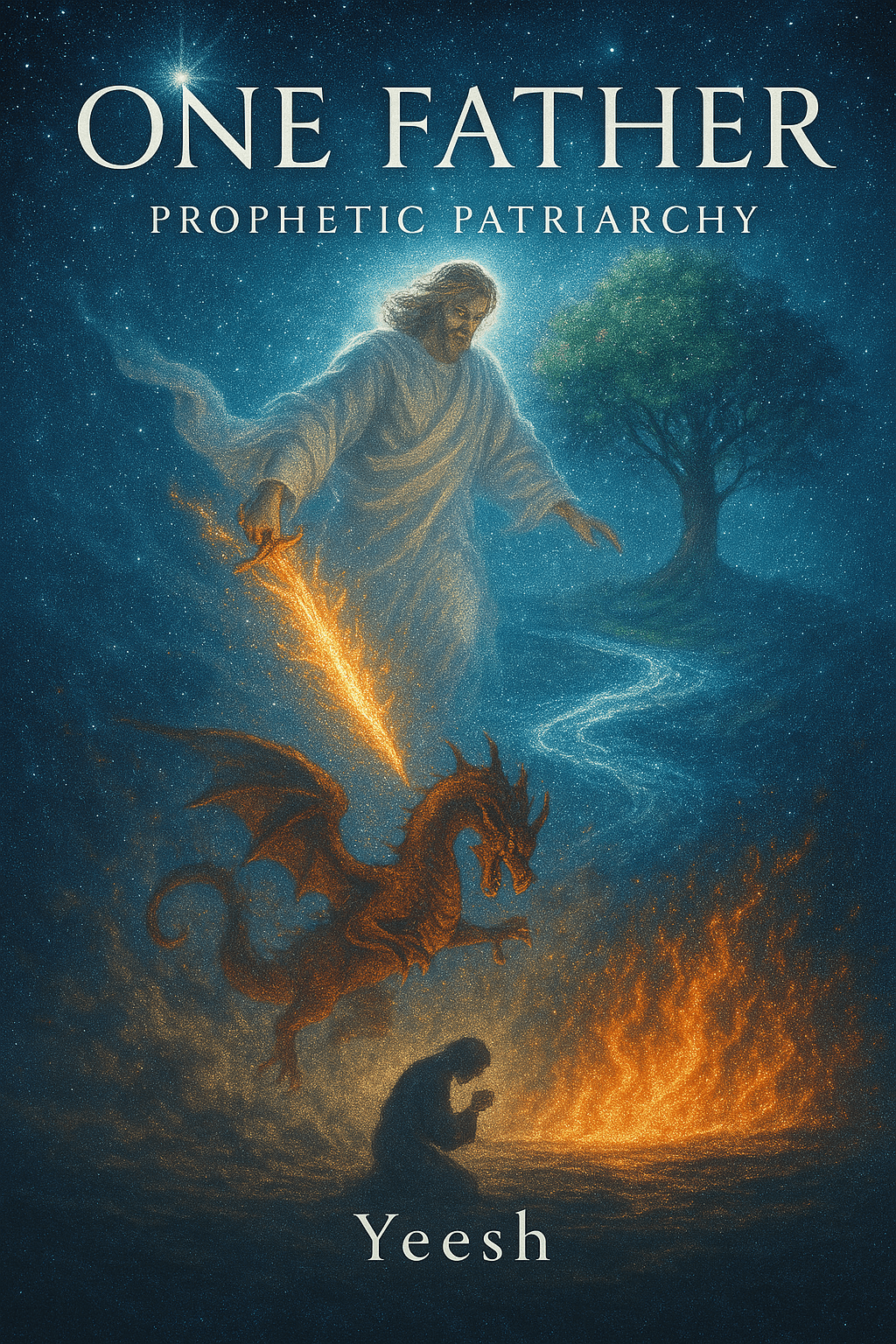
Ironically, those who enforce monogyny as moral law are guilty of doing exactly what they accuse others of. They twist a metaphor into legalism by taking it too literally in the flesh. They nullify Elohim’s actual Law by enforcing their tradition. They reject patriarchal love and provision, thus limiting the fruitfulness Elohim intended in the literal flesh. The irony loop is not without note. In the end, forcing artificial singularity where Elohim has permitted structured plurality is a human error and not a lawful decree, but indeed a tradition of man that has wreaked havoc for millennia. These verses are there for us to think in grander themes, and we can weaponize scripture as we are told to take the sword of the Spirit which is The Word of Elohim (Ephesians 6:17). However we cannot weaponize them against the Body of Messiah. We can however perform careful surgical procedures designed to help bring light to the body. Everything we do must be tempered against that which is The Word and the Spirit of the interpretation. So yes, some of us will yield his Word as a sword, but it should never be to steal, kill, and destroy. His word in the case of the Body of Messiah is a tool to heal, repair, and remove obstacles from eyes and

theological infections from the body. When added with prayer and fasting it is a sure way to bring rejuvenation and life to broken places and hurting people. It is no small thing to rightly divide the Word and to wield the sword of the Spirit not for destruction, but for healing and restoration within the Body. The temptation to fortify tradition, to build fences around the orchard and restrict the movement of living water, is as old as Eden itself. Yet the scroll testifies: when the pattern of creation is honored, when the Law is fulfilled in Spirit and truth rather than bound by the commandments of men, something greater unfolds, which is a return to the Father’s intent where fruitfulness, abundance, and ordered love are restored to the household of faith. In this, we glimpse the true nature of destiny not as a doctrine carved in stone or a future locked behind human reasoning, but as the living current that flows from the garden through every covenant-keeping heart. Destiny is not seized by force or decreed by tradition; it is received and revealed wherever men and women submit to the ancient order, letting the fullness of headship, plurality, and blessing bloom without artificial restraint. The creation ideal is not merely our point of origin, but the pattern by which destiny is continually born, watered, and multiplied generation after generation until the earth is filled with the knowledge of YHWH. So the call is not to retreat into legalism, nor to idolize the past, but to step boldly into the ongoing story for which we were always made. Destiny is both ancient and arriving, hidden in the deep structure of the Word and the rhythm of faithful lives. As we reject traditions that restrict and embrace the covenantal patterns that release, the orchard blooms again and the light of Eden pierces the present darkness. In honoring creation’s design, we don’t just remember our origins but we surely ignite the destiny written into our bones, awakening the fullness the Father intended from the beginning.