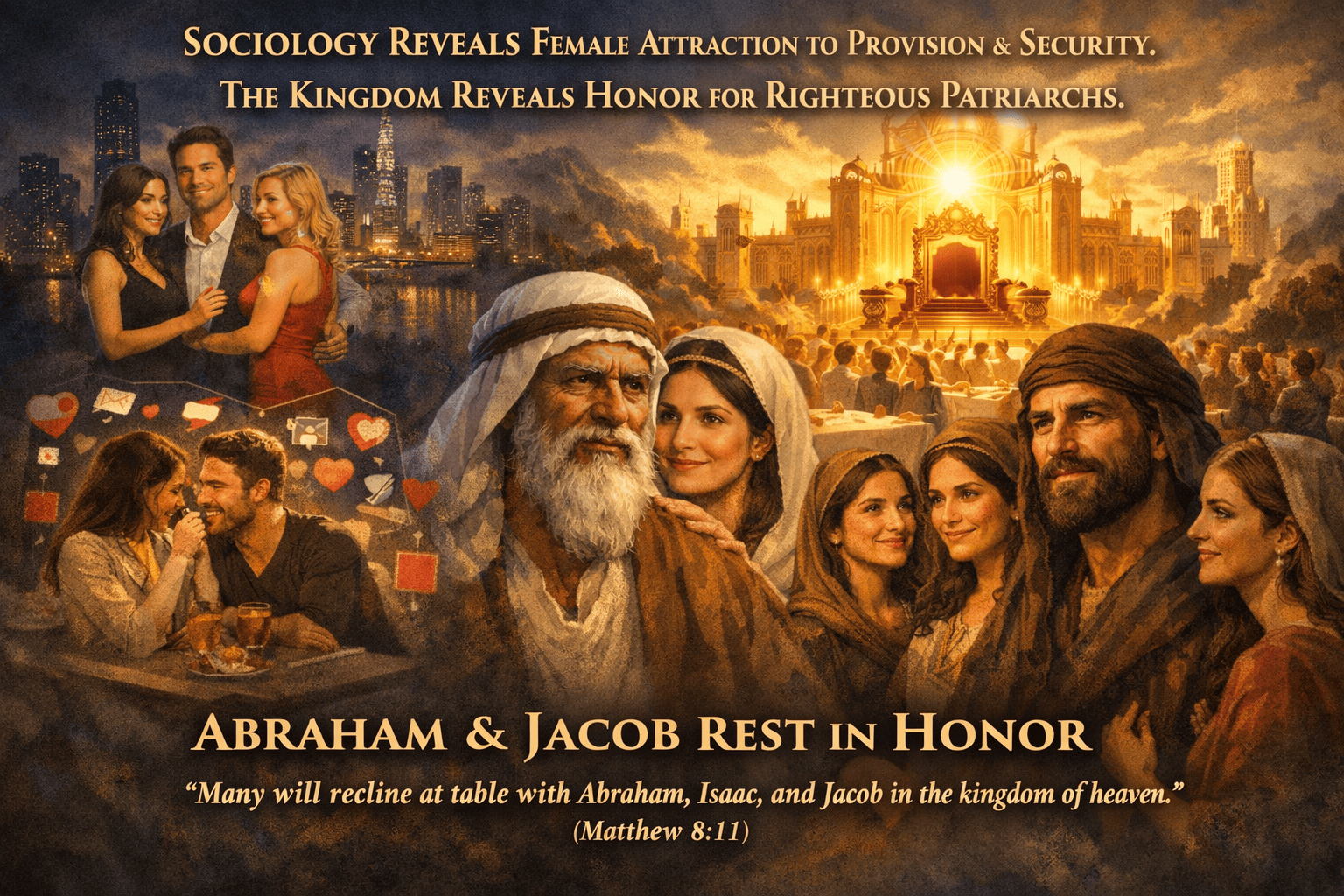
The Monogamy-Only Instinct Has a Sociology Problem
Modern people often speak as though women are naturally repelled by the idea of a highly honored patriarch who already has women around him. But that assumption runs against a great deal of cross-cultural mate-preference research.
No, the evidence does not say women in every place simply chase “the richest guy” in a cartoonish way. Real mate choice is more complex than that. Kindness matters. Character matters. Local customs matter. Family systems matter. But the broad pattern is still difficult to escape: women, on average, are not indifferent to male provision, security, competence, social standing, and publicly recognized honor.
And once that is admitted, a very uncomfortable question appears for modern monogamy-only theology:
If women predictably respond to male honor, provision, and status across cultures, why would the Kingdom of God be the one realm where those same signals suddenly become unattractive?
That is not a small question. It cuts to the heart of how people imagine the Kingdom.
What the Research Actually Shows
The classic 37-culture study by David Buss found that females valued cues to resource acquisition in potential mates more highly than males did. Decades later, a 45-country replication reported that this basic pattern remained robust: women, more than men, preferred older mates with financial prospects, while men, more than women, preferred youth and attractiveness. In other words, the modern world did not erase the older pattern. Large cross-cultural work kept finding it.
That still does not mean women are one-dimensional. Another large cross-cultural study using a “mate budget” design found that kindness, physical attractiveness, and good financial prospects were repeatedly prioritized, and for women specifically, good financial prospects functioned as a necessity rather than a luxury. So the literature does not say, “Women only want money.” It says something more precise: women consistently treat a man’s ability to provide and his social viability as meaningful signals when evaluating long-term partnership.
That matters because it destroys a favorite modern oversimplification. The issue is not whether women care about ethics or affection. They do. The issue is whether provision, stability, and honor stop mattering once we start talking theology. The evidence says no.
Culture Shapes the Expression, Not the Basic Logic
There is also good reason to resist the lazy line that women everywhere ignore marriage norms and simply bolt toward the highest-status male available. Culture clearly shapes how these preferences get expressed. Family control, ethnicity, religion, parental approval, and marriage customs all channel outcomes.
For example, recent work on arranged versus self-choice marriages in Indonesia found only minimal support for large husband-trait differences between the two groups, with stronger effects showing up in shared ethnicity and some education differences rather than in a universal free-choice stampede toward wealth. That is important because it shows that institutions constrain and redirect mate choice. Women respond inside systems.
But that only sharpens the main point.
If women respond inside systems, then the decisive question becomes: What system is forming them?
Babylon forms women one way. The Kingdom forms women another.
The Kingdom Is Not Less Hierarchical Than Fallen Society
One of the strangest modern assumptions is that the Kingdom of God must be flatter, less ordered, less patriarchal, and less honor-saturated than ordinary human culture. Scripture presents the opposite.
The Kingdom has a throne. The Kingdom has inheritance. The Kingdom has ranks, rewards, judgments, banquets, names, crowns, and public recognition. It is not the abolition of order. It is the perfection of order under righteousness.
So if fallen cultures already produce female responsiveness to provision, security, competence, and public esteem, why would the perfected culture of God produce less responsiveness to those things when they are finally attached to righteousness instead of vanity?
It would be far more coherent to say this:
The Kingdom does not erase female attraction to honor. It purifies the object of that attraction.
In Babylon, women may reward flashy status, predatory charisma, or unstable wealth. In the Kingdom, women would be expected to recognize righteous honor, covenant-bearing strength, faithful provision, and publicly vindicated patriarchal authority.
Christ Himself Places Abraham and Jacob in Open Kingdom Honor
This is where the monogamy-only instinct becomes especially difficult to maintain.
“I tell you, many will come from east and west and recline at table with Abraham, Isaac, and Jacob in the kingdom of heaven.” (Matthew 8:11)
“In that place there will be weeping and gnashing of teeth, when you see Abraham and Isaac and Jacob and all the prophets in the kingdom of God but you yourselves cast out.” (Luke 13:28)
Christ does not hide Abraham and Jacob at the edge of the frame. He puts them in the banquet scene. He presents them as honored men in the Kingdom.
And these are not monogamy-only patriarchs.
Abraham had Sarah, Hagar, and later Keturah. Jacob had Leah and Rachel, and then Bilhah and Zilpah were also brought into his household structure. Whatever debates people want to have about motive, pain, or household complexity, the simple fact remains: the men Christ publicly names in Kingdom honor are men whose lives do not fit modern monogamy-only sentiment.
So the relevant question is not whether modern readers feel awkward about that. The relevant question is what women do when a culture publicly honors such men.
And here the sociological evidence becomes highly suggestive.
Honor Attracts. It Does Not Repel.
Across cultures, women tend to treat male provision, competence, protection, and recognized status as meaningful signals. Additional work continues to show that women’s long-term evaluations are not merely about raw money, but about the combination of status with moral reputation. A 2025 study in Scientific Reports found that an ethical reputation enhanced ratings of long-term mating attractiveness and prestige even when set against resource cues.
That is striking for Kingdom theology. The Kingdom does not remove resources, honor, or prestige from the equation. It joins them to righteousness. It fuses moral vindication with public exaltation.
So when Christ depicts Abraham and Jacob reclining in honor at the Kingdom banquet, the idea that women there would be uniquely turned off by such men is not only exegetically awkward; it is sociologically backwards. If anything, the evidence points the other way. Public honor tends to increase attraction when it signals stability, provision, social proof, and enduring worth. Add righteousness to that honor, and the case becomes stronger, not weaker.
The Kingdom Inference
Social science does not prove doctrine. Scripture remains the higher authority. But social science can expose how implausible certain theological instincts really are.
And one very implausible instinct is this: that women throughout the world respond to male honor and provisioning strength, but in the Kingdom they will suddenly view highly honored patriarchs as romantically or relationally undesirable because modern Western monogamy sentiment says they should.
That does not follow from sociology, and it does not follow from Scripture.
A better inference is this:
- Women adapt to moral and marital systems.
- Across cultures, women repeatedly value signals tied to provision, security, and recognized status.
- The Kingdom is the most honor-saturated and publicly ordered culture imaginable.
- Christ explicitly depicts Abraham and Jacob there in honor.
- Therefore, it stands to reason that women in the Kingdom would be drawn toward righteous, honored patriarchs—not turned off by them.
That does not mean lust rules the Kingdom. It means order does. It means truth does. It means honor does. It means female perception is not annihilated in the age to come; it is brought into alignment with reality.
Why This Matters for Biblical Imagination
The real problem here is not the Bible. The real problem is that many readers have been trained by a culture that treats exclusivity itself as erotic virtue and plurality itself as emotional contamination. But Scripture does not speak that way. Scripture repeatedly ties honor, inheritance, fruitfulness, covenant, and household order to patriarchal realities modern people distrust.
So when Jesus openly names Abraham and Jacob in the Kingdom, modern readers have a choice. They can either keep importing modern disgust into the text, or they can allow the text to retrain their instincts.
The sociological evidence does not settle the theology, but it does make one thing very hard to deny: women are not generally wired to recoil from publicly honored, high-value, covenant-capable men. They are far more likely to notice them.
And if that is already true in broken cultures, why would it become false in the Kingdom of God?
Studies Referenced
- Buss, David M. (1989). “Sex Differences in Human Mate Preferences: Evolutionary Hypotheses Tested in 37 Cultures.” Behavioral and Brain Sciences 12(1): 1–14.
- Walter, Kathryn V., et al. (2020). “Sex Differences in Mate Preferences Across 45 Countries: A Large-Scale Replication.” Psychological Science 31(4): 408–423.
- Thomas, Andrew G., et al. (2020). “Mate Preference Priorities in the East and West: A Cross-Cultural Test of the Mate Preference Priority Model.” Journal of Personality 88(3): 606–620.
- Buss, David M., and David P. Schmitt (2019). “Mate Preferences and Their Behavioral Manifestations.” Annual Review of Psychology 70: 77–110.
- Snopkowski, Kristen, et al. (2025). “Partner Traits of Women in Arranged and Self-Choice Marriages.” Evolution and Human Behavior.
- Karthikeyan, S., et al. (2025). “Ethics Trumps Resources in Women’s and Men’s Evaluations of Potential Mates and Competitors.” Scientific Reports.
Conclusion
If women across cultures respond to provision, stability, status, and public honor, then the Kingdom should not be imagined as the one place where righteous, exalted patriarchs become strangely unattractive. Christ’s own Kingdom imagery points in the opposite direction. Abraham and Jacob are not hidden. They are honored.
And if women in the world notice honored men now, then women in the Kingdom—where honor is finally truthful—would have even less reason to turn away from them.
The burden of proof belongs to the person who says otherwise.