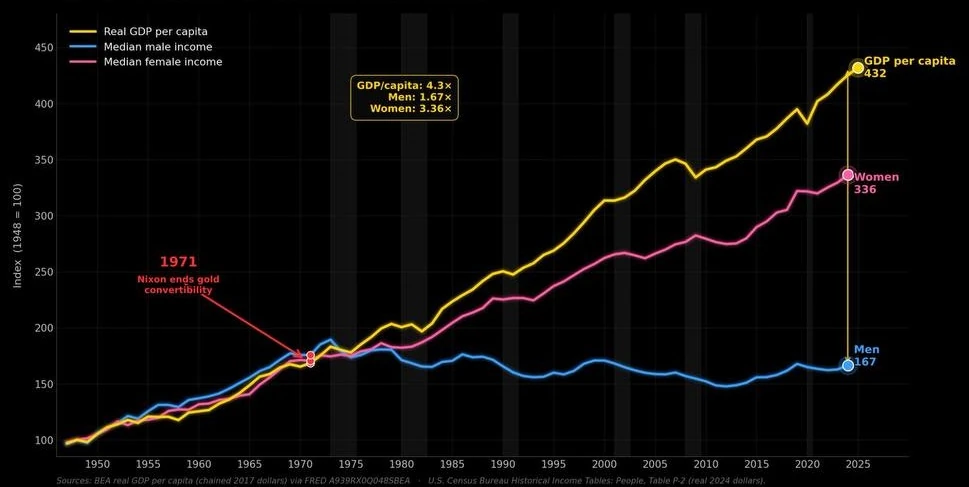
The chart speaks for itself at the surface. Real GDP per capita has multiplied 4.3× since 1948. Median female income has multiplied 3.36×. Median male income has multiplied 1.67×. The headline writer calls it the American Productivity–Pay Disconnect, and that framing is fair as far as it goes. Everyone’s labor has trailed what the nation produced. Women trail the GDP line too. But men — men are not just trailing. The man’s line stops climbing around 1971 and has, in real terms, gone almost nowhere for fifty years.
That is the visible story. There is a second story underneath it, and it is the one I think matters more for those who care about covenant order. I want to tell it carefully, because the easy versions of this argument — the ones that blame women for men’s flat wages, or that pretend men have only been victims in this stretch — are both wrong. Something larger and sadder than either of those happened to us.
The 1971 Hinge
The chart marks 1971 because that is the year Nixon ended gold convertibility. Whatever one thinks of the monetary economics, the line in the picture is undeniable: from 1948 to 1971, all three measures — GDP per capita, men’s wages, women’s wages — rise more or less together. After 1971 they fan apart. GDP keeps climbing. Women’s income keeps climbing, more steeply than before. Men’s income flattens and never recovers its slope.
Something happened to the man’s bread in 1971. And not just in the wallet. The same decade that flattened the wage line also gave us no-fault divorce as a national norm, the cultural mainstreaming of the sexual revolution, the rapid expansion of the welfare state into roles that had previously been held by husbands and fathers, and the beginning of the long argument that fathers were optional. The economic decoupling and the covenantal decoupling occurred in the same window. The currency stopped being tied to gold; the man stopped being tied to the household; the household stopped being tied to him.
This is what I have been calling, in One Father, the slow hollowing of the man through economic pressure, legal restriction, and moral shaming. The chart is one face of that hollowing. It is not the only face. But it is a face the data cannot deny.
What the Bread Was For
In Torah, a man’s earning was never private currency. It was covenantal provision — appointed before the labor began, terminating in a household he was head of.
“If he takes another wife to himself, he shall not diminish her food, her clothing, or her marital rights.” (Exodus 21:10)
The three obligations named there — food, clothing, marital union — are the structure of provision: bread, covering, seed. The man’s labor was already directed toward her body and her shelter and the continuance of her line. His work was not measured in wages. It was measured in whether his house was fed, whether his wife was clothed, whether his marriage bed was honored, whether his seed was carried.
This is also why Adam is placed in the garden “to work it (avad) and keep it (shamar)” (Genesis 2:15). The verbs are not industrial. Avad is the same root used for worship and service. Shamar is guard, watch, preserve. The man labors as a steward inside a territory he is responsible to keep. Strip the territory, and the labor remains, but the steward becomes a hired hand at best — a tax base at worst.
The 3.36× Without the Vow
I want to be careful with the chart, because the easy version of this argument is the wrong version.
Women’s median income has multiplied 3.36×. That, on its own, is no scandal. The Proverbs 31 woman traded; she bought fields; she had income. There is nothing in scripture that forbids a woman from working. Many of those earners are widows, single mothers whose covering was taken from them, never-married women whom no faithful man came to claim, or wives whose households need a second income to survive in a wage environment that has flattened the man’s line for fifty years. The 3.36× is, in many cases, the woman picking up what the system stopped putting in the man’s hand.
The harder question is what has not multiplied alongside the income.
- Marriage rates have collapsed.
- Total fertility has fallen below replacement.
- Roughly seven out of ten divorces are initiated by women, a number that has held stable for decades and crosses class lines.
- Father absence is the single strongest predictor of nearly every social pathology we measure in children.
The earning arrived. The covenantal architecture that the earning was supposed to fortify was, in the same era, being dismantled — partly by the courts, partly by the cultural machinery, partly by men who failed to lead, and partly by women who walked out of marriages many of them later regretted. None of those four causes alone explains what happened. Together they explain it well.
When Provision and Power Came Apart
What I want to name — carefully — is that the system we now live inside has separated who carries the weight from who carries the moral authority, and it has separated them along sex lines in a way that scripture does not.
- The man earns. The 1.67× line keeps climbing, slowly, even as productivity races ahead of him.
- The woman earns also. Her line climbs faster, from a much lower base, on top of the structures the man’s line built.
- In roughly seven cases out of ten, the woman is the one who dissolves the covenant.
- The state then redirects the man’s labor — through alimony, child support, and tax structure — to the woman who chose to leave.
- The cultural register meanwhile tells the man that he was the failed husband, the absent father, the source of the family’s suffering, and a danger to his own children unless supervised.
I do not say this to indict women as a class. Most women in long marriages are faithful, sacrificial, and load-bearing in ways the world rarely acknowledges. Most women who divorced did so under real pain — sometimes for reasons scripture itself names, sometimes because they were poorly led, sometimes because the cultural air they breathed told them a different life was waiting for them. The problem I am naming is not women. It is a structure in which the one whose labor is taxed, whose covenant can be dissolved without his consent, and whose name is publicly diminished is also called the one in power. The economic flows reveal what the rhetoric obscures. Power and blame have been formally separated, and the blame has been assigned to the one still carrying the weight.
To moralize over a man — to call him toxic, inadequate, dangerous, incapable — while drawing on his earnings is not the posture of a covenant partner. It is the posture of a creditor. The covenant calls both partners higher than that.
How We All Ended Up Here
I want to speculate, because the question is unavoidable. The chart shows the symptom. It does not show the cause. And anyone who reads only the chart will conclude that men are simply less productive, less ambitious, or less adapted to the modern economy. That is the cover story. I think the truer story is older and involves all of us.
In One Father I argue that the dragon’s warfare against headship runs along three lines simultaneously: economic pressure, legal restriction, and moral shaming. He cannot remove the man directly without provoking the very order he is trying to undo. So he hollows the man instead.
Economic pressure: the wage was severed from the productivity it generates, so that the man working harder than his father gets less than his father got. The 1.67× line is that. The man cannot provide as a single earner the way his grandfather did, so the wife must work, so the household must defer children, so the children come fewer and later, so fertility collapses, so the population must be replaced by other means, so the household structure that depended on the man’s sole sufficiency is quietly retired as nostalgic and impractical.
Legal restriction: the covenant was rewritten so the man is bound to it whether the woman keeps it or not. No-fault divorce means the woman can leave without cause and take the household with her. Custody defaults assume she is the primary parent. Child support attaches to the man whether or not he was the one who broke the bond. The covenant became one-way: he is held; she is freed.
Moral shaming: a generation of cultural product — films, sitcoms, talk shows, ad campaigns, classroom curricula, corporate training — was funded in which the father is buffoonish, the husband is the source of every household tension, the male instinct toward provision and protection is reframed as control, and the very desire for headship is itself the disease. A boy raised inside this culture cannot easily aspire to head a house, because he has been told from the cradle that to want to is already to be the villain.
And men contributed to this. I will not pretend otherwise. A great many men in this same window opted out: of marriage, of fatherhood, of sobriety, of fidelity, of the daily small labor of headship. Pornography became industrial. Drinking and despair rose. Sons grew up watching fathers who were physically present and covenantally absent. The cultural accusation that men had abandoned the household had partial purchase precisely because, in many homes, men had. The dragon’s strategy worked partly because we let it. A faithful diagnosis names the spiritual war and our complicity in it. Both are true.
The three lines run together. The wage flattened, the legal structure tilted, the moral story turned, and the man — pressed by all three — was told that his hollowing was liberation. For everyone. Including him. Many men believed it. Many women believed it. Most of us, in some way, are still living inside what we believed.
What Reciprocity Was Supposed to Look Like
The biblical pattern is not that the man earns and the woman receives. It is that the man earns into a covenant, the woman receives and multiplies what is given, and the household becomes more than either could have made alone. Proverbs 14:1 says the wise woman builds her house. Proverbs 31:11 says the heart of her husband trusts in her, and he will have no lack of gain. The reciprocity is real and it is structural: he covers, she builds; he provides, she multiplies; he protects, she nurtures the seed; the children grow inside an order that is older than either of them.
What the chart shows, alongside the divorce numbers and the fertility numbers, is that this pattern has thinned out in our generation. The man still labors — less rewarded, but still laboring. Many women still build — faithfully and quietly, more than the culture credits. But the structural supports that used to make reciprocity the easy path have been removed, and what remains in their place are incentives that often pull in the opposite direction. Marriage is treated as a private preference instead of a covenant under God. Divorce is treated as self-actualization instead of the breaking of an oath. Fatherhood is treated as a hobby instead of a calling. Motherhood is treated as a sacrifice instead of a glory. Inside that arrangement, even good people make worse choices than they would have made under a healthier order.
This is not most women individually, and it is not most men individually. It is the structural pattern of the era. And it cannot continue. A civilization in which men are taxed, blamed, and quietly replaced cannot reproduce itself. The chart, the divorce numbers, and the birth rates are saying the same thing in three different languages.
The Way Back
I do not write this to grieve, and I do not write it to condemn. I write it because the same scripture that names the hollowing also names the restoration, and the restoration begins where every restoration begins: with people willing to see the situation honestly and turn.
“And in that day seven women shall take hold of one man, saying, We will eat our own bread, and wear our own apparel: only let us be called by thy name, to take away our reproach.” (Isaiah 4:1)
Isaiah 4:1 is not a fantasy. It is the prophetic shape of what comes after the kind of collapse our chart is sketching. Women, having outlived the structure that promised them autonomy, voluntarily seek covenantal covering under faithful men — bringing their own bread and their own clothing, asking only for the name. The provision that the covenant once required of the man is, in the restoration, willingly carried by the woman, because what she now wants is not material support but covering. The reproach of being uncovered, of having no name, of having no head, becomes the thing she most wants removed.
The current order rewards the absence of headship. The coming order will reward its presence. The man who keeps walking faithfully through this stretch — who works without being properly rewarded, who heads his house without being culturally affirmed for it, who refuses to abandon the covenant the courts say he can walk away from — that man is being shaped, in the dark of this age, into the kind of head an Isaiah 4 woman will recognize. And the woman who, somewhere in this same dark, begins to suspect that what she was sold was not freedom but exposure — that woman is being shaped into the kind of bride a faithful head will be honored to cover.
The chart is real. The hollowing is real. The decoupling of male labor from male covering is real, and it is one of the largest social emergencies of our age. But the same God who appointed the man’s bread to feed his house has not abandoned the pattern. The line will turn back. The covering will be restored. The seed will yet multiply.
If you are a man reading this and feel the weight of how far the pattern has slipped — including the parts where you yourself have slipped — the call is not despair. The call is to return to the covenant in front of you. Feed your house. Cover your wife. Father your children. Refuse the cultural script that says your headship is the problem. Walk it out small and faithful.
If you are a woman reading this and feel something tighten when the divorce statistic lands — not anger, but a quieter recognition — the call is also not despair. The call is to ask, honestly, where the cultural script has shaped your view of marriage, of men, of covering, of submission, of what a household is for. Many women are coming to that question in this hour. Scripture has been waiting for them with the older, kinder answer.
The chart will not be the last word. The covenant will. And the way back — for both of us — begins with telling the truth about how we got here, and turning.
→ Read One Father (Free PDF)
→ Back to the Blog
— May 1, 2026