
The Man Outside the Timeline
Most people read Genesis 1 and 2 as if the only question is chronology. They want the text to behave like a stopwatch. First this happened, then that happened, then the next event happened. But Genesis is not merely a sequence of events. It is a prophetic structure. It is a house built with days, names, seeds, waters, lights, beasts, man, woman, and rest.
When Adam is read as formed on the third day, the reader is forced to rise above the flatness of ordinary sequence. He is no longer simply asking, “Where do I place this event on a timeline?” He is asking, “What is the Spirit revealing by arranging the text this way?” That is a different kind of sight.
And that sight matters. Because Scripture itself teaches that God declares the end from the beginning. The beginning is not merely the beginning. It is the end in seed form. Genesis is not only where the story starts. It is where the story is buried, waiting to be resurrected in understanding.
“To read Adam on the third day is not merely to move Adam backward in a timeline. It is to move the reader upward into a resurrection vantage.”
Isaiah gives the key: YHWH declares the end from the beginning, and from ancient times the things not yet done (Isaiah 46:9–10). That means the beginning is never merely the beginning. It is the seedbed of the end. Genesis does not only report what happened first; it contains, in seed form, where the whole story is going.
This is why the apostolic mind does not read by flesh alone. Paul says the Spirit searches even the depths of God, and that the spiritual man discerns what the natural man cannot receive. He concludes, we have the mind of Christ (1 Corinthians 2:10–16). The point is not that a man becomes God. The point is that the Spirit trains a man to see the Word from the Head rather than from the dust.
The Difference Between Chronology and Prophetic Structure
A flat chronological reading asks whether Genesis 2 happened before or after Genesis 1. A prophetic reading asks why Genesis 2 presents the man in a pre-sprouting, ground-centered, seed-bearing environment before the full emergence of the garden, before the naming of the creatures, and before the woman is built from his side.
Genesis 2:5 says that no plant of the field had yet sprung up because there was no man to work the ground. Then YHWH Elohim forms the man from the dust of the ground. Then, out of the ground, YHWH causes trees to spring up. That movement matters. The man is not merely dropped into a finished world. He is formed at the threshold of emergence. He is placed where ground, seed, water, breath, and vocation meet.
This is why the third-day reading is more than a date claim. It is a structural claim. Dry land appears. Seed-life is appointed. The ground is made ready. Then the man is formed from that ground, and the garden begins to rise in his sight. The first Adam is not merely made in time. He is planted in a pattern.
Adam Carried Through the Days
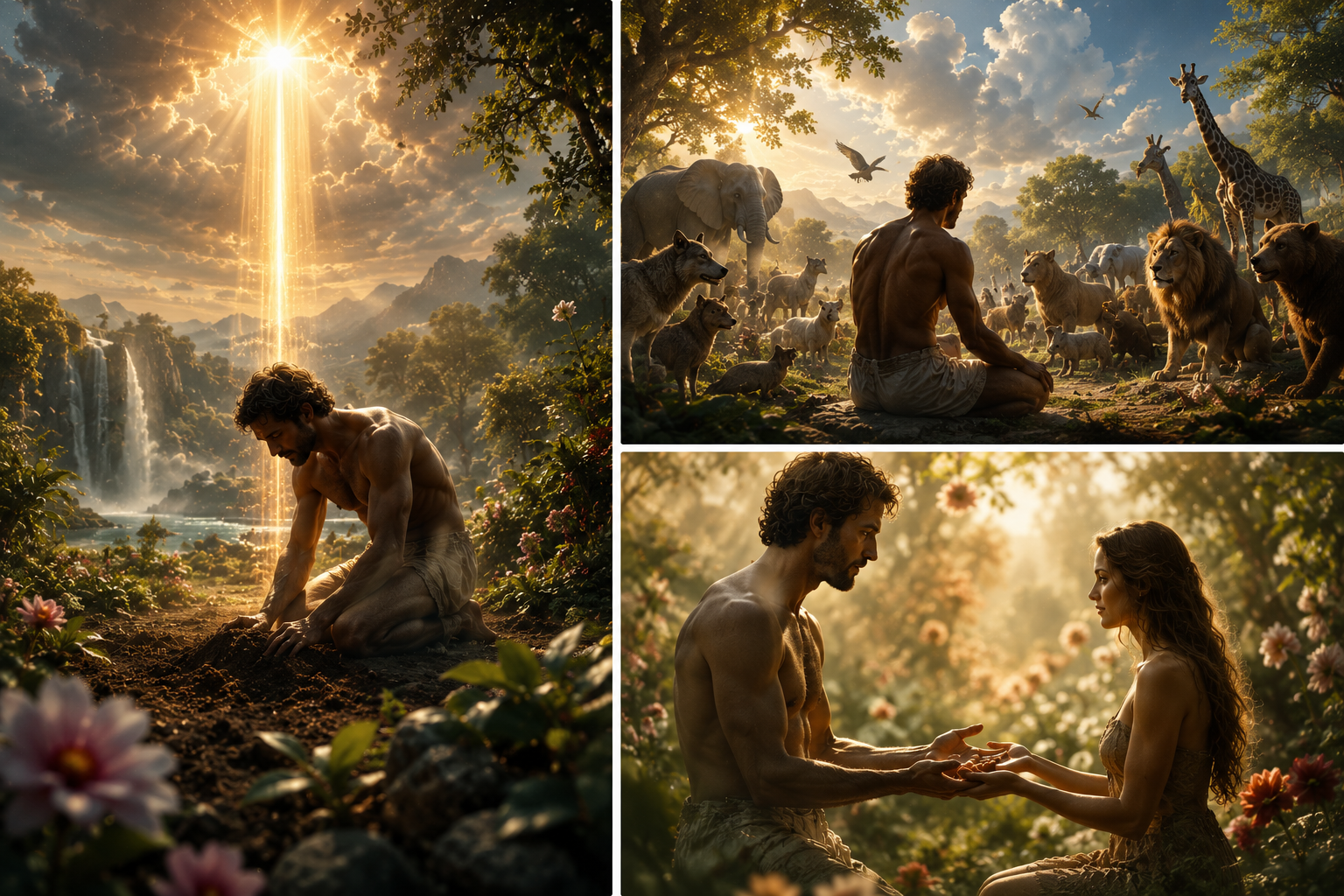
In this reading, Adam is not locked into a single moment. He is carried through the creation week as a living thread. He rises from the third-day ground. He stands amid the forming and naming of living creatures. He searches and finds no helper corresponding to him. Then, near the crown of the sixth day, the woman is built from his side and humanity is revealed as male and female.
That means Adam is not merely an event inside the days. He becomes a prophetic line running through them. He is formed in seed. He is brought into vocation. He names the living. He receives the woman. He approaches Sabbath. He is aimed at rest.
But the first Adam does not complete the movement. He reaches toward the wrong tree. He falls short of Sabbath fullness. He collapses back toward the dust from which he was taken.
The Last Adam completes what the first Adam failed to carry. Yeshua descends into the earth, rises on the third day, receives all authority in heaven and earth, and brings many sons to glory. The first Adam is formed from the ground on the third day pattern. The Last Adam rises from the ground on the third day fulfillment.
The Reader from Above
This is where the idea becomes personal. When a man begins to see Genesis structurally, he is not becoming God. He is not escaping creation. But he is learning to read from above rather than from the dust alone.
Paul says that the natural man does not receive the things of the Spirit, because they are spiritually discerned. He also says, “We have the mind of Christ.” That means the resurrected Head gives His people a new way to see. The believer is still in time, but he is no longer enslaved to the fallen mind’s flat reading of time.
In Messiah, the saints are already raised and seated in heavenly places. The body still waits for redemption, but the mind can already begin to participate in the age to come. This is not the final resurrection body. It is the firstfruits of resurrected sight.
The body still walks in time, but the renewed mind begins to read from the resurrection side of time.
This is why Ephesians says God has raised us up with Messiah and seated us with Him in the heavenly places (Ephesians 2:4–6). The body still walks inside time, but the renewed mind learns to seek those things which are above, where Messiah is seated at the right hand of God (Colossians 3:1–4).
Abraham gives an ancient witness to this kind of sight. Yeshua said, Abraham rejoiced to see my day: and he saw it, and was glad (John 8:56). Hebrews says the faithful saw the promises from afar and embraced them before receiving them in full (Hebrews 11:13). Faith can see fulfillment before the calendar reaches it.
John shows the same principle apocalyptically: he was in the Spirit on the Lord’s day (Revelation 1:10), and the Spirit opened history from a heavenly vantage. That is the safer way to say it: not that the man becomes timeless in himself, but that the Spirit gives him a resurrection vantage inside time.
The Lowkey Fulfillment of the Resurrected Saints
This is why the “timeless” language works, as long as we handle it carefully. The man who reads Genesis this way is not timeless in the absolute sense. Only God declares the end from the beginning by nature. But the man in Messiah is being trained to think from the Head. He is learning to see the beginning in light of the end, the seed in light of the fruit, the dust in light of resurrection.
That is a lowkey fulfillment of the resurrected saints in seed form. Not the fullness. Not the final body. But the mind of the coming age breaking into the present one.
The prophets saw from afar. Abraham saw Messiah’s day and rejoiced. John was in the Spirit and saw the unveiling. The saints are called to seek the things above, where Messiah is seated. So when a man reads Genesis from that vantage, he is participating in the very kind of sight Scripture promises to the sons of God.
The Beginning from the End
The irony is that the man who sees Adam on the third day may be accused of disrupting the timeline. But perhaps he is actually seeing the deeper timeline: seed, burial, rising, naming, bride, dominion, and rest.
That is the true prophetic movement. It begins in the ground and ends in glory. It begins with Adam formed from dust and ends with sons conformed to the image of the Last Adam. It begins with a garden and ends with a city. It begins with a man put to sleep for a bride and ends with Messiah pierced for His bride. It begins with the third-day ground and ends with the seventh-day rest of the Kingdom.
So the reader has not left Scripture. He has stepped deeper into it. He has not escaped time by imagination. He has been lifted into pattern by the Spirit. He has begun to read as a son seated with the Son, looking at the beginning through the resurrection that was hidden there all along.
Final Thought
Adam on the third day is not only about Adam. It is about the kind of man who can see Adam there. It is about the restoration of prophetic sight. It is about a son no longer reading as an orphan trapped in flat chronology, but as one raised with Messiah, learning to behold the Word from above.
The first Adam was formed from the ground. The Last Adam rose from it. And the sons who belong to Him are learning to read the ground correctly.