Samson Was Not the Fool
Samson has been flattened by readers who should have trembled before interpreting him.
He is often preached as a warning label: strong body, weak morals, bad taste in women, tragic end. But that is not how Judges introduces him. Judges introduces him through an angelic announcement, a barren womb, a consecrated head, and a divine mission against Philistine rule.
“For, lo, thou shalt conceive, and bear a son; and no razor shall come on his head: for the child shall be a Nazarite unto God from the womb: and he shall begin to deliver Israel out of the hand of the Philistines.”
— Judges 13:5
That sentence should govern the story.
Samson is not first a psychological case study. He is not first a failed man to be dissected by domesticated religion. He is a marked head in an occupied land, raised up when Israel had already learned to live beneath the wrong rulers.
And that may be why so many readers misread him. Samson does not fit the moral categories of a comfortable people. He is not polite enough to be safely admired. He is not tidy enough to be easily defended. He is not tame enough to be welcomed by a Judah that has already said, “Knowest thou not that the Philistines are rulers over us?” (Judges 15:11).
But the Spirit of YHWH keeps interrupting the story.
That is the fact modern moralism cannot survive.
The Text Introduces Him by Consecration, Not Failure
The first thing Scripture wants us to know about Samson is not that he is reckless, lustful, or foolish. The first thing Scripture tells us is that he is chosen before birth.
His mother is barren. An angel appears. A son is promised. The child is marked before he breathes his first breath. He is not a self-made warrior. He is not a random strongman. He is a consecrated deliverer from the womb.
That matters because the reader has no right to demote the man below the narrator’s introduction. If heaven introduces a man by consecration, we should be careful about introducing him by accusation.
The common reading says, “Samson was strong, but foolish.”
The text says, “Samson was consecrated from the womb, and he would begin to deliver Israel.”
Those are not the same frame.
This does not mean Samson was sinless. Scripture gives us no reason to make him morally perfect. But it does mean we should not impose judgments the text itself does not explicitly impose. The Torah-aware narrator knows how to condemn sin. Scripture is not shy when it wants the reader to see rebellion. Yet in the Samson cycle, the repeated emphasis is divine purpose, Spirit movement, enemy provocation, and eventual judgment on a false god’s house.
“But his father and his mother knew not that it was of the LORD, that he sought an occasion against the Philistines.”
— Judges 14:4
That verse is not decorative. It is a hermeneutical key.
Samson’s movement toward Philistine territory is not presented as mere appetite. His own parents do not understand what is happening, but the narrator tells us: YHWH is seeking an occasion against the Philistines.
That does not erase human responsibility. But it does expose shallow readings. The story is not merely about a man who cannot control himself. It is about YHWH using a consecrated man to create conflict with an occupying enemy that Israel had grown too willing to tolerate.
For the earlier foundation of this reading, see Samson: Asymmetric Warfare, Samson: Sleeper Cell of Consecrated Headship, and Out of the Strong Came Forth Sweetness.
The Hair Was Not Magic. It Was the Battlefield of the Head.
The hair of Samson has often been treated like a children’s story device, as if Samson had a magical weakness and Delilah guessed the password. But the law was not hidden. Israel had the Torah. The Philistines were not ignorant of religious signs. Samson’s head was visibly marked.
Numbers 6 says the Nazirite’s separation is upon his head:
“All the days of the vow of his separation there shall no razor come upon his head… he shall be holy, and shall let the locks of the hair of his head grow.”
— Numbers 6:5
The hair was not folk magic. The hair was not biological fuel. The hair was the public sign of consecration. It testified that Samson did not belong to himself.
So when the Philistines pursue the secret of Samson’s strength, they are not merely trying to solve a physical mystery. They are trying to identify the point of covenantal attachment. They want to know where the man is bound to his God.
Delilah’s extraction is therefore not just seduction. It is ritual warfare against the marked head.
The enemy is not trying to give Samson a haircut. The enemy is trying to sever the visible sign that this man belongs to YHWH.
And if we read the story this way, the target becomes obvious: Samson’s headship is the battleground. His hair is the sign. His secret is the point of access. The woman becomes the channel through which enemy rulers attempt to reach the consecrated head.
That is not a modern dating lesson. That is war.
Information Warfare, Not Stupidity
Samson’s story is full of words, riddles, secrets, interpretations, accusations, withheld information, and forced disclosure.
At the wedding feast, Samson gives a riddle:
“Out of the eater came forth meat, and out of the strong came forth sweetness.”
— Judges 14:14
The Philistines cannot solve it by wisdom. They solve it by pressuring the woman. The pattern is established early: they cannot defeat Samson directly, so they weaponize intimacy to extract what they cannot conquer.
Samson understands this. His response shows that he knows what happened:
“If ye had not plowed with my heifer, ye had not found out my riddle.”
— Judges 14:18
That is not the line of a clueless man. That is a man identifying the method of attack.
Later, with Delilah, the same structure intensifies. The enemy does not meet Samson in the open field. They bribe intimate proximity. They ask for the secret. Samson gives false answers. Once, twice, three times, he withholds the truth and watches the trap spring. The pattern is too obvious to call simple stupidity.
Samson is not unaware that Delilah is testing him. Every false answer is immediately followed by an ambush. He knows the room is compromised.
So the question is not, “How could Samson be so dumb?”
The deeper question is: Why does the story move from riddles to ropes to hair to blindness to the temple?
Because the war is escalating from border conflict to structural collapse. The Philistines want the secret of the consecrated head. YHWH is seeking an occasion against the Philistines. And Samson’s humiliation becomes the road by which he is placed between the pillars of Dagon’s house.
The Narrator Does Not Condemn Samson the Way Preachers Do
This is where we need discipline.
It is possible to say Samson may have sinned. It is not faithful to say every strange action in the story is obviously sin simply because it offends our modern religious instincts.
Scripture knows how to condemn when condemnation is the point. David is confronted. Saul is rejected. Eli’s house is judged. Achan is exposed. Israel’s idolatry is named. The prophets do not mumble when sin must be called sin.
But the Samson narrative repeatedly gives us another set of signals:
- He is announced by an angel.
- He is consecrated from the womb.
- His mission is to begin deliverance from the Philistines.
- His movement toward Philistine conflict is said to be “of YHWH.”
- The Spirit of YHWH comes upon him repeatedly.
- At the end, he prays and God strengthens him.
- Hebrews remembers him among the faithful.
“And what shall I more say? for the time would fail me to tell of Gideon, and of Barak, and of Samson…”
— Hebrews 11:32
That does not make Samson flawless. But it does mean we should hesitate before making him a punchline.
The modern reading often treats Samson as if the main point is, “Do not be like him.” Hebrews does not seem embarrassed to name him among the faithful. Judges does not present him as a mere cautionary tale. The Spirit does not abandon the story after the first uncomfortable scene.
So perhaps the problem is not that Samson is too morally confusing for Scripture.
Perhaps the problem is that Samson is too dangerous for domesticated readers.
Samson Embarrasses Comfortable Israel
One of the most revealing moments in the Samson cycle comes when the men of Judah confront him.
“Knowest thou not that the Philistines are rulers over us? what is this that thou hast done unto us?”
— Judges 15:11
That sentence exposes the condition of Israel.
Judah is not thinking like a free people. Judah is thinking like a managed people. They are not offended that the Philistines rule over them. They are offended that Samson has disturbed the arrangement.
This is why Samson has to be read as a deliverer under occupation. He does not merely fight Philistines. He exposes Israel’s accommodation to Philistine rule.
That is what prophetic deliverers often do. They embarrass the compromised people before they defeat the obvious enemy.
Samson makes occupation costly again.
He forces the question: who actually rules Israel?
The Philistines? Judah’s fear? Or YHWH?
And this is where modern readers may be closer to Judah than to Samson. We prefer controlled religion, moral tidiness, reputation management, and respectable heroes. Samson does not give us that. He gives us disruption. He gives us riddles. He gives us jawbones. He gives us foxes with firebrands. He gives us the collapse of a pagan temple.
Samson is not safe. But neither is deliverance.
More Last Adam Than First Adam
The shallow reading makes Samson a replay of Adam: a strong man undone by a woman.
There is truth in the echo, but not enough truth. Samson’s story does touch Adamic themes: woman, desire, sleep, loss, eyes, humiliation, and enemy triumph. But the story does not end in Adam’s pattern. It bends toward the Last Adam.
The first Adam sleeps and wakes to the beginning of the fall. Samson sleeps and wakes into captivity, but his captivity becomes the road to judgment against a false god.
The first Adam’s eyes are opened into shame. Samson’s eyes are taken, yet he sees his mission more clearly blind than Israel saw with sight.
The first Adam hides among trees. Samson stands between pillars.
The first Adam preserves himself and shifts blame. Samson lays down his life and takes the enemy house with him.
The first Adam’s failure strengthens the serpent’s dominion. Samson’s death crushes the structure of Dagon’s glory.
If Samson were merely another first Adam, the story would end with a man seduced, shorn, blinded, and mocked. But it does not end there. It ends with prayer, remembrance, renewed strength, outstretched arms, and the collapse of a false temple.
The final Samson is not hiding from judgment.
He is bearing judgment into the house of a false god.
This is why Samson belongs inside the larger pattern explored in One Father. Headship in Scripture is not mere control. It is covenant responsibility, exposure, burden, warfare, and, when necessary, sacrificial confrontation with false order. Samson is not a clean modern moral example. He is a prototype of consecrated headship under occupation.
That makes him less like the first Adam than many readers admit, and more like a shadow of the Second Man than many have dared to consider.
The Outstretched Arms and the Pillars
The final scene of Samson is one of the most powerful images in Judges.
He is blinded. He is mocked. He is placed in the house of Dagon while the Philistines celebrate their god’s victory.
“Our god hath delivered Samson our enemy into our hand.”
— Judges 16:23
That is the issue. The Philistines interpret Samson’s humiliation theologically. They believe Dagon has defeated YHWH’s consecrated man.
So the final battle is not merely Samson versus Philistines. It is YHWH versus Dagon.
Then the text gives one quiet reversal:
“Howbeit the hair of his head began to grow again after he was shaven.”
— Judges 16:22
The sign returns before the judgment falls.
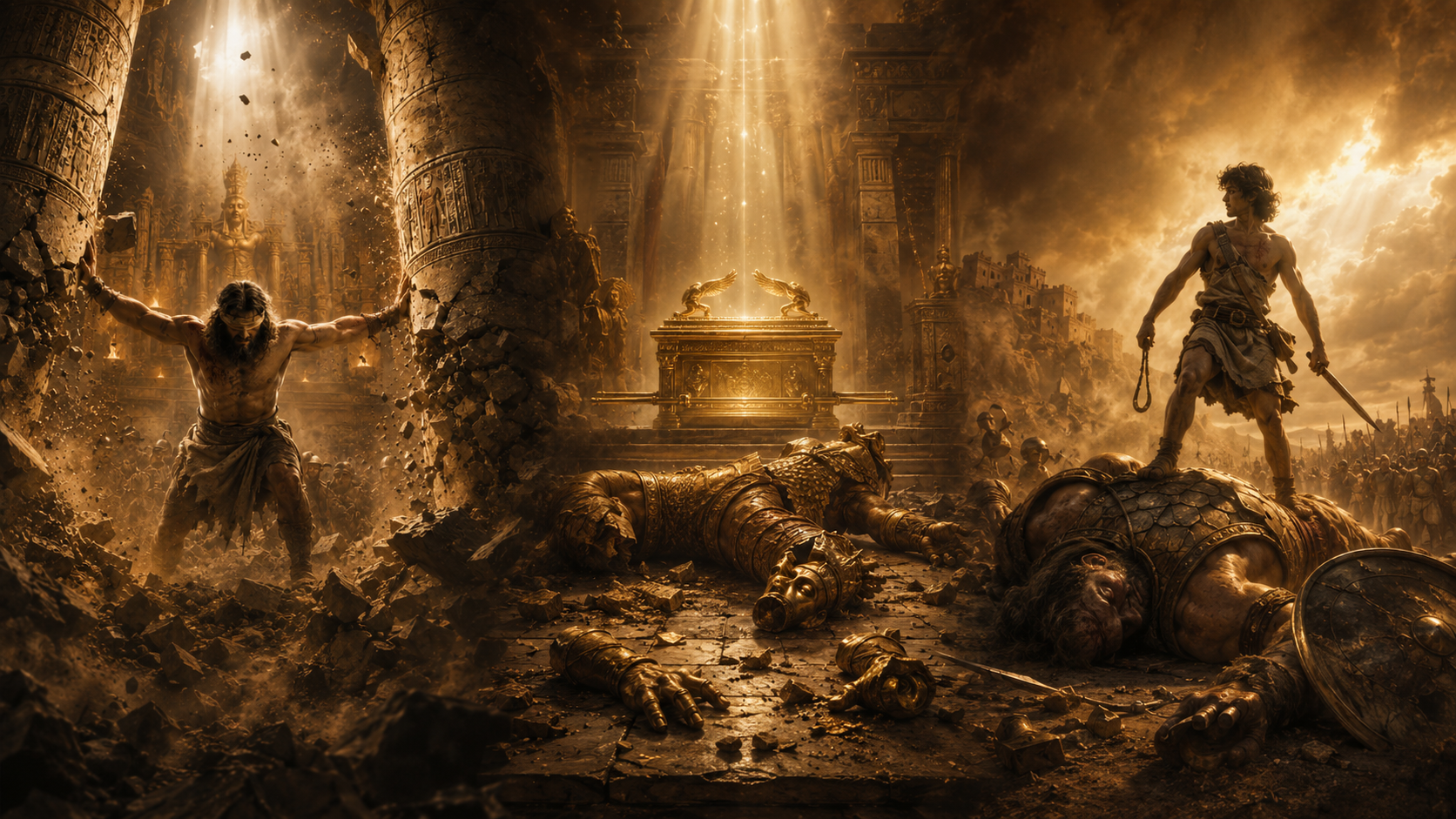
Samson asks to be placed where the house can be touched. He reaches for the pillars. He prays.
“O Lord GOD, remember me, I pray thee, and strengthen me, I pray thee, only this once…”
— Judges 16:28
Then he bows with all his might.
This is not the death of a fool. This is the death of a consecrated man who knows exactly where the weight-bearing points are.
The man who once killed with a jawbone now brings down a house with his hands. The man whose head was targeted now collapses the temple of the false head. The man whose eyes were taken now sees the architecture of judgment.
He dies, but Dagon’s house falls.
Samson Begins What Samuel Continues
Judges 13:5 says Samson would begin to deliver Israel from the Philistines.
That word matters.
Samson’s mission was not to complete the entire Philistine war in one lifetime. His mission was to begin the rupture. He was the first crack in the Philistine-Dagon order.
And once we see that, the next movement in Scripture becomes stunning.
After Samson, another barren woman cries out for a son. Another child is marked with “no razor” language. Another child becomes central to Israel’s transition out of the chaos of Judges. His name is Samuel.
“Then I will give him unto the LORD all the days of his life, and there shall no razor come upon his head.”
— 1 Samuel 1:11
Samson and Samuel are not identical, but they rhyme.
Samson is given through a barren womb by angelic announcement. Samuel is given through a barren womb by answered prayer.
Samson is marked by no razor. Samuel is vowed with no razor.
Samson begins deliverance from Philistine rule. Samuel leads Israel into prophetic order against Philistine oppression.
Samson brings down the house of Dagon. In Samuel’s era, Dagon himself falls before the ark.
“Behold, Dagon was fallen upon his face to the earth before the ark of the LORD; and the head of Dagon and both the palms of his hands were cut off upon the threshold.”
— 1 Samuel 5:4
Do not miss the echo.
Samson’s head was targeted. Samson’s hands were placed on the pillars. Then later, Dagon’s head and hands are cut off before the ark of YHWH.
Samson cracked the house. Samuel’s era watched the idol fall. David’s era would cut down the giant.
Samson is not an embarrassment in the deliverance arc.
He is the opening rupture.
The Collapse of False Headship
Dagon’s house is not just a building. It is a visible structure of false headship.
At the top are the lords of the Philistines. Beneath them are the people. Above them, in their imagination, is Dagon. And into that house they bring Samson, the consecrated head of Israel’s disruption, to make him entertainment.
False gods always turn conquered men into spectacle.
But YHWH turns the spectacle into judgment.
That is the irony of the story. The Philistines think Samson has been reduced to theater. In reality, he has been positioned at the load-bearing center of their religious order.
This is why the “foolish Samson” reading is too small. It cannot explain the architecture of the ending. It cannot explain why the final scene is a temple. It cannot explain why the story moves from hair to pillars, from secret to structure, from humiliation to worship war.
Samson’s final act is not random vengeance. It is the collapse of false headship.
The marked head is humiliated before the false head, and then the false house falls.
Why the Moral Cartoon Must Die
The moral cartoon of Samson survives because it is easy.
It gives preachers a simple lesson: do not chase women, do not waste your strength, do not reveal your secrets, do not be like Samson.
There are warnings in the story, yes. But if warning is all we see, we have not read deeply enough.
Samson is more than a warning. He is a witness.
He witnesses against Israel’s comfort under occupation. He witnesses against Philistine power. He witnesses against Dagon. He witnesses that YHWH can work through a man whom polite religion cannot easily manage. He witnesses that consecration may bring a man into conflict long before it brings him into honor.
And he witnesses that humiliation is not always defeat.
Sometimes humiliation is positioning.
Sometimes captivity is the corridor to the pillars.
Sometimes blindness sees what sighted men refuse to see.
Sometimes the man everyone mocks is the one God remembers.
Conclusion: When the Hair Began to Grow Again
Samson was not the whole deliverance.
He was the beginning.
He cracked the house. Samuel would see Dagon fall. David would cut down the giant. But Samson was the womb-consecrated rupture that made Philistine rule costly again.
So let the reader be careful.
The text does not remember Samson as a punchline. Hebrews remembers him among the faithful. Judges remembers him as the man through whom YHWH began to deliver Israel. And Dagon’s house remembered him as the blind man who saw enough to bring the pillars down.
Samson was not a fool.
He was a consecrated head under occupation.
And when his hair began to grow again, the house of the false god was already doomed.