The Question
At first glance, “the circle of the earth” and “the four corners of the earth” sound like competing images. A circle has no corners. A square has corners. So the modern reader is tempted to choose one image and discard the other.
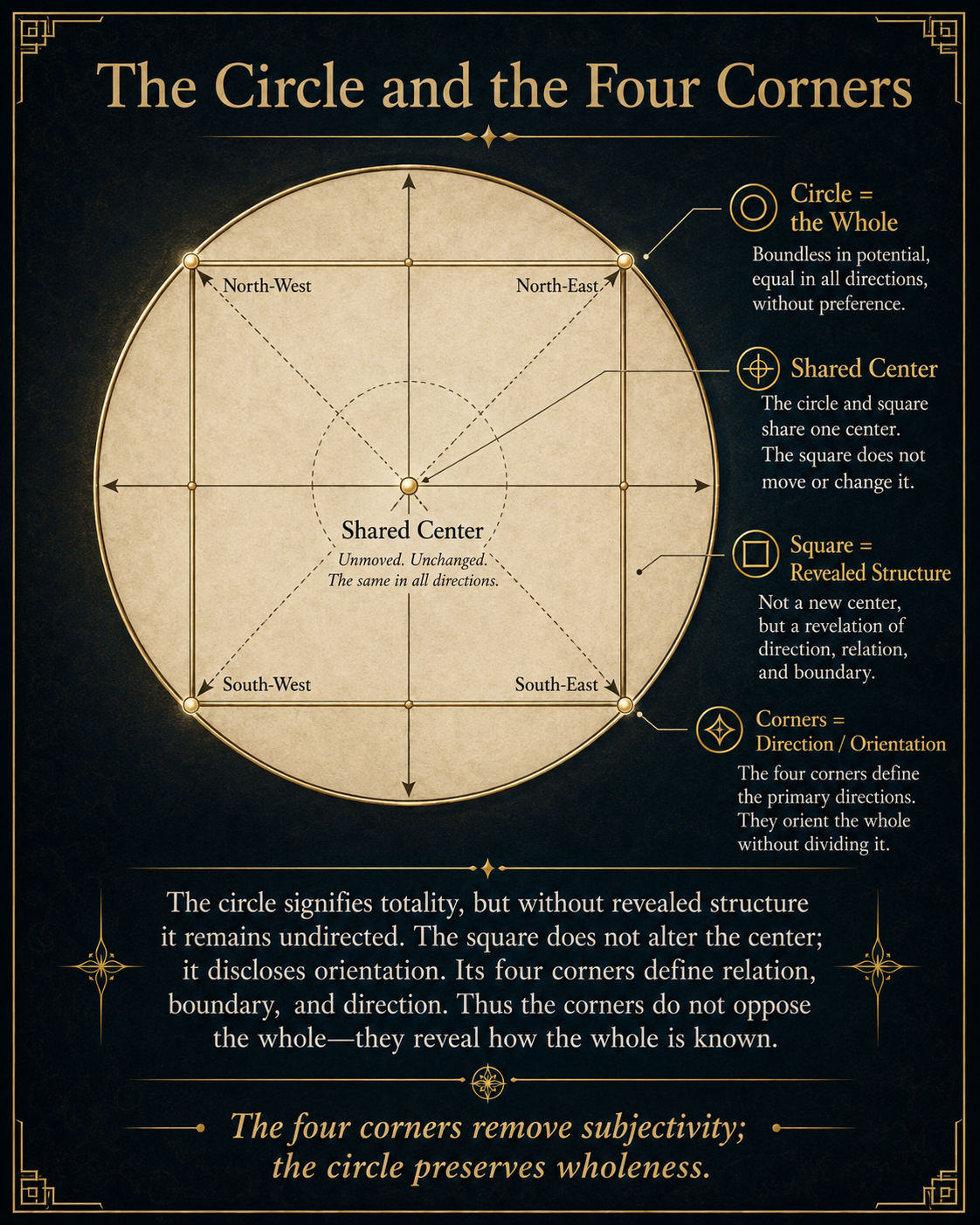
But Scripture often speaks in layered architecture rather than flat contradiction. The circle and the corners do not need to describe the same function. The circle can speak of the whole as bounded by God, while the four corners speak of the whole as oriented by God. One gives limit. The other gives direction. And beneath both there is a third image — a cornerstone — that gives the whole its alignment.
The circle represents the whole. The four corners establish orientation within the whole. The cornerstone gives the structure its fixed point of alignment. The line sets the measure by which everything is judged.
The Hebrew Behind the Image
The Hebrew text is built on a small set of architectural words. Each carries weight that the English flattens. Reading them together reveals that “circle” and “corner” and “cornerstone” and “line” are not poetic decorations — they are the technical vocabulary of a builder.
חוּג — chug · circle, circuit, vault
Used in Isaiah 40:22 (“the circle of the earth”), Job 22:14 (“the circuit of heaven”), and Proverbs 8:27 (“he set a compass upon the face of the depth”). It is the noun and verb of inscribing a bounded ring with a compass. It bounds.
כָּנָף — kanaph · wing, edge, extremity, skirt, corner
Isaiah 11:12 literally reads “the four kanaphot of the earth” — the four wings or outer reaches. The same word names the wings of the cherubim, the corners of a garment, and the hem under which Boaz takes Ruth. It orients toward the extremity.
פִּנָּה — pinnah · corner, pinnacle, chief
The root of eben pinnah (“stone of the corner,” the cornerstone) and rosh pinnah (“head of the corner,” Psalm 118:22). The same word names princes and chiefs — the head-of-corner is the head-of-the-house. It aligns.
קַו — qav · line, measuring line
Job 38:5 — “who hath stretched the line upon it?” Isaiah 28:17 — “judgment also to the qav.” Psalm 19:4 — “their qav is gone out through all the earth.” It measures and judges.
Together these four words compose the architectural grammar of creation. Chug bounds the whole. Kanaph reveals the four extremities. Pinnah aligns the structure from a fixed point. Qav measures the result. The first describes the field. The second orients the field. The third anchors the field. The fourth judges the field. Strip away any one of these and the building loses something essential.
The Circle: God Gives the Whole Its Boundary
Isaiah says that God “sitteth upon the circle of the earth” (Isaiah 40:22). Proverbs speaks of Wisdom present when God “set a compass upon the face of the depth” (Proverbs 8:27). Job says God “compassed the waters with bounds, until the day and night come to an end” (Job 26:10).
That language is not merely about roundness. It is about divine circumscription. God draws the limit. He tells the waters, the deep, the heavens, and the inhabited world where the boundary is. The circle is therefore not only shape-language; it is boundary-language. It means the created domain is not infinite chaos. It has a limit because God has marked it.
Job 38 makes the boundary explicit. “Who shut up the sea with doors, when it brake forth, as if it had issued out of the womb?” (v. 8). “Hitherto shalt thou come, but no further: and here shall thy proud waves be stayed” (v. 11). The sea has doors. The deep has a threshold. Even the chaos has a perimeter, and that perimeter is set by Yah.
So when Yah circles the earth, He gives it wholeness and boundary. He marks the outer perimeter of the world as a governed domain. The circle preserves the totality.
The Four Corners: God Gives the Whole Its Direction
Isaiah speaks of the dispersed of Judah being gathered “from the four corners of the earth” (Isaiah 11:12). Ezekiel announces judgment upon “the four corners of the land” (Ezekiel 7:2). Revelation shows four angels standing at “the four corners of the earth,” holding back “the four winds of the earth” (Revelation 7:1). Later, Satan deceives the nations in “the four quarters of the earth” (Revelation 20:8).
The four corners are directional. They are not there to cancel the circle. They are there to orient it. A circle by itself has no preferred direction. Every point on the circumference is equal. Without a revealed structure, one man can point anywhere and call it “the edge,” “the side,” or “the way.” But once the four corners are established, the whole is no longer directionless. North, south, east, and west become intelligible. The whole can now be gathered, measured, judged, and inhabited.
That means the four corners remove subjectivity. They establish reference. They give the circle a grammar of direction.
The corners do not divide the whole. They reveal how the whole is known.
The Pattern Repeats: Center and Four
The pattern of a holy center surrounded by four cardinal extensions is not occasional in Scripture. It is the structural grammar of biblical space. It recurs at every scale — garden, camp, sanctuary, vision, and city — with such consistency that the architecture itself becomes a teaching.
In Eden, one river became four. “And a river went out of Eden to water the garden; and from thence it was parted, and became into four heads” (Genesis 2:10). Pishon, Gihon, Hiddekel, Euphrates. One source. Four directions. The original four corners flow from one center. The garden is the prototype of every ordered territory that follows.
In the wilderness, the camp of Israel was arranged foursquare around the tabernacle (Numbers 2). Three tribes on the east under Judah, three on the south under Reuben, three on the west under Ephraim, three on the north under Dan. Twelve tribes oriented as four corners around a holy center where the Ark rested between the cherubim. The whole nation moved as one foursquare body with God in the middle, and when the cloud lifted, the body moved as one.
The bronze altar was foursquare, with horns at its four corners (Exodus 27:1–2). The breastplate of judgment was foursquare, with twelve stones in four rows of three (Exodus 28:17–21). The Most Holy Place itself was a perfect cube — twenty cubits by twenty cubits by twenty cubits (1 Kings 6:20) — the foursquare extended into three dimensions, with the Ark of the Covenant centered within. The same grammar repeats at every scale of the sanctuary.
In Ezekiel’s vision, four living creatures stood at the four corners of the throne, each with four faces — lion, ox, man, eagle (Ezekiel 1:10; 10:14). The throne in the center. The faces oriented outward in all four directions. Revelation 4:6–8 repeats it exactly: “in the midst of the throne, and round about the throne, were four beasts.” In the midst, and round about. Center and four. The cosmic throne room is built on the same plan as the camp.
And finally, the New Jerusalem descends in the same form. “The city lieth foursquare, and the length is as large as the breadth” (Revelation 21:16). Twelve gates — three on each of the four sides — bearing the names of the twelve tribes. Twelve foundations bearing the names of the twelve apostles. The same architectural grammar fulfilled at the eschaton. The city is not an upgrade away from temple geometry; it is temple geometry consummated.
From the first river in Eden to the last city descending, the structure does not change. One center. Four corners. Twelve gates. Measured by a line. Held together by a cornerstone. Yah does not build one way in the wilderness and another way in heaven. The blueprint is consistent because the Architect is.
The Line and the Cornerstone
Job 38 gives the bridge between these ideas. Yah asks Job:
“Where wast thou when I laid the foundations of the earth? declare, if thou hast understanding. Who hath laid the measures thereof, if thou knowest? or who hath stretched the line upon it? Whereupon are the foundations thereof fastened? or who laid the corner stone thereof?”
— Job 38:4–6
This is architectural language. God does not speak of creation as random material scattered into existence. He speaks as a builder. He lays foundations. He measures. He stretches the line. He fastens the base. He lays the cornerstone.
The line matters because structure requires a true reference. The cornerstone matters because the whole building is aligned from it. Once the cornerstone is laid, the walls can be judged straight or crooked. Once the line is stretched, direction is no longer subjective. The builder has established the standard.
This is why cornerstone language is so powerful throughout Scripture. “The stone which the builders refused is become the head stone of the corner” (Psalm 118:22). Isaiah says, “Behold, I lay in Zion for a foundation a stone, a tried stone, a precious corner stone, a sure foundation” (Isaiah 28:16). Then, immediately after, God says He will lay “judgment also to the line, and righteousness to the plummet” (Isaiah 28:17).
The plumb line and the measuring line are inseparable from the cornerstone, because without them the cornerstone could not be tested. Amos sees this directly: “Behold, the Lord stood upon a wall made by a plumbline, with a plumbline in his hand… Behold, I will set a plumbline in the midst of my people Israel” (Amos 7:7–8). The plumbline is set in the midst. The reference is not external. It is interior, central, and active. The structure is judged from the inside out. Zechariah sees the same: “I lifted up mine eyes again, and looked, and behold a man with a measuring line in his hand. Then said I, Whither goest thou? And he said unto me, To measure Jerusalem” (Zechariah 2:1–2). The city is mapped according to the divine ruler, not the human eye.
The cornerstone does not merely hold weight. It sets alignment. It is the fixed point that makes the whole structure objective.
The Cornerstone Is a Person
The New Testament does not leave the cornerstone as an abstract image. It makes the identification explicit. The stone Isaiah saw laid in Zion, the stone the builders rejected that became the head of the corner — this is Yeshua. The Gospels record Him quoting Psalm 118:22 over Himself (Matthew 21:42; Mark 12:10; Luke 20:17). Peter declares it before the council: “This is the stone which was set at nought of you builders, which is become the head of the corner” (Acts 4:11). And again in his epistle, weaving Isaiah and the Psalm together: “Behold, I lay in Sion a chief corner stone, elect, precious: and he that believeth on him shall not be confounded” (1 Peter 2:6).
Paul carries the same image into ecclesiology. The household of God is “built upon the foundation of the apostles and prophets, Yeshua Messiah himself being the chief corner stone; in whom all the building fitly framed together groweth unto an holy temple in the Lord” (Ephesians 2:20–21). The whole building grows from Him. The line is stretched from Him. The measure is taken from Him.
This is the climax of the architectural argument. The cornerstone is not a metaphor for an abstract principle. It is a Person. When Yah “lays the cornerstone,” He is laying His Son as the alignment from which the whole house is measured. Every line of the structure runs true from Him, or it does not run true at all. The four corners of the earth are not aligned by an idea of north — they are aligned by a Name. The plumbline is not set in the midst of an institution — it is set in the midst of a people who are being conformed to one image. The cornerstone, the line, and the measure all converge in Yeshua.
Why Exact North Matters
This is where the temple image becomes important. If the whole earth is only a circle without revealed orientation, then temple placement becomes subjective. But if Yah establishes the four corners, then the circle has direction. Exact north can be known. Once north is known, east, west, and south are also fixed. Then the temple corners can be placed exactly where they belong.
The tabernacle and the temple were not oriented by chance. The entrance faced east. The Most Holy Place sat in the west. The lampstand stood on the south side; the table of showbread on the north (Exodus 26:35). Every implement had a cardinal place. When Solomon built the temple, he built on the threshing floor of Ornan (1 Chronicles 21:18–22:1), at a site marked by the angel of the Lord — the placement was given, not chosen by preference. Ezekiel’s future temple is measured by a man with “a line of flax in his hand, and a measuring reed” (Ezekiel 40:3), and every gate, court, and chamber is laid out by direction: east, north, south, then back to east where the glory returns (Ezekiel 43:1–4).
That is why He “draws the line.” The line is not decorative. It is the builder’s act of imposing order on space. The square gives structure. The corners give orientation. The circle gives boundary. Together they make the world not merely present, but inhabitable.
If Yah circles the earth, He gives it limits. If Yah establishes the corners, He gives it direction. If Yah lays the cornerstone, He gives it foundation. If Yah stretches the line, He gives it judgment.
The Kingdom Descending Into Ordered Territory
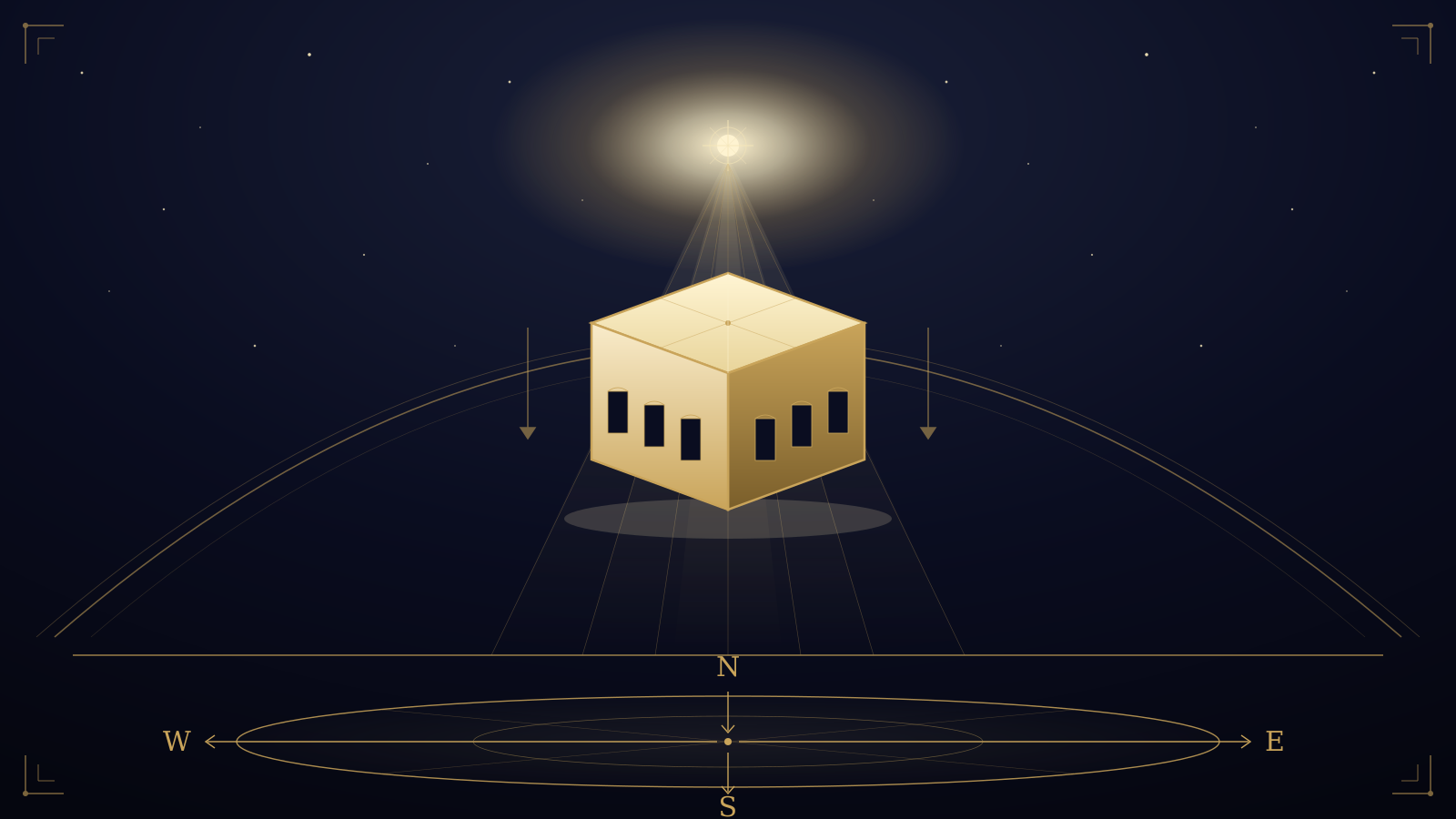
The video helps visualize the deeper point. The Kingdom descends from above; it does not emerge from human subjectivity below. It comes down from the heavenly realm and lands on earth as a ruled, measured, ordered territory. That image fits the biblical pattern: heaven establishes earth, the builder draws the line, and the city comes down according to divine measurement.
Revelation 21 gives this same imagery when the holy city descends from heaven and is measured. The angel takes “a golden reed to measure the city, and the gates thereof, and the wall thereof” (Revelation 21:15). The result: twelve thousand furlongs each side, the length and the breadth and the height equal (v. 16). The wall measured one hundred and forty four cubits (v. 17). The city is not vague. It is not floating abstraction. It is structured, proportioned, foursquare, and measured. The Kingdom does not abolish boundary and direction; it perfects them.
So the point is not merely “flat earth” or “globe” in the modern debate. The deeper claim is that creation is not subjective space. It is ordered territory under God. The circle marks the whole. The four corners orient the whole. The cornerstone aligns the whole. The line measures the whole. And the Kingdom descends into the world God has ordered.
The Philosophical Necessity
Wholeness without orientation remains abstract. A circle may contain the whole, but it does not tell the inhabitant how to stand, how to build, how to face, or how to measure. Direction requires fixed reference points. Without those points, interpretation becomes fluid. Every man can invent his own north.
That is why the four corners are philosophically necessary. They destroy subjectivity by revealing orientation. And that is why the cornerstone is necessary. It destroys relativism by establishing the fixed point from which the house is measured. Once the line is stretched from the cornerstone, the structure can be judged. It can be true or crooked. It can be plumb or out of line.
The circle gives totality. The corners give direction. The cornerstone gives alignment. The line gives judgment. Together they reveal a world that is not accidental, not floating, and not self-defined, but built by Yah according to order.
The Same Grammar in the Household
The household carries this same architectural grammar. A father is the cornerstone of his house — the fixed point from which the rest of the structure is measured. The walls of the household are aligned to him as he is aligned to Yeshua, who is aligned to the Father. “The head of every man is Messiah; and the head of the woman is the man; and the head of Messiah is God” (1 Corinthians 11:3). That is not a sociological observation. That is a building specification.
When the cornerstone of a house is true, the walls run true. When the cornerstone is laid in Yeshua, the household is aligned to heaven. When the patriarch holds the line, the household is measured by the same plumbline that is set in the midst of Israel. This is why prophetic patriarchy is not a personal preference but a structural necessity. The household either has a cornerstone, or it has no measure. Either the line is stretched from a fixed point, or every wall calls itself plumb.
The same applies to the congregation, the city, and the nation. Each is a house. Each requires a cornerstone. Each is judged by a line. The grammar does not change because the scale changes. Garden, household, camp, tabernacle, temple, city — one center, four corners, twelve gates, one Stone.
Final Formulation
The “circle of the earth” and the “four corners of the earth” are not contradictions when read architecturally. The circle speaks of the whole as bounded by God. The corners speak of the whole as oriented by God. The cornerstone speaks of the fixed foundation by which the whole is aligned. The line speaks of the measure by which the whole is judged.
If Yah draws the circle, He establishes the boundary. If Yah sets the corners, He establishes direction. If Yah lays the cornerstone, He establishes the point from which everything else must be measured. If Yah stretches the line, He establishes the judgment that exposes every crooked wall. This means creation is not merely a place. It is a structured domain. It is territory with boundary, direction, foundation, and judgment — and a Person at the center who holds it all together.
The four corners remove subjectivity. The circle preserves wholeness. The cornerstone establishes truth. The line sets the measure. And the Stone the builders rejected is the head of the corner.