
Every Head Must Read
There is a quiet weakness that enters a people when men stop searching the Scriptures for themselves.
It does not always look like rebellion at first. Sometimes it looks like humility. Sometimes it looks like respect for teachers. Sometimes it looks like a man saying, “I am not a scholar,” or “I just listen to what my pastor says,” or “I trust the people who have studied this more than me.”
There is a place for teachers. There is a place for elders. There is a place for receiving instruction from those who have labored longer in the Word. Scripture itself gives teachers as gifts to the body.
But there is no place in Scripture for the male head who permanently outsources his own duty to read, know, love, practice, and obey the Word of God.
Every head must read.
Not because every head is independent from the body. Not because every man becomes his own final authority. Not because the congregation does not matter.
Every head must read because the Word of God is not given only to institutions, teachers, or platforms. It is given to the people of God, and especially to the heads who must answer before God for the houses, children, judgments, words, and examples placed under their care.
The Word Must Be on the Man
The pattern begins early in Torah.
“And these words, which I command thee this day, shall be in thine heart: and thou shalt teach them diligently unto thy children...”
Deuteronomy 6:6–7
The command does not begin with a lecture hall. It begins with the heart of the covenant man. The words must be in him before they are taught through him.
He is commanded to speak of them when he sits in his house, when he walks by the way, when he lies down, and when he rises up. This is not occasional religious content. This is household atmosphere. This is daily pattern. This is the Word saturating the life of the house through the man who is responsible to carry it.
Joshua receives the same principle in concentrated form:
“This book of the law shall not depart out of thy mouth; but thou shalt meditate therein day and night...”
Joshua 1:8
Notice the movement. The book is not to depart from his mouth. He is to meditate in it day and night. The goal is not intellectual display, but careful obedience: “that thou mayest observe to do according to all that is written therein.”
Scripture does not separate reading from doing. A man who reads but will not obey becomes puffed up. A man who obeys without reading soon obeys something other than God.
Public Reading and Personal Responsibility
This calling is not only private. Moses commanded that the Law be read publicly before Israel at the appointed time, so that men, women, children, and the stranger within the gates would hear, learn, fear YHWH, and observe the words of the Torah (Deuteronomy 31:10–13). The qahal was gathered around the Word, but that public hearing did not erase the duty of the individual head. It intensified it.
Nehemiah 8 gives the fuller picture: the people gathered as one man, Ezra opened the book, the Levites gave the sense, and the people understood the reading. That is the balance. The Word is read in assembly, explained by appointed teachers, and received by individuals who must understand and obey.
Paul gives the same pattern to Timothy: the sacred writings are able to make a man wise unto salvation, and all Scripture is God-breathed so that the man of God may be complete, equipped for every good work (2 Timothy 3:14–17). Scripture is not decoration for the head. It is equipment.
The King Had to Write His Own Copy
One of the clearest witnesses is the law for the king.
“And it shall be, when he sitteth upon the throne of his kingdom, that he shall write him a copy of this law in a book...”
Deuteronomy 17:18
This is astounding. The king was not told merely to appoint priests who knew the Law. He was not told merely to have scribes summarize it for him. He was commanded to write for himself a copy, keep it with him, and read in it all the days of his life.
Why?
“That he may learn to fear the LORD his God, to keep all the words of this law and these statutes, to do them.”
Deuteronomy 17:19
The head must not be above the Word. The head must be under the Word.
Leadership that does not read becomes pride. Authority that does not tremble before the text becomes appetite. Judgment that does not pass through the Law of God becomes the will of man dressed up as wisdom.
The king had to read because the king had to fear God. The same principle applies in miniature to every male head. A man may not sit over a house while refusing to sit under the Word.
The Autodidactic Calling
By “autodidactic,” I do not mean autonomous.
I do not mean isolated. I do not mean anti-teacher. I do not mean every man becomes a wandering pope with a Bible and no correction.
I mean that every man is personally responsible to become a disciplined learner under God’s Word.
He must learn to read. He must learn to compare Scripture with Scripture. He must learn to meditate. He must learn to ask questions. He must learn to test claims. He must learn to be corrected by the text even when the correction costs him dearly.
This is exactly the pattern Ezra gives us:
“For Ezra had prepared his heart to seek the law of the LORD, and to do it, and to teach in Israel statutes and judgments.”
Ezra 7:10
There is the order:
- Seek the Law of YHWH.
- Do what is written.
- Teach from a life submitted to it.
Too many men want to teach before they seek. Others want to comment before they obey. Others want to repeat a teacher’s conclusion without ever doing the Berean work of testing whether these things are so.
But the noble pattern is clear:
“They received the word with all readiness of mind, and searched the scriptures daily, whether those things were so.”
Acts 17:11
The Bereans were not rebellious because they tested teaching against Scripture. They were noble.
Even apostolic preaching was brought to the text. How much more should every modern teacher, tradition, podcast, sermon, commentary, and theological system be brought to the same test?
What Is the Qahal?
The Hebrew word qahal is written קהל. It refers to an assembly, congregation, or gathered people. It is not merely a crowd. It is a people summoned together with identity, order, and covenantal purpose.
The qahal is the gathered assembly of the people before God. It is where households, heads, sons, elders, priests, teachers, fathers, and brothers exist together under the Word and presence of YHWH.
This matters because Scripture does not give us two false choices.
The choice is not between radical individualism and passive institutional dependence.
The biblical pattern is personally responsible participation inside the gathered people of God.
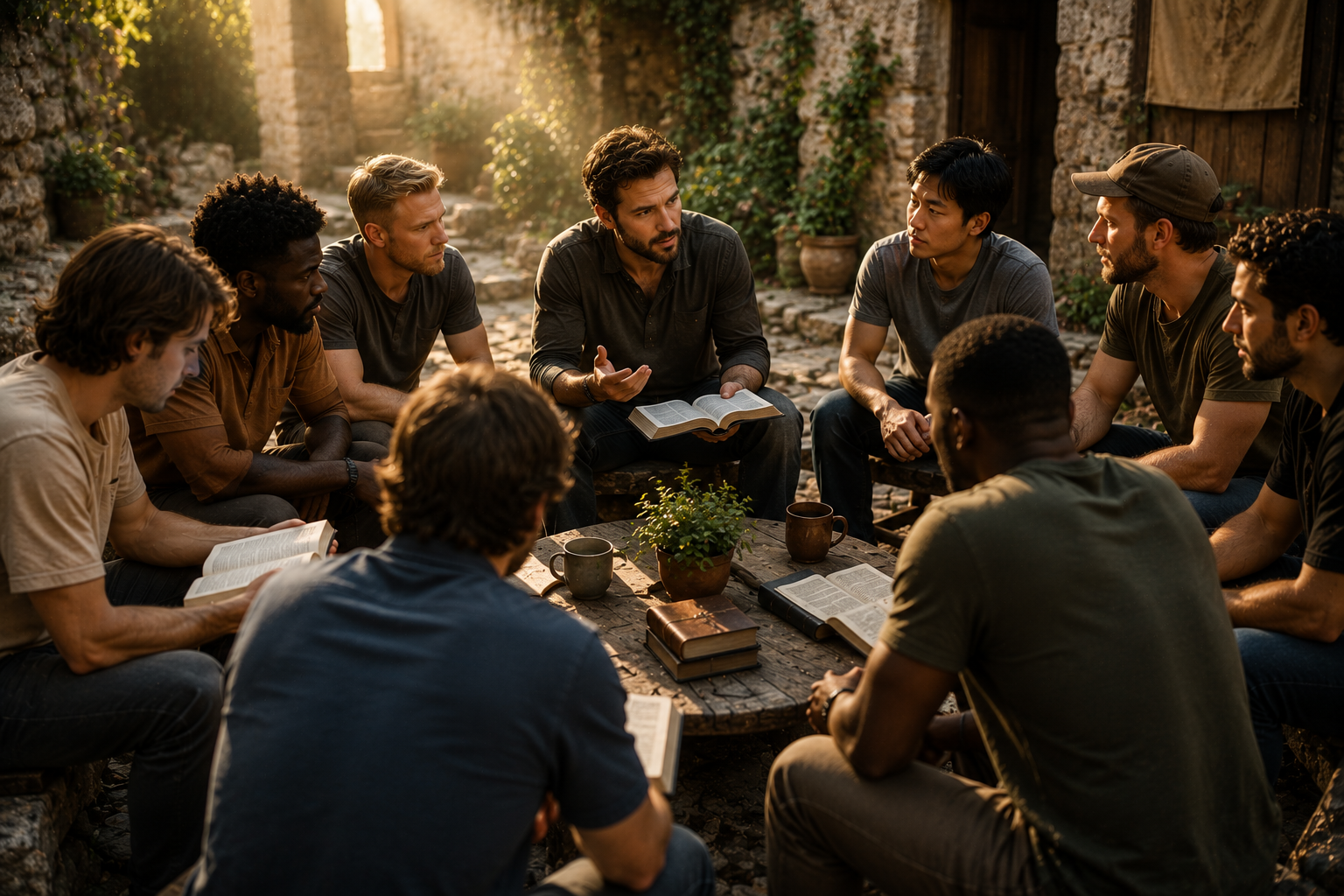
The man reads. The man studies. The man seeks. The man obeys. Then he brings the fruit of that labor into the qahal, where other men test, sharpen, confirm, challenge, refine, and strengthen what he has seen.
This is not a threat to the congregation. This is the strength of the congregation.
A Pictographic Meditation on קהל
The lexical meaning of qahal is assembly or congregation. The pictographic layer should be treated as illustrative rather than load-bearing doctrine, but it can still give us a beautiful meditation on the word.
- Qoph ק can suggest the back of the head, the horizon, what is gathered beyond immediate sight, or what is drawn together.
- Hey ה can suggest behold, reveal, breath, or what is made visible.
- Lamed ל can suggest staff, authority, shepherding, or teaching.
As a meditation, קהל can be pictured as a people gathered to behold revealed instruction under shepherding authority.
That is exactly what the qahal should be.
Not a mob. Not a consumer audience. Not a personality cult. Not an institution where men go to stop thinking.
The qahal is the gathered people under God, where the Word is opened, the men are sharpened, households are strengthened, and the assembly becomes wiser because its members are not empty.
Iron Sharpens Iron
“Iron sharpeneth iron; so a man sharpeneth the countenance of his friend.”
Proverbs 27:17
Iron does not sharpen mud.
For sharpening to happen, both men must bring substance. A man who has never studied can still learn, but he cannot sharpen in the same way as a man who has wrestled with the text, prayed through the text, obeyed the text, and allowed the text to cut him.
This is why the autodidactic calling is not anti-qahal. It is pro-qahal.
If every man comes empty, the assembly becomes dependent on one voice. If every man comes merely repeating his favorite teacher, the assembly becomes a battlefield of borrowed conclusions. But if every man comes having personally sought the Word, then the qahal becomes a place of living refinement.
One man sees a connection. Another man tests it. One man brings a passage. Another brings a balancing witness. One man overstates a point. Another gently corrects him. One man has suffered through obedience and brings wisdom not merely from pages, but from scars.
This is how men sharpen one another.
This is how the qahal grows.
Each One Has
Paul gives a powerful glimpse of congregational participation:
“How is it then, brethren? when ye come together, every one of you hath a psalm, hath a doctrine, hath a tongue, hath a revelation, hath an interpretation.”
1 Corinthians 14:26
That verse does not create chaos. Paul immediately says everything should be done unto edifying. But notice the assumption: the brothers are not empty. “Every one of you hath...”
That means the gathering was not imagined as one man thinking while everyone else merely consumed. The body was meant to supply. The members were meant to bring something. The congregation was meant to be built up by ordered participation.
Colossians says the same thing another way:
“Let the word of Christ dwell in you richly in all wisdom; teaching and admonishing one another...”
Colossians 3:16
The Word must dwell richly in the people before the people can teach and admonish one another rightly.
The qahal is strongest when the Word does not dwell in one official mouth only, but richly in the gathered people.
Teachers Are Gifts, Not Replacements
This does not diminish teachers. It restores their purpose.
Ephesians 4 says Messiah gives apostles, prophets, evangelists, pastors, and teachers for the perfecting of the saints, for the work of ministry, and for the edifying of the body of Messiah.
Teachers are gifts. Elders are needed. Shepherds matter.
But the purpose of a teacher is not to make men permanently dependent on the teacher. The purpose is to equip the saints to maturity.
A true teacher does not want a congregation of passive repeaters. He wants men who can handle the Word rightly, test claims faithfully, obey with courage, and bring fruit into their houses and into the qahal.
Paul tells Timothy:
“Study to shew thyself approved unto God, a workman that needeth not to be ashamed, rightly dividing the word of truth.”
2 Timothy 2:15
The workman must handle the Word. He must not be ashamed. He must be approved before God, not merely applauded by men.
What Breaks When Men Relinquish the Calling?
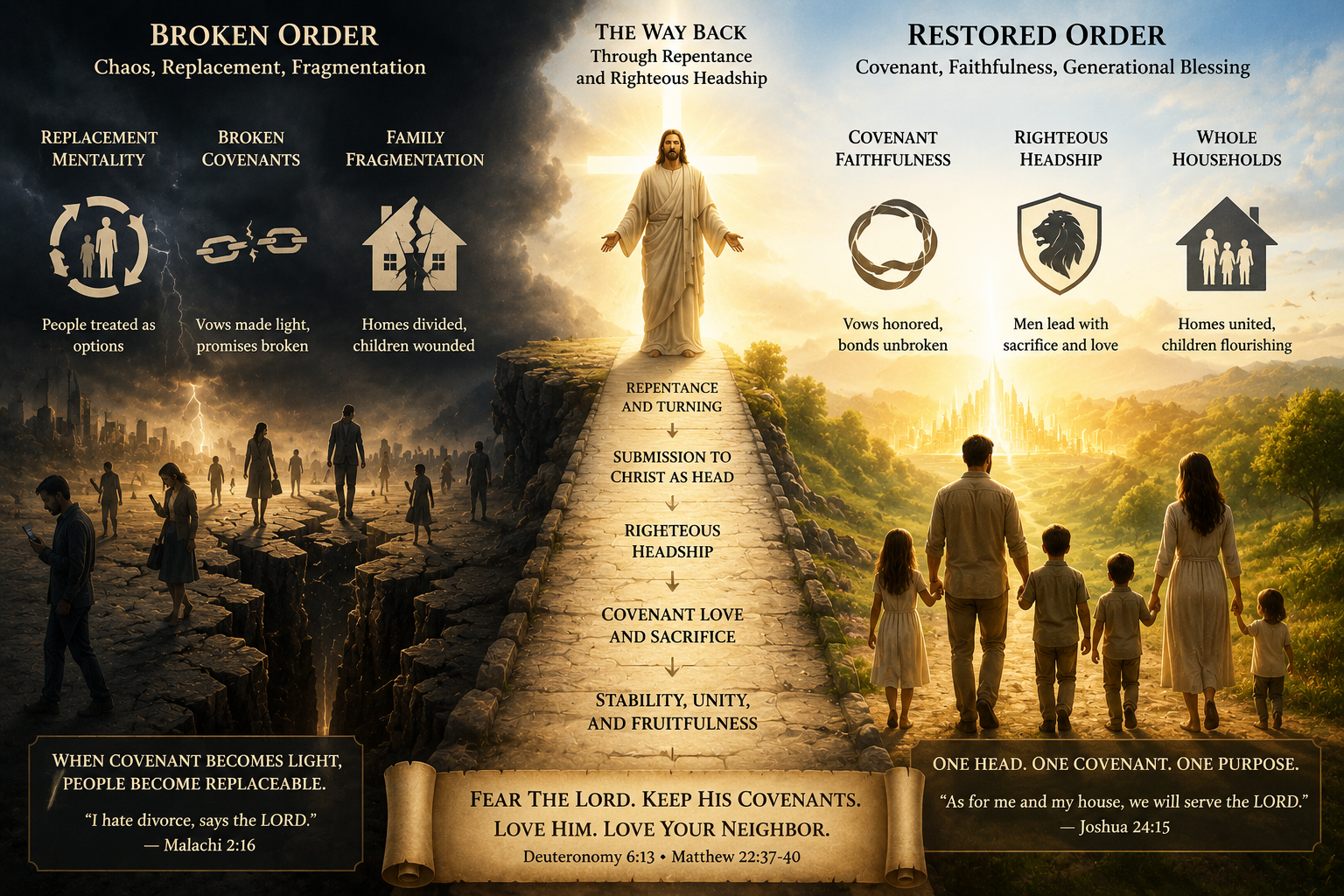
When male heads relinquish the autodidactic calling, several things begin to break.
First, households weaken. A man cannot feed his house from a pantry he never enters. If all he has is borrowed bread, his children will learn dependence before they learn discernment.
Second, discernment collapses. A man who does not know the Word for himself becomes vulnerable to charisma, trends, fear, tribal pressure, and inherited error.
Third, the qahal becomes brittle. Instead of many sharpened men strengthening one another, the assembly becomes dependent on a few dominant voices. That may look efficient, but it is fragile.
Fourth, tradition becomes heavier than truth. When men stop searching the Scriptures, they begin defending what they received from men more fiercely than what they have verified in the Word.
Fifth, obedience becomes abstract. Men can talk about “biblical values” while avoiding the actual commands, patterns, warnings, and confrontations of Scripture.
This is how a people can be religious and still become weak.
They hear much, but search little. They quote much, but obey selectively. They gather often, but bring little living fruit.
The Word Is Not Optional for the Head
Psalm 1 gives the image of the blessed man:
“But his delight is in the law of the LORD; and in his law doth he meditate day and night.”
Psalm 1:2
The blessed man is not merely near people who know the Law. He delights in it himself. He meditates in it himself. He becomes like a tree planted by rivers of water.
Psalm 119 asks:
“Wherewithal shall a young man cleanse his way? by taking heed thereto according to thy word.”
Psalm 119:9
The young man’s way is cleansed by guarding it according to the Word. Not according to vibes. Not according to market pressure. Not according to whatever is popular among his peers.
According to the Word.
James also warns us:
“But be ye doers of the word, and not hearers only, deceiving your own selves.”
James 1:22
The danger is not only ignorance. The danger is self-deception through hearing without doing.
A man can sit under years of teaching and still be self-deceived if he never becomes a doer.
The Individual Within the Qahal
The individual male head matters.
Not as an island. Not as a rebel. Not as a man detached from elders, fathers, brothers, or the congregation.
He matters because God deals with men personally and covenantally. Adam is called. Noah builds. Abraham obeys. Moses ascends. Joshua chooses. David writes. Ezra studies. Timothy is charged. The Bereans search.
Again and again, Scripture places the Word before men and calls them to respond.
Then those men bring their obedience into the people.
This is the intended purpose: the individual seeks God in the Word, then the qahal receives the fruit of many individually responsible men gathered together under one God.
The man does not disappear into the qahal.
The qahal does not replace the man.
The man is formed by the Word, and then the gathered people are strengthened by men who have been formed by the Word.
Every Head Must Seek the Word Himself
So the charge is simple.
Every head must read.
Every head must seek.
Every head must learn.
Every head must obey.
Every head must bring the fruit of that obedience into the qahal.
This is not a call to arrogance. It is a call to responsibility.
This is not a rejection of teachers. It is a rejection of passivity.
This is not a denial of the congregation. It is a defense of what the congregation is supposed to be.
The qahal is not where men go to stop thinking. It is where men go to bring their thinking under covenantal refinement.
The qahal is not where the individual calling dies. It is where the individual calling bears communal fruit.
The qahal is not a substitute for the man’s duty to seek the Word. It is the assembly where men who seek the Word sharpen one another under God.
If the head will not seek the Word, the house will live on borrowed light.
But when heads become readers, doers, and bringers of the Word, the qahal becomes strong.
And strong men under the Word build strong houses.
And strong houses gathered under God become a faithful congregation.
That is the design.
That is the beauty.
Every head must read.