
The Theme We Keep Missing: The Spirit’s Victory Over Sin
Most sermons reduce Samson to a cautionary tale about lust: “A strong man who couldn’t handle women.” But Judges itself refuses that flattening. Samson’s story is not written as a morality cartoon. It is written as a deliverance campaign—messy, provocative, and Spirit-driven—where the LORD wins in ways we do not always understand.
If you want the narrator’s lens, it’s here:
“His father and mother did not know that it was from the LORD, for he was seeking an opportunity against the Philistines.” (Judges 14:4)
That line doesn’t sound like God scrambling to salvage a mistake. It sounds like God initiating a strategy. The LORD is “seeking an occasion”—a pretext, a pressure point—against an occupying power. And Samson is the instrument He raises for that kind of war.
Israel Was Occupied—and Domesticated
Judges 14:4 adds the hard detail most modern preaching rushes past: “At that time the Philistines ruled over Israel.” The tragedy is not merely Philistine strength; it is Israel’s adaptation. When a culture becomes comfortable under foreign rule, deliverance rarely begins with a clean army-on-army battle line.
So the LORD raises a deliverer who doesn’t begin with a trumpet blast. He begins with access—moving inside enemy space, igniting conflict where the nation has learned to avoid it.
Asymmetric Warfare: Samson’s Method
Asymmetric warfare is how an oppressed people destabilize a dominant power: unconventional entry points, psychological pressure, information warfare, and disproportionate escalation—often without an army.
That is exactly what Judges shows Samson doing.
- He moves alone (no Israelite coalition follows him).
- He enters Philistine territory repeatedly (Timnah, Gaza, Sorek).
- He turns social spaces into combat spaces (wedding feasts, city gates, temple celebrations).
- He forces the enemy to reveal themselves (through predictable extraction and betrayal).
In other words: Samson does not merely fight Philistines. He destabilizes the system that keeps Israel subdued.

Why the “Dumb With Women” Reading Doesn’t Fit the Text
A “dumb” Samson doesn’t match the repeated structure of the narrative. Judges keeps returning to one theme: information.
- He proposes a riddle that only an insider could solve (Judges 14:12–14).
- He resists relational pressure to reveal the answer (14:16–17).
- He publicly names the method of extraction when they succeed (14:18).
- With Delilah, he gives multiple false answers before the final reveal (Judges 16:6–14).
This is not naïveté. This is controlled disclosure—what a tactician does when he assumes betrayal is not a surprise but a certainty.
And that certainty matters: in a compromised culture, betrayal is not the “twist.” It is the mechanism. Samson’s campaign is built around it.
The Riddle Was a Battlefield Device
Samson’s riddle was not party entertainment. It was a trap set in enemy territory under enemy pressure:
“Out of the eater came something to eat. Out of the strong came something sweet.” (Judges 14:14)
The contest forces only two outcomes:
- They lose publicly (humiliation and loss), or
- They win by weaponizing covenant access—using the woman, the relationship, the mingled boundary to extract intelligence.
Either way, the enemy is exposed. Either way, conflict escalates. This is asymmetric warfare: forcing the oppressor to reveal his methods and then striking where he thinks he is safest—inside social cover.
Patriarchal Repositioning Without Declaring War on the Church
Samson’s story presses a question modern men feel but often can’t name: what do you do when your people are timid, your culture is softened, and compromise has become normal?
Judges does not answer that question with a lecture about “being nicer.” It answers with a Spirit-empowered deliverer who provokes conflict on purpose—because sometimes the only way to wake a domesticated nation is to make occupation uncomfortable again.
Sometimes provocation is not immaturity. Sometimes it is strategy.
The Spirit’s Pattern: The LORD Keeps Winning Through the Mess
Here is the theme that collapses modern moralism: the Spirit of the LORD does not abandon Samson every time readers expect it to. In fact, Judges repeatedly says the opposite—the Spirit rushes upon him in moments that look provocative (Judges 14:6, 14:19, 15:14).
This does not mean every detail is meant to be imitated. It means something stronger: the LORD is not fragile. He wins through instruments the comfortable would disqualify. He advances deliverance even when the method looks strange to polite religion.
And when the narrative does mark a decisive shift, it does so with a visible covenant sign—Samson’s consecration marker (Judges 16:19–20). Judges isn’t asking us to build a modern doctrine of hair. It is showing us that consecration is real, embodied, and public—and that the LORD can move a campaign into captivity not as “defeat,” but as repositioning for a foundation strike.
The Irony: He Destroyed Their Foundation From Underneath
Here is the ending irony that changes everything.
Samson doesn’t defeat the Philistines from above. He defeats them from underneath—inside the very world of mingling, compromise, and social cover that had already numbed Israel into submission. The Philistines thought they were mocking a captured man. Israel had learned to coexist. But the LORD had written a different ending.
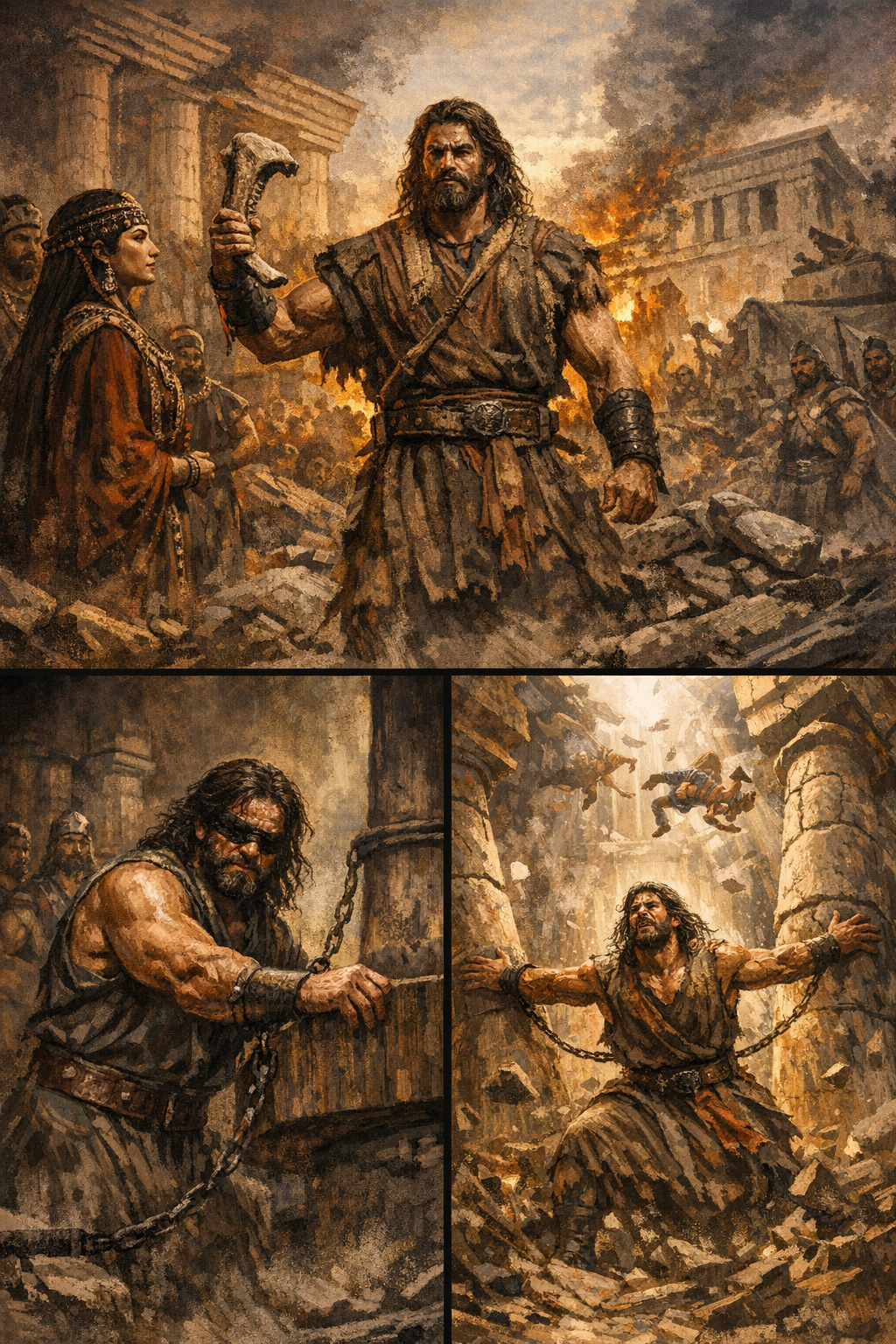
In the finale, Samson brings down the house of Dagon (Judges 16:23–30). The story doesn’t close with “sin won.” It closes with the Spirit’s victory—Yahweh striking the religious center, the political spectacle, and the confidence of the oppressor.
That is why Scripture can honor Samson’s place in the deliverance story (and why later readers remember him as a man of faith): not because we understand every tactic, but because the LORD’s purpose stands. In a time when Israel was passive, the Spirit raised a man who made oppression costly—and then toppled the foundation of Philistine power.
What Samson Teaches Modern Men
- Stop flattening Scripture into moral cartoons. Judges is telling a war story, not a dating warning.
- Recognize spiritual war underneath social life. Feasts, relationships, and public honor are battlegrounds in Judges.
- Learn the wisdom of controlled disclosure. In compromised cultures, betrayal is predictable; wisdom prepares.
- Trust the Spirit’s supremacy. God wins even when the method offends polite religion.
- Reposition like a patriarch. Not with rage, but with courage—making oppression uncomfortable and shifting the nation’s posture back toward deliverance.