
There is a difference between the beginning of the day and the maturity of the day.
That may sound obvious in ordinary life, but it becomes surprisingly important once the idea of prophetic time is brought into view.
In the previous post, I argued that the question of when a biblical day begins is not trivial. If the prophetic day starts in light, the present age looks late and fading. If it starts in darkness but the meaningful hinge is sunrise, the same age may be better read as early and brightening. That is the significance of the 500-year phase shift. It does not change the real date. It changes where the light belongs inside the day.
The next question is obvious:
If we accept the real Hebrew year as 5786, and if we read the present through that shifted model, how far into the day are we?
The answer is: not far — but perhaps far enough to matter.
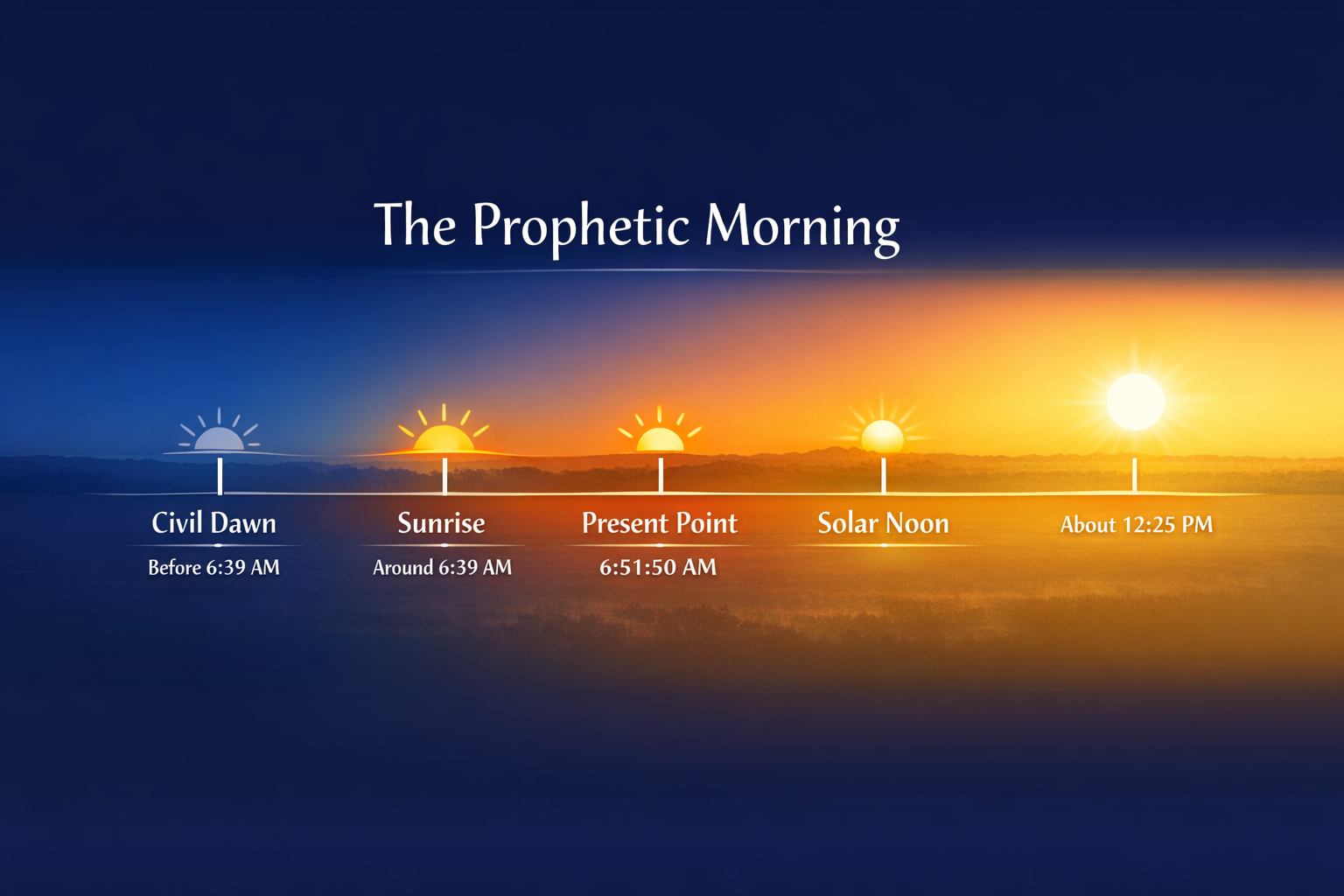
1. The basic calculation
If one prophetic day is treated symbolically as 1000 years, then:
- 24 hours = 1000 years
- 1 hour = 41.67 years
- 1 year = 1.44 prophetic minutes
Under the shifted model, the present Hebrew year 5786 lands around:
6:51:50 AM
That is not an arbitrary number. It comes from keeping the real year fixed while using the 500-year shift only as a symbolic phase adjustment.
So now the question becomes practical:
Is 6:51:50 AM still darkness?
Is it twilight?
Or is it already day?
2. Why Israel and harvest matter
If Scripture repeatedly frames “that Day” in the imagery of harvest, ingathering, and ripening, then it is reasonable to ask what dawn in Israel during the harvest season looks like.
That does not prove an exact date. It does not eliminate mystery. But it gives us a biblical setting for the imagination.
Jerusalem in the fall harvest window gives us a useful frame. In that season, sunrise is not generic. It occurs at a real hour in a real land. And if our symbolic clock lands around 6:52 AM, then the question is whether that falls before or after the average sunrise line.
That is the hinge.
3. The simple answer
Using average Jerusalem fall sunrise conditions, 6:52 AM falls just after sunrise, not before it.
That means the shifted model does not place us in pre-dawn darkness.
It does not even place us merely in twilight.
It places us just inside official daylight.
That is the first major takeaway.
4. A simple table
| Marker | Approx Symbolic Time | Meaning |
|---|---|---|
| Civil dawn | before 6:39 AM | the light is visible, but the sun is not yet up |
| Sunrise hinge | about 6:39 AM | official day begins |
| Present point | about 6:51:50 AM | just inside full light |
| Solar noon | about 12:25 PM | mature daylight |
This is why the present moment can be described as already in the day, while still being very early in the day.
5. Why this matters theologically
This is where the whole model becomes more than math.
Many people imagine kingdom language in one of two crude ways:
- either the world is still fully in darkness until everything changes at once
- or the kingdom must already be fully established if any light has begun
But ordinary day does not work that way.
There is a real span between:
- the first visible light,
- official sunrise,
- and the strong clarity of noon.
That gives us a more nuanced prophetic imagination.
If the shifted model is correct, then the present age may be understood as:
- past the sunrise hinge
- inside official day
- but still far from the maturity of the day
That means the kingdom need not arrive in its fullest public strength the moment the day officially begins. There may be a long prophetic stretch between sunrise and full day.
6. A strong biblical clue
Scripture gives a line that fits this beautifully:
But the path of the just is as the shining light, that shineth more and more unto the perfect day.
— Proverbs 4:18
That verse does not describe the birth of light only. It describes light increasing.
That is exactly the category we need.
If sunrise marks the official beginning of day, then the stretch between the present point and symbolic noon may be understood as the phase of light increasing toward the perfect day.
Not twilight.
Not darkness.
Not full noon.
But the strengthening morning.

7. How far do we still have to go?
This is the second major takeaway.
Even if the present point lies just after sunrise, solar noon is still far ahead in prophetic terms.
That means:
- the day may have begun,
- but the day has not matured.
In symbolic language, we may already be inside the day while still being centuries from its fullest public strength.
That is an important corrective.
It means readers should not hear “sunrise” and think “everything must already look like noon.” The light may be real without yet being complete in its manifestation.
8. What this adds to the previous post
The previous essay asked whether the present age is better read as a fading evening or a brightening morning.
This post adds a further distinction:
even if the morning reading is correct, the present point may still be very early morning, not full day.
That matters because it gives prophetic time room to breathe.
It allows us to say:
- the light has begun,
- the day has officially opened,
- but the fuller establishment of that day still lies ahead.
That is a far more realistic and scripturally textured way to speak about kingdom time than either instant-collapse pessimism or instant-kingdom triumphalism.
9. The cleanest summary
If the real Hebrew year remains 5786, and if the present is read through the 500-year prophetic phase shift, then the current moment may fall at about 6:51:50 AM on the symbolic clock.
That places us:
- not in night,
- not merely in twilight,
- but just inside official day.
And yet the stronger fullness of the day — the symbolic noonday clarity — would still lie far ahead.
So the most useful way to describe the present may be this:
We are not waiting for dawn. We may already be standing just inside the day. But the day is still young.