
Introduction
There are questions in Scripture that appear small until we realize how much they govern. The question of when a day begins is one of them.
At first, it may seem like a matter of calendar mechanics. Does the day begin at evening, as traditional Jewish reckoning often assumes? Does it begin at dawn, as some readers infer from the naming of light as “Day” and darkness as “Night”? Is this only a question of liturgical practice, or does it have consequences for the prophetic imagination of Scripture itself?
Within the world of One Father, that question becomes unexpectedly weighty. If creation is not only history but pattern, not only sequence but prophecy, then the structure of the day may inform the structure of redemptive time. If the creation week prefigures the architecture of history, and if Scripture invites us to see a relationship between a divine “day” and a thousand-year horizon, then the question of where a day begins may change how we perceive the entire present age.
This is not an attempt to set dates. It is not a claim to know the day or hour. It is not an effort to replace vigilance with arithmetic. Rather, it is an attempt to think carefully about the symbolic and prophetic logic of time in Scripture, and to ask whether a difference in day-start may yield a difference in prophetic phase. The goal is not certainty where the text has left mystery. The goal is clarity about the implications of two rival models.
One model suggests that we are late in the sixth day, nearing its decline, with darkness rushing toward the threshold of Sabbath. The other suggests that if the prophetic day begins in darkness but the meaningful prophetic anchor is light, then the same historical moment may be better understood as just past dawn, not before sunset. In one model, darkness is incoming. In the other, light is incoming. In one model, we are straining under the final glow of a fading age. In the other, we are stepping into the first rays of an age that has not yet fully manifested but has already begun to brighten the horizon.
The distinction matters.
It matters because Scripture is a book deeply concerned with time, and not merely in the mechanical sense. Scripture cares about beginnings and endings, about evenings and mornings, about appointed times and fulfilled times, about seedtime and harvest, about “the third day” and “that Day,” about labor and rest, about creation and consummation. It cares about time because time is not neutral. Time is ordered under God. Time is carried by covenant. Time is gathered up into Messiah. Time itself bends toward Sabbath.
In One Father, this becomes explicit. The resurrection of Yeshua on the third day is framed not as an isolated miracle but as a pattern woven into the architecture of Scripture itself. As the book says, “The resurrection of Yeshua on the third day is not merely a historical claim - it is the prophetic pattern upon which the entire architecture of scripture is built.”
Later, when speaking of Sabbath fulfillment, One Father says, “This is the day that has no evening, because the light does not wane,” and then presses even further: “For the Seventh Day is not behind us. It is before us.”
That line is the doorway into this essay.
If the seventh day is before us, then the shape of the sixth day matters. If the third day governs resurrection, fruitfulness, and emergence, then the seventh governs rest, enthronement, and household completion. And if history is somehow moving through the pattern of these days, then we must ask whether the sixth day is primarily ending in fading light or breaking open in rising light.
That is the pivot.
Day in Scripture Is Not One-Dimensional
Any serious discussion of prophetic time must begin with a simple admission: Scripture uses the word “day” in more than one sense.
Sometimes “day” means the period of light as distinguished from night. Genesis 1:5 states:
“And God called the light Day, and the darkness he called Night.”
— Genesis 1:5
That verse alone gives genuine footing to a dawn or light-first intuition. Light is explicitly named “Day.” Darkness is not called “Day.” It is called “Night.” If one were reading only this verse, one could easily conclude that the most natural beginning of “day” is with the arrival of light.
And yet Scripture does not stop there. Genesis 1 does not simply define terms. It also narrates cycles. Again and again, the pattern appears:
“And the evening and the morning were the first day.”
“And the evening and the morning were the second day.”
“And the evening and the morning were the third day.”
This repeated formula does not merely name the light; it frames the whole cycle. It treats the creation “day” as a unit in which darkness and light belong together. This is one reason many readers instinctively think in terms of evening-to-evening, or at least darkness-to-light, when they read the creation account.
Then Torah adds another layer. In legal and liturgical contexts, specific holy boundaries are sometimes explicitly marked from evening to evening:
“It shall be unto you a sabbath of rest… from even unto even, shall ye celebrate your sabbath.”
— Leviticus 23:32
This matters, because it means that in at least some covenantal contexts, evening-boundary language is not simply inferred; it is legislated.
So already we can see the problem. “Day” may mean at least four things:
- the light portion of a cycle,
- the entire cycle of darkness and light together,
- a holy-time boundary marked liturgically,
- a symbolic or prophetic unit larger than a literal day.
If these are collapsed into one undifferentiated category, confusion follows. But if they are distinguished, a richer picture emerges. Scripture is not inconsistent. It is layered. A biblical “day” can be literal and symbolic, calendrical and theological, local and cosmic. The question is not whether all uses are identical. They are not. The question is how the uses interrelate.
This becomes essential when we turn to prophetic time.
Why the 1000-Year “Day” Idea Exists at All
The notion that history may be read through the pattern of a thousand-year “day” is not an arbitrary invention. It emerges from several scriptural observations that, taken together, create a strong typological field.
The first and most famous text is Psalm 90:
“For a thousand years in thy sight are but as yesterday when it is past, and as a watch in the night.”
— Psalm 90:4
This verse does not give a mechanical formula. It does not say every prophetic day must always equal exactly one thousand literal years in every context. But it does establish an analogy between divine time and human time. The perspective of God relativizes our measures. A thousand years, from His vantage, are not what they are from ours.
Peter takes up the same logic:
“But, beloved, be not ignorant of this one thing, that one day is with the Lord as a thousand years, and a thousand years as one day.”
— 2 Peter 3:8
Again, this is not stopwatch language. Peter is not inviting numerological fanaticism. He is defending the faithfulness of God against mockery. The Lord’s timing is not failure. Delay is not absence. Divine chronology does not bow to impatient human expectation.
And yet it would be careless to say these texts do nothing more than relativize time. The fact that Scripture repeatedly places “day” and “thousand years” into analogical relationship means the typological possibility is real. It opens a field of reflection in which the creation week may be seen as more than a record of beginnings. It may also be a prophetic pattern.
That possibility is strengthened by Revelation 20, where “a thousand years” appears not as abstract poetry but as a concrete eschatological measure:
“And he laid hold on the dragon… and bound him a thousand years.”
— Revelation 20:2
Whatever one’s millennial framework, Revelation undeniably gives the thousand-year period an eschatological weight. That, in turn, makes the long-standing Christian instinct understandable: six “days” of labor, one seventh “day” of rest, with history itself unfolding according to a sabbatical rhythm.
Hebrews deepens this further. The writer does not treat the Sabbath merely as a memorial of the past. He treats it as a still-open promise:
“There remaineth therefore a rest to the people of God.”
— Hebrews 4:9
This is crucial. Sabbath is not merely behind us in creation. It is ahead of us in fulfillment. It is both memory and destination. The seventh day becomes eschatological.
This is exactly where One Father presses its insight. In your own language, “This is the day that has no evening, because the light does not wane.” That is more than a devotional line. It is a theology of time. It treats the seventh day not as a closed historical event but as the everlasting Sabbath into which Messiah reigns and calls His sons.
So the 1000-year day framework rests on at least five pillars:
- Psalm 90’s divine-time analogy,
- 2 Peter 3’s reaffirmation of that analogy,
- Revelation 20’s explicit thousand-year horizon,
- Hebrews 4’s insistence that Sabbath remains open,
- the sabbatical architecture of creation itself.
None of these forces a rigid chronometric scheme. But together they create a deeply biblical reason to think that the creation week may pattern the redemptive week of history.
Time in One Father: From Third-Day Resurrection to Seventh-Day Rest
To understand why the day-start question matters within One Father, we must first understand how the project already treats time.
Your broader Genesis reading is not obsessed with Western stopwatch chronology. It treats Genesis as a structure of ordered meaning, a world in which sequence matters, but where sequence is also theological. That is one reason your Day 3 / Day 6 Adam-Eve framework carries so much weight. Adam belongs to the Day Three pattern of soil, seed, and fruitfulness, while Eve emerges later to complete the male-female fullness of humanity.
More importantly for our present purpose, this means your theology is already structured around days as symbolic blocks of meaning, not merely units of elapsed time. Day Three is not just “the third literal day.” It is the day of emergence, fruitfulness, life from the earth, and resurrection pattern. One of your companion papers summarizes it this way:
“The first Adam rose from dust on the third day; the Last Adam rose from the grave on the third day. Both point to fruitfulness, covenant, and new creation.”
That insight matters here because once Day Three becomes typological, Day Seven almost necessarily becomes typological too. If the third day is resurrection-coded, the seventh day is rest-coded. If the third day is emergence, the seventh is completion. If the third day is seed breaking the ground, the seventh is household settled in peace.
This is why your own book can say, in a line that deserves to be read carefully, “Yeshua rose on the third day as last Adam, yes, but He reigns from the seventh as the Everlasting Father.”
That sentence contains the whole essay in seed form.
It means that time in Scripture is not merely cyclical. It is christological. Days are not empty containers. They are appointed forms of revelation. The third day reveals Messiah as life-from-death. The seventh reveals Him as enthroned rest, the Father’s house open, the Sabbath no longer only commanded but inhabited.
Thus the question before us is not random. If history is moving from third-day resurrection pattern toward seventh-day rest, then the structure of the sixth day becomes the field of our current struggle. We are living somewhere in the interval between resurrection and consummation, between firstfruits and final ingathering, between the opening of the tomb and the open house of the Sabbath.
Where, exactly, is that “somewhere”?
That is where the night-start versus light-start question begins to matter.
The Day-Start Question: Night First or Light First?
There are at least two broad instincts available to the biblical reader.
A. The Light-First Intuition
This intuition begins with Genesis 1:5:
“God called the light Day, and the darkness he called Night.”
If “Day” names the light, then one may infer that the proper beginning of a day is not darkness but the first appearance of light. This fits ordinary human experience as well. Dawn feels like beginning. Morning feels like arrival. Light opens activity, visibility, labor, and witness. Darkness feels like closure, concealment, and waiting.
This intuition has real theological power. It resonates with themes of revelation, resurrection, newness, and hope. A dawn-start model tends to imagine God’s day as beginning in manifestation.
B. The Night-First Intuition
This intuition begins with the repeated Genesis refrain:
“And the evening and the morning were the first day.”
It is reinforced by evening-boundary language in the Law, especially in liturgical contexts:
“From even unto even…”
— Leviticus 23:32
This instinct sees the day as beginning in darkness and moving toward light. It is not a denial that light is “Day” in one sense. Rather, it holds that the full day-cycle begins with evening and is completed by morning.
This model also has strong theological force. It emphasizes that God brings order out of darkness, life out of silence, resurrection out of death, dawn out of night. It matches the pattern of the gospel itself: burial precedes rising. The grave comes before the empty tomb. Tribulation precedes deliverance. Evening gives way to morning.
Neither intuition is foolish. Neither should be caricatured. The issue is not whether one can construct arguments for each. One can. The issue is what happens when these models are mapped onto prophetic time.
Because if a day is only twenty-four literal hours, then the difference between sunset-start and sunrise-start is only part of a day. But if a “day” becomes a prophetic block of one thousand years, the same structural difference suddenly becomes enormous.
That is the opening for the 500-year shift.
The 1000-Year Day and the Meaning of a 500-Year Shift
Here we must be extremely precise, because this is the point at which misunderstandings multiply.
The proposal is not that we change the real calendar.
The proposal is not that the Hebrew year has been miscounted by five hundred years.
The proposal is not that “5500 literally becomes 6000.”
The proposal is much subtler, and much stronger: if the prophetic day is one thousand years long, and if that day contains a darkness phase and a light phase, then the symbolic position of “light” differs depending on whether the day is understood to begin with darkness or with light.
That is all.
If one prophetic day equals one thousand years, then:
- 1000 years = 24 hours
- 500 years = 12 hours
- 1 hour = about 41.67 years
So if the day begins in light, then the light phase is anchored at the opening of the 1000-year block.
But if the day begins in darkness, then the arrival of light belongs not to the opening of the block but roughly to its midpoint.
That creates a half-day, or half-millennium, shift in symbolic positioning.
The real year stays the same. The prophetic coordinate changes.
This is why the phrase “500-year shift” is useful but must be handled carefully. It is a phase shift, not a chronological revision. It tells us not that the historical timeline has changed, but that our interpretation of the symbolic moment may change.
To say it plainly:
- In a light-first model, the thousand-year day opens in light.
- In a night-first model, the thousand-year day opens in darkness, and the light phase arrives roughly 500 years later.
Thus the same historical year may be described in two very different ways depending on which symbolic anchor is used.
This has major implications for the present age.
Suppose, for instance, that one is using the common broad framework in which the sixth “day” runs from year 5000 to 6000. If the current Hebrew year is 5786, then one is 786 years into the sixth day. On a 24-hour symbolic clock, that places the age around 18.86 hours into the day, or about 6:52 on the clock.
Now the question becomes: what does that 6:52 mean?
If the day began with light, then 6:52 may sound like evening, decline, the final portion of day before darkness.
But if the day began in darkness and the meaningful prophetic hinge is dawn, then 6:52 may instead be read relative to sunrise, not sunset. In that case, one may ask whether 6:52 is still night, or whether it is just beyond the first appearance of light.
The difference is interpretive, not chronological. The numbers stay fixed. The symbolic mapping changes.
This is the heart of the matter.
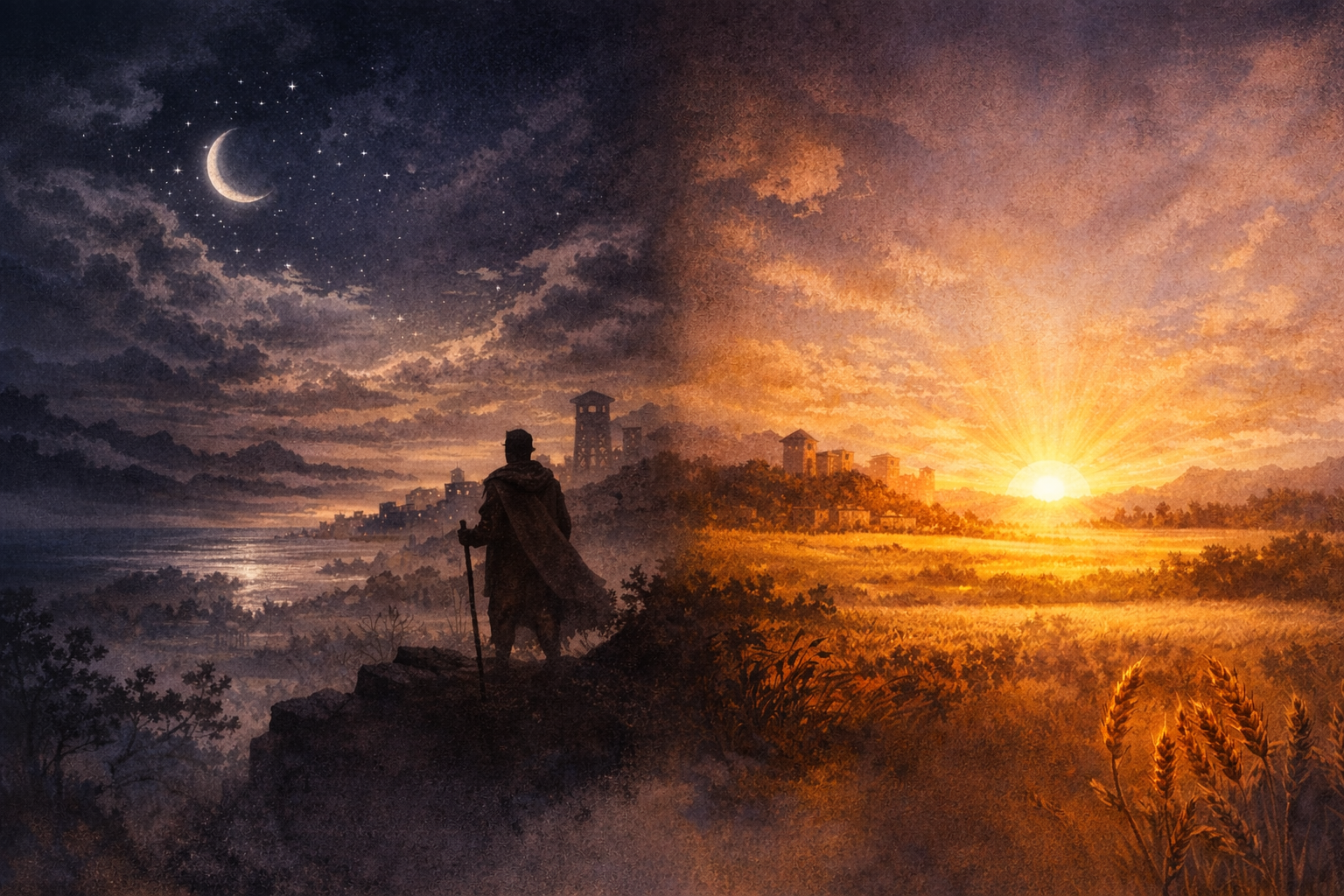
Why the Present Age Can Look Like Twilight in One Model and Dawn in Another
Once the phase shift is understood, the implications become obvious.
Model One: No Phase Shift, or Light Anchored to the Opening of the Day
In this model, the sixth day begins in light. If we are currently late in that day, then the symbolic tone of the age is one of waning brightness. This makes the present moment feel like late afternoon or approaching dusk. The light is still present, but it is declining. Darkness is not behind us; it is ahead of us.
This model fits naturally with readings of Scripture that emphasize apostasy, lawlessness, tribulation, the darkening of the age before the appearing of Messiah, and a twilight world groaning under the fading of the old order.
Under this approach, to say “the Day is approaching” means that the horizon of Sabbath is near, but the immediate atmosphere may be one of gathering darkness before the great transition.
Model Two: Night First, with Light Anchored to the Midpoint
In this model, the prophetic day begins in darkness, and the meaningful arrival of morning belongs about halfway through the day. Here the same clock reading may be interpreted not as late decline but as just beyond dawn.
This does not remove conflict. It does not imply naïve triumphalism. Dawn is not noon. Morning light may still break into a world full of shadow, war, and upheaval. But it shifts the direction of movement.
Instead of light fading into night, the age may be understood as night yielding to light.
That is a radical difference.
One model says the present age is fundamentally defined by what is being lost. The other says it is fundamentally defined by what is beginning to emerge.
This is why the difference matters so much. These are not merely abstract calendar theories. They produce two different spiritual atmospheres.
“As You See the Day Approaching”: Boundary or Broad Advance?
At this point Hebrews 10 becomes especially important:
“Not forsaking the assembling of ourselves together… but exhorting one another: and so much the more, as ye see the day approaching.”
— Hebrews 10:25
The wording matters. The verse does not say merely, “when the Day arrives.” It says, “as you see the day approaching.” That language suggests process, visibility, and nearness that extends over time. It implies that the approach of the Day is not a mathematical instant only. It is a discernible movement.
In a prophetic-week framework, that is highly significant. It suggests that “the Day” may be said to approach through an extended phase, not merely at the exact technical boundary where one age becomes another.
This supports one of the most important insights that emerged in our discussion: the whole latter stretch of the sixth day may properly be called the period in which the seventh-day rest is approaching. The horizon of Sabbath is not merely one second away when the counter hits its final number. It is approaching through the visible signs, rhythms, and ripening of the age.
And that means both models may preserve urgency, though in different tones.
In the twilight model, the Day approaches through deepening crisis and darkening contrast.
In the dawn model, the Day approaches through widening light and firstfruits emergence.
Either way, Hebrews does not force us into a razor-thin notion of transition. It allows the whole latter movement of history to be charged with approach.
Harvest, “That Day,” and the Seasonal Imagination of Israel
The next step in the argument is one of the most interesting, because it brings symbolic time into contact with land, seasons, and covenant geography.
Scripture frequently describes the climactic Day of the Lord in harvest terms.
Joel declares:
“Put ye in the sickle, for the harvest is ripe: come, get you down; for the press is full… for the day of the LORD is near.”
— Joel 3:13–14
Revelation echoes the same imagery in its harvest and winepress scenes. Messiah’s appearing is repeatedly framed not only as intervention but as ingathering, threshing, reaping, and pressing. These are not random agricultural metaphors. They are eschatological metaphors rooted in covenant time.
This matters because harvest is seasonal.
And if the final Day is repeatedly imagined in harvest language, then the question may legitimately be asked: what seasonally informed dawn should govern our symbolic imagination of that day?
Within a Jewish and Hebrew context, harvest imagery naturally directs the mind toward the agricultural calendar of Israel, especially the ingathering rhythms associated with the fall. This does not prove that Messiah must return on a specific feast day. That would be too much. But it does suggest that if we are going to imagine “that Day” seasonally, the most natural covenantal imagination is not generic. It is Israelite. It is harvest-shaped. It is likely autumnal.
That introduces a fascinating real-world factor: dawn in Israel does not occur at the same clock-time in every season. Sunrise in Jerusalem in the fall does not match sunrise in midsummer. If one is using a symbolic clock and asking whether the current prophetic position lies before or after “dawn,” then the season matters.
This is not numerology. It is symbolic realism.
If the Day is harvest-coded, and if harvest in Israel points toward the fall, then a prophetic “6:52 AM” should not be evaluated against an arbitrary modern abstraction of dawn. It should be evaluated, at least conceptually, against dawn in Israel around the harvest season.
And this is where the argument becomes remarkably suggestive.
Because when that is done, 6:52 AM does not sound like deep night. It sounds like a moment at or just after sunrise.
That is not proof. But it is meaningful.
It means that if the night-first prophetic model is correct, and if the light-phase is interpreted relative to harvest-season dawn in Israel, then the current age may not be best understood as pre-dawn darkness at all. It may be more accurately understood as first light.
Not noon. Not full kingdom manifestation. Not finished Sabbath. But first light.
And if that is so, then the horizon changes.

Why This Does Not Mean the Real Date Changes
This point must be repeated because it is so easy to lose.
The Hebrew year remains what it is. The real date is not altered. No historical chronology is being pushed backward by five hundred years.
The 500-year shift belongs entirely to the prophetic side. It is an interpretive phase adjustment within the thousand-year day model.
This distinction is essential because otherwise critics will rightly object that the argument is arbitrary. It is not arbitrary, but it is also not chronological revisionism.
The logic is simple:
- keep the real year,
- keep the 1000-year prophetic day,
- ask where light belongs within that day,
- notice that if darkness comes first, then dawn arrives later,
- realize that the arrival of dawn in a 1000-year day implies a symbolic midpoint shift of roughly 500 years.
That is the model.
It is not a new calendar. It is a way of reading prophetic phase.
The Theological Implications of Darkness Incoming
Let us take the first model seriously.
If the present age is late in a light-first sixth day, then the spiritual atmosphere is one of encroaching darkness. The church stands in a world that may still be illuminated in part, but whose direction is decline. In such a model, the signs of the times are chiefly read through apostasy, lawlessness, deception, persecution, collapse, and the sense that the final labor of man is exhausting itself before Sabbath.
This model is not without biblical warrant. Scripture does speak of tribulation, shaking, judgment, and a final confrontation between the kingdom of God and the kingdoms of men. The prophets do not promise a smooth transition into rest. They speak of fire, winepress, and reckoning. Even your own work on judgment and restoration frequently frames headship, covering, and restoration against the backdrop of societal collapse and post-judgment rebuilding.
So the twilight model should not be dismissed. It speaks to real biblical themes. It reminds believers that the world does not simply glide into Sabbath. The cursed order resists. The serpent thrashes. Babylon ripens. The sixth day may end in conflict.
This model also preserves a certain gravity. It warns against shallow optimism. It keeps the church sober, watchful, and resistant to the seductions of the age.
If this model is right, then we are living in the last glow of a day whose light is fading, and the nearness of Sabbath will be signaled not by increasing ease but by intensifying contrast.
That is a coherent reading.
The Theological Implications of Light Incoming
Now let us take the second model equally seriously.
If the prophetic day begins in darkness, and if the current symbolic position lies just beyond dawn relative to Israel’s harvest-season horizon, then the present age may be better understood not as a day collapsing into night but as a night beginning to surrender to morning.
This does not eliminate judgment. Dawn does not abolish struggle. In fact, dawn often intensifies visibility. Shadows are still long. Conflict remains real. But the direction is reversed. The dominant movement is no longer toward concealment but toward revelation.
This has profound theological consequences.
It would mean that the present age should be read not merely as terminal decline but as firstfruits emergence. The light is not full yet, but it is real. The labor of the sixth day continues, but it is increasingly illumined by the nearness of the seventh. The Day is approaching not only as threat but as brightness.
This harmonizes beautifully with several themes in One Father.
Your seventh-day language is not a language of collapse only. It is a language of invitation:
“This is the marriage rehearsal. This is the festival of fulfillment. This is the day that has no evening, because the light does not wane.”
That is not the language of terminal gloom. It is the language of arrival, household, wedding, table, and rest. It is the language of sons being called home.
Likewise, when your book says, “For the Seventh Day is not behind us. It is before us,” it frames the future not merely as catastrophe but as dwelling.
This matters because it suggests that a dawn-first interpretation of our current prophetic position may actually fit the deep mood of your theology better than a pure twilight model. One Father is not a book of denial about judgment. But neither is it a book dominated by decaying-world pessimism. It is a book of ordered restoration, Fatherhood, sonship, household, and final rest under the reign of Yeshua.
In that sense, the dawn model feels native to the project.
It says that the age may still be sixth-day in labor, but the light of the seventh has begun to touch the edges of the field.
Third Day, Sixth Day, Seventh Day: The Arc of the Story
One of the strengths of your broader framework is that it does not isolate the seventh day from the third.
The third day in your work is the day of emergence. Dry land appears. Seed is appointed. Life rises from the ground. Adam is formed in the soil-and-fruitfulness pattern, and Messiah, as Last Adam, fulfills that same pattern in resurrection.
The seventh day, by contrast, is the day of rest, enthronement, and house-completion.
That means the whole arc of history may be read as moving from emergence, through labor, toward rest.
Or more deeply: from seed, through growth, toward harvest.
That last line is especially important for this essay. Because if the third day is seed and the seventh day is Sabbath, then the sixth day necessarily becomes harvest pressure. It is the last great labor before repose. It is the day of multiplication, dominion, human fullness, and also of fatigue. The sixth day carries both crown and burden.
This may explain why the present age feels so strained. We live in the longest workday. We live between resurrection and rest. We live after the opening of the tomb but before the fully opened house. We live in the hour of labor, naming, ordering, conflict, and preparation.
The question then becomes: are we laboring toward sunset or toward sunrise?
That is the whole difference between the two models.
A Possible Synthesis: Twilight and Dawn Are Not Total Opposites
At this point an important caution is needed. The two models should not be turned into simplistic opposites in which one means “all dark” and the other means “all bright.”
Biblical transitions are rarely that flat.
Twilight and dawn share something in common: both are thresholds. Both mix shadow and light. Both are unstable. Both announce transition. Both are charged with tension.
This means that even if one concludes that the phase-shift model is more compelling, one need not pretend the present age feels like full morning. It does not. A dawn-reading may still preserve conflict, judgment, upheaval, and the slow painful visibility that comes when darkness is losing its cover.
Similarly, the twilight-reading need not deny that the nearness of Sabbath already casts some anticipatory light backward into the present.
Thus a wiser synthesis may be this: the church lives in a threshold age, but the decisive question is the direction of the threshold. Are we crossing from brightness into obscurity, or from obscurity into brightness?
That is the true theological issue.
And here the harvest-season dawn model has real force. If “that Day” is harvest-coded, and if our symbolic location lies just beyond sunrise in that seasonal frame, then the threshold may indeed be one of incoming light.
The Cautions: What This Essay Does Not Claim
Because the subject is eschatological, caution is a form of faithfulness.
This essay does not claim to know the day or the hour.
It does not claim that the thousand-year day model can be wielded with exact certainty.
It does not claim that seasonal symbolism can be converted into predictive precision.
It does not claim that all biblical references to “day” collapse into one unified code.
It does not claim that those who begin the day at evening in liturgical practice are thereby wrong in every sense, nor that those who begin the day at dawn have solved the whole matter.
What it does claim is more modest and, I think, more interesting:
- Scripture gives enough warrant to think typologically about thousand-year days.
- Scripture gives enough warrant to ask whether the day begins in darkness or in light.
- If the day begins in darkness, then the light-phase of a prophetic day arrives later than if the day begins in light.
- That creates a meaningful symbolic shift of about 500 years within the 1000-year framework.
- If the final Day is harvest-coded, then it is legitimate to imagine its dawn in Israel’s harvest-season horizon.
- Under that model, the present age may be better understood as just beyond dawn than as just before dusk.
That is the case. No more than that. But also no less.
Conclusion: Twilight or First Light?
We return, then, to the question with which we began: when does the prophetic day begin?
If the answer is evening, then history may move from darkness toward light. If the answer is dawn, then history may move from light toward darkness. If the creation week patterns the redemptive week, then this is not an idle distinction. It shapes how we imagine the present age. It shapes how we hear Hebrews when it says, “as you see the Day approaching.” It shapes whether we read our era primarily as fading light or first light.
Within the world of One Father, where the third day is the spine of resurrection and the seventh day is the house of rest, the question becomes especially rich. The whole project already teaches us to see Scripture as ordered architecture, not fragmented anecdotes. It already teaches us that time is structured under Messiah, that Yeshua rises on the third day and reigns from the seventh, that Sabbath is not merely memory but destination, and that the final day is “the day that has no evening, because the light does not wane.”
If that is so, then perhaps the present age is not best imagined only as a dying glow. Perhaps it is also, and maybe more truly, the hour just after dawn. The darkness still lingers. The shadows are still long. The field is not yet fully illumined. But the horizon has changed. The light is not merely hoped for. It has begun.
This would mean that the church does not stand at the end of a day only. It stands at the beginning of a morning that still looks, to tired eyes, like night.
And that may be the deepest implication of all.
Not that we know too much, but that we may have been looking at the same age from the wrong side.
Not that the real date has shifted, but that the symbolic light-line has.
Not that the seventh day is already complete, but that its first brightness may already be touching the sixth.
And if that is true, then the final word is not fear, but invitation.
For the Seventh Day is not behind us. It is before us. And the One who dwells there is calling us home.